
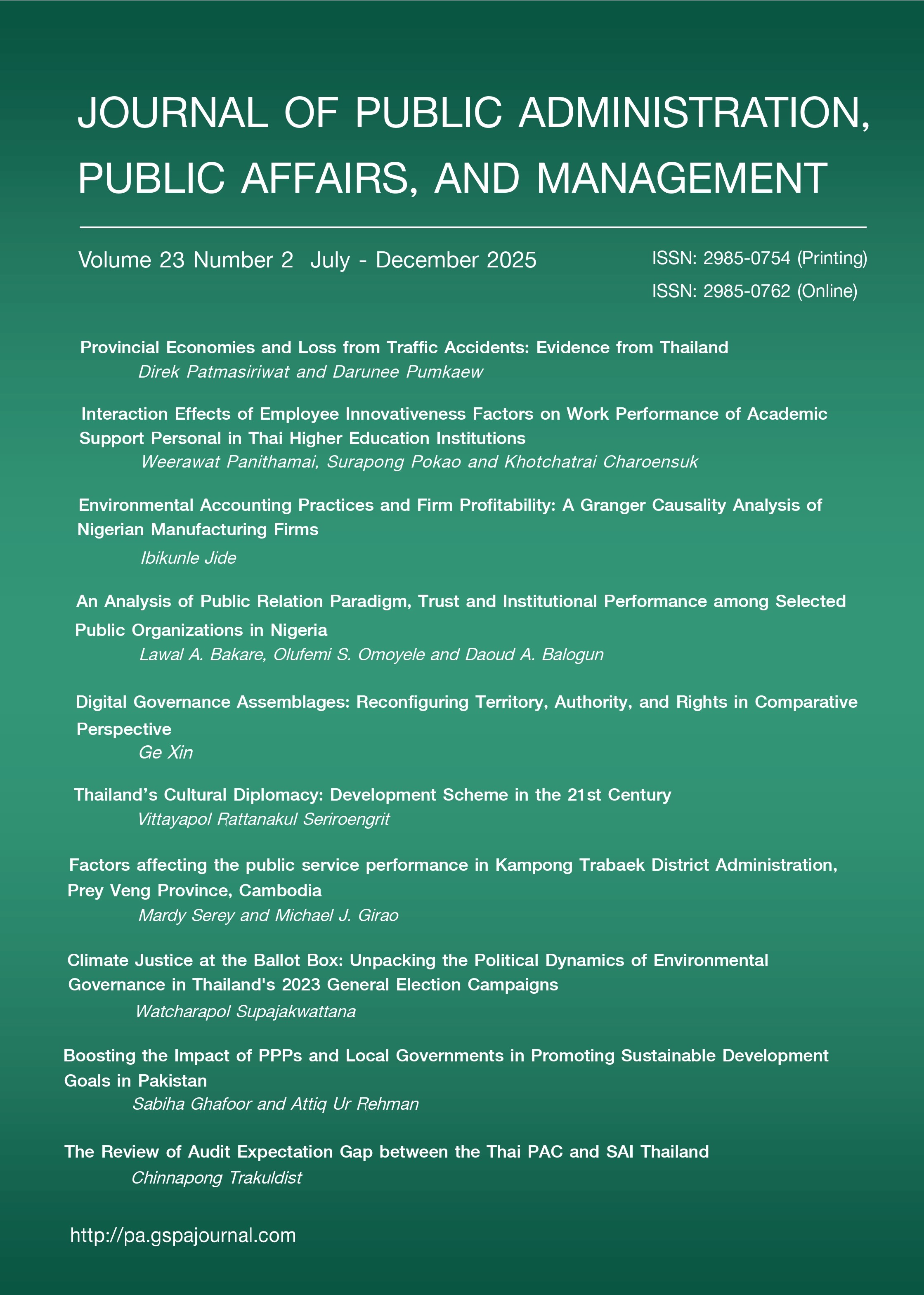
The Review of Audit Expectation Gap between the Thai PAC and SAI Thailand
Keywords:
Accountability, Public Accounts Committees, Supreme Audit Institutions, Audit Expectation GapAbstract
The relationship between the Public Accounts Committee (PAC) and the Supreme Audit Institution (SAI) is essential for maintaining accountability in public financial management. While international models demonstrate strong collaboration between these bodies, the Thai PAC and the State Audit Office of Thailand (SAO) have long exhibited limited engagement, weak communication, and inconsistent oversight practices. This situation has coincided with increasing trends of non compliance, misuse, and mismanagement of public funds. This paper systematically reviews existing literature, compares Thai practices with international standards, and proposes a framework for studying the audit expectation gap (AEG) between the Thai PAC and SAO. Understanding this gap will support institutional reforms, strengthen parliamentary oversight, and enhance the overall accountability ecosystem in Thailand.
References
Aldons, M. E. (1985). Classification of parliamentary committees. Australian Journal of Public Administration, 44(4), 333–351. https://doi.org/10.1111/j.1467-8500.1985.tb01025.x
Bovens, M. (2007). Analysing and assessing accountability: A conceptual framework. European Law Journal, 13(4), 447–468. https://doi.org/10.1111/j.1468-0386.2007.00378.x
Chinpuvadol, P., & Boonyanet, W. (2020). The audit expectation gap between auditors and financial statements’ users. Journal of Federation of Accounting Professions, 2(5), 4–33.
Chowdhury, R. R., Innes, J., & Kouhy, R. (2005). The public sector audit expectations gap in Bangladesh. Managerial Auditing Journal, 20(8), 893–908. https://doi.org/10.1108/02686900510619719
Chowdhury, R., & Innes, J. (1998). A Qualitative Analysis of the Audit Expectations Gap in the Public Sector of Bangladesh. International Journal of Auditing, 2(3), 247–261. https://doi.org/10.1111/1099-1123.00043
Daud, Z. M. (2007). The study of the audit expectations gap in the public sector of Malaysia [Master’s thesis, Department of Accounting & Finance, University of Stirling]. STORRE: Stirling Online Research Repository. https://dspace.stir.ac.uk/bitstream/1893/447/1/The%20Audit%20Expectations%20Gap.pdf
Dubrow, G. (2020). A critical review of public accounts committees. Commonwealth Secretariat.
Ferry, L., Hamid, F., & Dutra, S. (2023). An international comparative study of the audit and accountability arrangements of supreme audit institutions. Journal of Public Budgeting, Accounting & Financial Management, 35(4), 431-450. https://doi.org/10.1108/JPBAFM-10-2022-0164
Gray, G. L., Turner, J. L., Coram, P. J., & Mock, T. J. (2011). Perceptions and misperceptions regarding the unqualified auditor's report by financial statement preparers, users, and auditors. Accounting Horizons, 25(4), 659–684. https://doi.org/10.2308/acch-50060
Guthrie, J. E., & Parker, L. D. (1999). A Quarter of a Century of Performance Auditing in the Australian Federal Public Sector: A Malleable Masque. Abacus, 35(3), 302–332. https://doi.org/10.1111/1467-6281.00048
Humphrey, C. (1997). Debating Audit Expectations. In M. Sherer & S. Turley (Eds.), Current issues in auditing (pp. 1–29). Paul Chapman Publishing.
Humphrey, C., Moizer, P., & Turley, S. (1992). The audit expectations gap—Plus ça change, plus c’est la même chose?. Critical Perspectives on Accounting, 3(2), 137–161. https://doi.org/10.1016/1045-2354(92)90008-F
International Budget Partnership. (2018). Open Budget Survey 2017 report. International Budget Partnership.
International Budget Partnership. (2021). Country summary – Thailand. International Budget Partnership.
International Organization of Supreme Audit Institutions Development Initiative. (2017). Guidance on Supreme Audit Institutions’ engagement with stakeholders. INTOSAI Development Initiative.
International Organization of Supreme Audit Institutions. (2010). How to increase the use and impact of audit reports: A guide for Supreme Audit Institutions. INTOSAI.
Inter-Parliamentary Union & United Nations Development Programme. (2017). Global Parliamentary Report 2017. IPU and UNDP.
Jitbun, W. (2012). Improving efficiency and effectiveness of the academic advice to the Public Accounts Committees of the House of Representatives. Secretariat of the House of Representatives.
Koh, H. C., & Woo, E. S. (1998). The expectation gap in auditing. Managerial Auditing Journal, 13(3), 147–154. https://doi.org/10.1108/02686909810208038
Liggio, C. D. (1974). The expectation gap: The accountant’s Waterloo. Journal of Contemporary Business, 3(3), 27–44.
Mechkova, V., Lührmann, A., & Lindberg, S. I. (2019). The accountability sequence: From de jure to de facto constraints on governments. Studies in Comparative International Development, 54(1), 40–70. https://doi.org/10.1007/s12116-018-9262-5
Mulgan, R. (2003). Holding power to account: Accountability in modern democracies. Palgrave Macmillan.
OECD. (2023). Toolkit for mainstreaming and implementing gender equality 2023. OECD Publishing.
Pierre, J., & de Fine Licht, J. (2019). How do supreme audit institutions manage their autonomy and impact? A comparative analysis. Journal of European Public Policy, 26(2). https://doi.org/10.1080/13501763.2017.1408669
Porter, B. (1993). An Empirical Study of the Audit Expectation-Performance Gap. Accounting and Business Research, 24(93), 49–68. https://doi.org/10.1080/00014788.1993.9729463
Porter, B., Ó hÓgartaigh, C., & Baskerville, R. (2012). Audit Expectation-Performance Gap Revisited: Evidence from New Zealand and the United Kingdom. Part 2: Changes in the Gap in New Zealand 1989–2008 and in the United Kingdom 1999–2008. International Journal of Auditing, 16(3), 215–247. https://doi.org/10.1111/j.1099-1123.2011.00444.x
Pungboonpanich, P., & Jadesadalug, V. (2020). The Stakeholders’ Expectation on the Audit Service and Approach for Reduction of Audit Expectation Gap. Executive Journal, 40(1), 98–114.
Ruhnke, K., & Schmidt, M. (2014). The audit expectation gap: Existence, causes, and the impact of changes. Accounting and Business Research, 44(5), 572–601. https://doi.org/10.1080/00014788.2014.929519
Saikaew, S. (2009). Strengthening the legislative branch in the national budget process: The role of the Budget Administration Oversight Committee. King Prajadhipok’s Institute Journal, 7(1), 5–26.
Sangdetch, A. (2010). Enhancing the operational efficiency of secretariat services for the Budget Administration Oversight Committee. Secretariat of the House of Representatives.
Setthabut, N., & Lertpaitune, S. (2003). The effectiveness of the Thai Parliament: A comprehensive research report. Thailand Research Fund and King Prajadhipok’s Institute.
Sikka, P., Puxty, A., Willmott, H., & Cooper, C. (1998). The impossibility of eliminating the expectations gap: Some theory and evidence. Critical Perspectives on Accounting, 9(3), 299–330. https://doi.org/10.1006/cpac.1997.0159
Sirisamphan, T. (2003). The development of systems and mechanisms for scrutinizing public administration. Chulalongkorn University.
Suthatip, T., Siriwan, N., Sihabunli, J., Panto, P., & Santitham, W. (2005). The role of committees in the government policy. King Prajadhipok’s Institute.
Sutheewasinnon, P., & Saikaew, S. (2015). The public accounts committees in Thailand: A short note. In Z. Hoque (Ed.), Making governments accountable: The role of public accounts committees and national audit offices (pp. 264–271). Routledge.
The World Bank. (2009). Kingdom of Thailand: Public expenditure and financial accountability—Public financial management assessment. The World Bank.
The World Bank. (2018). Strengthening legislative scrutiny in the Western Balkans. The World Bank.
Wehner, J. (2003). Principles and patterns of financial scrutiny: Public Accounts Committees in the Commonwealth. Commonwealth & Comparative Politics, 41(1), 21–36. https://doi.org/10.1080/14662040412331310181
Downloads
Published
How to Cite
Issue
Section
License

This work is licensed under a Creative Commons Attribution-NonCommercial-NoDerivatives 4.0 International License.


