
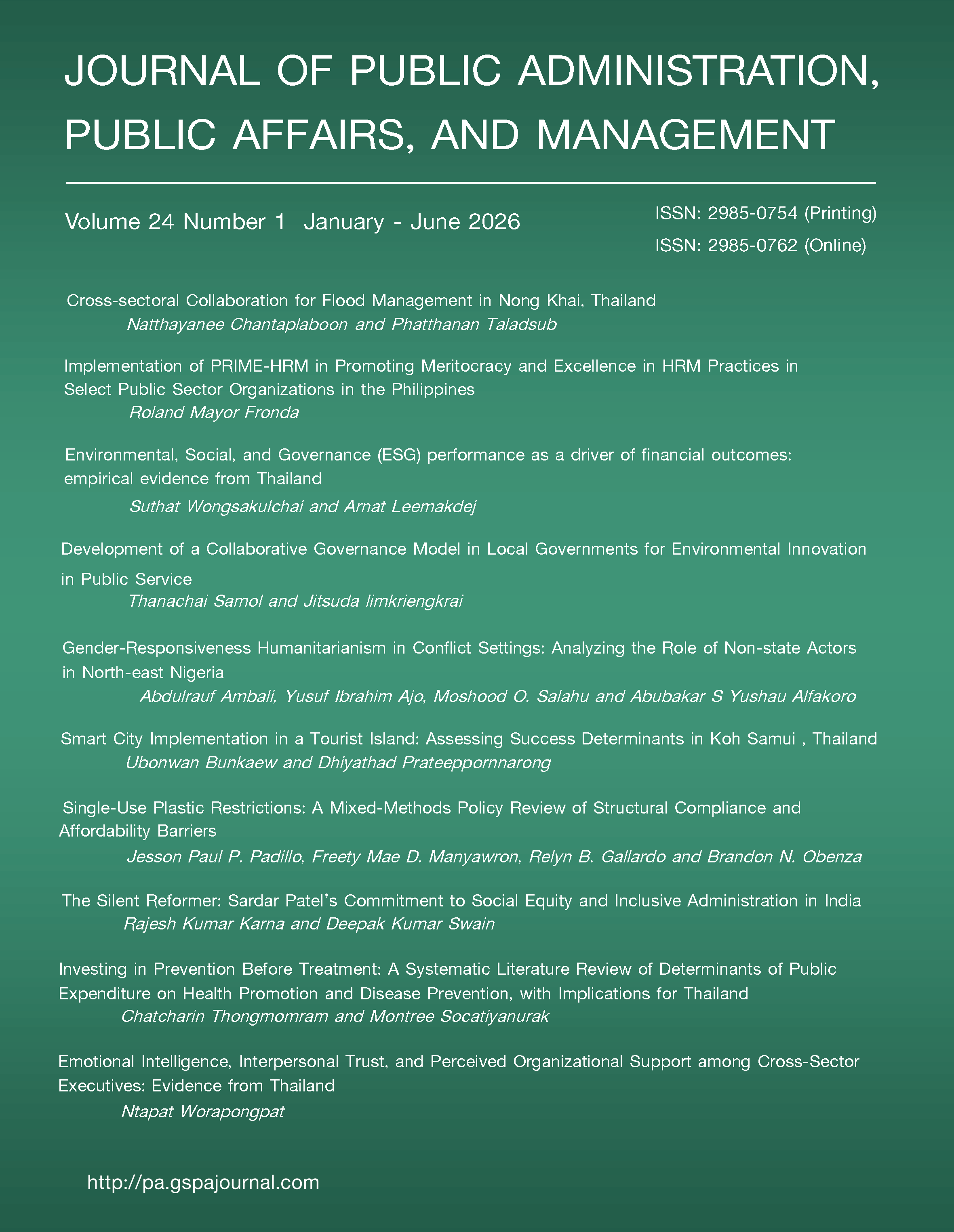
Emotional Intelligence, Interpersonal Trust, and Perceived Organizational Support among Cross-Sector Executives: Evidence from Thailand
-
Keywords:
Emotional intelligence, interpersonal trust, perceived organizational support, Social Exchange Theory, cross-sector executives, ThailandAbstract
In increasingly complex organizational environments in Thailand, executives working across public, private, and civil society sectors face substantial emotional and relational demands that influence their perceptions of organizational support. Drawing on Social Exchange Theory (SET), this study examines how emotional intelligence (EI) contributes to perceived organizational support (POS) through relational exchange processes. Specifically, it investigates the mediating role of interpersonal trust in explaining the relationship between emotional intelligence and perceived organizational support among executives operating in diverse organizational settings. Using a quantitative cross-sectional research design, data were collected from executives representing multiple sectors in Thailand and analyzed using Partial Least Squares Structural Equation Modeling (PLS-SEM). The findings reveal a significant positive relationship between emotional intelligence and perceived organizational support. Interpersonal trust was found to be a strong and statistically significant mediator, indicating that emotionally intelligent executives are more capable of developing trust-based relationships, which subsequently enhance perceptions of organizational support. Furthermore, demographic variables, including age, gender, and professional experience, did not significantly affect perceived organizational support.This study extends Social Exchange Theory by empirically demonstrating the relational mechanism through which emotional intelligence generates organizational outcomes. By identifying interpersonal trust as a key mediating process, the study contributes to the literature on emotional intelligence, interpersonal trust, perceived organizational support, and leadership in multi-sector organizational contexts. Practically, the findings highlight the importance of fostering emotionally intelligent and trust-oriented leadership to strengthen organizational support, improve collaborative relationships, and enhance organizational resilience in complex institutional environments.
References
Bhukari, W., & Jayasekara, B. E. A. (2025). Integration of Emotional and Social Intelligence for SME Sustainability in Emerging Markets: A Conceptual Paper for Proactive Resilience in National Leadership. Sri Lankan Journal of Management, 30(01), 77–97. https://doi.org/10.33939/sljm.30.01.04.2025
Blau, P. M. (1964). Exchange and power in social life. New York, NY: Wiley.
Bryson, J. M., Crosby, B. C., & Stone, M. M. (2015). Designing and implementing cross-sector collaborations: Needed and challenging. Public Administration Review, 75(5), 647–663.
Cropanzano, R., & Mitchell, M. S. (2005). Social exchange theory: An Interdisciplinary Review. Journal of Management, 31(6), 874–900. https://doi.org/10.1177/0149206305279602
Eisenberger, R., Huntington, R., Hutchison, S., & Sowa, D. (1986). Perceived organizational support. Journal of Applied Psychology, 71(3), 500–507. https://doi.org/10.1037/0021-9010.71.3.500
Emerson, K., & Nabatchi, T. (2015). Collaborative governance regimes. Washington, DC: Georgetown University Press.
Goleman, D. (1995). Emotional intelligence: Why it can matter more than IQ. New York, NY: Bantam Books.
Imran, M., & Haroon, M. (2025). BRIDGING KNOWLEDGE AND INNOVATION: A SYSTEMATIC LITERATURE REVIEW ON KNOWLEDGE MANAGEMENT (KM), INNOVATIVE WORK BEHAVIOUR (IWB), AND ORGANIZATIONAL INNOVATIVENESS (OI) FOR THE PROSPECTIVE OF HUMAN RESOURCE DEVELOPMENT. Insights-Journal of Life and Social Sciences, 3(6 (Life)), 94–110. https://doi.org/10.71000/p3sqp441
Marques, S. H., Bilro, R. G., Gonçalves, M., & Rather, R. A. (2022). Partners we can trust: The role of employee engagement influencing partnerships’ relationship quality in the voluntary sector. Management Research the Journal of the Iberoamerican Academy of Management, 20(2), 148–168. https://doi.org/10.1108/mrjiam-01-2022-1258
Mayer, J. D., Caruso, D. R., & Salovey, P. (2016). The ability model of emotional intelligence: Principles and updates. Emotion Review, 8(4), 290–300. https://doi.org/10.1177/1754073916639667
Mayer, R. C., Davis, J. H., & Schoorman, F. D. (1995). An integrative model of organizational trust. Academy of Management Review, 20(3), 709–734. https://doi.org/10.5465/amr.1995.9508080335
Rhoades, L., & Eisenberger, R. (2002). Perceived organizational support: A review of the literature. Journal of Applied Psychology, 87(4), 698–714. https://doi.org/10.1037/0021-9010.87.4.698
Rousseau, D. M., Sitkin, S. B., Burt, R. S., & Camerer, C. (1998). Not so different after all: A cross-discipline view of trust. Academy of Management Review, 23(3), 393–404. https://doi.org/10.5465/amr.1998.926617
Saleem, I. (2022). The role of emotional intelligence in leadership and organizational performance. International Review of Business and Social Sciences, 2(1), 11–19.
Salovey, P., & Mayer, J. D. (1990). Emotional intelligence. Imagination, Cognition and Personality, 9(3), 185–211. https://doi.org/10.2190/DUGG-P24E-52WK-6CDG
Vang, C. (2025). Cultivating ethical leadership in middle management: a qualitative study of formative experience and organizational support. Pepperdine Digital Commons. https://digitalcommons.pepperdine.edu/etd/1628
Worapongpat, N. (2025a). Empowering leadership and organizational citizenship behavior of local government officials toward smart local development: A case study of Mueang District, Maha Sarakham Province. Asian Journal of Humanities and Social Innovation, 2(3), 27–37. https://so14.tci-thaijo.org/index.php/AJHSI/article/view/1691
Worapongpat, N. (2025b). Guidelines for developing the digital competency of local government personnel in Maha Sarakham Province. HUSO Journal of Humanities and Social Sciences, 9(2), 1–19. https://so06.tci-thaijo.org/index.php/husojournalpnru/article/view/288591
Worapongpat, N. (2025c). Guidelines for public service development through one-stop services toward digital local government. Nakhon Ratchasima Journal of Humanities and Social Sciences, 1(6), 77–103. https://so11.tci-thaijo.org/index.php/NJHSS/article/view/2857
Worapongpat, N. (2025d). Impact of local administrators’ behaviors on employee motivation in public local administrative organizations for realizing smart local governance: A case study of Maha Sarakham Province. Modern Public Administration Science, 2(6), 288–302. https://so17.tci-thaijo.org/index.php/jppi/article/view/1427
Worapongpat, N. (2025e). Innovative local leadership and community enterprise development: A participatory governance approach in Maha Sarakham Province, Thailand. Wisdom Journal of Humanities and Social Sciences, 2(10), 31–43. https://so19.tci-thaijo.org/index.php/WJHS/article/view/2512
Worapongpat, N. (2025f). Reducing the digital divide and promoting access to public services for the elderly in local administrative organizations of Mueang District, Maha Sarakham Province. Journal of Public and Private Issues, 2(4), 232–241. https://so17.tci-thaijo.org/index.php/jppi/article/view/1206
Worapongpat, N. (2025g). Strategic human resource management of entrepreneurs in the OEM-based health and beauty supplement industry in the local administrative area of Samut Sakhon. Vocational Education Innovation and Research Journal, 9(2), 44–59. https://so06.tci-thaijo.org/index.php/ve-irj/article/view/281947
Worapongpat, N. (2025h). Digital Skills of Local Government Executives in the 21st Century and Their Relationship with Employee Performance in Mueang District, Maha Sarakham Province. Trends of Humanities and Social Sciences Research, 13(1), 96–108. https://so03.tci-thaijo.org/index.php/Humanties-up/article/view/286667
Worapongpat, N. (2025i). The Desired Leadership Qualities of Administrators Influencing the Development of a Learning Innovation Organization for the Development of Local Personnel in Mueang District, Mahasarakham Province. Journal of Political Science and Public Administration, Kasetsart University (JPSPAKU), 3(1), 1–32. https://so14.tci-thaijo.org/index.php/PSPAJKU/article/view/1541
Zuniga, T. R., Masias, A. A., de Atausinchi, C. M. M. S., Guevara, V. R. M., Esparza, C. J. Z., & Acevedo-Carrillo, M. (2025). Transformational leadership and artificial intelligence in university educational management: A literature review. Lex Localis: Journal of Local Self-Government, 23(S2), 116–135. https://lex-localis.org/index.php/LexLocalis/article/view/800276
Downloads
Published
How to Cite
Issue
Section
License

This work is licensed under a Creative Commons Attribution-NonCommercial-NoDerivatives 4.0 International License.


