
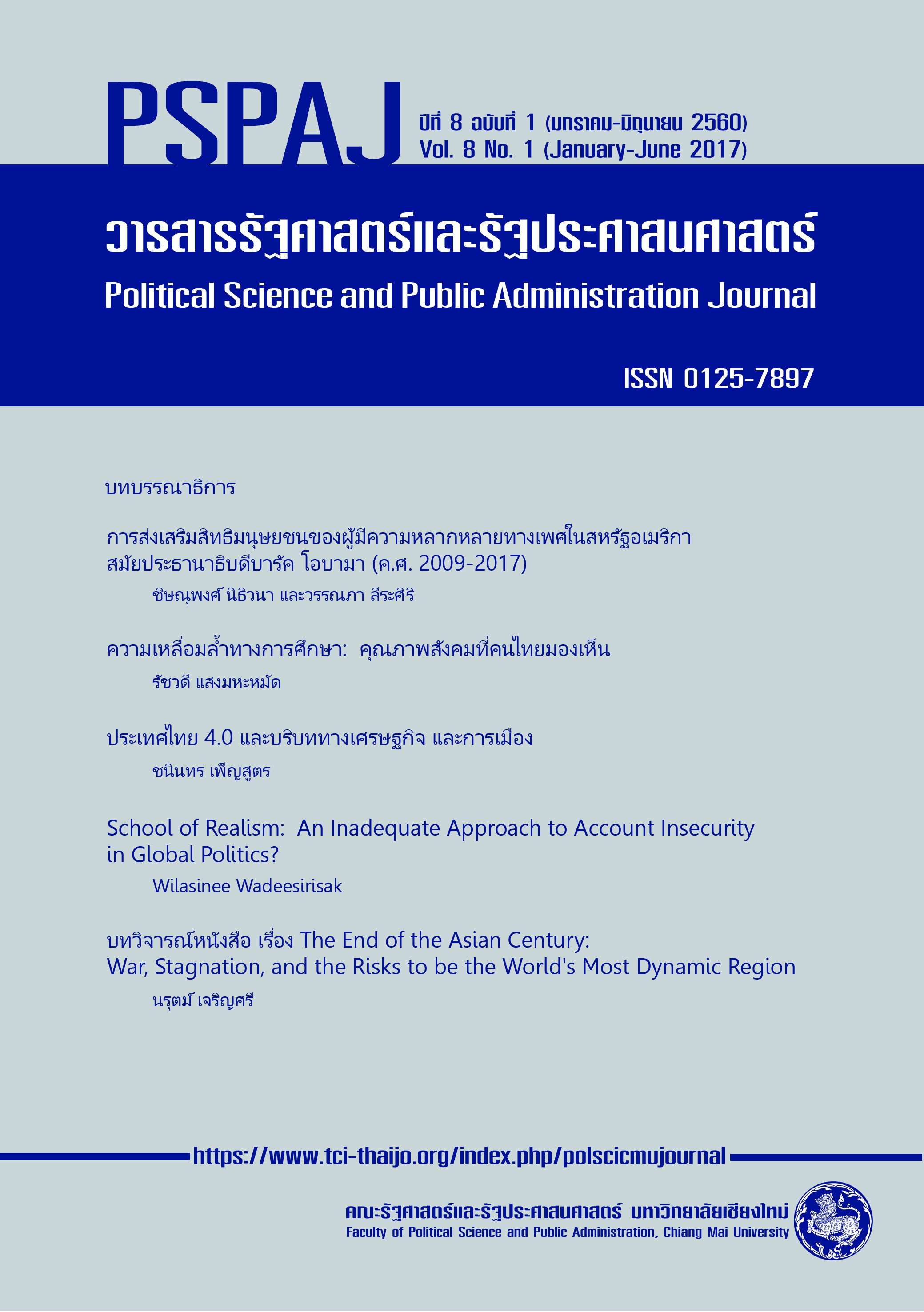
School of Realism: An Inadequate Approach to Account Insecurity in Global Politics?
Article Sidebar
Main Article Content
Abstract
School of realism is a dominant school of thought in the discipline of International Relations. However, it has been vigorously criticized as an approach which overlooks many of the significant actors and phenomena in contemporary world politics. Therefore, it is contested as a theory that gives us an inadequate explanation of insecurity in world politics. This article argues that realist theory might primarily emphasizes states as the core actors but it does not overlook other important actors and phenomena in contemporary world politics. Since there is no single theory that can explain every aspect of world politics, realist approach solely articulates an account of insecurity of state actor rather than of other non-state actors. It remains one of the most influential schools of thought in explaining world politics.
Downloads
Article Details
- เนื้อหาและข้อมูลที่ลงตีพิมพ์ในวารสารรัฐศาสตร์และรัฐประศาสนศาสตร์ถือเป็นข้อคิดเห็นและความรับผิดชอบของผู้เขียนบทความโดยตรง ซึ่งกองบรรณาธิการวารสารรัฐศาสตร์และรัฐประศาสนศาสตร์ ไม่จำเป็นต้องเห็นด้วย หรือร่วมรับผิดชอบใดๆ
- บทความและข้อมูล ที่ได้รับการตีพิมพ์ในวารสารรัฐศาสตร์และรัฐประศาสนศาสตร์ ถือเป็นลิขสิทธิ์ของวารสาร หากบุคคลหรือหน่วยงานใดต้องการนำข้อมูลไปใช้ประโยชน์ในทางวิชาการ ขอให้อ้างอิงแหล่งที่มาด้วย
References
Baylis, J., Smith, S., and Owens, P. (2008). Introduction. In J. Baylis, S. Smith, and P. Owens (Eds). The globalization of world politics: an introduction to international relations. (4th ed.). (pp. 1-13). Oxford: Oxford University Press.
Brown, C. and Ainley, K. (2009). Understanding International Relations. Hampshire: Palgrave.
Burchill, S. and Linklater, A. (2009). Introduction. In S. Burchill, et al. (Eds). Theories of International Relations. (pp. 1-30). Hampshire: Palgrave.
Burgess, J. P. (2008). Non-military security challenges. In C. A. Snyder (Ed.). Contemporary Security and Strategy. (pp. 60-78). New York: Palgrave.
Burke, A. (2007). Security. In R. Devetak, A. Burke, & J. George (Eds). An introduction to International Relations: Australian Perspectives. (pp. 144-154). Melbourne: Cambridge University Press.
Donnelly, J. (2009). Realism. In S. Burchill, et al. (Eds). Theories of International Relations. (pp. 31-56). Hampshire: Palgrave.
Dougherty, J. E. and Jr., R. L. (2002). Contending Theories of International Relations: A Comprehensive Survey. New York: Longman.
Dunne, T., & Schmidt, B. C. (2008). Realism. In In J. Baylis, S. Smith, and P. Owens (Eds). The globalization of world politics: an introduction to international relations. (4th ed.). (pp. 90-106). Oxford: Oxford University Press.
Dunne, T., & Schmidt, B. C. (2011). Realism. In J. Baylis, S. Smith, & P. Owens (Eds), The Globalization of World Politics: an introduction to international relations. (5th ed.). (pp. 83-99). Oxford: Oxford University Press.
Elman, C. (2007). Realism. In M. Griffiths (Ed.). International Relations theories for the twenty-first century: an introduction. (pp. 11-20). New York: Routledge.
Frankel, B. (1997). Realism: Restatements and Renewal. Portland: Routledge.
George, J. (2007). International Relations theory in an era of critical diversity. In R. Devetak, A. Burke, and J. George (Eds). An Introduction to International Relations: Australian Perspectives. (pp. 31-42). Melbourne: Cambridge University Press.
Goldstein, J. S. and Pevehouse, J. C. (2012). International Relations. Madison: Pearson Longman.
Griffiths, M. and O'Callaghan, T. (2007). Realism. In R. Devetak, A. Burke, and J. George (Eds). An Introduction to International Relations: Australian Perspectives. (pp. 54-63). Melbourne: Cambridge University Press.
Hay, C. (2007). International Relations Theory and Globalization. In T. Dunne, M. Kurki, and S. Smith (Eds). International Relations Theories: discipline and diversity. (pp. 266-287). Oxford: Oxford University Press.
Jackson, R. and Sørensen, G. (2003). Introduction to International Relations: theories and approaches. Oxford: Oxford University Press.
Kapstein, E. (1995). Is Realism Dead? The Domestic Sources of International Politics. International Organization, 49 (4), 751-774.
Lebow, R. N. (2007). Classical Realism. In T. Dunne, M. Kurki and S. Smith (Eds). International Relations Theories: discipline and diversity. (pp. 52-70). Oxford: Oxford University Press.
Lynn-Jones, S. M. (2008). Realism and Security Studies. In C. A. Snyder (Ed.). Contemporary security and strategy. (pp. 14-33). New York: Palgrave Macmillan.
Mearsheimer, J. J. (2002, March 1). The Problem of Terrorism. Retrieved from http://globetrotter.berkeley.edu/people2/Mearsheimer/mearsheimer-con5.html. (Institute of International Studies)
Mearsheimer, J. J. (2005, May 19). Hans Morgenthau and the Iraq war: realism versus neo-conservatism. Retrieved from https://www.opendemocracy.net/democracy-americanpower/morgenthau_2522.jsp. (Open Democracy)
Mearsheimer, J. J. (2006). Conversations in International Relations: Interview with John J. Mearsheimer. International Relations, 20 (1), 105-123.
Mutimer, D. (2008). Beyond Strategy: Critical Thinking on the New Security Studies. In C. A. Snyder (Ed.). Contemporary security and strategy. (pp. 34-59). New York: Palgrave.
Raymond, G. A. and Kegley, C. A. (2005). The global future: a brief introduction to world politics. Belmont: Thomson.
Steans, J. and Pettiford, L. (2005). Introduction to International Relations: perspectives and themes. Harlow: Pearson.
Tickner, J. A. and Sjoberg, L. (2007). Feminism. In T. Dunne, M. Kurki, and S. Smith (Eds). International Relations Theories: Discipline and Diversity. (pp. 185-202). Oxford: Oxford University Press.
Wohlforth, W. C. (1995). Realism and the end of the Cold War. International Security, 19 (3), 91-129.
Zakaria, F. (1992). Is Realism Finished? The National Interest, 30, 21-32.
