
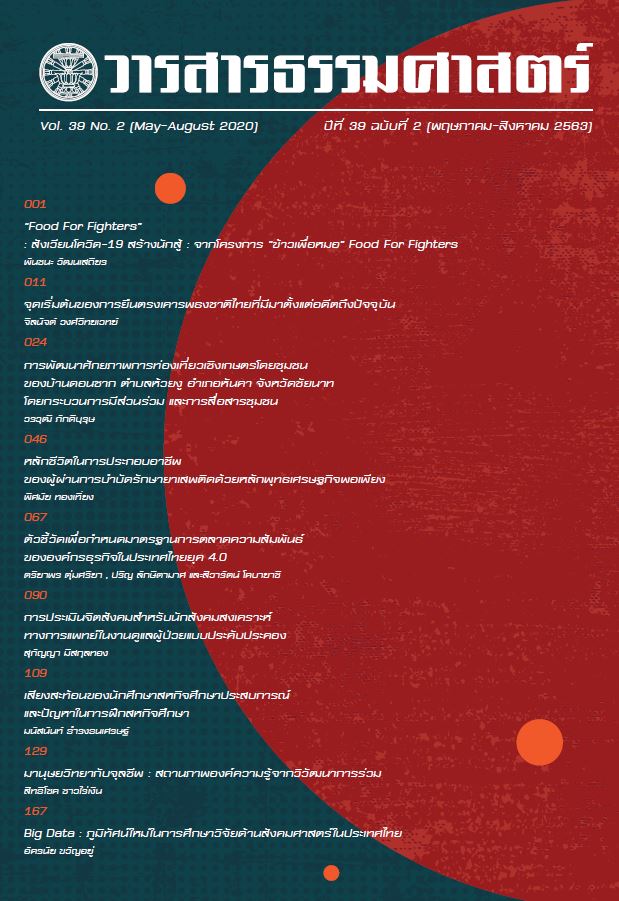
มานุษยวิทยากับจุลชีพ: สถานภาพองค์ความรู้จากวิวัฒนาการร่วม
Article Sidebar
Main Article Content
บทคัดย่อ
“จุลชีพ” เป็นสิ่งที่นักมานุษยวิทยาสนใจมาไม่ต่ํากว่า 70 ปี เริ่มต้นจากการศึกษาปัจจัยทางวัฒนธรรมต่อการเกิดและการระบาดของโรค ติดเชื้อที่มีสาเหตุจากจุลชีพก่อโรค รวมทั้งการศึกษาอิทธิพลของวัฒนธรรมท้องถิ่นต่อความสําเร็จของมาตรการควบคุมโรคในทศวรรษ 1950 ถึง 1990 ต่อมาความตื่นตัวของประชาคมโลกต่อสถานการณ์เชื้อดื้อยาในต้นศตวรรษที่ 21 ทำให้ความสนใจจุลชีพของนัก มานุษยวิทยาขยายมาสู่เรื่องอิทธิพลของมนุษย์ โดยเฉพาะการใช้ยาต้านจุลชีพและปัจจัยเชิงโครงสร้างของการใช้ยา ต่อการกลายพันธุ์ เพื่อความอยู่รอดของจุลชีพ หลังจากนั้นโครงการไมโครไบโอมในมนุษย์ในปี 2008 ทำให้นักมานุษยวิทยาได้ทบทวนแนวคิดเกี่ยวกับ ร่างกาย ความสัมพันธ์ระหว่างมนุษย์กับสิ่งแวดล้อม และตั้งคำถามต่อความเป็นมนุษย์ และในปัจจุบันที่มีการระบาดของไวรัส SARSCoV-2 จุลชีพก่อโรคติดเชื้อไวรัสโคโรนา 2019 (Covid-19) เกิดขึ้น นักมานุษยวิทยาก็เริ่มมีส่วนร่วมต่อการถกเถียงประเด็นทางสังคมที่ เกิดขึ้นจากการระบาดและมาตรการควบคุมโรค อาทิ ความสัมพันธ์ระหว่างมนุษย์กับสัตว์ป่าและสัตว์เลี้ยงที่ส่งผลต่อการระบาดของโรค แบบข้ามสายพันธุ์ ความเหลื่อมล้ำของคนรวยกับคนจนต่อการปรับตัวให้เข้ากับมาตรการควบคุมการระบาดของโรค การเหยียดเชื้อชาติ และการเกลียดกลัวชาวต่างชาติ ระบบอาหารโลกหลังพ้นช่วงการระบาดของโลก บทความนี้ต้องการนำเสนอว่า จุลชีพและมานุษยวิทยา มีความสัมพันธ์กับแบบ “วิวัฒนาการร่วม” กล่าวคือ ในขณะที่มานุษยวิทยามีส่วนทำให้จุลชีพมีที่ทางในโลกสังคมศาสตร์และ มนุษยศาสตร์มากขึ้น ขณะเดียวกันจุลชีพก็มีส่วนผลักดันให้มานุษยวิทยาการแพทย์และแวดวงมานุษยวิทยาโดยรวมมีความก้าวหน้าใน เชิงทฤษฎีและในเชิงประยุกต์เช่นกัน
Article Details
เอกสารอ้างอิง
จันทนี เจริญศรี, ศุภวิทย์ ถาวรบุตร, โกมาตร จึงเสถียรทรัพย์, จักรกริช สังขมณี, ชูศักดิ์ ภัทรกุล วณิชย์และ เสมอชัย พูลสุวรรณ. (2559). ศาสตร์ อศาสตร์ : เข้ามาข้างนอก ออกไปข้างใน. กรุงเทพฯ: พารากราฟ
ชญาน์ทัต ศุภชลาศัย. (2560). สลาวอย ชิเชค: สิ่งไม่ใช่มนุษย์/หลังมนุษย์. วารสารสังคมศาสตร์มหาวิทยาลัยนเรศวร 13(2), 121 – 133. DOI : 10.14456/jssnu.2017.19
ชัชชล อัจนากิตติ. (2561). หมอพื้นบ้านในยุคโรคไร้เชื้อเรื้อรัง. (วิทยานิพนธ์ปริญญามหาบัณฑิต). มหาวิทยาลัยธรรมศาสตร์, คณะสังคมวิทยาและมานุษยวิทยา.
ปกรณ์ คงสวัสดิ์. (2559). “ชีวาณูสงเคราะห์”: วิทยาศาสตร์และเทคโนโลยีชีวภาพใต้ร่มพระบารมีณ สถานีเกษตรหลวงอ่างขาง อ.ฝาง จ.เชียงใหม่. (วิทยานิพนธ์ปริญญามหาบัณฑิต). มหาวิทยาลัยธรรมศาสตร์, คณะสังคมวิทยาและมานุษยวิทยา.
พนา กันธา. (2560). พหุภววิทยาในโลกคู่ขนานระหว่างสัตว์กับมนุษย์. วารสารสังคมศาสตร์มหาวิทยาลัยนเรศวร 13(2), 5-24. DOI : 10.14456/jssnu.2017.14
ภสยุมาศ ภูมาศ. วิษณุ ธรรมลิขิตกุล. ภูษิต ประคองสาย. ตวงรัตน์ โพธะ. อาทร ริ้วไพบูลย์. สุพล ลิมวัฒนานนท์. (2555). ผลกระทบด้านสุขภาพและเศรษศาสตร์จากการติดเชื้อดื้อยาต้านจุลชีพในประเทศไทย: การศึกษาเบื้องต้น. วารสารวิจัยระบบสาธารณสุข 6(3). 352 –360.
รวิวรรณ รักถิ่นกําเนิด. (2561). เหา กับ เธอ: อํานาจและการต่อรองของผู้ต้องขังหญิงในทัณฑสถาน. (วิทยานิพนธ์ปริญญามหาบัณฑิต). มหาวิทยาลัยธรรมศาสตร์, คณะสังคมวิทยาและมานุษยวิทยา.
วีรวรรณ ลุวีระ. (2549). การดื้อยาปฏิชีวนะของแบคทีเรีย. สงขลานครินทร์เวชสาร. 21(5). 453 –459.
สรัช สินธุประมา. (2561). ฟอนต์ลูกทุ่ง: เทคโนโลยีดิจิทัลกับการก่อร่างตัวตนของคนทําป้าย. (วิทยานิพนธ์ปริญญามหาบัณฑิต). มหาวิทยาลัยธรรมศาสตร์, คณะสังคมวิทยาและมานุษยวิทยา.
สุดแดน วิสุทธิลักษณ์, สายพิณ ศุพุทธมงคล, ลีลา วรวุฒิสุนทร, ชัยวัฒน์ สถาอานันท์, สุรเดช โชติอุดมพันธ์, จอง, เชยอง, มลธิณี แจ้งสามสี และ ธนภัทร ไผทรัตน์. (2560). สิงสาราสัตว์ : มานุษยวิทยาว่าด้วยสัตว์และสัตว์ศึกษา. กรุงเทพฯ : มูลนิธิเพื่อการศึกษาประชาธิปไตยและการพัฒนา (โครงการจัดพิมพ์คบไฟ)
Ali, I. ( 2020). The COVID-19 Pandemic: Making Sense of Rumor and Fear: Op-Ed. Medical Anthropology, 1-4.
Allison, A. C. (1954). Protection afforded by sickle-cell trait against subtertian malarial infection. British medical journal, 1(4857), 290.
Alyanak, O. ( 2020). Faith, Politics and the COVID-19 Pandemic: The Turkish Response. Medical Anthropology, 1-2.
Andersen, K.G., Rambaut, A., Lipkin, W.I. et al. The proximal origin of SARS-CoV2. Nat Med 26, 450–452 (2020)
Armelagos, G. J., & Cohen, M. N. (Eds.). (1984). Paleopathology at the Origins of Agriculture (pp. 235-269). Orlando, FL: Academic Press.
Arya, O. P. , Nsanzumuhire, H. , & Taber, S. R. (1973). Clinical, cultural, and demographic aspects of gonorrhoea in a rural community in
Uganda. Bulletin of the World Health Organization, 49(6), 587.
Association of Social Anthropologist of the UK & Commonwealth. (2018). .Sociality,
Matter, and the Imagination. Re-Creating Anthropology. Retrieve from https://theasa.org/downloads/conferences/asa18/asa18_programme.pdf
Association of Social Anthropologist of the UK & Commonwealth. (2019) . Anthropological Perspectives on Global Challenges. Retrieve from
https://nomadit.co.uk/conference/asa19#8017
Bello, C. S., Elegba, O. Y., & Dada, J. D. (1983). Sexually transmitted diseases in northern Nigeria. Five years' experience in a university teaching hospital clinic. Sexually Transmitted Infections, 59(3), 202-205.
Blangero, J. (1982). Part 6: The P blood group system: Genetic adaptation to helminthic zoonoses. Medical anthropology, 6(1), 57-69.
Broom A, Broom J, Kirby E. (2014). Cultures of resistance? A Bourdieusian analysis of doctors' antibiotic prescribing. Soc Sci Med, 2014;110:81-8 . doi:10.1016/j.socscimed.2014.03.030
Brown, N., & Nettleton, S. (2017). ‘There is worse to come’: The biopolitics of traumatism in Antimicrobial Resistance (AMR) . The Sociological
Review, 65(3), 493-508.
Brown, P. J. , & Inhorn, M. C. (2013) . The anthropology of infectious disease: international health perspectives. Routledge.
Bryner, Jeanna. ( 2020). Cat infected with COVID-19 from owner in Belgium. Retrieved from https://www.livescience.com/cat-infected-covid-19-fromowner.html
Center for Disease Control and Prevention. (2019). Antibiotic Resistance Threat in the United State. Retrieved from https:// www.cdc.gov/ drugresistance/pdf/threats-report/2019-ar-threats-report-508.pdf
Center for Disease Control and Prevention. ( 2020). COVID-19 and Animals. Retrieved from https:// www.cdc.gov/ coronavirus/ 2019-ncov/ daily-lifecoping/animals.html?CDC_AA_refVal=https%3A%2F%2Fwww.cdc.gov%2Fc oronavirus%2F2019-ncov%2Fprepare%2Fanimals.html
Chandler, C. , Hutchinson, E. , & Hutchison, C. (2016). Addressing antimicrobial resistance through social theory: an anthropologically oriented report.
Chandler, C. , Hutchinson, E. , & Hutchison, C. (2016). Addressing antimicrobial resistance through social theory: an anthropologically oriented report.
Chandler, C.I.R. (2019). Current accounts of antimicrobial resistance: stabilisation, individualisation and antibiotics as infrastructure. Palgrave Commun 5, 53 (2019). https://doi.org/10.1057/s41599-019-0263-4
Chandler, Clare. (2018). Fresh Perspectives: Social Research on Antimicrobial Resistance Symposium and Networking Event British Academy London UK 10 September 2018. Retrieve from http://antimicrobialsinsociety.org/wpcontent/ uploads/ 2018/ 09/ AMR-Symposium-2018-Conference-BookletWeb.pdf
Chuengsatiansup, K. , Limsawart, W. (2019). Tuberculosis in the borderlands: migrants, microbes and more-than-human borders. Palgrave Commun 5, 31 (2019). https://doi.org/10.1057/s41599-019-0239-4
Crosby, A. W. ( 2003) . The Columbian exchange: biological and cultural consequences of 1492 (Vol. 2). Greenwood Publishing Group.
Ding, H. T., Taur, Y., & Walkup, J. T. (2017). Gut microbiota and autism: key concepts and findings. Journal of autism and developmental disorders, 47(2) , 480-489.
Dubos, R. (1966). The microbiota of the gastrointestinal tract. Gastroenterology, 51(5), 868-874.
Dudden, Alexis & Marks, Andrew. ( 2020). South Korea took rapid, intrusive measures against Covid-19 – and they worked. Retrieved from
https://www.theguardian.com/commentisfree/2020/mar/20/south-korearapid-intrusive-measures-covid-19
Dunn, F. L. (1976). Human behavioural factors in the epidemiology and control of Wuchereria and Brugia infections. Bulletin of the Public Health Society of Malaysia.
Editorial Board. (1988). Social Science & Medicine Special Issue Anthropological Studies of Diarrheal Illness. 27(1).
Farmer, P. (2004). Pathologies of power: Health, human rights, and the new war on the poor (Vol. 4). Univ of California Press.
Fortané, N. (2019). Veterinarian ‘ responsibility’ : conflicts of definition and appropriation surrounding the public problem of antimicrobial resistance in France. Palgrave Commun 5, 67(2019). https://doi.org/10.1057/s41599-019-0273-2
Fuller, G. K. , & Fuller, D. C. (1981). Part II: Hydatid disease in Ethiopia: epidemiological findings and ethnographic observations of disease
transmission in southwestern Ethiopia. Medical Anthropology, 5(3) , 293-312.
Greenhough, B., Read, C. J., Lorimer, J., Lezaun, J., McLeod, C., Benezra, A., ... & Dumitriu, A. (2020). Setting the agenda for social science research on the human microbiome. Palgrave Communications, 6(1), 1-11.
Hanks Jr, L. M. , & Hanks, J. R. (1955). Diphtheria immunization in a Thai community. Health, Culture and Community, 155-185.
Helmreich, S. (2014). Homo microbis: The human microbiome, figural, literal, political. Thresholds, 52-59.
Hinchliffe, S., Butcher, A., & Rahman, M. M. (2018). The AMR problem: demanding economies, biological margins, and co-producing alternative
strategies. Palgrave Communications, 4(1), 1-12.
Hinchliffe, Steve, Chandler, Clare, Chuengsatiansup, Komatra, Lambert, Helen. (2019). Anti-biosis – social and cultural inquiries into human-microbe relations. Retrieve from https://www.nature.com/collections/egehbdefja
Hsu, F. L. (1955). A cholera epidemic in a Chinese town. Health, Culture, and Community: Case Studies of Public Reactions to Health Programs. BD Paul, ed, 135-154.
Jiang, S., Shi, Z., Shu, Y., Song, J., Gao, G. F., Tan, W., & Guo, D. (2020). A distinct name is needed for the new coronavirus. Lancet.
Kirby, T. (2020). Efforts escalate to protect homeless people from COVID-19 in UK. The Lancet. Respiratory Medicine.
Kirchhelle, C. (2016). Toxic confusion: the dilemma of antibiotic regulation in West German food production (1951–1990). Endeavour, 40(2), 114.
Kirchhelle, C. (2018). Swann song: antibiotic regulation in British livestock production (1953–2006). Bulletin of the History of Medicine, 92(2), 317-350.
Kirksey, S. E., & Helmreich, S. (2010). The emergence of multispecies ethnography. Cultural anthropology, 25(4), 545-576.
Kongrut, Anchalee. (2020). The poor can't afford to self-quarantine. Retrieved from https://www.bangkokpost.com/opinion/opinion/1881795/the-poor-cantafford-to-self-quarantine
Lam, T.T., Shum, M.H., Zhu, H. et al. Identifying SARS-CoV-2 related coronaviruses in Malayan pangolins. Nature (2020).
Lambert, H, Chen, M & Cabral, C, 2019, ‘ Antimicrobial resistance, inflammatory responses: a comparative analysis of pathogenicities, knowledge hybrids and the semantics of antibiotic use’. Palgrave Communications, 5.
Lambert, H, Chen, M & Cabral, C, 2019, ‘ Antimicrobial resistance, inflammatory responses: a comparative analysis of pathogenicities, knowledge hybrids and the semantics of antibiotic use’. Palgrave Communications, 5.
Landecker, H. (2016). Antibiotic resistance and the biology of history. Body & Society, 22(4), 19-52.
Lanese, Nicoletta. (2020). First dog with confirmed coronavirus infection has died — but we don't know if it was because of the virus. Retrieved from https:/ / www. livescience. com/ coronavirus-first-case-human-to-dogtransmission.html
Larkin, B. (2013). The politics and poetics of infrastructure. Annual review of anthropology, 42, 327-343.
Li, X., Song, Y., Wong, G., & Cui, J. (2020). Bat origin of a new human coronavirus: there and back again. Science China Life Sciences, 63(3), 461-462.
Lindenbaum, S. (2015) . Kuru sorcery: disease and danger in the New Guinea highlands. Routledge.
Livingstone, F. B. (1958). Anthropological Implications of Sickle Cell Gene Distribution in West Africa 1. American Anthropologist, 60(3), 533-562.
Lock, M., Burke, W., Dupré, J., Landecker, H., Livingston, J., Martin, P., ... & Buchanan, A. V. (2015). Comprehending the body in the era of the
epigenome. Current Anthropology, 56(2), 163-164.
Lung, Natalie. (2020). Hong Kong Dog Dies After Release From Coronavirus Quarantine. Retrieved from https://www.bloomberg.com/news/articles/2020-03-18/hong-kong-dog-tested-for-coronavirus-dies-after-quarantine
Marchesi, J. R. , & Ravel, J. (2015). The vocabulary of microbiome research: a proposal.
Matthews, Owen. (2020). Britain Drops Its Go-It-Alone Approach to Coronavirus. Retrieved from https:/ / foreignpolicy. com/ 2020/ 03/ 17/ britain-ukcoronavirus-response-johnson-drops-go-it-alone/
Meheus, A., De Clercq, A., & Prat, R. (1974). Prevalence of gonorrhoea in prostitutes in a Central African town. British Journal of Venereal Diseases, 50(1), 50.
Meindl, R. S. (1987). Hypothesis: a selective advantage for cystic fibrosis heterozygotes. American Journal of Physical Anthropology, 74(1), 39-45.
National Center for Biotechnology Information. (2020). Search query: human microbiome. Retrieved from https:// pubmed.ncbi.nlm.nih.gov/ ?term=human+microbiome
National Human Genome Research Institute. (2019). The Human Microbiome Project. Retrieved from https://www.genome.gov/human-genome-project
Nerlich, B., & James, R. (2009). “The post-antibiotic apocalypse” and the “war on superbugs”: catastrophe discourse in microbiology, its rhetorical form and political function. Public Understanding of Science, 18(5), 574-590.
Nichter, Mark (Ed.). (1993). Medical Anthropology Cross-Cultural Studies in Health and Illness 15(4): Acute Respiratory Infection. Retrieved from https://www.tandfonline.com/doi/abs/10.1080/01459740.1994.9966097
O'neill, J. (2014). Antimicrobial Resistance. Tackling a Crisis for the Health and Wealth of Nations.
Palmer, James. (2020). Don’t Blame Bat Soup for the Coronavirus. Retrieved from https:// foreignpolicy.com/2020/01/ 27/ coronavirus-covid19-dont-blamebat-soup-for-the-virus/
Paul, B. D. (1955). Health, culture, and community. Russell Sage Foundation. Paxson, H. (2008). Post-pasteurian cultures: The microbiopolitics of raw-milk cheese in the United States. Cultural anthropology, 23(1), 15-47.
Peterson, J., Garges, S., Giovanni, M., McInnes, P., Wang, L., Schloss, J. A., ... & Baker, C. C. (2009). The NIH human microbiome project. Genome research, 19(12), 2317-2323.
Podolsky, S. H., Bud, R., Gradmann, C., Hobaek, B., Kirchhelle, C., Mitvedt, T., ... & Lie, A. K. (2015). History teaches us that confronting antibiotic resistance
requires stronger global collective action. The Journal of law, medicine & ethics, 43(3_suppl), 27-32.
Raffaetà, R. (2020). Another Day in Dystopia. Italy in the Time of COVID-19. Medical Anthropology, 1-3.
Rajagopala, S. V., Vashee, S., Oldfield, L. M., Suzuki, Y., Venter, J. C., Telenti, A., & Nelson, K. E. ( 2017). The human microbiome and cancer. Cancer Prevention Research, 10(4), 226-234.
Rees, T., Bosch, T., & Douglas, A. E. (2018). How the microbiome challenges our concept of self. PLoS biology, 16(2), e2005358.
REUTERS. (2020). China bans trade, consumption of wild animals due to coronavirus. Retrieved from https://www.reuters.com/article/us-chinahealth-wildlife/china-bans-trade-consumption-of-wild-animals-due-tocoronavirus-idUSKCN20J069
Rhodes, T. , Lancaster, K. , & Rosengarten, M. (2020). A model society: maths, models and expertise in viral outbreaks.
Schaffer, Jennifer. (2020). Why are the rich and famous getting coronavirus tests while we aren't? Retrieved from https:/ / www. theguardian. com/commentisfree/2020/mar/21/rich-famous-coronavirus-tests-covid-19-tomhanks
Schluter, J., Peled, J. U. , Taylor, B. P. , Smith, M. , Markey, K. A. , Taur, Y. , ... & Amoretti, L. A. (2020). An association between the gut microbiota and immune cell dynamics in humans. bioRxiv, 618256.
Sharon, G., Sampson, T. R., Geschwind, D. H., & Mazmanian, S. K. (2016). The central nervous system and the gut microbiome. Cell, 167(4), 915-932.
Singer, M. (2016). Anthropology of infectious disease. Routledge.
Singer, M., & Baer, H. (2018). Critical medical anthropology. Routledge.
Sochocka, M., Donskow-Łysoniewska, K., Diniz, B. S., Kurpas, D., Brzozowska, E., & Leszek, J. (2019). The gut microbiome alterations and inflammation-driven pathogenesis of Alzheimer’s disease-a critical review. Molecular neurobiology, 56(3), 1841-1851.
Song, P., & Walline, J. (2020). Virtual Technologies of Care in a Time of Viral Crisis: An Ethnographic View from Hong Kong. Somatosphere.
Thonard, J. C., & Scherp, H. W. (1958). Inhibition of a collagenase by the human gingival microbiota. Journal of bacteriology, 76(4), 355.
Torero, Maximo. (2020). A battle plan for ensuring global food supplies during the COVID-19 crisis. Retrieved from http:/ / www. fao. org/ news/ story/en/item/1268059/icode/
Tseng, C. H., & Wu, C. Y. (2019). The gut microbiome in obesity. Journal of the Formosan Medical Association, 118, S3-S9.
Turshen, M. (1984). The political ecology of disease in Tanzania. Rutgers University Press.
Wellin, E. (1955). Water boiling in a Peruvian town. Health, culture and community, 71-103.
White, A. I. ( 2020). Historical linkages: epidemic threat, economic risk, and xenophobia. The Lancet, 395(10232), 1250-1251.
Winter, G., Hart, R. A., Charlesworth, R. P., & Sharpley, C. F. (2018). Gut microbiome and depression: what we know and what we need to know. Reviews in the Neurosciences, 29(6), 629-643.
Wood, C. S. (1979) . Human sickness and health: a biocultural view. Mayfield Publishing Company.
World Health Organization. (2013). The Expanded Programme on Immunization. Retrieved from https:/ / www. who. int/ immunization/ programmes_systems/supply_chain/benefits_of_immunization/en/
World Health Organization. (2015). Global Action Plan on Antimicrobial Resistance. Retrieved from https://apps.who.int/iris/bitstream/handle/10665/193736/9789241509763_eng.pdf?sequence=1
World Health Organization. (2017). Fact sheets on sustainable development goals:
health targets. Antimicrobial resistance. Retrieved from http://www.euro. who.int/__data/assets/pdf_file/0005/348224/Fact-sheet-SDG-AMR-FINAL07-09-2017.pdf?ua=1
World Health Organization. (2018). Antimicrobial resistance. Retrieved from https://www.who.int/news-room/fact-sheets/detail/antimicrobial-resistance
World Health Organization. (2020). Coronavirus disease ( COVID-2019) situation reports. Retrieved from https://www.who.int/emergencies/diseases/novelcoronavirus-2019/situation-reports
World Organization for Animal Health. (2020). Questions and Answers on the COVID-19. Retrieved from https:/ / www.oie.int/en/scientificexpertise/specific-information-and-recommendations/questions-andanswers-on-2019novel-coronavirus/
Zhou, P., Yang, X., Wang, X. et al. (2020). A pneumonia outbreak associated with a new coronavirus of probable bat origin. Nature 579, 270–273
