
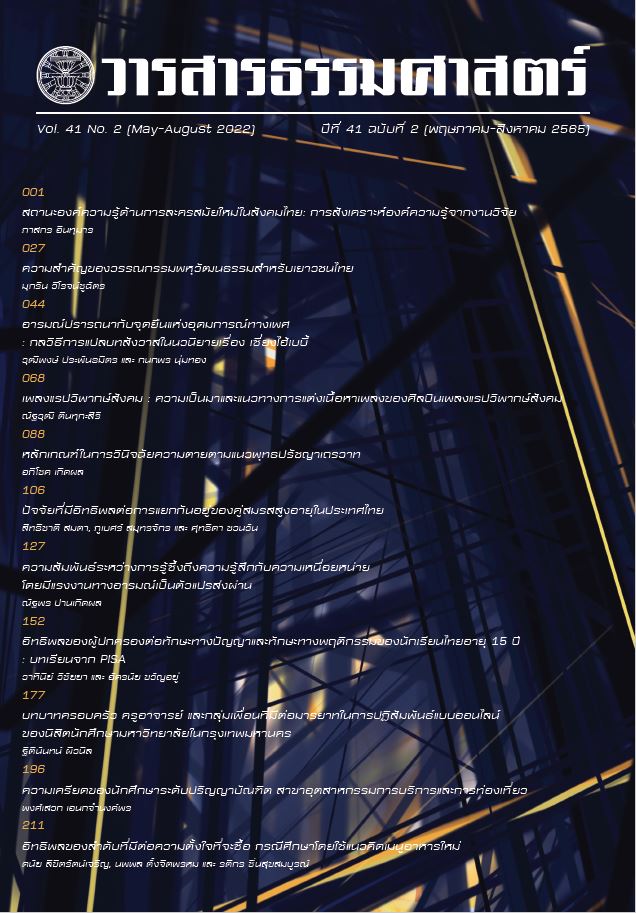
ปัจจัยที่มีอิทธิพลต่อการแยกกันอยู่ของคู่สมรสสูงอายุในประเทศไทย
Article Sidebar
Main Article Content
บทคัดย่อ
การศึกษานี้มีวัตถุประสงค์เพื่อศึกษาปัจจัยที่มีอิทธิพลต่อรูปแบบการอยู่อาศัยของผู้สูงอายุที่แยกกันอยู่กับคู่สมรส ซึ่งมีความสำคัญต่อการพึ่งพาทางเศรษฐกิจ สุขภาพ และจิตใจระหว่างคู่สมรส รวมถึงเพื่ออธิบายสถานการณ์และความสัมพันธ์ของรูปแบบการอยู่อาศัยของผู้สูงอายุที่แยกกันอยู่กับคู่สมรสในรูปแบบการอยู่อาศัยที่แตกต่างกัน โดยเป็นการศึกษาเชิงปริมาณ ใช้ข้อมูลจากโครงการสำรวจ ประชากรสูงอายุในประเทศไทย พ.ศ.2560 มีจำนวนประชากรตัวอย่าง คือ ผู้สูงอายุ 60 ปีขึ้นไป จำนวน 26,077 คน โดยการวิเคราะห์ข้อมูลใช้การทดสอบไคสแควร์และการวิเคราะห์การถดถอยโลจิสติกทวิภาค ผลการวิจัย พบว่าเพศ ระดับการศึกษา เขตที่อยู่อาศัย การมีบุตรที่อาศัยอยู่ในครัวเรือนเดียวกัน ที่อยู่ของ บุตรนอกครัวเรือน และการทำงาน มีความสัมพันธ์กับการตัดสินใจแยกกันอยู่ของผู้สูงอายุที่มีสถานภาพ ปัจจุบันสมรส กล่าวคือ ส่วนใหญ่มักเป็นผู้สูงอายุเพศหญิงที่มีระดับการศึกษามัธยมตอนปลายหรือสูงกว่า อาศัยอยู่ในเขตเทศบาล ไม่ได้ทำงาน รวมถึงการมีบุตรที่อยู่ใกล้ จะทำให้ผู้สูงอายุที่มีสถานภาพปัจจุบัน สมรสติดสินใจแยกกันอยู่กับคู่สมรส ข้อเสนอแนะเชิงนโยบายจากผลการวิจัยนี้ คือ ขยายอายุการทำงานของผู้สูงอายุที่มีสถานภาพสมรสแยกกันอยู่เพื่อให้มีโอกาสการสนับสนุนช่วยเหลือซึ่งกันและกันยาวนานมากขึ้น อีกทั้งควรมีนโยบายการดูแลและเฝ้าระวังผู้สูงอายุที่มีสถานภาพปัจจุบันสมรสแยกกันอยู่ซึ่งอาศัย อยู่คนเดียวตามลำพังและไม่มีผู้ดูแล รวมถึงมาตรการลดหย่อนทางภาษีแก่บุตรในการดูแลผู้สูงอายุควรคำนึงถึงการอยู่อาศัยในรูปแบบต่าง ๆ
Article Details
เอกสารอ้างอิง
กองทุนประชากรแห่งสหประชาชาติประจำประเทศไทย. (2558). รายงานสถานการณ์ประชากรไทย พ.ศ. 2558 โฉมหน้าครอบครัวไทย ยุคเกิดน้อย อายุยืน. กรุงเทพฯ : สำนักพิมพ์กองทุนประชากรแห่งสหประชาชาติประจำประเทศไทย.
ศุทธิดา ชวนวัน และคณะ. (2563). รูปแบบการอยู่อาศัยของผู้สูงอายุไทยในเขตเมือง เพื่อสนับสนุนการมีที่อยู่อาศัยและการดูแลที่เหมาะสม (รายงานวิจัยฉบับสมบูรณ์). กรุงเทพฯ : มูลนิธิสถาบันวิจัยและพัฒนาผู้สูงอายุไทย.
สำนักงานสถิติแห่งชาติ. (2554). สรุปสำหรับผู้บริหารการสำรวจสุขภาพจิตกับประชากรสูงอายุในประเทศไทย พ.ศ. 2554. กรุงเทพฯ: สำนักงานสถิติแห่งชาติ.
สำนักงานสถิติแห่งชาติ. (2560). การสำรวจประชากรสูงอายุในประเทศไทย พ.ศ.2560. กรุงเทพฯ: สำนักงานสถิติแห่งชาติ.
Broese van Groenou, M., te Riele, S., & de Jong Gierveld, J. (2019). Receiving Support and Care in Older Age: Comparing LAT Relationships with First Marriages, Remarriages, and Cohabitation. Journal of Family Issues, 40(13), 1786–1807.
Carter, B., & McGoldrick, M. (Eds.). (1989). The changing family life cycle: A framework for family therapy (2nd ed.). Boston, MA: Ally and Bacon.
Castro-Martin, T., Domínguez-Folgueras, M., & Martín-García, T. (2008). Not truly partnerless: Non-residential partnerships and retreat from marriage in Spain. Demographic Research, 18, 443–468.
Coulter, R., & Hu, Y. (2017). Living apart together and cohabitation intentions in Great Britain. Journal of Family Issues, 38, 1701–1729.
De Jong Gierveld, J. (2004). Remarriage, unmarried cohabitation, living apart together: Partner relationships following bereavement or divorce. Journal of Marriage and Family, 66, 236–243.
Elder, G. H., Johnson, M. K., & Crosnoe, R. (2003). The Emergence and Development of Life Course Theory. In Handbook of Social Movements across Latin America (pp. 3–19). Handbook of Social Movements across Latin America.
Haskey J. (2005). Living arrangements in contemporary Britain: having a partner who usually lives elsewhere and living apart together (LAT). Population trends, (122), 35–45.
Haskey, J., & Lewis, J. (2006). Living apart together in Britain: Context and meaning. International Journal of Law in Context, 2, 37–48.
Karlsson, S. G., & Borell, K. (2002). Intimacy and autonomy, gender and ageing: Living apart together. Ageing International, 27(4), 11-26.
Knodel J., Prachuabmoh V., and Chayovan N. (2011). The Changing Well-being of Thai Elderly: An update from the 2011 Survey of Older Persons in Thailand. Chiang Mai: HelpAge International.
Lei, X., Strauss, J., Tian, M., & Zhao, Y. (2015). Living arrangements of the elderly in China: evidence from the CHARLS national baseline. China Economic Journal, 8(3), 191–214.
Lewin, A. C. (2017). Intentions to live together among couples living apart: Differences by age and gender. European Journal of Population, 34(5), 721-743.
McCarthy, J. R., and Edwards, R. (2011). Key concepts in family studies: Family Life Cycle and Life Course. London: SAGE.
Idler, E. L. and Y. Benyamini. (1997, March). Self-rated Health and Mortality: A Review of Twenty-seven Community Studies. Journal of Health & Social Behavior. 38(1): 21-37.
Reimondos, A., Evans, A., & Gray, E. (2011). Living-apart-together (LAT) relationships in Australia: An overview. Family Matters, 87, 43–55.
Regnier-Loilier, A., Beaujouan, É, & Villeneuve-Gokalp, C. (2009). Neither single, nor in a couple. a study of living APART together in France. Demographic Research, 21, 75-108.
Régnier-Loilier, A., & Vignoli, D. (2018). The diverse nature of living apart together relationships: an Italy–France comparison. Journal of Population Research, 35(1), 1–22.
Pothisiri, W., & Quashie, N. T. (2018). Preparations for Old Age and Well-Being in Later Life in Thailand: Gender Matters?. Journal of Applied Gerontology. 37(6): 783-810.
Samanta, T., Chen, F., & Vanneman, R. (2015). Living Arrangements and Health of Older Adults in India. Journals of Gerontology - Series B Psychological Sciences and Social Sciences, 70(6), 937-947.
Sereny, M. D., & Gu, D. (2011). Living Arrangement Concordance and its Association with Self-Rated Health Among Institutionalized and Community-Residing Older Adults in China. Journal of Cross-Cultural Gerontology, 26(3), 239-259.
Sereny, M. (2011). Living Arrangements of Older Adults in China: The Interplay Among Preferences, Realities, and Health. Research on Aging, 33(2), 172–204.
Teerawichitchainan, B., Knodel, J., & Pothisiri, W. (2015). What does living alone really mean forolder persons? A comparative study of Myanmar, Vietnam, and Thailand. Demographic Research, S15(48), 1329-1360.
Turunen, J., Fransson, E., & Bergström, M. (2017). Self-esteem in children in joint physical custody and other living arrangements. Public Health, 149, 106–112.
Upton-Davis, K. (2012). Living Apart Together Relationships (LAT): Severing intimacy from obligation. Gender Issues, 29(1), 25–38.
Yu, C. Y., Hou, S. I., & Miller, J. (2018). Health for older adults: The role of social capital and leisure-time physical activity by living arrangements. Journal of Physical Activity and Health, 15(2), 150-158.
Zhou, Z., Cai, L., Zhuang, M., Hong, Y. A., & Fang, Y. (2019). A longitudinal analysis of the association between the living arrangements and psychological well-being of older Chinese adults: the role of income sources. BMC Geriatrics, 19(1), 347.
