
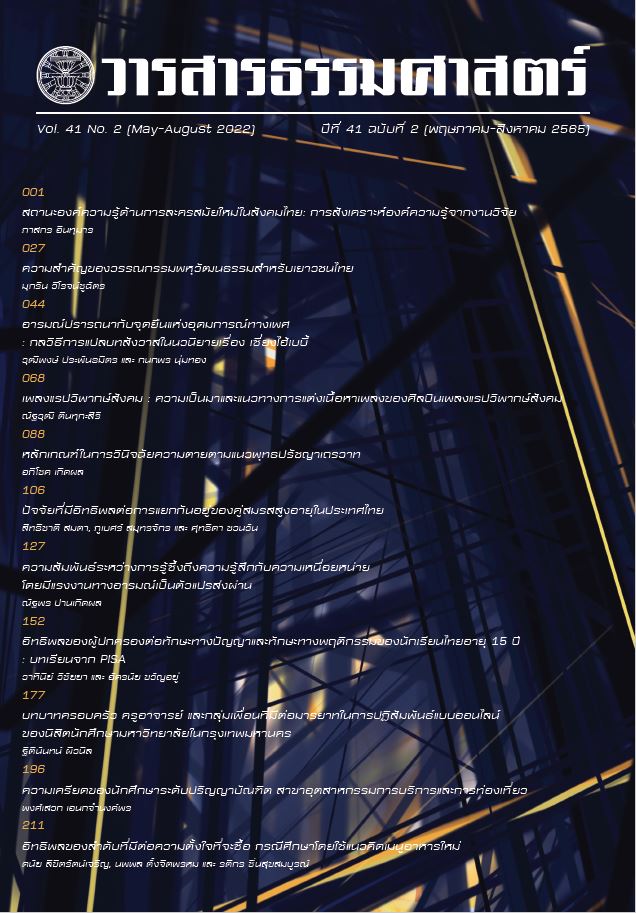
อิทธิพลของผู้ปกครองต่อทักษะทางปัญญาและทักษะทางพฤติกรรมของนักเรียนไทย อายุ 15 ปี: บทเรียนจาก PISA
Article Sidebar
Main Article Content
บทคัดย่อ
บทความนี้มีวัตถุประสงค์เพื่อศึกษาระดับทักษะทางปัญญาและทักษะทางพฤติกรรมของนักเรียนไทย ตลอดจนความสัมพันธ์เชิงสาเหตุระหว่างทุนของผู้ปกครองกับทักษะทางปัญญาและทักษะทางพฤติกรรมของนักเรียนไทย เพื่อนำผลการศึกษาที่ได้ไปจัดทำข้อเสนอแนะเชิงนโยบายในการยกระดับทักษะทางปัญญาและทักษะทางพฤติกรรมของนักเรียนไทย โดยอาศัยแนวคิดทุนทางเศรษฐกิจและทุนทางวัฒนธรรมของปิแอร์ บูร์ดิเยอ เป็นกรอบในการศึกษา ทั้งนี้ อาศัยฐานข้อมูลโครงการประเมินผลนักเรียนร่วมกับนานาชาติ ซึ่งจัดเก็บโดยองค์การเพื่อความร่วมมือและการพัฒนาทางเศรษฐกิจ โดยกลุ่มตัวอย่างคือนักเรียนไทยอายุ 15 ปี จำนวน 8,249 คน จากทั่วประเทศ
ผลจากการใช้สถิติพรรณาพิจารณาระดับทักษะของนักเรียน พบว่า ในมิติคะแนนทักษะทางปัญญา นักเรียนชายเป็นกลุ่มที่มีระดับทักษะทางปัญญาต่ำกว่านักเรียนหญิง และนักเรียนในโรงเรียนเอกชนมีคะแนนทักษะทางปัญญาสูงกว่าโรงเรียนรัฐบาล ในขณะที่มิติคะแนนทักษะทางพฤติกรรม พบว่า นักเรียนชายมีทักษะทางพฤติกรรมใกล้เคียงกับนักเรียนหญิง แต่นักเรียนในโรงเรียนรัฐบาลมีทักษะทางพฤติกรรมสูงกว่าโรงเรียนเอกชน สำหรับการใช้แบบจำลองสมการโครงสร้างศึกษาความเชื่อมโยงระหว่างตัวแปรทุนของผู้ปกครองและตัวแปรทักษะของนักเรียน พบว่า ทุนทางเศรษฐกิจและทุนทางวัฒนธรรมของผู้ปกครอง เป็นปัจจัยสำคัญที่เกื้อหนุนให้นักเรียนมีทักษะทางปัญญาที่เพิ่มสูงขึ้นอย่างมีนัยยะสำคัญ นอกจากนี้ทักษะทางพฤติกรรมของนักเรียนยังมีส่วนเกื้อหนุนทักษะทางปัญญาของนักเรียนด้วย โดยค่ารากที่สองของค่าความคลาดเคลื่อนกําลังสองเฉลี่ย (RMSE) เท่ากับ 0.071 และค่าดัชนีความกลมกลืนระหว่างข้อมูลเชิงประจักษ์กับแบบจำลองที่กำหนดขึ้น (GFI) เท่ากับ 0.874
ข้อค้นพบดังกล่าวสะท้อนความเหลื่อมล้ำของทุนทางเศรษฐกิจและทุนทางวัฒนธรรมในกลุ่มผู้ปกครองซึ่งสัมพันธ์กับทักษะของนักเรียน ทั้งนี้ บทความนี้มีข้อเสนอแนะเชิงนโยบายเพื่อยกระดับทักษะของนักเรียนว่า โรงเรียนต้องจัดสรรทรัพยากรทางการศึกษาแก่นักเรียนจากครัวเรือนที่มีข้อจำกัดทางเศรษฐกิจ ให้ความสำคัญกับกิจกรรมเชิงสุนทรียะ การมีส่วนร่วมของสถาบันครอบครัว รวมทั้ง ให้น้ำหนักกับการพัฒนาทั้งทักษะทางปัญญาและทักษะทางพฤติกรรมของนักเรียน
Article Details
เอกสารอ้างอิง
กาญจนา แก้วเทพ และ สมสุข หินวิมาน. (2560). สายธารแห่งนักคิดทฤษฎีเศรษฐศาสตร์การเมืองกับสื่อสารศึกษา. มหาสารคราม: อินทนิล.
ทิพย์วรรณ สุขใจรุ่งวัฒนา และ ธีรศักดิ์ อุ่นอารมย์เลิศ. (2553). การศึกษาปัจจัยที่ส่งผลต่อพฤติกรรมการเรียนที่ดีของนักเรียนชั้นมัธยมศึกษาปีที่ 3 สังกัดสำนักบริหารงานคณะกรรมการส่งเสริมการศึกษาเอกชน จังหวัดนครปฐม. ศิลปากรศึกษาศาสตร์วิจัย, 1(2), 126-139.
พัชสุดา กัลยาณวุฒิ. (2558). ปัจจัยที่ส่งผลกระทบต่อผลสัมฤทธิ์ทางการศึกษาของนักศึกษาระดับ ปวช.และระดับปวส.ของวิทยาลัยเทคโนโลยีพายัพและบริหารธุรกิจ. เชียงใหม่: วิทยาลัยเทคโนโลยีพายัพและบริหารธุรกิจ.
ศราวุฒิ งามยิ่ง, ปริชัย ดาวอุดม และมณฑนา พิพัฒน์เพ็ญ. (2563). กวดวิชาการแปลงทุนเศรษฐกิจเป็นความได้เปรียบในสนามการศึกษาของนักเรียนชั้นนำ. สังคมศาสตร์และมานุษยวิทยาเชิงพุทธ, 5(10), 149-164.
ภาษาอังกฤษ
Borghans, L., Duckworth, A. L., Heckman, J. J., & ter Weel, B. (2008). The Economics and Psychology of Personality Traits. Journal of Human Resources, 43(4), 972–1059.
Bourdieu, P. (1986). The Forms of Capital. In J. Richardson (Ed.), Handbook of Theory and Research for the Sociology of Education, pp. 241-258. New York: Greenwood Press.
Breakspear, S. (2014). How Does PISA Shape Education Policy Making? Why How We Measure Learning Determines What Counts in Education. Seminar Series Paper No. 240. Victoria: Centre for Strategic Education.
Cardona, A., Diewald, M., Kaiser, T., & Osmanowski, M. (2015). Measuring Cultural Capital: Sense of Entitlement, Concerted Cultivation, Leisure Activities, Gatekeeper Bias and Skills. SFB 882 Technical Report, No. 15. Bielefeld, Germany: DFG Research Center (SFB).
Cheng, S.-T. (2012). Cultural Capital, Economic Capital, and Academic Achievement: Some Evidence from TAIWAN. (Doctor of Philosophy, Sociology, Michigan State University).
Cordero, J. M., Muñiz, M., & Polo, C. (2016). The Determinants of Cognitive and Non-cognitive Educational Outcomes: Empirical Evidence in Spain Using a Bayesian Approach. Applied Economics, 48(35), 3355-3372, doi: 10.1080/ 00036846.2015.1137554
De Coulon, A., Meschi, E., & Vignoles, A. (2011). Parents' Skills and Children's Cognitive and Non-cognitive Outcomes. Education Economics, 19(5), 451-474.
De Graaf, N., De Graaf, P., & Kraaykamp, G. (2000). Parental Cultural Capital and Educational Attainment in the Netherlands: A Refinement of the Cultural Capital Perspective. Sociology of Education, 73(2), 92-111.
Goßmann, F. (2018). Measuring Cultural Capital in the NEPS. NEPS Survey Paper No. 48. Bamberg, Germany: Leibniz Institute for Educational Trajectories, National Educational Panel Study.
Green, F. (2011). What is Skill? An Inter-Disciplinary Synthesis. LLAKES Research Paper 20. London, UK: Centre for Learning and Life Chances in Knowledge Economies and Societies.
Gunindi, Y., Sahin, F. T., & Demircioglu, H. (2012). Functions of the Family: Family Structure and Place of Residence. Energy Education Science and Technology Part B. Social and Educational Studies, 4(1), 549-556.
Heckman, J. j., Stixrud, J., & Urzua, S. (2006). The Effects of Cognitive and Noncognitive Abilities on Labor Market Outcomes and Social Behavior. Journal of Labor Economics, 24(3), 411-480.
Ho, E. S. (2010). Family Influences on Science Learning among Hong Kong Adolescents: What We Learned from PISA. International Journal of Science and Mathematics Education, 8(3), 409-428.
Hora, M.T., & Blackburn Cohen, C. A. (2018). Cultural Capital at Work: How Cognitive and Noncognitive Skills Are Taught, Trained, and Rewarded in a Chinese Technical College. Community College Review, 46(4), 388-416.
Jaeger, M. M. (2009). Equal Access but Unequal Outcomes: Cultural Capital and Educational Choice in a Meritocratic Society. Social Forces, 87(4), 1943-1972.
Katsillis, J., & Rubinson, R. (1990). Cultural Capital, Student Achievement, and Educational Reproduction: The Case of Greece. American Sociological Review, 55(2), 270-279.
Kautz, T., Heckman, J. J., Diris, R., Weel, B., & Borghans, L. (2014). Fostering and Measuring Skills: Improving Cognitive and Non-Cognitive Skills to Promote Lifetime Success. OECD Education Working Papers 110. Paris: OECD Publishing.
Liu, A. (2016). Children's Non-Cognitive Skills and the Effects of Family SES on Academic Achievement. PSC Research Report No. 16-862. Michigan: Population Studies Center.
Lombardi, C. M., & Dearing, E. (2021). Maternal Support of Children's Math Learning in Associations Between Family Income and Math School Readiness. Child Development, 92(1), e39-e55. doi: 10.1111/cdev.13436
Luo, F., Guan, J., Xia, Q., & Sun, C. (2017). Analysis on the Influence of Family Background and Cultural Capital on the Non-cognitive Skills of Children. Education Journal, 6(6), 188-195.
Mooney, A., Oliver, C., & Smith, M. (2009). Impact of Family Breakdown on Children’s Well-Being: Evidence Review. DSCF Research Report No. DCSF-RR113. London: Department for Children, Schools and Families.
Reay, D. (2004). Education and Cultural Capital: The Implications of Changing Trends in Education Policies. Cultural Trends, 13(2), 73-86.
Sullivan, A. (2001). Cultural Capital and Educational Attainment. Sociology, 35(4), 893-912.
Tan, C. (2017). Examining Cultural Capital and Student Achievement: Results of a Meta-Analytic Review. Alberta Journal of Educational Research, 63(2), 139-159.
Tan, C., & Liu, D. (2018). What is the Influence of Cultural Capital on Student Reading Achievement in Confucian as Compared to Non-Confucian Heritage Societies? Compare: A Journal of Comparative and International Education, 48(6), 896-914.
Topçu, M. S., Arıkan, S., & Erbilgin, E. (2015). Turkish Students’ Science Performance and Related Factors in PISA 2006 and 2009. The Australian Educational Researcher, 42(1), 117–132.
Upali, P. (2017). Impact of Family on Children's Wellbeing. Journal of Sociology and Social Work, 5(1), 149-158.
Zhou, K. (2016). Non-Cognitive Skills: Definitions, Measurement and Malleability. Paper Commissioned for the Global Education Monitoring Report 2016, Education for People and Planet: Creating Sustainable Futures for All. Retrieved January 10, 2021, from https://unesdoc.unesco.org/ark:/48223
/pf0000245576
