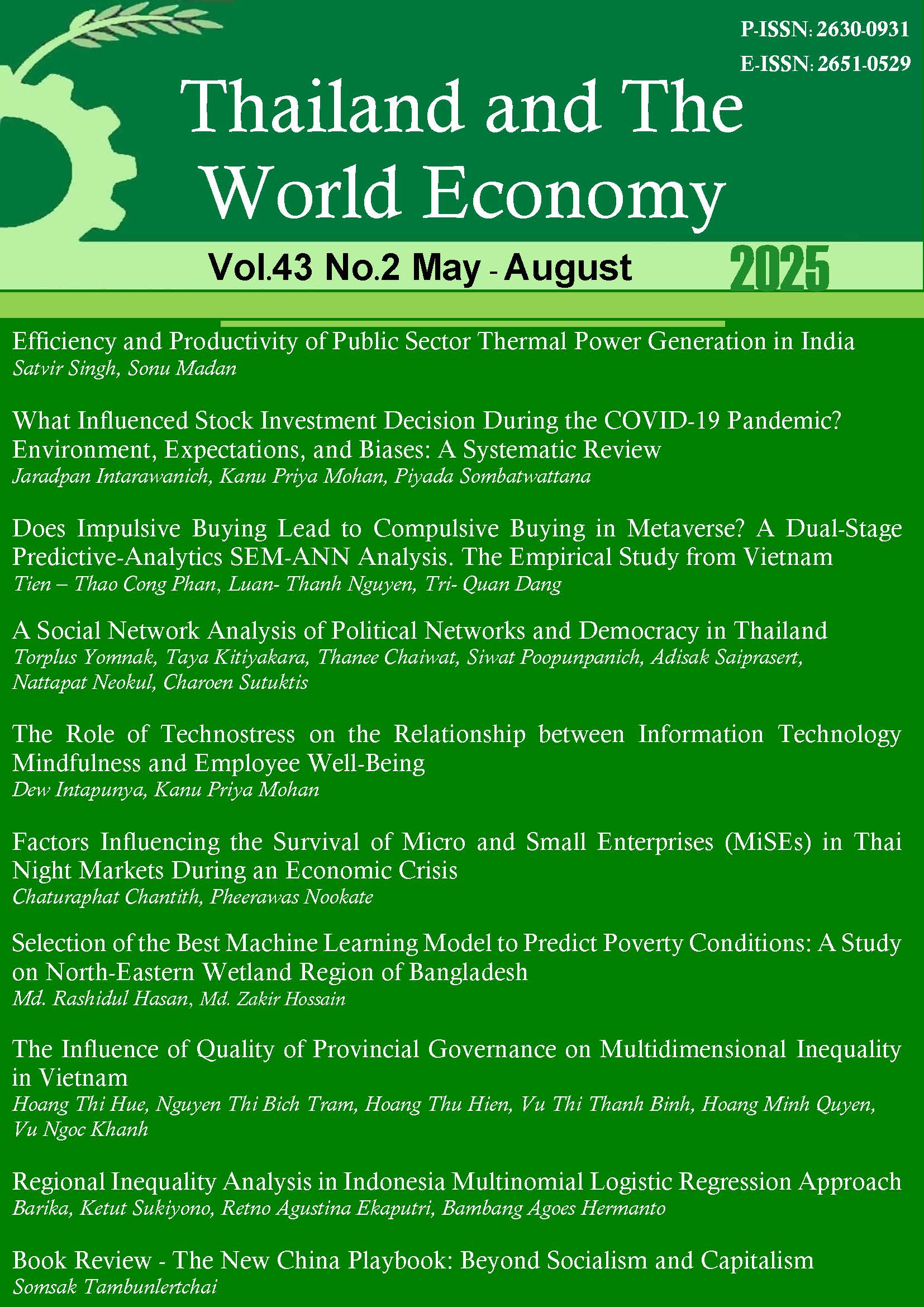
A Social Network Analysis of Political Networks and Democracy in Thailand
Keywords:
Politics, Network, Democracy, Member of parliament, Kin, Nepotism, RelationshipAbstract
Personal relationships have historically been a significant influence in Thai culture, extending into national politics. Ties between members of the Senate and the House of Representatives through various networks are good examples of this observation. Academic research has suggested that such networks could lead to oligarchic politics and thus jeopardise the quality of a functioning democracy, but it has yet to identify the specific patterns and quantify the intensity of these relationships. Using Social Network Analysis framework, this paper compared the levels and patterns of relationships between members of Parliament during four recent parliamentary terms and analysed their relationship with the quality of Thailand’s democracy during each period. The results showed a strong inverse correlation between the intensity of political networks and the quality of democracy. Although the mechanism for this relationship is not clear, these political networks may intervene in government policymaking to formulate policies that favour partisans and coordinate to reduce democratic governance of policymaking and other political institutions. The finding suggests that Social Network Analysis can be used to monitor the level of in-group networks in parliament, which may reduce economic rent-seeking, a distinguished characteristic of oligarchy, and thus facilitate a better-functioning democracy in Thailand.
References
Alizada, N., Boese, V. A., Lundstedt, M., Morrison, K., Natsika, N., Sato, Y., ... & Lindberg, S. I. (2022). Autocratization changing nature?. Democracy Report 2022. Retrieved from Varieties of Democracy Institute (V-Dem) http://v-dem.net/
media/publications/dr_2022.pdf
Borgatti, S. P., & Halgin, D. S. (2011). On network theory. Organization Science, 22(5), 1168–1181.
Brown, R. A. (2006). Indonesian corporations, cronyism, and corruption. Modern Asian Studies, 40(4), 953-992.
Chardchawarn, S. (2012). Karn muang Thai nai krabuan karn krajai amnat : Sueksa phan botbat khong nak wichakan kharatchakan nak karn muang lae prachachon [Politics in the decentralization process: A study through the roles of civil servant academics, politicians, and citizens]. Bangkok: Faculty of Political Science, Thammasat University.
Christensen, S. (1993). Thailand: The institutional and political underpinnings of growth. World Bank Publications. Retrieved from https://documents1.
worldbank.org/curated/en/668001468778162871/pdf/multi0page.pdf
De Rynck, F., & Voets, J. (2006). Democracy in area-based policy networks: The case of Ghent. The American Review of Public Administration, 36(1), 58-78.
Doner, R., & Ramsay, A. (2000). Rent-seeking and economic development in Thailand. In M. Khan & K. Jomo (Eds.), Rents, rent-seeking and economic development: Theory and evidence in Asia (pp. 145-181). Cambridge: Cambridge University Press.
Gerring, J., Thacker, S. C., & Alfaro, R. (2012). Democracy and human development. The Journal of Politics, 74(1), 1-17.
Gil-Mendieta, J., & Schmidt, S. (1996). The political network in Mexico. Social Networks, 18(4), 355-381.
Hadjikhani, A., & Ghauri, P. N. (2001). The behaviour of international firms in socio-political environments in the European Union. Journal of Business Research, 52(3), 263–275.
Integrated Network for Societal Conflict Research. (2018). Polity5: Regime Authority Characteristics and Transitions [Data set]. Retrieved from https://view.officeapps.live.com/op/view.aspx?src=https%3A%2F%2Fwww.systemicpeace.org%2Finscr%2Fp5v2018.xls&wdOrigin=BROWSELINK
Jackson, D., & Amundsen, I. (2022). Tuning in to the politics of (anti-) corruption: Astute interventions and deeper accountability. U4 Issue No. 2022:3 Retrieved from https://www.u4.no/publications/tuning-in-to-the-politics-of-anti-corruption-astute-interventions-and-deeper-accountability.pdf
Jang, S. J. (2009). Are diverse political networks always bad for participatory democracy? Indifference, alienation, and political disagreements. American Politics Research, 37(5), 879-898.
Klitgaard, R. (1988). Controlling Corruption. California, United States of America: University of California Press.
Kumpha, A. (2018). Dynamics of network monarchy: Observations about changes of Thai elite network during B.E. 2495 - 2535. The Journal of the Thai Khadi Research Institute, 15(2), 41-88.
Kuzio, T. (2011). Political culture and democracy. Ukraine as an immobile state. East European Politics and Societies, 25(01), 88-113
McCargo, D. (2005). Network monarchy and legitimacy crises in Thailand. The Pacific Review, 18(4), 499-519.
Moolsilpa, P. (2016). Concept on the acquisition of Thai senator in the Past Decade. AU Law Journal, 7(1), 18-33.
Pathmanand, U. (2016). Network Thaksin: Structure, roles and reaction. In P. Phongpaichit & C. Baker (Eds), Unequal Thailand: Aspects of income, wealth and power (pp. 136-161). Singapore: NUS Press.
Patty, J. W., & Penn, E. M. (2017). Network theory and Political Science. In J. N. Victor, H. M. Alexander, & L. Mark (Eds.), The Oxford handbook of political networks (pp. 147-174). Oxford, United Kingdom: Oxford University Press.
Phongpaichit, P., Treerat, N., & Baker, C. (2016). Very distinguished alumni: Thai political networking. Southeast Asian Studies, 5(1), 19-34.
Pixley, J. (1994). Unemployment and democracy—at an impasse?. Labour & Industry: A journal of the social and economic relations of work, 6(1), 35-48.
Putnam, R. D. (1993). The prosperous community: Social capital and public life. The American Prospect, 13(4), 35-42.
Rohitarachoon, P., & Hossain, F. (2012). Decentralized recruitment and selection in Thailand: Friend or foe to local public administration?. International Journal of Public Administration, 35(8), 553-561.
Sørensen, E., & Torfing, J. (2003). Network politics, political capital, and democracy. International Journal of Public Administration, 26(6), 609-634.
Sørensen, E., & Torfing, J. (2005). Network governance and post-liberal democracy. Administrative Theory & Praxis, 27(2), 197-237.
Stokman, F. N. (2001). Networks: social. In N. J. Smelser & P. B. Baltes (Eds.), International encyclopedia of the social & behavioral sciences (pp. 10509–10514). Oxford, United Kingdom: Pergamon Press.
Suphap, R. (2019). Legal consideration regarding the election, powers and duties of senators under the constitution of the kingdom of Thailand B.E. 2560 (2017). Nitipat NIDA Journal, 8(2), 65-81.
Thananithichot, S., & Satidporn, W. (2016). Political dynasties in Thailand: The recent picture after the 2011 general election. Asian Studies Review, 40(3), 1-20.
Thanasthit, U. (2020). Language in Thai constitutions : The comparative study of 1997 and 2017 Thai constitutions. Journal of Politics and Governance, 10(2), 87–103. Retrieved from https://so03.tci-thaijo.org/index.php/jopag/article/view/245534
Thinbangtieo, O. (2020). Ban Yai Bangsaen group (Khun Pluem clan) and election in March 24, 2019. Burapha Journal of Political Economy, 8(1), 49-80.
Transparency International. (2021). Corruption perceptions index 2020. Retrieved from https://www.transparency.org/en/cpi/2020/index/nzl
Treerat, N., & Vanichaka, P. (2016). Elite networking through special executive courses. In P. Phongpaichit & C. Baker (Eds), Unequal Thailand: Aspects of income, wealth and power (pp. 73–96). Singapore: NUS Press.
The Secretariat of the House of Representatives. (2017). Priab tiab ratthathammanoon pi 1997 - 2007 lae ratthathammanoon pi 2017 [Comparison of the 1997-2007 constitution and the 2017 constitution]. Retrieved from The Secretariat of the House of Representatives Pressing https://cdc.parliament.go.th/
draftconstitution2/ewt_dl_link.php?nid=1106&filename=index
V-Dem Institute. (2022). The V-Dem Dataset. Retrieved from https://www.v-dem.net/vdemds.html
Ward, M. D., Stovel, K., & Sacks, A. (2011). Network analysis and political science. Annual Review of Political Science, 14(1), 245-264.
Wasserman, S., & Faust, K. (1994). Social network analysis: Methods and applications (Structural analysis in the social sciences). Cambridge: Cambridge University Press.
Yomnak, T. (2016). Corruption in Thailand: A study of corruption and anti-corruption reforms in Thailand’s construction sector (Doctoral dissertation). University of Cambridge, UK.
Yomnak, T., & Ruckchart, S. (2021). Collaboration network of Thailand’s anti-corruption organizations. Southeast Asian Journal of Economics, 9(1), 27-4
Downloads
Published
How to Cite
Issue
Section
Categories
License
Copyright (c) 2025 Thailand and The World Economy

This work is licensed under a Creative Commons Attribution-NonCommercial-NoDerivatives 4.0 International License.