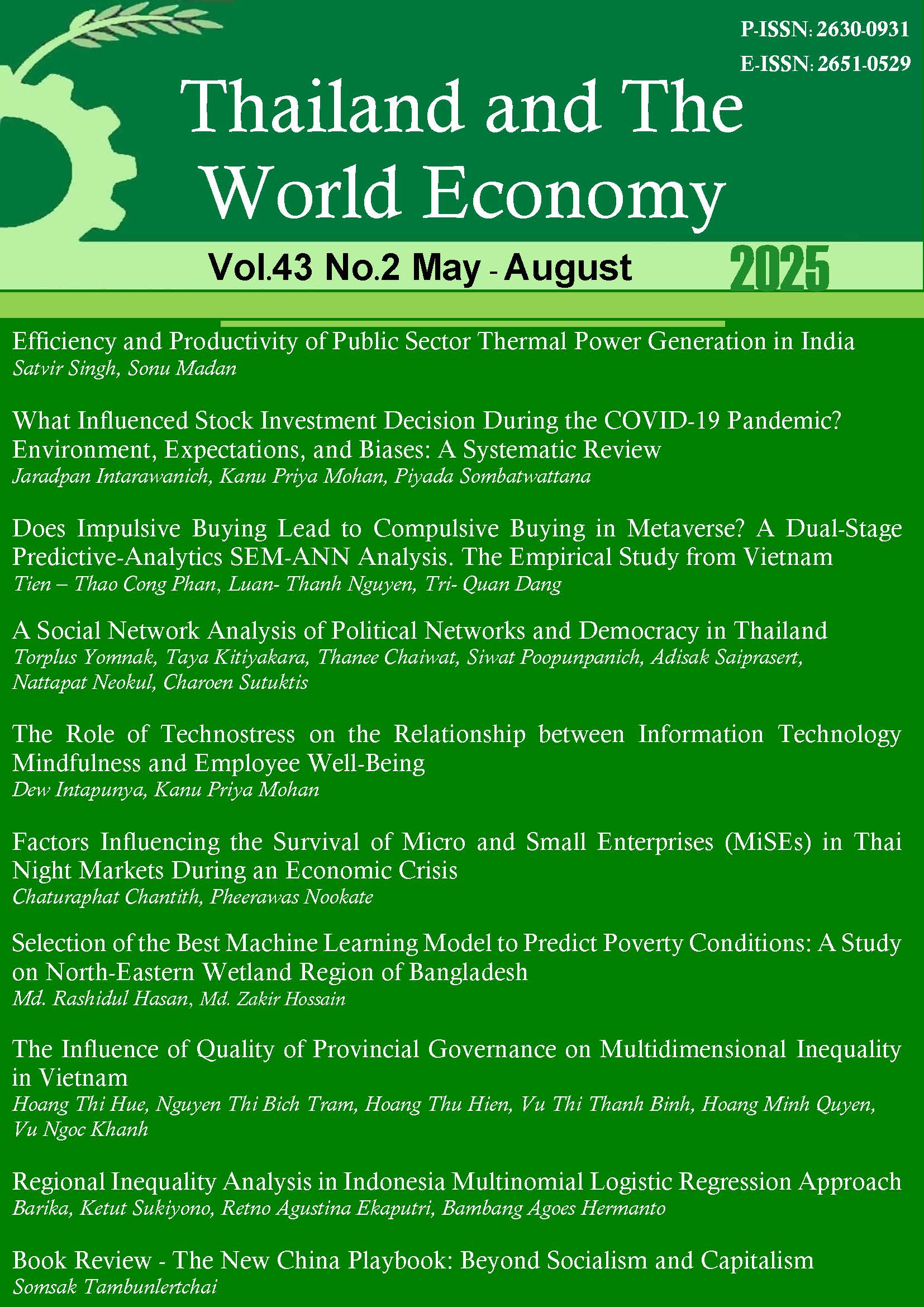
The Role of Technostress on the Relationship between Information Technology Mindfulness and Employee Well-Being
Keywords:
IT mindfulness, technostress, affective well-being, job satisfactionAbstract
The COVID-19 pandemic affected Thailand’s economy at a macro level and impacted work lives of individuals at a micro level. Since many organizations changed the work policy to remote working and work from home, it resulted in deteriorating work well-being. Research showed that employees were forced to spend extended hours in front of computers, triggering stress due to excessive technological use, or ‘technostress.’ This study explored technostress and its role in the relationship between information technology mindfulness (IT mindfulness) and employee well-being, measured in two dimensions: affect and job satisfaction. The current study is the SEM analysis using data from 220 IT users at work to study the interrelationship among technostress, IT mindfulness, affect, and job satisfaction. The results showed that technostress has a negative effect on affect (β = -.59, p < .01) and on job satisfaction (β = -.39, p < .01). Additionally, technostress has a mediating role in the relationship between IT mindfulness and affect (β= .22, p < .05). The findings can be applied to generate awareness in organizations and help in developing effective strategies to alleviate work stress due to the extreme use of technology.
References
Achor, S. (2018). Big potential: How transforming the pursuit of success raises our achievement, happiness, and well-being. New York: Crown Currency, a division of Penguin Random House, LLC.
Ballantyne, C., Hunter, P. V., Potter, G. K., & Myge, I. (2021). Mindfulness and perceptions of physical health: The mediating role of perceived stress. Canadian Journal of Behavioural Science/Revue Canadienne des Sciences du Comportement, 53(3), 321-327.
Banerjee, A., & Chaudhury, S. (2010). Statistics without tears: Populations and samples. Industrial Psychiatry Journal, 19(1), 60-65.
Barrero, J., Bloom, N., & Davis, S. (2021). Why working from home will stick. National Bureau of Academic Research Working Paper No. w28731. Retrieved from https://www.nber.org/papers/w28731.
Bartlett, L., Martin, A., Neil, A. L., Memish, K., Otahal, P., Kilpatrick, M., & Sanderson, K. (2019). A systematic review and meta-analysis of workplace mindfulness training randomized controlled trials. Journal of Occupational Health Psychology, 24(1), 108-126.
Boyer-Davis, S. (2019). Technostress: An antecedent of job turnover intention in the accounting profession. Journal of Business and Accounting, 12(1), 49-63.
Brown, K. W., & Ryan, R. M. (2003). The benefits of being present: Mindfulness and its role in psychological well-being. Journal of Personality and Social Psychology, 84(4), 822-848.
Byrne, B.M. (2010). Structural equation modeling with AMOS: Basic concepts, applications, and programming. New York: Taylor and Francis Group Publication.
Celik, M. (2011). A theoretical approach to the job satisfaction. Polish Journal of Management Studies, 4(2), 7-14.
Choi, S. B., & Lim, M. S. (2016). Effects of social and technology overload on psychological well-being in young South Korean adults: The mediatory role of social network service addiction. Computers in Human Behavior, 61, 245-254.
Diener, E., Colvin, C. R., Pavot, W. G., & Allman, A. (1991). The psychic costs of intense positive affect. Journal of Personality and Social Psychology, 61(3), 492-503.
Dragano, N., & Lunau, T. (2020). Technostress at work and mental health: Concepts and research results. Current Opinion in Psychiatry, 33(4), 407-413.
Edgar, F., Geare, A., & Zhang, J. A. (2017). A comprehensive concomitant analysis of service employees’ well-being and performance. Personnel Review, 46(8), 1870-1889.
Elder, C., Nidich, S., Moriarty, F., & Nidich, R. (2014). Effect of transcendental meditation on employee stress, depression, and burnout: A randomized controlled study. Permanente Journal, 18(1), 19-23.
Epstein, R. M. (1999). Mindful practice. Jama, 282(9), 833-839.
Fan, Y., Chen, J., Shirkey, G., John, R., Wu, S. R., Park, H., & Shao, C. (2016). Applications of structural equation modeling (SEM) in ecological studies: An updated review. Ecological Processes, 5, 1-12.
Farmania, A., Elsyah, R. D., & Fortunisa, A. (2022). The phenomenon of technostress during the COVID-19 pandemic due to work from home in Indonesia. Sustainability, 14(14).
George, D., & Mallery, P. (2010). SPSS for Windows step by step : A simple guide and reference, 17.0 update. New York: Allyn & Bacon.
Hair, J.F., Black, W.C., Babin, B.J., & Anderson, R.E. (2010). Multivariate data analysis: A global perspective. New Jersey: Prentice Hall.
Hang, Y., Hussain, G., Amin, A., & Abdullah, M. I. (2022). The moderating effects of technostress inhibitors on techno-stressors and employee's well-being. Frontiers in Psychology, 12.
Hertzog, M. A. (2008). Considerations in determining sample size for pilot studies. Research in Nursing & Health, 31(2), 180-191.
Ioannou, A., Lycett, M., & Marshan, A. (2024). The role of mindfulness in mitigating the negative consequences of technostress. Information Systems Frontiers, 26(2), 523-549.
Ioannou, A., & Papazafeiropoulou, A. (2017, 2017/01/01). Using IT mindfulness to mitigate the negative consequences of technostress. Twenty-third Americas Conference on Information Systems, Boston. Retrieved from https://www.researchgate.net/profile/Athina-Ioannou/publication/319109382_
Using_IT_Mindfulness_to_Mitigate_the_Negative_Consequences_of_Technostress/links/5995673da6fdccaded254faa/Using-IT-Mindfulness-to-Mitigate-the-Negative-Consequences-of-Technostress.pdf
Jager, J., Putnick, D. L., & Bornstein, M. H. (2017). II. More than just convenient: The scientific merits of homogeneous convenience samples. Monographs of the Society for Research in Child Development, 82(2), 13-30.
Järveläinen, J., Sell, A., & Walden, P. (2021). The impact of IT mindfulness on complex task performance. Paper presented at the 54th Hawaii International Conference on System Sciences, Online. Retrieved from http://hdl.handle.net/10125/70762
Kabat-Zinn, J. (1982). An outpatient program in behavioral medicine for chronic pain patients based on the practice of mindfulness meditation: Theoretical considerations and preliminary results. General Hospital Psychiatry, 4, 33-47.
Kabat-Zinn, J. (2003). Mindfulness-based interventions in context: Past, present, and future. Clinical Psychology: Science and Practice, 10(2), 144–156.
Korosec-Serfaty, M., Vasseur, A., Léger, P. M., & Sénécal, S. (2021). Disentangling technostress and financial stress impacts on users’ psychophysiological responses and coping behaviors in the context of mobile banking. In: Nah, F.FH., Siau, K. (eds) International Conference on Human-Computer Interaction (pp. 213-227). Cham: Springer International Publishing.
Laker, B. (2021). 94% of workers are stressed: KPMG research reveals Covid-19’s lingering effects on employees. Retrieved from https://www.forbes.com/sites/benjaminlaker/2021/05/04/the-future-world-of-work-is-fascinating-reveals-new-research-from-kpmg/?sh=1e34b8ab6865
Lawler, E., Cammann, C., Nadler, D., & Jenkins, D. (1975). Michigan Organizational Assessment Questionnaire (MOAQ) [Database record]. APA PsycTests. Retrieved from https://psycnet.apa.org/doiLanding?doi=10.1037%2Ft01581-000
Lee, A. R., Son, S.-M., & Kim, K. K. (2016). Information and communication technology overload and social networking service fatigue: A stress perspective. Computers in Human Behavior, 55, 51-61.
Maier, C., Wirth, J., Laumer, S., & Weitzel, T. (2017). Personality and technostress: theorizing the influence of IT mindfulness. In ICIS 2017 Proceedings, 1–11. Retrieved from https://aisel.aisnet.org/cgi/viewcontent.cgi?article=1152
&context=icis2017
Mheidly, N., Fares, M. Y., & Fares, J. (2020). Coping with stress and burnout associated with telecommunication and online learning. Frontiers in Public Health, 8.
Nimrod, G. (2018). Technostress: Measuring a new threat to well-being in later life. Aging & Mental Health, 22(8), 1086-1093.
Pawar, B. S. (2016). Workplace spirituality and employee well-being: An empirical examination. Employee Relations, 38(6), 975-994.
Pfaffinger, K. F., Reif, J. A., & Spieß, E. (2022). When and why telepressure and technostress creators impair employee well-being. International Journal of Occupational Safety and Ergonomics, 28(2), 958-973.
Pfeffer, J. (2018). The overlooked essentials of employee well-being. McKinsey Quarterly, 3(2018), 82-89.
Pflügner, K., Maier, C., & Weitzel, T. (2021). The direct and indirect influence of mindfulness on techno-stressors and job burnout: A quantitative study of white-collar workers. Computers in Human Behavior, 115.
Pirkkalainen, H., Salo, M., Makkonen, M., & Tarafdar, M. (2017). Coping with technostress: When emotional responses fail. Paper presented at the 38th International Conference on Information Systems, Seoul. Retrieved from http://urn.fi/URN:NBN:fi:jyu-201711064145
Pradhan, R. K., & Hati, L. (2022). The measurement of employee well-being: Development and validation of a scale. Global Business Review, 23(2), 385-407.
Ragu-Nathan, T. S., Tarafdar, M., Ragu-Nathan, B. S., & Tu, Q. (2008). The consequences of technostress for end users in organizations: Conceptual development and empirical validation. Information Systems Research, 19(4), 417-433.
Reb, J., & Choi, E. (2014). Mindfulness in organizations. The Psychology of Meditation. Retrieved from https://ink.library.smu.edu.sg/lkcsb_research/4199
Rexroth, M., Michel, A., & Bosch, C. (2017). Promoting well-being by teaching employees how to segment their life domains. Zeitschrift für Arbeits- und Organisationspsychologie A&O, 61(4), 197-212.
Riglea, S., Rus, C. L., & Ratiu, L. (2021). The mediating role of the work-family conflict in the relationship between technostress and psychological well-being in the COVID-19 pandemic context. Psihologia Resurselor Umane, 19(2).
Roberts, N. H., Thatcher, J. B., & Klein, R. (2007). Using information technology mindfully. Paper presented at the 2007 Southern Association for Information Systems Conference. Retrieved from https://aisel.aisnet.org/sais2007/1
Ryan, R. M., & Deci, E. L. (2001). On happiness and human potentials: A review of research on hedonic and eudaimonic well-being. Annual Review of Psychology, 52(1), 141-166.
Sandoval-Reyes, J., Idrovo-Carlier, S., & Duque-Oliva, E. J. (2021). Remote work, work stress, and work–life during pandemic times: A Latin America situation. International Journal of Environmental Research and Public Health, 18(13).
Srivastav, A. K., & Das, P. (2015). A study on employees’ attitude towards the organization and job satisfaction. International Journal of Science and Research (IJSR), 7(4),102-107.
Stewart, T. (2023). Marketing and media faced with ‘worst-ever’ talent shortage. Retrieved from https://newdigitalage.co/advertising/marketing-and-media-faced-with-worst-ever-talent-shortage/
Swanson, E. B., & Ramiller, N. C. (2004). Innovating mindfully with information technology. MIS Quarterly, 28(4), 553-583.
Tarafdar, M., Tu, Q., Ragu-Nathan, B. S., & Ragu-Nathan, T. S. (2007). The impact of technostress on role stress and productivity. Journal of Management Information Systems, 24(1), 301-328.
Tarafdar, M., Tu, Q., & Ragu-Nathan, T. (2010). Impact of technostress on end-user satisfaction and performance. Journal of Management Information Systems, 27(3), 303-334.
Thatcher, J. B., Wright, R. T., Sun, H., Zagenczyk, T. J., & Klein, R. (2018). Mindfulness in information technology use: Definitions, distinctions, and a new measure. MIS Quarterly, 42(3), 831-848.
Thompson, E. R. (2007). Development and validation of an internationally reliable short-form of the positive and negative affect schedule (PANAS). Journal of cross-cultural psychology, 38(2), 227-242.
Tingaz, E. O., Solmaz, S., Ekiz, M. A., & Atasoy, M. (2023). The relationship between mindfulness and self-rated performance in student-athletes: The mediating role of depression, anxiety and stress. Sport Sciences for Health, 19(2), 657-663.
Tuan, L. T. (2022). Employee mindfulness and proactive coping for technostress in the COVID-19 outbreak: The roles of regulatory foci, technostress, and job insecurity. Computers in Human Behavior, 129.
Valikhani, A., Kashani, V. O., Rahmanian, M., Sattarian, R., Rahmati Kankat, L., & Mills, P. J. (2020). Examining the mediating role of perceived stress in the relationship between mindfulness and quality of life and mental health: Testing the mindfulness stress buffering model. Anxiety, Stress, & Coping, 33(3), 311-325.
Van De Voorde, K., Paauwe, J., & Van Veldhoven, M. (2012). Employee Well-
being and the HRM-organizational performance relationship: A review of quantitative studies. International Journal of Management Reviews, 14(4), 391-407.
Verbeke, A., Schulz, R., Greidanus, N., & Hambley, L. (2008). Growing the virtual workplace: The integrative value proposition for telework. Massachusetts, USA: Edward Elgar Publishing.
Warr, P., & Nielsen, K. (2018). Wellbeing and work performance. Handbook of well-being. Salt Lake City, UT: DEF Publishers.
Wright, T. A. (2006). To be or not to be [happy]: The role of employee well-being. Academy of Management Perspectives, 20(3), 118-120.
Wu, W., Chin, W., & Liu, Y. (2022). Technostress and the smart hospitality employee. Journal of Hospitality and Tourism Technology, 13(3), 404-426.
Zikmund, W. G. (2010). Business Research Methods (7Ed.).New Delhi: South Western.
Downloads
Published
How to Cite
Issue
Section
Categories
License
Copyright (c) 2025 Thailand and The World Economy

This work is licensed under a Creative Commons Attribution-NonCommercial-NoDerivatives 4.0 International License.