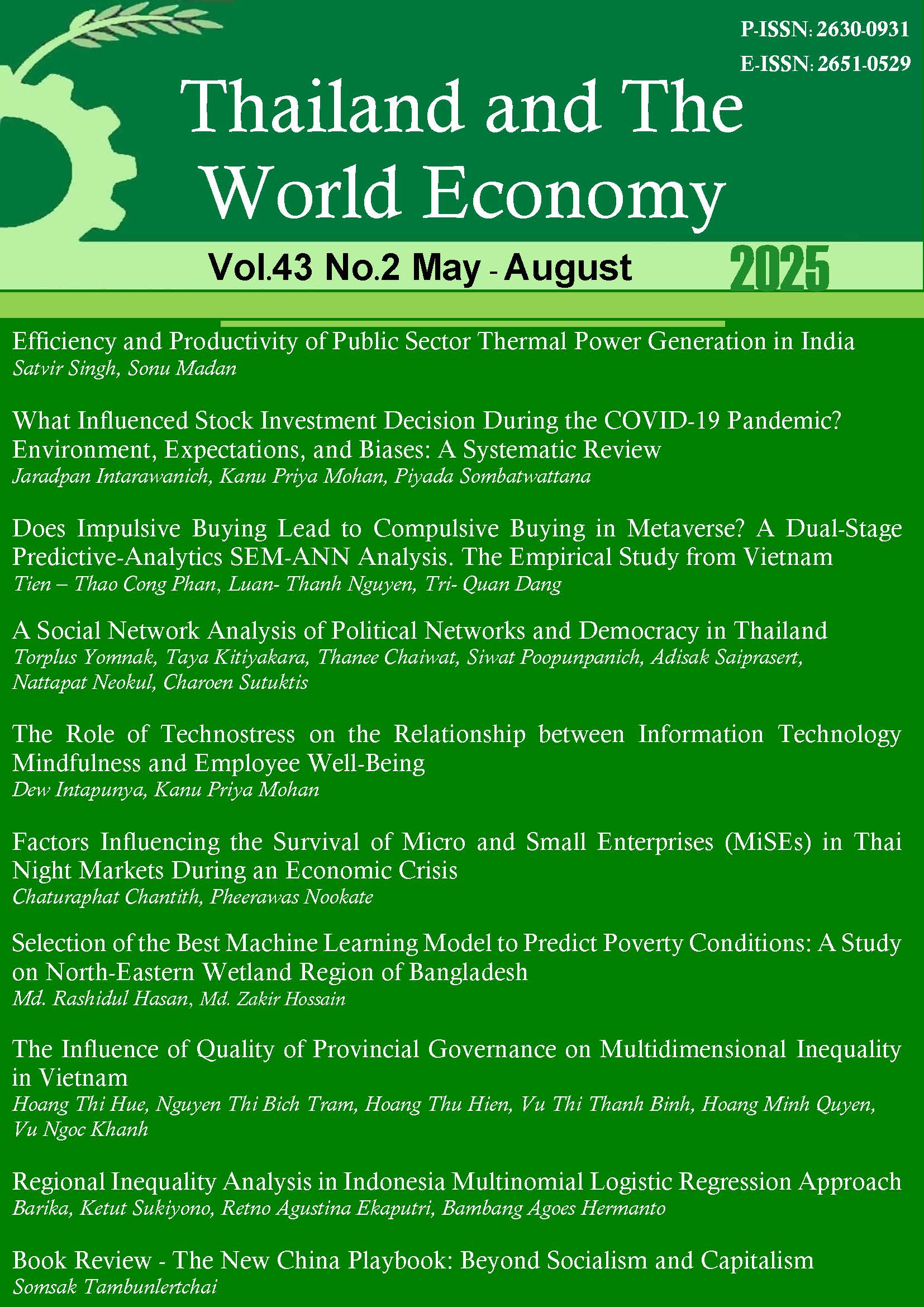
Does Impulsive Buying Lead to Compulsive Buying in Metaverse? A Dual-Stage Predictive-Analytics SEM-ANN Analysis. The Empirical Study from Vietnam
Keywords:
Metaverse, Impulsive, compulsive, PLS-SEM, ANN, SORAbstract
The expansion of the metaverse, an all-encompassing digital environment that integrates virtual reality, augmented reality, and the internet, has fundamentally altered human interaction and behavior, including online purchasing. Due to its interactivity and immersion, the metaverse provides a unique experience that blurs the line between the physical and digital realms. A multitude of prominent corporations have established virtual retail locations within the metaverse, enabling customers to virtually examine merchandise by utilizing photorealistic avatars; this has led to a surge in revenue. Considerable scholarly investigation has been devoted to the subject of impulsive online shopping behavior. Furthermore, the evolution of the metaverse may intensify predispositions towards impulsive and compulsive buying. Nevertheless, there is a dearth of empirical research examining the impact of the metaverse on consumer decision-making. The primary objective of this research endeavor is to examine the impact of the metaverse on compulsive and impulsive buying behavior. Specifically, this study will investigate the influence of perceived value, social influence conformity, metaverse engagement presence, and virtual identity alignment. The utilization of the S-O-R framework in this study provides valuable insights into consumer behavior in virtual environments, which have substantial ramifications for developers and businesses operating in the metaverse. In order to enhance comprehension of consumer behavior in the metaverse, this research utilized a non-probability judgmental sampling technique to select 186 respondents who are active participants in online purchasing within the metaverse in Vietnam. Next, the PLS-SEM and ANN analyses were applied to test the relationship among variables. The research substantiates the importance of impulsive buying and its impact on compulsive buying within the metaverse setting by identifying two influential factors (PCV and MEP) that determine impulsive buying. This study offers significant contributions to the understanding and administration of consumer behavior in the metaverse.
References
Akram, U., Hui, P., Khan, M. K., Yan, C., & Akram, Z. (2018). Factors affecting online impulse buying: Evidence from Chinese social commerce environment. Sustainability (Switzerland), 10(2).
Ali, F., Ali, L., Gao, Z., Terrah, A., & Turktarhan, G. (2022). Determinants of user’s intentions to book hotels: A comparison of websites and mobile apps. Aslib Journal of Information Management, 76 (1), 16-41.
Alvarez-Risco, A., Del-Aguila-Arcentales, S., Rosen, M. A., & Yáñez, J. A. (2022). Social cognitive theory to assess the intention to participate in the Facebook Metaverse by citizens in Peru during the COVID-19 pandemic. Journal of Open Innovation: Technology, Market, and Complexity, 8(3).
Barreda-Ángeles, M., & Hartmann, T. (2022). Psychological benefits of using social virtual reality platforms during the covid-19 pandemic: The role of social and spatial presence. Computers in Human Behavior, 127(October)
Bighiu, G., Manolică, A., & Roman, C. T. (2015). Compulsive buying behavior on the internet. Procedia Economics and Finance, 20(15), 72–79.
Black, D. W. (2022). Compulsive shopping: A review and update. Current Opinion in Psychology, 46.
Brunelle, C., & Grossman, H. (2022). Predictors of online compulsive buying: The role of personality and mindfulness. Personality and Individual Differences, 185(September 2021).
Buhalis, D., Lin, M. S., & Leung, D. (2023). Metaverse as a driver for customer experience and value co-creation: Implications for hospitality and tourism management and marketing. International Journal of Contemporary Hospitality Management, 35(2), 701–716.
Barreda-Ángeles, M., & Hartmann, T. (2022). Psychological benefits of using social virtual reality platforms during the covid-19 pandemic: The role of social and spatial presence. Computers in Human Behavior, 127(October).
Cahyani, S. R., & Artanti, Y. (2023). Pengaruh online customer trust dan online store environment terhadap online impulse buying melalui perceived enjoyment sebagai variabel mediasi Studi pada konsumen TikTok shop [The influence of online customer trust and online store environment on online impulse buying of fashion products through perceived enjoyment of TikTok shop consumers]. Jurnal Ilmu Manajemen, 11(2), 252–265.
Chakraborty, D., Polisetty, A., & Rana, N. P. (2024). Consumers’ continuance intention towards metaverse-based virtual stores: A multi-study perspective. Technological Forecasting and Social Change, 203.
Chin, W., Cheah, J.-H., Liu, Y., Ting, H., Lim, X.-J., & Cham, T. H. (2020). Demystifying the role of causal-predictive modeling using partial least squares structural equation modeling in information systems research. Industrial Management & Data Systems, 120(12), 2161–2209.
Chopdar, P. K., & Balakrishnan, J. (2020). Consumers response towards mobile commerce applications: S-O-R approach. International Journal of Information Management, 53.
Christopher Westland, J. (2010). Lower bounds on sample size in structural equation modeling. Electronic Commerce Research and Applications, 9(6), 476–487.
Dang Quan, T., Wei-Han Tan, G., Aw, E. C.-X., Cham, T.-H., Basu, S., & Ooi, K.-B. (2024). Can you resist the virtual temptations? Unveiling impulsive buying in metaverse retail. Asia Pacific Journal of Marketing and Logistics, 36(10), 2259–2280.
Dang, T.-Q., Tan, G. W.-H., Aw, E. C.-X., Ooi, K.-B., Metri, B., & Dwivedi, Y. K. (2023). How to generate loyalty in mobile payment services? An integrative dual SEM-ANN analysis. International Journal of Bank Marketing, 41 (6), 1177-1206.
Dang Quan, T., Wei-Han Tan, G., Aw, E. C.-X., Cham, T.-H., Basu, S., & Ooi, K.-B. (2024). Can you resist the virtual temptations? Unveiling impulsive buying in metaverse retail. Asia Pacific Journal of Marketing and Logistics, , 36 ( 10), 2259-2280.
Dhanesh, G. S. (2017). Putting engagement in its PRoper place: State of the field, definition and model of engagement in public relations. Public Relations Review, 43(5), 925–933.
Dwivedi, Y. K., Hughes, L., Wang, Y., Alalwan, A. A., Ahn, S. J., Balakrishnan, J., Barta, S., Belk, R., Buhalis, D., Dutot, V., Felix, R., Filieri, R., Flavián, C., Gustafsson, A., Hinsch, C., Hollensen, S., Jain, V., Kim, J., Krishen, A. S., … Wirtz, J. (2023). Metaverse marketing: How the metaverse will shape the future of consumer research and practice. Psychology and Marketing, 40(4), 750–776.
Falk, M., & Miller, A. G. (1992). Infrared spectrum of carbon dioxide in aqueous solution. Vibrational Spectroscopy, 4(1), 105–108.
Giang, B. K., & Shah, D. (2023). Marketing in the Metaverse: Conceptual understanding, framework, and research agenda. Journal of Business Research, 155.
Hair, J. F., Risher, J. J., Sarstedt, M., & Ringle, C. M. (2019). When to use and how to report the results of PLS-SEM. European Business Review, 31(1), 2–24.
Hair, J., Hollingsworth, C. L., Randolph, A. B., & Chong, A. Y. L. (2017). An updated and expanded assessment of PLS-SEM in information systems research. Industrial Management and Data Systems, 117(3), 442–458.
Jafar, R. M. S., Ahmad, W., & Sun, Y. (2023). Unfolding the impacts of metaverse aspects on telepresence, product knowledge, and purchase intentions in the metaverse stores. Technology in Society, 74.
Karim, M. W., Chowdhury, M. A. M., Masud, M. A. Al, & Arifuzzaman, Md. (2021). Analysis of factors influencing impulse buying behavior towards e-tailing sites: An application of S-O-R model. Contemporary Management Research, 17(2), 97–126.
Kim, J. (2021). Advertising in the Metaverse: Research agenda. Journal of Interactive Advertising, 21(3), 141–144.
Koohang, A., Nord, J. H., Ooi, K.-B., Tan, G. W.-H., Al-Emran, M., Aw, E. C.-X., Baabdullah, A. M., Buhalis, D., Cham, T.-H., Dennis, C., Dutot, V., Dwivedi, Y. K., Hughes, L., Mogaji, E., Pandey, N., Phau, I., Raman, R., Sharma, A., Sigala, M., … Wong, L.-W. (2023). Shaping the Metaverse into reality: A holistic multidisciplinary understanding of opportunities, challenges, and avenues for future investigation. Journal of Computer Information Systems, 63(3), 735–765.
Lee, J., Park, D.-H., & Han, I. (2008). The effect of negative online consumer reviews on product attitude: An information processing view. Electronic Commerce Research and Applications, 7(3), 341–352.
Lim, A.-F., Lee, V.-H., Foo, P.-Y., Ooi, K.-B., & Wei–Han Tan, G. (2021). Unfolding the impact of supply chain quality management practices on sustainability performance: an artificial neural network approach. Supply Chain Management: An International Journal, 27(5), 611–624.
Nguyen, L. T., Dwivedi, Y. K., Tan, G. W. H., Aw, E. C. X., Lo, P. S., & Ooi, K. B. (2022). Unlocking pathways to mobile payment satisfaction and commitment. Journal of Computer Information Systems, 63(4), 998-1015.
Nguyen, L.-T., Duc, D. T. V., Dang, T.-Q., & Nguyen, D. P. (2023). Metaverse banking service: Are we ready to adopt? A deep learning-based dual-stage SEM-ANN Analysis. Human Behavior and Emerging Technologies, 2023. Retrieved from https://onlinelibrary.wiley.com/doi/10.1155/2023/6617371
Nguyen, H.-B., & Nguyen, L.-T. (2021). Factors influence blockchain adoption in supply chain management among companies based in Ho Chi Minh City. Proceedings of the Conference Towards ASEAN Chairmanship 2023 (T-A-C 23 2021). 1–13. Dordrecht, The Netherlands: Atlantis Press.
Nguyen, L., Nguyen, D., Ngoc, K. N.-N., & Duc, D. T. V. (2023). Blockchain adoption in logistics companies in Ho Chi Minh City. Cogent Business & Management, 10(2), 1–24.
Lo, P. S., Dwivedi, Y. K., Wei-Han Tan, G., Ooi, K. B., Cheng-Xi Aw, E., & Metri, B. (2022). Why do consumers buy impulsively during live streaming? A deep learning-based dual-stage SEM-ANN analysis. Journal of Business Research, 147, 325–337.
Quan, T. D., Thanh, L. N., & Thuy, T. N. T. (2023). The capability of e-reviews in online shopping. Integration of the PLS- SEM and ANN method. International Journal of Professional Business Review, 8(7).
Maraz, A., Eisinger, A., Hende, B., Urbán, R., Paksi, B., Kun, B., Kökönyei, G., Griffiths, M. D., & Demetrovics, Z. (2015). Measuring compulsive buying behaviour: Psychometric validity of three different scales and prevalence in the general population and in shopping centres. Psychiatry Research, 225(3), 326–334.
Moon, M. A., Faheem, S., & Farooq, A. (2022). I, me, and my everything: Self conceptual traits and compulsive buying behavior. Journal of Retailing and Consumer Services, 68(June).
Mehta, M., Pancholi, G., & Saxena, D. A. (2023). Metaverse changing realm of the business world: A bibliometric snapshot. Journal of Management Development, 42(5), 373–387
Payal, R., Sharma, N., & Dwivedi, Y. K. (2024). Unlocking the impact of brand engagement in the metaverse on real-world purchase intentions: Analyzing pre-adoption behavior in a futuristic technology platform. Electronic Commerce Research and Applications, 65.
Peixoto, S. A., Vasconcelos, F. F. X., Guimarães, M. T., Medeiros, A. G., Rego, P. A. L., Lira Neto, A. V, de Albuquerque, V. H. C., & Rebouças Filho, P. P. (2020). A high-efficiency energy and storage approach for IoT applications of facial recognition. Image and Vision Computing, 96.
Shi, W., Li, F., & Hu, M. (2023). The influence of atmospheric cues and social presence on consumers’ impulse buying behaviors in e-commerce live streaming. Electronic Commerce Research, 2023.
Shiau, W.-L., & Huang, L.-C. (2022). Scale development for analyzing the fit of real and virtual world integration: An example of Pokémon Go. Information Technology & People, 36(2), 500–531.
Suh, A. (2023). How users cognitively appraise and emotionally experience the metaverse: focusing on social virtual reality. Information Technology & People, 37(4), 1613–1641.
Tan, G. W.-H., Lee, V.-H., Hew, J.-J., Ooi, K.-B., & Wong, L.-W. (2018). The interactive mobile social media advertising: An imminent approach to advertise tourism products and services?. Telematics and Informatics, 35(8), 2270–2288.
Tan, G. W.-H., Ooi, K.-B., Dwivedi, Y. K., & Wei, J. (2022). Guest editorial: Advancing mobile payment research in the age of digital acceleration. Internet Research, 32(6), 1753–1756.
Tarka, P., Kukar-Kinney, M., & Harnish, R. J. (2022). Consumers’ personality and compulsive buying behavior: The role of hedonistic shopping experiences and gender in mediating-moderating relationships. Journal of Retailing and Consumer Services, 64.
Theadora, C., Amelia, M. V., Tan, G. W. H., Lo, P. S., Ooi, K. B., & Dwivedi, Y. K. (2022). How does involvement build loyalty towards music-streaming platforms? A multi-analytical SEM-ANN technique. Journal of Product and Brand Management, 4(November 2022), 645–660.
Wijenayake, S., van Berkel, N., Kostakos, V., & Goncalves, J. (2020). Impact of contextual and personal determinants on online social conformity. Computers in Human Behavior, 108(February).
Wong, L.-W., Lee, V.-H., Tan, G. W.-H., Ooi, K.-B., & Sohal, A. (2022). The role of cybersecurity and policy awareness in shifting employee compliance attitudes: Building supply chain capabilities. International Journal of Information Management, 66.
Wong, L.-W., Tan, G. W.-H., Lee, V.-H., Ooi, K.-B., & Sohal, A. (2023). Psychological and system-related barriers to adopting Blockchain for operations management: An artificial neural network approach. IEEE Transactions on Engineering Management, 70(1), 67–81.
Wu, I. L., Chiu, M. L., & Chen, K. W. (2020). Defining the determinants of online impulse buying through a shopping process of integrating perceived risk, expectation-confirmation model, and flow theory issues. International Journal of Information Management, 52(February).
Yang, F., Tang, J., Men, J., & Zheng, X. (2021). Consumer perceived value and impulse buying behavior on mobile commerce: The moderating effect of social influence. Journal of Retailing and Consumer Services, 63(December 2020).
Yang, P., Sheng, H., Yang, C., & Feng, Y. (2024). How social media promotes impulsive buying: Examining the role of customer inspiration. Industrial Management and Data Systems, 124(2), 698–723.
Yu, C., Cheah, J. H., & Liu, Y. (2022). To stream or not to stream? Exploring factors influencing impulsive consumption through gastronomy livestreaming. International Journal of Contemporary Hospitality Management, 34(9), 3394–3416.
Yuan, S., Liu, L., Su, B., & Zhang, H. (2020). Determining the antecedents of mobile payment loyalty: Cognitive and affective perspectives. Electronic Commerce Research and Applications, 41.
Zafar, A. U., Shen, J., Shahzad, M., & Islam, T. (2021). Relation of impulsive urges and sustainable purchase decisions in the personalized environment of social media. Sustainable Production and Consumption, 25, 591–603.
Zhang, L., Shao, Z., Li, X., & Feng, Y. (2021). Gamification and online impulse buying: The moderating effect of gender and age. International Journal of Information Management, 61.
Zhao, Y., Jiang, J., Chen, Y., Liu, R., Yang, Y., Xue, X., & Chen, S. (2022). Metaverse: Perspectives from graphics, interactions and visualization. Visual Informatics, 6(1), 56–67.
Zheng, Y., Yang, X., Liu, Q., Chu, X., Huang, Q., & Zhou, Z. (2020). Perceived stress and online compulsive buying among women: A moderated mediation model. Computers in Human Behavior, 103(January 2019), 13–20.
Zheng, Y., Yang, X., Liu, Q., Chu, X., Huang, Q., & Zhou, Z. (2020). Perceived stress and online compulsive buying among women: A moderated mediation model. Computers in Human Behavior, 103(January 2019), 13–20.
Downloads
Published
How to Cite
Issue
Section
Categories
License
Copyright (c) 2025 Thailand and The World Economy

This work is licensed under a Creative Commons Attribution-NonCommercial-NoDerivatives 4.0 International License.