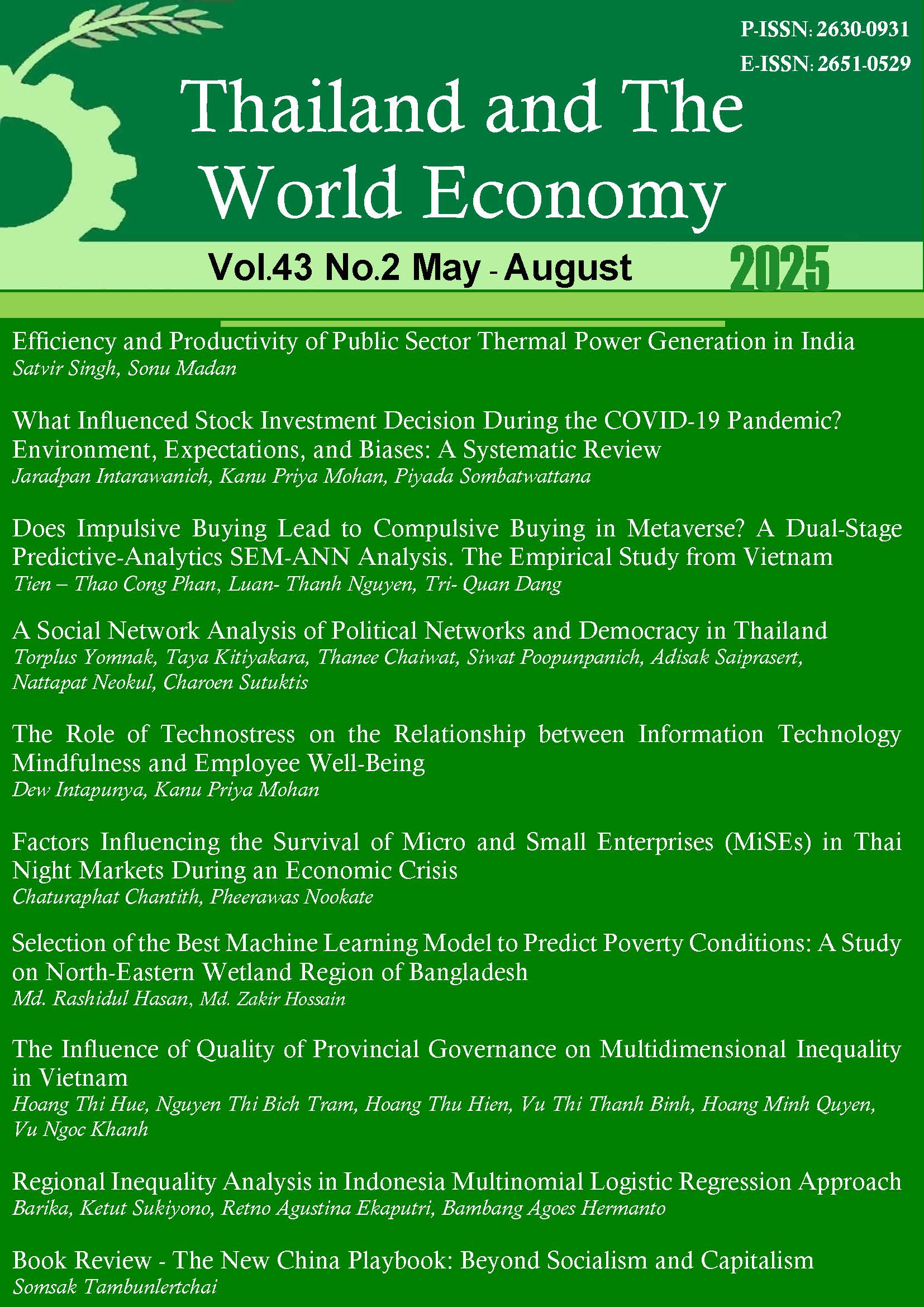
The Influence of Quality of Provincial Governance on Multidimensional Inequality in Vietnam
Keywords:
Atkinson inequality index, GMM, multidimensional inequality, quality of governanceAbstract
The study examines the influence of the quality of governance on multidimensional inequality in 63 Vietnamese provinces through the Viet Nam Provincial Governance and Public Administration Performance Index (PAPI) and the Vietnam Household Living Standard Survey (VHLSS) over 5 years (2012, 2014, 2016, 2018, and 2020). The article measures multidimensional inequality by the Atkinson inequality index through 4 dimensions: consumption, health, education, and housing, as suggested by Tsui (1995, 1999). Applying the Generalized Method of Moments (GMM), the result shows that the quality of governance has a negative effect on multidimensional inequality. From there, the study proposes recommendations to improve the quality of governance and reduce multidimensional inequality in Vietnam.
References
Akçay, S. (2006). Corruption and human development. Cato Journal, 26(1), 29-48.
Aluko, O. (2011). The effects of location and neighbourhood attributes on housing values in metropolitan Lagos. Ethiopian Journal of Environmental Studies and Management, 4(2), 69-82.
Atkinson, A. B., & Bourguignon, F. (1982). The comparison of multi-dimensioned distributions of economic status. The Review of Economic Studies, 49(2), 183-201.
Bahmani-Oskooee, M., & Maki-Nayeri, M. (2019). Asymmetric effects of policy uncertainty on domestic investment in G7 countries. Open Economies Review, 30(4), 675-693.
Bahmani‐Oskooee, M., & Xi, D. (2011). Economic uncertainty, monetary uncertainty and the demand for money in Australia. Australian Economic Papers, 50(4), 115-128.
Baloch, A., Noor, Z. M., Habibullah, M. S., & Bani, Y. (2017). The impact of gender equality on education inequality: A global analysis based on GMM dynamic panel estimation. International Journal of Economics and Management, 11(3), 691-714.
Brenner, N., & Theodore, N. (2002). Cities and the geographies of “actually existing neoliberalism”. Antipode, 34(3), 349-379.
Bui, A. T., Dungey, M., Nguyen, C. V., & Pham, T. P. (2014). The impact of natural disasters on household income, expenditure, poverty and inequality: Evidence from Vietnam. Applied Economics, 46(15), 1751-1766.
Bui, T. K. T., & Erreygers, G. (2020). Multidimensional inequality in Vietnam, 2002–2012. Economies, 8(2).
Caruso, R., & Baronchelli, A. (2013). Economic aspects of the complementarity between corruption and crime: Evidence from Italy in the period 1996–2005. International Journal of Monetary Economics and Finance, 6(2-3), 244-260.
Dalton, H. (1920). The measurement of the inequality of incomes. The Economic Journal, 30(119), 348-361.
Dang, Q. V. (2016). The impact of corruption on provincial development performance in Vietnam. Crime, Law and Social Change, 65(4-5), 325-350.
Danish, M. H., & Nawaz, S. M. N. (2022). Does institutional trust and governance matter for multidimensional well-being? Insights from Pakistan. World Development Perspectives, 25.
Decancq, K., & Lugo, M. A. (2009). Measuring inequality of well-being with a correltation-sensitive multidimensional Gini index. ECINEQ, Society for the Study of Economic Inequality (No. 124). Retrieved from https://www.ecineq.org/milano/WP/ECINEQ2009-124.pdf
Decancq, K., & Lugo, M. A. (2012). Inequality of wellbeing: A multidimensional approach. Economica, 79(316), 721-746.
Ferrara, A. R., & Nisticò, R. (2019). Does institutional quality matter for multidimensional well-being inequalities? Insights from Italy. Social Indicators Research, 145(3), 1063-1105.
Frey, B. S., & Stutzer, A. (2000). Happiness, economy and institutions. The Economic Journal, 110(466), 918-938.
Gallego, F. A. (2010). Historical origins of schooling: The role of democracy and political decentralization. The Review of Economics and Statistics, 92(2), 228-243.
Garedow, F. A. (2022). Political institutions and economic performance in Ethiopia: An auto regressive distributed lag bound approach to co-integration. Journal of Economics and Development, 24(1), 2-17.
Ghura, M. D. (1998). Tax revenue in Sub-Saharan Africa: Effects of economic policies and corruption. Retrieved from https://books.google.com.vn/
books?hl=vi&lr=&id=XFsYEAAAQBAJ&oi=fnd&pg=PA3&ots=PFFmT1dbSm&sig=UenS4b0sPzFhHFxIt7vpuT4PyD8&redir_esc=y#v=onepage&q&f=false
Giang, L. T., Nguyen, C. V., & Nguyen, H. Q. (2020). The impacts of economic growth and governance on migration: Evidence from Vietnam. The European Journal of Development Research, 32(4), 1195-1229.
González‐Benito, J., & González‐Benito, Ó. (2006). A review of determinant factors of environmental proactivity. Business Strategy and the Environment, 15(2), 87-102.
Gough, K. V., & Tran, H. A. (2009). Changing housing policy in Vietnam: Emerging inequalities in a residential area of Hanoi. Cities, 26(4), 175-186.
Gupta, H. V., Sorooshian, S., & Yapo, P. O. (1998). Toward improved calibration of hydrologic models: Multiple and noncommensurable measures of information. Water Resources Research, 34(4), 751-763.
Gupta, S., Davoodi, H. R., & Tiongson, E. (2000). Corruption and the provision of health care and education services. IMF Working Paper No. 116. Retrieved from https://www.imf.org/external/pubs/ft/wp/2000/wp00116.pdf.
Huque, A. S., & Zafarullah, H. (Eds.). (2017). International development governance. New York: Routledge.
Huther, J., & Shah, A. (1998). Applying a simple measure of good governance to the debate on fiscal decentralization. World Bank Policy Research Working Paper No.1894. Retrieved from https://documents1.worldbank.org/curated/fr/
/pdf/multi-page.pdf.
IGI Global (2020), What is Governance Quality?. Retrieved from: https://www.igi-global.com/dictionary/corporate-social-performance-and-governance-quality-across-the-brics-countries/93968
Kataeva, V. I., Kaurova, O. V., Koludarova, S. V., Sulyagina, J. O., Fomicheva, T. V., & Kryukova, E. M. (2015). Barriers of inequality in social institutions of Russia. Biosciences Biotechnology Research Asia, 12(3), 2813-2820.
Kaufmann, D., Kraay, A., & Mastruzzi, M. (2003). Governance matters III: Governance indicators for 1996-2002. World Bank Policy Research Working Paper No. 3106. Retrieved from https://openknowledge.worldbank.org/server/api/core/bitstreams/
fe7c8a73-4ab0-5e4f-9640-8bfaf5c91e4d/content.
Kien, V. D., Van Minh, H., Giang, K. B., Weinehall, L., & Ng, N. (2014). Horizontal inequity in public health care service utilization for non-communicable diseases in urban Vietnam. Global Health Action, 7(1).
Klomp, J., & De Haan, J. (2008). Effects of governance on health: A cross‐national analysis of 101 countries. Kyklos, 61(4), 599-614.
Kolm, S. C. (1977). Multidimensional egalitarianisms. The Quarterly Journal of Economics, 91(1), 1-13.
Lambert, P. (2001). Horizontal inequity comparisons. Social Choice and Welfare, 18(4), 799-816.
Lee, J., & Zhu, Y. P. (2006). Urban governance, neoliberalism and housing reform in China. The Pacific Review, 19(1), 39-61.
MDRI (2020). Báo cáo nghiên cứu: Bất bình đẳng đa chiều tại Việt Nam. [Research Report: Multidimensional inequality in Vietnam]. Retrieved from https://oi-files-cng-v2-prod.s3.eu-west-2.amazonaws.com/vietnam.oxfam.org/s3fs-public/
file_attachments/OXFAM%20RESEARCH%20REPORT%20-%20EN%20%28Final%29.pdf.
Mingat, A., & Tan, J. P. (1998). The mechanics of progress in education: Evidence from cross-country data. World Bank Publications No 2015. Retrieved from https://documents1.worldbank.org/curated/ru/992721468741368498/105505322_20041117162511/additional/multi-page.pdf
Mohammed, U. (2022). Remittances, institutions and human development in Sub-Saharan Africa. Journal of Economics and Development, 24(2), 142-157.
Muller, C., & Trannoy, A. (2012). Multidimensional inequality comparisons: A compensation perspective. Journal of Economic Theory, 147(4), 1427-1449.
Narayan, D. (2000). Voices of the poor: Can anyone hear us?. World Bank No 20246. Retrieved from https://docs.adaptdev.info/lib/L9HXD3SC.
Nguyen, T. V., Bach, T. N., Le, T. Q., & Le, C. Q. (2017). Local governance, corruption, and public service quality: Evidence from a national survey in Vietnam. International Journal of Public Sector Management, 30(2), 137-153.
Nifo, A., & Vecchione, G. (2014). Do institutions play a role in skilled migration? The case of Italy. Regional studies, 48(10), 1628-1649.
Rajkumar, A. S., & Swaroop, V. (2008). Public spending and outcomes: Does governance matter?. Journal of development economics, 86(1), 96-111.
Rose-Ackerman, S. (1997). The political economy of corruption. Corruption and the Global Economy, 31(60).
Saǧlam, B. B. (2021). Educational inequality versus income inequality: An empirical investigation. The Economic and Social Review, 52(3), 269-299.
Sen, A. (1973). On economic inequality. Oxford: Clarendon Press
Sen, A. (1985). Commmodities and capabilities. North-Holland: Oxford University Press.
Sen, A. (1993). Capability and well-being73. The Quality of Life, 30, 270-293.
Sen, A. (1997). From income inequality to economic inequality. Southern Economic Journal, 64(2), 383-401.
Sudsawasd, S., & Charoensedtasin, T. (2015). Trade liberalisation and income inequality in Thailand: A household-level analysis. Thammasat Economic Journal, 33(1), 24-75.
Tran, T. N. M., & Pasquier-Doumer, L. (2019). Full-day schooling and educational inequality in Vietnam. The Journal of Development Studies, 55(5), 786-804.
Tsui, K. Y. (1995). Multidimensional generalizations of the relative and absolute inequality indices: The Atkinson-Kolm-Sen approach. Journal of Economic Theory, 67(1), 251-265.
Tsui, K. Y. (1999). Multidimensional inequality and multidimensional generalized entropy measures: An axiomatic derivation. Social Choice and Welfare, 16(1), 145-157.
UNDP (1997). Governance for sustainable human development: A UNDP policy document. Retrieved from https://digitallibrary.un.org/record/492551?v=pdf
Van Phan, P., & O’Brien, M. (2019). Multidimensional wellbeing inequality in a developing country: A case study of Vietnam. Social Indicators Research, 145, 157-183.
Varlamova, J., & Larionova, N. (2015). Macroeconomic and demographic determinants of household expenditures in OECD countries. Procedia Economics and Finance, 24, 727-733.
World Bank (1989). Sub-Saharan Africa: From crisis to sustainable growth. Retrieved from https://documents1.worldbank.org/curated/en/498241468742846138/pdf/multi0page.pdf.
World Bank (1992). Governance and development. Retrieved from https://documents1.worldbank.org/curated/en/604951468739447676/pdf/Governance-and-development.pdf
Yusuf, A. A., Sumner, A., & Rum, I. A. (2014). Twenty years of expenditure inequality in Indonesia, 1993–2013. Bulletin of Indonesian Economic Studies, 50(2), 243-254.
Downloads
Published
How to Cite
Issue
Section
Categories
License
Copyright (c) 2025 Thailand and The World Economy

This work is licensed under a Creative Commons Attribution-NonCommercial-NoDerivatives 4.0 International License.