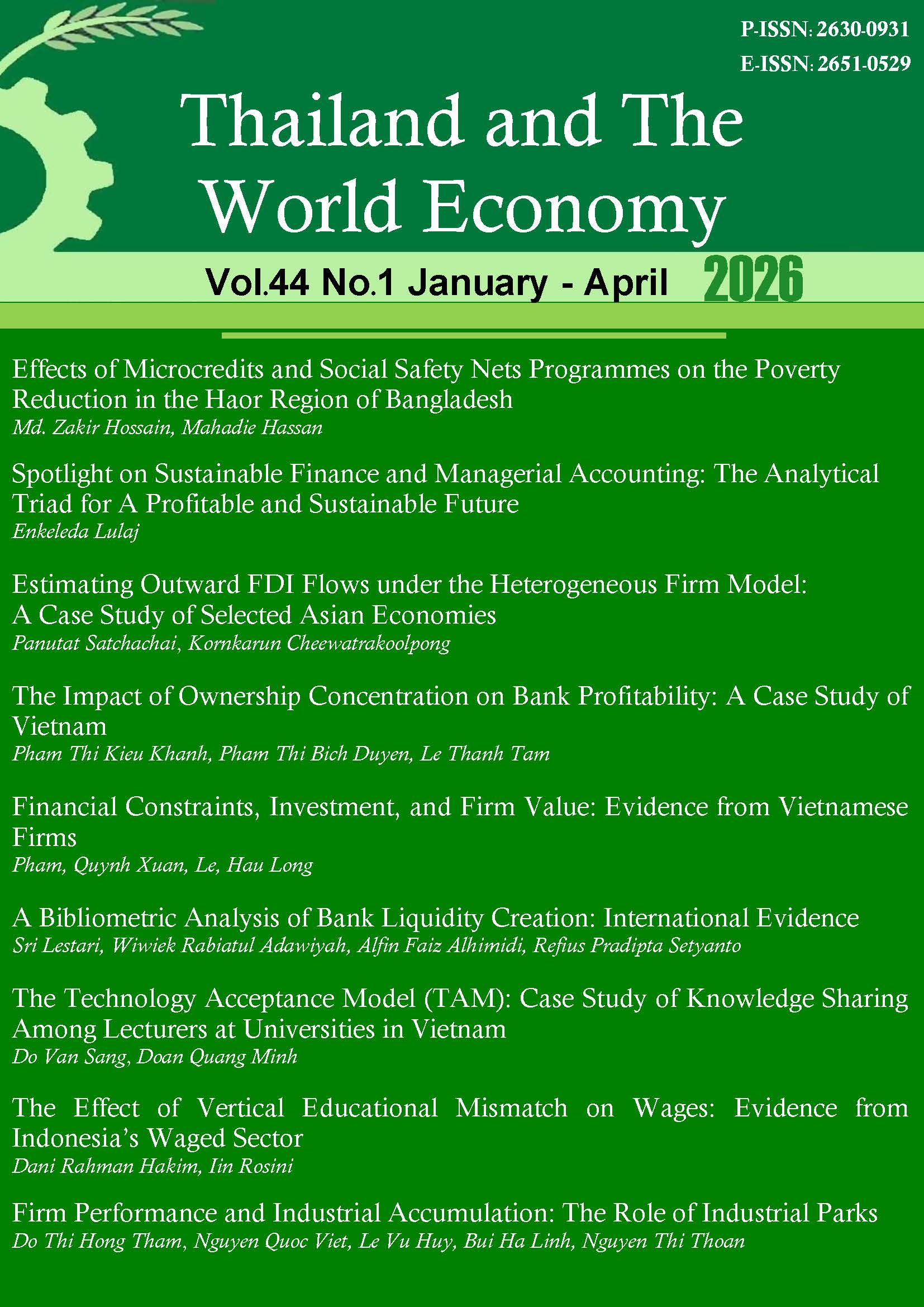
Spotlight on Sustainable Finance and Managerial Accounting: The Analytical Triad for A Profitable and Sustainable Future
Keywords:
Sustainable Finance, Management Accounting, Profitability, Sustainable Future, Analytical Triad, Cost Analysis, value supply Chain Analysis, Continuous Improvement Analysis, Structural Equation ModellingAbstract
This study, focused on sustainable finance and management accounting, explores the analytical triad of vsCHA (Value and Supply Chain Analysis), COA (Cost Analysis), and CIA (Continuous Improvement Analysis), examining their interactions and their impact on firm sustainability. Data were collected from 208 companies in Kosovo between 2021 and 2023 and analyzed using exploratory factor analysis (EFA), confirmatory factor analysis (CFA), and structural equation modeling (SEM) with SPSS (64-bit) and AMOS (26.0) software. The results validate the analytical triad of vsCHA, COA, and CIA as a reliable model for enhancing sustainable finance and management accounting, promoting both profitability and long-term sustainability. Significant positive relationships were found between vsCHA and COA, and between CIA and COA, with COA acting as a mediator. The study confirms that vsCHA aids in identifying market trends, optimizing supply chains, and guiding innovation, while CIA helps maintain competitive advantage, boost sales, and improve efficiency. COA facilitates the implementation of competitive practices, ensuring sustainable business practices. Ultimately, the findings highlight the direct and positive impact of vsCHA, COA, and CIA on firm sustainability, driving efficiency, cost optimization, and continuous improvement. Future research should explore the global application of this triad.
References
Abouzid, I., & Saidi, R. (2023). Digital twin implementation approach in supply chain processes. Scientific African, 21.
Adejumo, A. V., Adejumo, O. O., & Efobi, U. R. (2022). Finance schemes and small business development in Nigeria. In E. Osabuohien, G. Odularu, D. Ufua & R. Osabohien (eds), Advances in small business finance and management (pp. 201–220). Emerald Group Publishing Limited.
Adıgüzel, H. (2023). Increasing the efficiency of delivery operations and customer profitability analysis with a time-driven activity-based costing model. Emerald Emerging Markets Case Studies. Advance online publication,1-17.
Ahmad, M., Wu, Q., & Khattak, M. S. (2023). Intellectual capital, corporate social responsibility and sustainable competitive performance of small and medium-sized enterprises: Mediating effects of organizational innovation. Kybernetes, 52(10), 4014–4040.
Alamelu, R., Jayanthi, M., Dinesh, S., Nalini, R., Shobhana, N., & Amudha, R. (2023). Sustainable supply chain and circular economy ingenuities in small manufacturing firms – A stimulus for sustainable development. Materials Today: Proceedings, 92(Part 1), 17–23.
Alfon, I., & Andrews, P. (1999). Cost‐benefit analysis in financial regulation: How to do it and how it adds value. Journal of Financial Regulation and Compliance, 7(4), 339–352.
Ali, A. J., Islam, A., & Howe, L. P. (2013). A study of sustainability of continuous improvement in the manufacturing industries in Malaysia: Organizational self‐assessment as a mediator. Management of Environmental Quality: An International Journal, 24(3), 408–426.
Arsawan, W. E., Koval, V., Suhartanto, D., Babachenko, L., Kapranova, L., & Suryantini, N. P. S. (2023). Invigorating supply chain performance in small medium enterprises: exploring knowledge sharing as moderator. Business, Management and Economics Engineering, 21(1), 1–18.
Azadda, W. N., Koomson, S., & Klutse, S. K. (2024). Sustainable finance and business risk resilience: A conceptual perspective and suggestions for upcoming research. VILAKSHAN - XIMB Journal of Management, 21(1), 66–78.
Bednářová, M., Tesařová, M., & Šimberová, I. (2023). The evolution of digital transformation in SMEs in the manufacturing industry in the different blocks of the BM Canvas since the beginning of the pandemic. Business, Management and Economics Engineering, 21(1), 48–62.
Bischoff, P., Hogreve, J., Elgeti, L., & Kleinaltenkamp, M. (2023). How salespeople adapt communication of customer value propositions in business markets. Industrial Marketing Management, 114, 226-242,
Bodendorf, F., Lutz, M., Michelberger, S., & Franke, J. (2022). An empirical investigation into intelligent cost analysis in purchasing. Supply Chain Management, 27(6), 785-808.
Cano, J. A., Londoño-Pineda, A. A., Campo, E. A., & Fernández, S. A. (2023). Sustainable business models of e-marketplaces: An analysis from the consumer perspective. Journal of Open Innovation: Technology, Market, and Complexity, 9 (3).
Carraresi, L., & Bröring, S. (2021). How does business model redesign foster resilience in emerging circular value chains?. Journal of Cleaner Production, 289.
Chatzipetrou, E., & Moschidis, O. (2018). A multidimensional longitudinal meta-analysis of quality costing research. International Journal of Quality & Reliability Management, 35(2), 405-429.
Chen, Me., Tang, X., Liu, H., & Gu, J. (2023). The impact of supply chain concentration on integration and business performance. International Journal of Production Economics, 257.
Delias, P., & Nguyen, G., TH. (2021). Prototyping a business process improvement plan. An evidence-based approach. Information Systems, 101.
Dunk, A. S. (2012). Assessing the contribution of product life cycle cost analysis, customer involvement, and cost management to the competitive advantage of firms. In M. J. Epstein & J. Y. Lee (Eds.), Advances in Management Accounting (Vol. 20, pp. 211–226). Emerald Group Publishing Limited.
Elia, G., Raguseo, G., Solazzo, G., & Pigni, F. (2022). Strategic business value from big data analytics: An empirical analysis of the mediating effects of value creation mechanisms. Information & Management, 59(8).
Endenich, C., Hoffjan, A., Schlichting, T., & Trapp, R. (2016). Harmonizing management accounting in international subsidiaries: Beyond national borders. Journal of Business Strategy, 37 (1), 27-33.
Ershadi, M.J., Najafi, N. & Soleimani, P. (2019). Measuring the impact of soft and hard total quality management factors on customer behavior based on the role of innovation and continuous improvement. The TQM Journal, 31(6), 1093-1115.
Feng, T., Yang, Sh., & Sheng, H. (2022). Supply chain integration and novelty-centered business model design: An organizational learning perspective. European Management Journal, 42(3), 414-424.
Franzò, S., & Urbinati, A. (2023). Managing resource loops in circular supply chains: A taxonomy of multi-sided platforms in the B2B setting. Industrial Marketing Management, 115, 185-197.
Glémain, P. (2011). The strategy and fundamentals of sustainable finance serving sustainable development. In W. Sun, C. Louche & R. Pérez (eds), Critical Studies on Corporate Responsibility, Governance and Sustainability
Finance and Sustainability: Towards a New Paradigm? A Post-Crisis Agenda (pp. 187-209). Emerald Group Publishing Limited, Bingley,.
Gonzalez, R.V.D. & Martins, M.F. (2016). Capability for continuous improvement: Analysis of companies from automotive and capital goods industries. The TQM Journal, 28 (2), 250-274.
Guerreiro, R., Rodrigues Bio, S., &Vazquez Villamor Merschmann, E. (2008). Cost‐to‐serve measurement and customer profitability analysis. The International Journal of Logistics Management, 19 (3), 389-407.
Guinot, J., Sinn, J. W., Badar, M. A., & Ulmer, J. M. (2017). Cost consequence of failure in failure mode and effect analysis. International Journal of Quality & Reliability Management, 34(8), 1318–1342.
Hariyati, H., Tjahjadi, B., & Soewarno, N. (2019). The mediating effect of intellectual capital, management accounting information systems, internal process performance, and customer performance. International Journal of Productivity and Performance Management, 68 (7), 1250-1271.
Hasan, M. M., Nekmahmud, M., Lu, Y., & Patwary, M. A. (2019). Green business value chain: A systematic review. Sustainable Production and Consumption, 20, 326–339.
Herzberg, R., Trebbin, A., & Schneider, F. (2023). Product specifications and business practices as food loss drivers – A case study of a retailer's upstream fruit and vegetable supply chains. Journal of Cleaner Production, 417.
Hiebl, M., R., W. (2013). Management accounting in the family business: tipping the balance for survival. Journal of Business Strategy, 34 (6), 19-25.
Hoch, J. S., & Chaussé, P. (2018). Econometric considerations when using the net benefit regression framework to conduct cost-effectiveness analysis. In Health Econometrics (Contributions to Economic Analysis(Vol. 294). Emerald Group Publishing Limited.
Hohan, A. I., Olaru, M., & Pirnea, I. C. (2015). Assessment and continuous improvement of information security based on TQM and business excellence principles. Procedia Economics and Finance, 32, 352–359.
Holma, A.M. (2014). Adaptation in business contexts: Working triadic relationships. In Deep Knowledge of B2B Relationships within and across Borders (Advances in Business Marketing and Purchasing, Vol. 20, pp. 119-291). Emerald Group Publishing Limited.
Hristov, I., Cristofaro, M., & Cimini, R. (2023). Non-financial resources to enhance companies’ profitability: A stakeholder perspective. Management Research Review, 47(13), 22-50.
Hussain, S., Rasheed, A., & Rehman, S.u. (2023). Driving sustainable growth: exploring the link between financial innovation, green finance and sustainability performance: Banking evidence. Kybernetes, 53(11), 4678-4696.
Ibrahim, A., Rundle-Thiele, S., Knox, K., & Almestarihi, R. (2022). The relative merit of two segmentation approaches: Executives views and a cost-benefit analysis. Journal of Social Marketing, 12(4), 607-622.
Khodabakhshi, M., & Ahmadi, M. (2022). An approach to cost-benefit analysis by competitive advantages with stochastic data. Journal of Modelling in Management, 17 (1), 297-308.
Kocaoglu, B., & A. Zafer Acar. (2015). Developing an ERP triggered business process improvement cycle from a case company. Procedia-Social and Behavioral Sciences, 181, 107-114.
Lam, M., O'Donnell, M., & Robertson, D. (2015). Achieving employee commitment for continuous improvement initiatives. International Journal of Operations & Production Management, 35 (2), 201-215.
Lee, H. (2004). The role of competence‐based trust and organizational identification in continuous improvement. Journal of Managerial Psychology, 19 (6), 623-639.
Li, X., & Hu, J. (2012). Business impact analysis based on supply chain's knowledge sharing ability. Procedia Environmental Sciences, 12(Part B), 1302-1307.
Lin, J., Lin, Sh., Benitez, J., Luo, X., R., & Ajamieh, A. (2023). How to build supply chain resilience: The role of fit mechanisms between digitally-driven business capability and supply chain governance. Information & Management, 60(2),
Lulaj, E. (2021). Accounting, reforms and budget responsibilities in the financial statements. Accounting and Finance, 91(1), 61–69.
Lulaj, E. (2021). Quality and reflecting of financial position: an enterprises model through logistic regression and natural logarithm. Journal of Economic Development, Environment and People, 10(1), 26–50.
Lulaj, E. (2023). A sustainable business profit through customers and its impacts on three key business domains: Technology, innovation, and service (TIS). Business, Management and Economics Engineering, 21(1), 19–47.
Lulaj, E. (2025). Penny-Wise Acumen in costonomics: transforming costs into entrepreneurial gold through smart financial management. Journal of Risk and Financial Management, 18(1).
Lulaj, E., & Iseni. E. (2018). Role of analysis CVP (Cost-Volume-Profit) as an important indicator for planning and making decisions in the business environment. European Journal of Economics and Business Studies, 4(2),99-114.
Lulaj, E., & Minguez-Vera, A. (2024). Cash flow dynamics: amplifying swing models in a volatile economic climate for financial resilience and outcomes. Scientific Annals of Economics and Business, 71(3), 315–336
Lulaj, E., Dragusha, B., & Hysa, E. (2023). Investigating accounting factors through audited financial statements in businesses toward a circular economy: Why a sustainable profit through qualified staff and investment in technology? Administrative Science, 13(3).
Lulaj, E., Dragusha, B., & Lulaj, D. (2024a). Market mavericks in emerging economies: redefining sales velocity and profit surge in today’s dynamic business environment. Journal of Risk and Financial Management, 17(9).
Lulaj, E., Dragusha, B., Hysa, E., & Voica, M. C. (2024c). Synergizing sustainability and financial prosperity: unravelling the structure of business profit growth through consumer-centric strategies—the cases of Kosovo and Albania. International Journal of Financial Studies, 12(2).
Lulaj, E., Gopalakrishnan, A., Kehinde Lamidi, K. (2025). Financing and investing in women-led businesses: understanding strategic profits and entrepreneurial expectations by analysing the factors that determine their company success. Periodica Polytechnica Social and Management Sciences, 33(1), 59–75.
Lulaj, E., Hysa, E., & Panait, M. (2024b). Does digitalization drive sustainable transformation in finance and accounting?. Kybernetes, ahead-of-print (ahead-of-print).
Maiga, A. S. (2015). Information systems integration and firm profitability: Mediating effect of cost management strategy. In Advances in management accounting (Vol. 25, pp. 95–114). Emerald Group Publishing Limited.
Mburayi, L., & Wall, T. (2018). Sustainability in the professional accounting and finance curriculum: An exploration. Higher Education, Skills and Work-Based Learning, 8 (3), 291-311.
McWilliam, S., E., Kim, J., K., Mudambi, R., & Nielsen, B., B. (2020). Global value chain governance: Intersections with international business. Journal of World Business, 55(4).
Meng, Sh., & Wu, X. (2023). Risk analysis of cruise ship supply chain based on the set pair analysis-Markov chain model. Ocean & Coastal Management, 245.
Meyer, B., H., Prescott, B., C., Sheng, & X., SH. (2023). The impact of supply chain disruptions on business expectations during the pandemic. Energy Economics, 126.
Miemczyk, J., Johnsen, T. E., & Macquet, M. (2012). Sustainable purchasing and supply management: A structured literature review of definitions and measures at the dyad, chain, and network levels. Supply Chain Management, 17(5), 478-496.
Moskvina, J., Hanea, A., Vedlūga, T., & Mockevičienė, B. (2024). Frugal innovation as intersection between complexity of early cost estimation, machine learning and expert-based decision system. In B. Mockevičienė (Ed.), Participation Based Intelligent Manufacturing: Customisation, Costs, and Engagement (Chapter 6). Emerald Group Publishing Limited.
Mouzas, S., & Bauer, F. (2022). Rethinking business performance in global value chains. Journal of Business Research, 144, 679-689,
Naeem, M.A., Karim, S., Rabbani, M.R., Bashar, A., & Kumar, S. (2023). Current state and future directions of green and sustainable finance: A bibliometric analysis. Qualitative Research in Financial Markets, 15 (4), 608-629.
Negi, P., & Jaiswal, A. (2024). Sustainable bonds as a sustainable financial instrument: Thematic insights and future prospects. Qualitative Research in Financial Markets, ahead-of-print(ahead-of-print).
Nielsen, S. (2018). Reflections on the applicability of business analytics for management accounting – and future perspectives for the accountant. Journal of Accounting & Organizational Change, 14 (2), 167-187.
Nilsson-Witell, L., Antoni, M., & Dahlgaard, J. J. (2005). Continuous improvement in product development: Improvement programs and quality principles. International Journal of Quality & Reliability Management, 22(8), 753-768.
Nilsson‐Witell, L., Antoni, M., & Dahlgaard, J., J. (2005). Continuous improvement in product development: Improvement programs and quality principles. International Journal of Quality & Reliability Management, 22 (8), 753-768.
Oesterreich, Th. D., Anton, E., & Teuteberg, F. (2022). What translates big data into business value? A meta-analysis of the impacts of business analytics on firm performance. Information & Management, 59(6).
Ojasalo, J. (2001). Key account management at company and individual levels in business‐to‐business relationships. Journal of Business & Industrial Marketing, 16 (3), 199-220.
Omotayo, T.S., Boateng, P., Osobajo, O., Oke, A., & Obi, L.I. (2020). Systems thinking and CMM for continuous improvement in the construction industry. International Journal of Productivity and Performance Management, 69 (2), 271-296.
Oprime, P. C., Henrique de Sousa Mendes, G., & Lopes Pimenta, M. (2012). Continuous improvement: Critical factors in Brazilian industrial companies. International Journal of Productivity and Performance Management, 61(1), 69-92.
Ozili, P.K. (2023). Assessing global interest in decentralized finance, embedded finance, open finance, ocean finance and sustainable finance. Asian Journal of Economics and Banking, 7 (2), 197-216.
Patil, R.B., Kothavale, B.S., Waghmode, L.Y., & Pecht, M. (2021). Life cycle cost analysis of a computerized numerical control machine tool: A case study from Indian manufacturing industry. Journal of Quality in Maintenance Engineering, 27(1), 107-128.
Ramos, E., Dien, S., Gonzales, A., Chavez, M., & Hazen, B. (2021). Supply chain cost research: A bibliometric mapping perspective. Benchmarking: An International Journal, 28(3), 1083-1100.
Raza, S. A., Govindaluri, S. M., & Bhutta, M. K. (2023). Research themes in machine learning applications in supply chain management using bibliometric analysis tools. Benchmarking: An International Journal, 30(3), 834-867.
Riglietti, F. G. (2022). Business continuity management as a key enabler of supply chain resilience: A conceptual paper. IFAC-PapersOnLine, 55(10), 2197–2202.
Root, J. (2007). Film noir. In P. Cook (Ed.), The cinema book (3rd ed., pp. 305–315). London, England: British Film Institute.
Roslender, R., Hart, S., & Nielsen, C. (2023). Strategic management accounting revisited: Building on insights from the business model field. Journal of Accounting & Organizational Change, 20(1), 1-20.
Rukanova, B., Engelenburg, S. V., Ubacht, J., Tan, Y. T., Geurts, M., Sies, M., Molenhuis, M., Slegt, M., & Dijk, D. V. (2023). Public value creation through voluntary business to government information sharing enabled by digital infrastructure innovations: A framework for analysis. Government Information Quarterly, 40(2).
Saidane, D., & Ben Abdallah, S. (2021). Sustainable finance: Concepts, analyses and perspectives. In D.Bourghelle, R. Pérez & P. Rozin (Eds), Rethinking finance in the face of new challenges (Vol. 15, pp. 181-192). Emerald Group Publishing Limited. https://doi.org/10.1108/S2043-9059202115
Sakib, M. N., Kawsar, M., & Bithee, M. M. (2025). Continuous improvement through Lean Six Sigma: A systematic literature review and bibliometric analysis. International Journal of Lean Six Sigma, 16(5), 1252-1275.
https://doi.org/10.1108/IJLSS-08-2024-0173
Sakthivel, S. (2023). A critical review of cost-benefit analysis for business software investments. American Journal of Business, 38 (4), 229-247.
Samaranayake, P., McLean, M. W., & Weerabahu, S. K. (2024). Application of lean and quality improvement methods for improving operational performance in coal supply chains: A case study. International Journal of Quality & Reliability Management, 41(6), 1594-1622.
Schilling, L., & Seuring, S. (2023). Mobile financial service-enabled micro-businesses driving sustainable value creation in emerging markets. Technological Forecasting and Social Change, 192.
Schneider, M., Hendrichs, H., & Hoffmann. V., H. (2010). Navigating the global carbon market: An analysis of the CDM's value chain and prevalent business models. Energy Policy, 38 (1), 277-287.
Seiler, C. A., & Papanagnou, P. S. (2020). On the relationship between financial performance and position of businesses in supply chain networks. International Journal of Production Economics, 227.
Senftlechner, D., & Hiebl, M.R.W. (2015). Management accounting and management control in family businesses: Past accomplishments and future opportunities. Journal of Accounting & Organizational Change, 11(4), 573-606.
Settanni, E., & Emblemsvåg, J. (2010). Applying a non‐deterministic conceptual life cycle costing model to manufacturing processes. Journal of Modelling in Management, 5(3), 220-262.
Shah, A., Rose, C., Ibrahim, A., Khan, S. A. R., & Tanveer, M. (2023). A resource and leagile strategy in business operations for performance improvement. Decision Analytics Journal, 7.
Shamsuddoha, M. (2015). Integrated supply chain model for sustainable manufacturing: A system dynamics approach. In Sustaining competitive advantage via business intelligence, knowledge management, and system dynamics (Advances in Business Marketing and Purchasing, Vol. 22B, pp. 155-399). Emerald Group Publishing Limited.
Sharma, A. K., Srivastava, M. K., & Sharma, R. (2024). Exposition of techno-functional components of intelligent food supply chain: A review and future research agenda. Journal of Business & Industrial Marketing, 39(9), 1928-1949.
Silvi, R., & Cuganesan, S. (2006). Investigating the management of knowledge for competitive advantage: A strategic cost management perspective. Journal of Intellectual Capital, 7(3), 309-323.
Teichmann, F.M.J., Boticiu, S.R., & Sergi, B.S. (2023). Compliance concerns in sustainable finance: An analysis of peer-to-peer (P2P) lending platforms and sustainability. Journal of Financial Crime, 31 (4), 993-1001.
Umar, U. H., & Al-Faryan, M. A. S. (2024). The impact of working capital management on the profitability of listed halal food and beverage companies. Managerial Finance, 50(3), 534–557
Uriona Maldonado, M., Leusin, M. E., Bernardes, T. C. d. A., & Vaz, C. R. (2020). Similarities and differences between business process management and lean management. Business Process Management Journal, 26(7), 1807-1831.
van Raaij, E.M. (2005). The strategic value of customer profitability analysis. Marketing Intelligence & Planning, 23(4), 372-381.
Wang, Zh., Wei, Sh., J., Yu, X., & Zhu, K. (2022). Global value chains over business cycles. Journal of International Money and Finance, 126.
Wankhede, V. A., & Agrawal, R. (2025). Unveiling the nexus of Industry 4.0 and Lean Six Sigma for sustainable development: Insights from bibliometric and structural topic modeling analysis. International Journal of Lean Six Sigma, ahead-of-print(ahead-of-print).
Wei, Sh., Xu, W., Guo, X., & Chen, X. (2023). How does business-IT alignment influence supply chain resilience? Information & Management, 60(6).
Wickramasinghe, V., & Chathurani, M.N. (2021). Effects of continuous improvement in streamlining HRM practices. Business Process Management Journal, 27 (3), 883-900.
Wolf, T., Kuttner, M., Feldbauer-Durstmüller, B., & Mitter, C. (2020). What we know about management accountants’ changing identities and roles – a systematic literature review. Journal of Accounting & Organizational Change, 16(3), 311-347.
Wouters, M., & Morales, S. (2014). The contemporary art of cost management methods during product development. In Advances in management accounting (Vol. 24, pp. 201–220). Emerald Group Publishing Limited.
Yuen, K., F., Thai, V., V., & Wong, Y., D. (2016). The effect of continuous improvement capacity on the relationship between of corporate social performance and business performance in maritime transport in Singapore. Transportation Research Part E: Logistics and Transportation Review, 95, 62-75,
Zailani, S., Rahman, M.K., Nizamani, A.H., Aziz, A.A., Bhuiyan, M.A., & Gazi, M.A.I. (2023). Sustainable supply chain performance lesson from Malaysian manufacturing firms. Foresight, 26(2), 205-224.
Zighan, S., & Ruel, S. (2023). SMEs’ resilience from continuous improvement lenses. Journal of Entrepreneurship in Emerging Economies, 15(2), 233-253.
Zimmermann, R., Ferreira, L., M., & Moreira, A., C. (2020). How supply chain strategies moderate the relationship between innovation capabilities and business performance. Journal of Purchasing and Supply Management, 26(5).
Downloads
Published
How to Cite
License
Copyright (c) 2025 Thailand and The World Economy

This work is licensed under a Creative Commons Attribution-NonCommercial-NoDerivatives 4.0 International License.