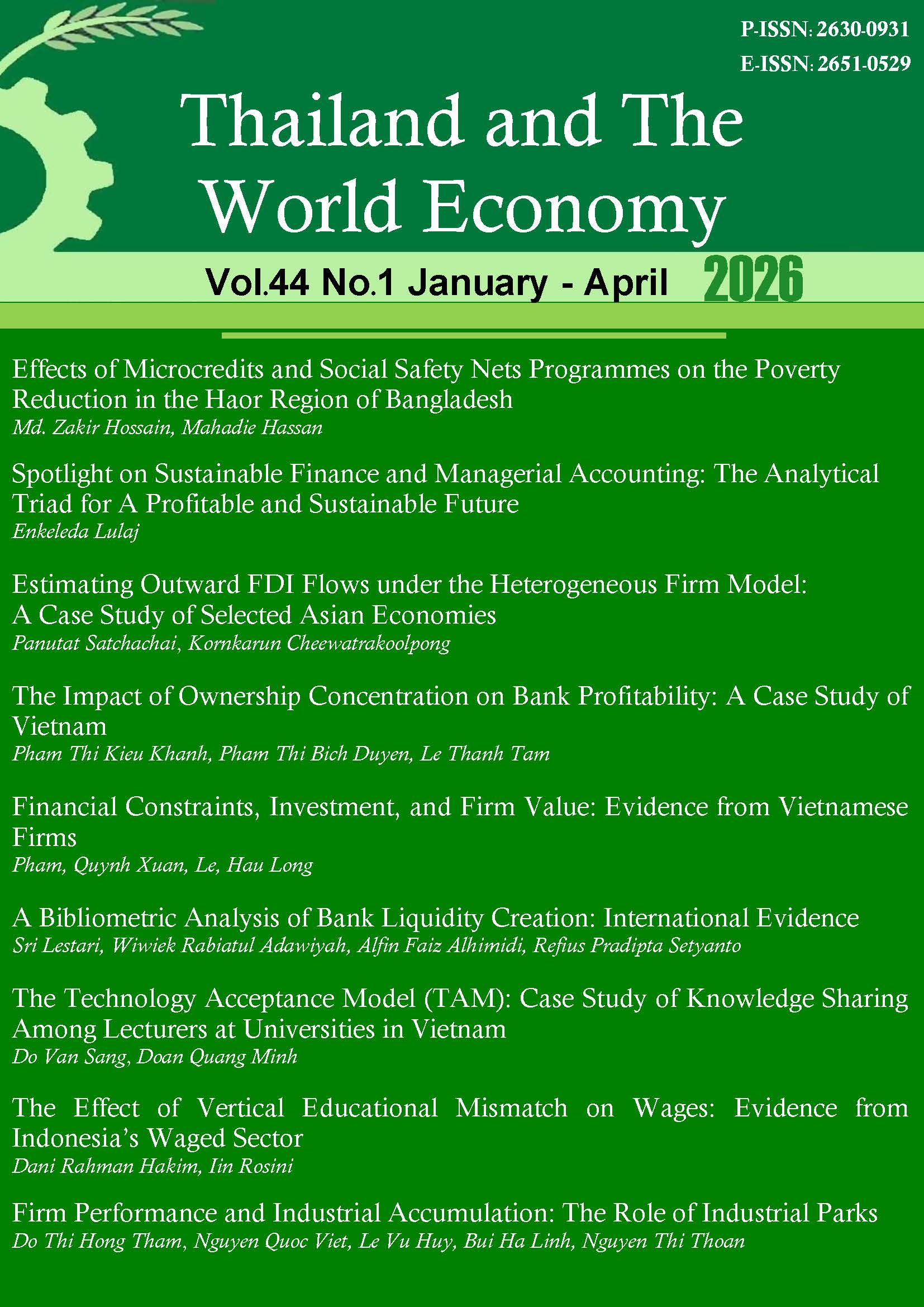
Financial Constraints, Investment, and Firm Value: Evidence from Vietnamese Firms
Keywords:
Financial Constraints, Firm Investment, Firm Value, Optimal InvestmentAbstract
In an imperfect capital market, firms face financial constraints due to information asymmetry. These constraints have a significant impact on the effectiveness of investment decisions. When either an underinvestment or overinvestment process occurs, it directly affects the firm's value. This study aims to examine the quadratic relationship between investment and firm value, specifically within the context of financial constraints. Our analysis is based on a dataset comprising 269 Vietnamese non-financial firms listed on the Ho Chi Minh City Stock Exchange (HOSE) from 2013 to 2022, resulting in a total of 2,690 firm-year observations. After checking the stationarity of panel data, three estimation methods are OLS, REM, and FEM tested in turn, and finally, the GLS method is applied to deal with the heteroskedasticity problem. The results indicate a quadratic relationship between investment and firm value, suggesting the presence of an optimal investment level. Notably, the optimal level varies depending on the firm's degree of financial constraints. Firms with fewer financial constraints tend to have a higher optimal investment level compared to those with greater financial constraints.
References
Altaf, N., & Shah, F. A. (2018). Investment and financial constraints in Indian firms: Does working capital smoothen fixed investment?. Decision, 45, 43-58.
Ater, D. (2017). Capital structure and firm value of non-financial firms listed at the Nairobi securities exchange. Research Journal of Finance and Accounting, 8(4), 18-22.
Ben Naceur, S., Goaied, M., & Belanes, A. (2006). On the determinants and dynamics of dividend policy. International Review of Finance, 6(1‐2), 1-23.
Bhagat, S., Moyen, N., & Suh, I. (2005). Investment and internal funds of distressed firms. Journal of Corporate Finance, 11(3), 449-472.
Breitung, J. (2001). The local power of some unit root tests for panel data. In B.H. Baltagi.,T.B. Fomby, & R.C. Hill (Eds.), Nonstationary panels, panel cointegration, and dynamic panels (pp. 161-177). West Yorkshire, England: Emerald Group Publishing Limited.
Burton, B. M., Lonie, A. A., & Power, D. M. (1999). The stock market reaction to investment announcements: The case of individual capital expenditure projects. Journal of Business finance & Accounting, 26(5‐6), 681-708.
Chen, S.-S., & Ho, K. W. (1997). Market response to product-strategy and capital-expenditure announcements in Singapore: Investment opportunities and free cash flow. Financial Management, 26(3) , 82-88.
Cleary, S. (1999). The relationship between firm investment and financial status. The Journal of Finance, 54(2), 673-692.
Del Brio, E., De Miguel, A., & Pindado, J. (2003). Investment and firm value: An analysis using panel data. Applied Financial Economics, 13(12), 913-923.
Devereux, M., & Schiantarelli, F. (1990). Investment, financial factors, and cash flow: Evidence from UK panel data. In R.G. Hubbard (Ed.), Asymmetric information, corporate finance, and investment (pp. 279-306). Chicago, Lllinois, USA: University of Chicago Press.
Farooq, M. A., & Masood, A. (2016). Impact of financial leverage on value of firms: Evidence from cement sector of Pakistan. Research Journal of Finance and Accounting, 7(9), 73-77.
Farooq, S., Ahmed, S., & Saleem, K. (2015). Overinvestment, growth opportunities and firm performance: Evidence from Singapore stock market. Corporate Ownership & Control, 12(3), 454-467.
Fazzari, S., Hubbard, R. G., & Petersen, B. C. (1987). Financing constraints and corporate investment. National Bureau of Economic Research Working Paper No.2387. Cambridge, Massachusetts, United States of America. Retrieved from https://www.nber.org/system/files/working_papers/w2387/w2387.pdf
Fu, F. (2010). Overinvestment and the operating performance of SEO firms. Financial Management, 39(1), 249-272.
Guariglia, A., & Yang, J. (2016). A balancing act: Managing financial constraints and agency costs to minimize investment inefficiency in the Chinese market. Journal of Corporate Finance, 36, 111-130.
Guizani, M., & Ajmi, A. N. (2021). Financial conditions, financial constraints and investment-cash flow sensitivity: Evidence from Saudi Arabia. Journal of Economic and Administrative Sciences, 37(4), 763-784.
Gujarati, D. N. (2008). Basic Econometrics (5th Edition). United States: McGraw-Hill Education.
Hovakimian, G., & Titman, S. (2003). Corporate investment with financial constraints: Sensitivity of investment to funds from voluntary asset sales. National Bureau of Economic Research Working Paper No. 9432. Cambridge, Massachusetts, United States of America. Retrieved from https://www.nber.org/papers/w9432. .
Hubbard, R. G. (1997). Capital-market imperfections and investment. National Bureau of Economic Research Working Paper No. 5996. Cambridge, Massachusetts, United States of America. Retrieved from https://www.nber.org/system/files/
working_papers/w5996/w5996.pdf
Jensen, M. C. (1986). Agency costs of free cash flow, corporate finance, and takeovers. The American Economic Review, 76(2), 323-329.
Kaplan, S. N., & Zingales, L. (1997). Do investment-cash flow sensitivities provide useful measures of financing constraints?. The Quarterly Journal of Economics, 112(1), 169-215.
Lamont, O., Polk, C., & Saaá-Requejo, J. (2001). Financial constraints and stock returns. The Review of Financial Studies, 14(2), 529-554.
Levin, A., Lin, C.-F., & Chu, C.-S. J. (2002). Unit root tests in panel data: Asymptotic and finite-sample properties. Journal of Econometrics, 108(1), 1-24.
Liu, N., & Bredin, D. (2010). Institutional investors, over-investment and corporate performance. University College Dublin, Ireland.
Liu, S., Yin, C., & Zeng, Y. (2021). Abnormal investment and firm performance. International Review of Financial Analysis, 78.
McConnell, J. J., & Muscarella, C. J. (1985). Corporate capital expenditure decisions and the market value of the firm. Journal of Financial Economics, 14(3), 399-422.
Modigliani, F., & Miller, M. H. (1958). The cost of capital, corporation finance and the theory of investment. The American Economic Review, 48(3), 261-297.
Modigliani, F., & Miller, M. H. (1963). Corporate income taxes and the cost of capital: A correction. The American Economic Review, 53(3), 433-443.
Morgado, A., & Pindado, J. (2003). The underinvestment and overinvestment hypotheses: An analysis using panel data. European Financial Management, 9(2), 163-177.
Myers, S., & Majluf, N. (1984). Corporate financing decisions when firms have investment information that investors do not. Journal of Financial Economics, 13(2), 187-221.
Nagy, N., Newman, D., & Nelson, D. (2009). Determinants of profitability: What factors play a role when assessing a firm’s return on assets. Department of Economics, The University of Akron, USA .
Perotti, E. C., & Vesnaver, L. (2004). Enterprise finance and investment in listed Hungarian firms. Journal of Comparative Economics, 32(1), 73-87.
Plasmans, J. (2006). Modern linear and nonlinear econometrics (Vol. 9). New York, USA: Springer Science & Business Media.
Ross, S. A., Westerfield, R., Jordan, B. D., & Biktimirov, E. N. (2008). Essentials of corporate finance. New York, USA: McGraw-Hill/Irwin.
Schaller, H. (1993). Asymmetric information, liquidity constraints, and Canadian investment. Canadian Journal of Economics, 26(3), 552-574.
Stiglitz, J. E., & Weiss, A. (1981). Credit rationing in markets with imperfect information. The American Economic Review, 71(3), 393-410.
Titman, S., Wei, K. J., & Xie, F. (2004). Capital investments and stock returns. Journal of Financial and Quantitative Analysis, 39(4), 677-700.
Vogt, S. C. (1994). The cash flow/investment relationship: Evidence from US manufacturing firms. Financial Management, 23(2), 3-20.
Woolridge, J. R. (1988). Competitive decline and corporate restructuring: Is a myopic stock market to blame?. Journal of Applied Corporate Finance, 1(1), 26-36.
Downloads
Published
How to Cite
Issue
Section
Categories
License
Copyright (c) 2025 Thailand and The World Economy

This work is licensed under a Creative Commons Attribution-NonCommercial-NoDerivatives 4.0 International License.