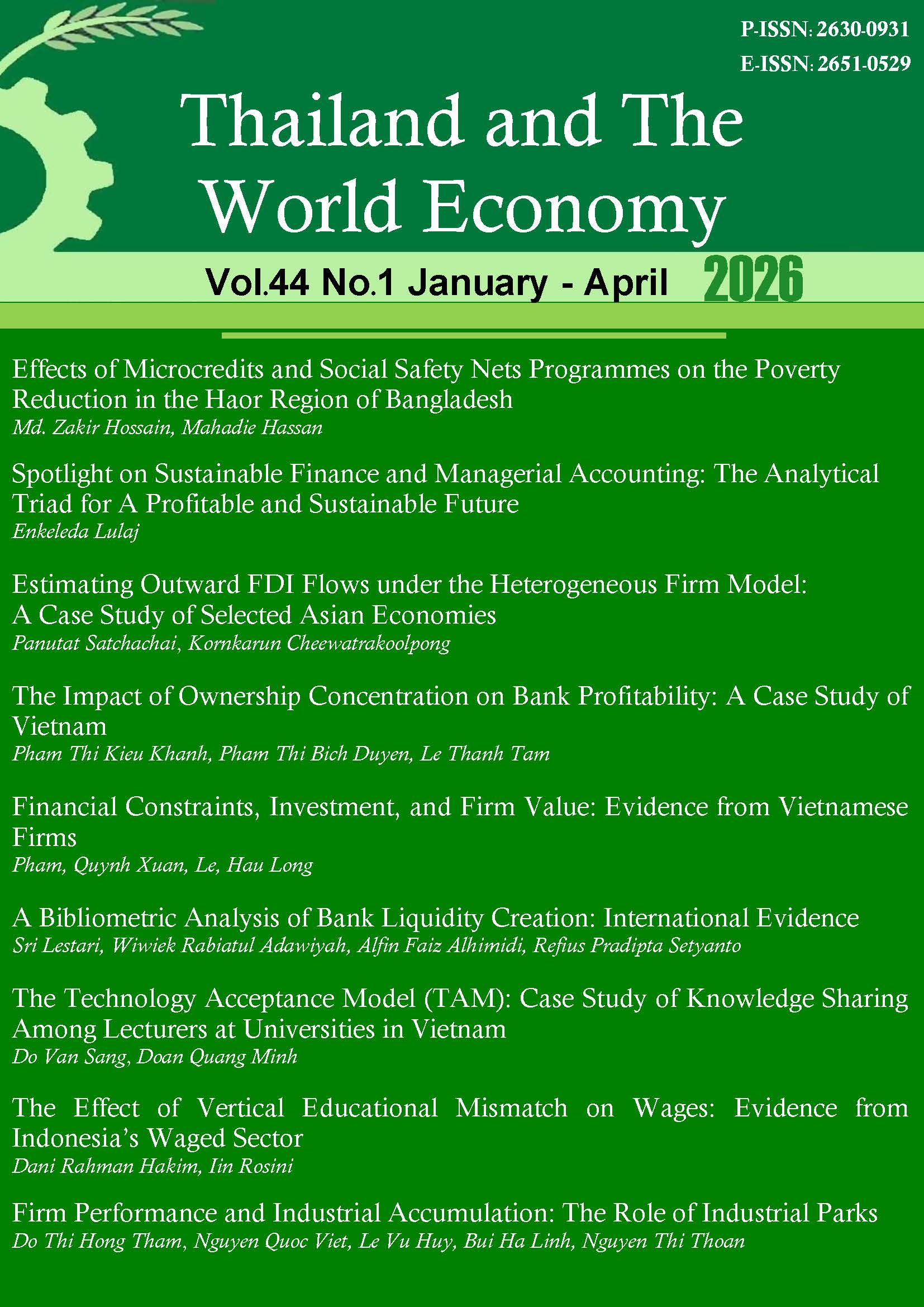
The Effect of Vertical Educational Mismatch on Wages: Evidence from Indonesia's Waged Sector
Keywords:
Educational Mismatch, Overeducation, Undereducation, WagesAbstract
This study is the first to analyse the determinants and wage impacts of vertical educational mismatches in the wage sector in Indonesia. This study is also the first to examine the wage effect of vertical educational mismatch based on the fields of study, gender, and spatial conditions of the worker cohorts. Using the 2022 national labour force survey datasets, we calculate overeducation and undereducation using the job analysis approach. We found that almost half of the Indonesian workforce held jobs that did not correspond to their level of education. The determinants of vertical educational mismatch are identified based on individual, educational, and fields of study, job and employer, and spatial characteristics. Using the ORU[i] and VV[ii] models, we found that the wage effect of vertical educational mismatch relied on gender, fields of study, and spatial conditions. In general, both overeducated and undereducated workers earn a wage premium. Overeducated workers in urban areas get higher returns than those in rural areas. However, if estimated based on the field of study cohort, there is a wage penalty for overeducated workers in at least seven fields. This study indicates that the mechanism of supply and demand for educated labour in each scientific field and industrial sector determines the wage impact of vertical educational mismatch.
[i]ORU stands for Overeducation, Required Education, and Undereducation. It is an economic model by Duncan and Hoffman (1981) that estimates the return to overeducation, required education, and undereducation
[ii]VV stands for Verdugo and Verdugo. It is the economic model that was developed by Verdugo and Verdugo (1989) to estimate the wage penalty or premiums for vertically mismatched workers (i.e., overeducated or undereducated)
References
Abidin, Z. Z., & Zakariya, Z. (2018). The impacts of over-education on economic growth in Malaysia. Journal of Islamic, Social, Economics and Development, 3(11), 85–95.
Bauer, T. K. (2002). Educational mismatch and wages: A panel analysis. Economics of Education Review, 21(3), 221–229.
Becker, G. S. (1992). Human capital and the economy. Proceedings of the American Philosophical Society, 136(1), 85–92. Retrieved from http://www.jstor.org/stable/986801
Bedir, N. (2014). The impact of over-education and under-education on earnings : Egypt in a post-revolutionary era. School of Economics and Management, Lund University, Sweden.
Belfield, C. (2010). Over-education: What influence does the workplace have?. Economics of Education Review, 29(2), 236–245.
Blázquez, M., & Budría, S. (2012). Overeducation dynamics and personality. Education Economics, 20(3), 260–283.
Büchel, F., & Battu, H. (2003). The theory of differential overqualification: Does it work? Scottish Journal of Political Economy, 50(1), 1–16.
Carmichael, F., Darko, C., & Kanji, S. (2021). Wage effects of educational mismatch and job search in Ghana and Kenya. Education Economics, 29(4), 359–378.
Caroleo, F. E., & Pastore, F. (2018). Overeducation at a glance. Determinants and wage effects of the educational mismatch based on AlmaLaurea data. Social Indicators Research, 137(3), 999–1032.
Carroll, D., & Tani, M. (2015). Job search as a determinant of graduate over-education: evidence from Australia. Education Economics, 23(5), 631–644.
Chaya, P., Mashindano, O., & Chisomi, D. (2013). Over education and under education in the Tanzanian formal sector: determinants and policy implications. International Journal of Education Economics and Development, 4(4), 371–391.
Chevalier, A., & Lindley, J. (2009). Overeducation and the skills of UK graduates. Journal of the Royal Statistical Society, 170(2), 307–337.
Chung, Y. (2001). Overeducation and undereducation and their effect on earnings: Evidence from Hong Kong, 1986-1996. Pacific Economic Review, 6(3), 401–418.
Clark, B., Joubert, C., & Maurel, A. (2017). The career prospects of overeducated Americans. IZA Journal of Labor Economics, 6(3), 1–29.
Cohn, E., & Khan, S. P. (1995). The wage effects of overschooling revisited. Labour Economics, 2(1), 67–76.
Croce, G., & Ghignoni, E. (2012). Demand and supply of skilled labour and overeducation in Europe: A country-level analysis. Comparative Economic Studies, 54(2), 413–439.
Cutillo, A., & Pietro, G. Di. (2006). The effects of overeducation on wages in Italy: A bivariate selectivity approach. International Journal of Manpower, 27(2), 143–168.
Devillanova, C. (2013). Over-education and spatial flexibility: New evidence from Italian survey data. Papers in Regional Science, 92(3), 445–464.
Diem, A. (2015). Overeducation among graduates from universities of applied sciences: Determinants and consequences. Journal of Economic & Financial Studies, 3(02), 63–77.
Diem, A., & Wolter, S. C. (2014). Overeducation among Swiss university graduates: determinants and consequences. Journal for Labour Market Research, 47(4), 313–328.
Dolton, P., & Vignoles, A. (2000). The incidence and effects of overeducation in the U.K. graduate labour market. Economics of Education Review, 19(2), 179–198.
Duncan, G. J., & Hoffman, S. D. (1981). The incidence and wage effects of overeducation. Economics of Education Review, 1(1), 75–86.
Ege, A. A., & Erdil, E. (2023). Determinants of overlapping mismatch in the Turkish labour market. Journal for Labour Market Research, 57(1), 1–9.
Frank, R. H. (1978). Why women earn less: The theory and estimation of differential overqualification. American Economic Review, 68(3), 360–373. http://www.jstor.org/stable/1805267
Groeneveld, S., & Hartog, J. (2004). Overeducation, wages and promotions within the firm. Labour Economics, 11(6), 701–714.
Groot, W. (1996). The incidence of, and returns to overeducation in the UK. Applied Economics, 28(10), 1345–1350.
Grunau, P., & Pecoraro, M. (2017). Educational mismatch and promotions to managerial positions: A test of the career mobility theory. Applied Economics, 49(12), 1226–1240.
Gujarati, D. (2015). Econometrics by example (2nd ed). United Kingdom: Palgrave Macmillan Education.
Haddad, G. R. K., & Habibi, N. (2017). Vertical skill mismatch and wage consequences in low-skilled jobs: Evidence from Iran. International Labour Review, 156(1), 45–72.
Hartog, J. (2000). Over-education and earnings: Where are we, where should we go? Economics of Education Review, 19(2), 131–147.
Hartog, J., & Oosterbeek, H. (1988). Education, allocation and earnings in the Netherlands: Overschooling? Economics of Education Review, 7(2), 185–194.
Hout, M. (1984). Status, autonomy, and training in occupational mobility. American Journal of Sociology, 89(6), 1379–1409.
Iriondo, I., & Amaral, T. P. (2016). The effect of educational mismatch on wages in Europe. Journal of Policy Modeling, 38(2), 304–323.
Johnes, G. (2019). The incidence of and returns to ‘overeducation’: PIAAC evidence on the G7. Minerva, 57(1), 85–107.
Jovanovic, B. (1979). Job matching and the theory of turnover. Journal of Political Economy, 87(5, Part 1), 972–990.
Kain, J. F. (1992). The spatial mismatch hypothesis: Three decades later. Housing Policy Debate, 3(2), 371–460.
Karakaya, G., Plasman, R., & Rycx, F. (2007). Overeducation on the Belgian labour market: Evaluation and analysis of the explanatory factors through two types of approaches. Compare, 37(4), 513–532.
Kiker, B. F., Santos, M. C., & De Oliveira, M. M. (1997). Overeducation and undereducation: Evidence for Portugal. Economics of Education Review, 16(2), 111–125.
Korpi, T., & Tåhlin, M. (2009). Educational mismatch, wages, and wage growth: Overeducation in Sweden, 1974–2000. Labour Economics, 16(2), 183–193.
Kupets, O. (2015). Skill mismatch and overeducation in transition economies. IZA World of Labor. Retrieved from https://doi.org/10.15185/izawol.224.
Leuven, E., & Oosterbeek, H. (2011). Overeducation and mismatch in the labor market. In E. A. Hanushek, S. Machin, & L. Woessmann (Eds.), Handbook of the Economics of Education (pp. 283–326). Amsterdam, Netherlands : Elsevier B.V.
Li, I. W., Harris, M., & Sloane, P. J. (2018). Vertical, horizontal and residual skills mismatch in the Australian graduate labour market. Economic Record, 94(306), 301–315.
Li, I. W., & Miller, P. W. (2015). Overeducation and earnings in the Australian graduate labour market : An application of the Vahey model. Education Economics, 23(1), 63–83.
McFadden, D. (2021). Quantitative methods for analysing travel behaviour of individuals: Some recent developments. In D. A. Hensher & P. R. Stopher (Eds.), Behavioural travel modelling (pp. 279–318). London, England: Routledge.
McGuinness, S., Bergin, A., & Whelan, A. (2018). Overeducation in Europe: Trends, convergence, and drivers. Oxford Economic Papers, 70(4), 994–1015.
McGuinness, S., Pouliakas, K., & Redmond, P. (2018). Skills mismatch: Concepts, measurement and policy approaches. Journal of Economic Surveys, 32(4), 985–1015.
Mincer, J. A. (1974). Schooling, experience, and earnings. Cambridge, England: National Bureau of Economic Research.
Mugijayani, W. (2020). Return to education and education mismatch in Indonesia. (Doctoral Dissertation, Cardiff University, Cardiff, Wales). Retrieved from http://orca.cf.ac.uk/131497/.
Munsech, Q. C. (2019). Measuring overeducation: Incidence, correlation and overlaps across indicators and countries. Social Indicators Research, 145(1), 279–301.
Neycheva, M. (2020). Qualification mismatch and growth in the Eastearn European region. Balkan and Near Eastern Journal of Social Sciences, 06(04), 71–77.
Ordine, P., & Rose, G. (2017). Too many graduates? A matching theory of educational mismatch. Journal of Human Capital, 11(4), 423–446.
Park, K., & Jang, D. (2017). The wage effects of over-education among young stem graduates. Singapore Economic Review, 63(1), 1–20.
Pholphirul, P. (2017). Educational mismatches and labor market outcomes: Evidence from both vertical and horizontal mismatches in Thailand. Education + Training, 59(5), 534–546.
Piracha, M., Tani, M., & Vadean, F. (2012). Immigrant over- and under-education : The role of home country labour market experience. IZA Journal of Migration, 1(3), 1–21.
Quinn, M. A., & Rubb, S. (2006). Mexico’s labor market: The importance of education-occupation matching on wages and productivity in developing countries. Economics of Education Review, 25(2), 147–156.
Robert, P. (2014). Job mismatch in early career of graduates under post-communism. International Journal of Manpower, 35(4), 500–513.
Rubb, S. (2006). Educational mismatches and earnings: Extensions of occupational mobility theory and evidence of human capital depreciation. Education Economics, 14(2), 135–154.
Rumberger, R. W. (1981). The rising incidence of overeducation in the U.S. Labor market. Economics of Education Review, 1(3), 293–314.
Sattinger, M. (1993). Assignment models of the distribution of earnings. Journal of Economic Literature, 31(2), 831–880.
Sattinger, M., & Hartog, J. (2013). Nash bargaining and the wage consequences of educational mismatches. Labour Economics, 23, 50–56.
Schweri, J., Eymann, A., & Aepli, M. (2020). Horizontal mismatch and vocational education. Applied Economics, 52(32), 3464–3478.
Senkrua, A. (2015). The mismatch in Thai labor market: Overeducation. Journal of Economics, 19(1), 92-116. Retrieved from https://so01.tci-thaijo.org/index.php/
CMJE/article/view/61018
Serikbayeva, B., & Abdulla, K. (2022). Education-job mismatch: implications for individual earnings and aggregate output. Social Indicators Research, 163(2), 723–752.
Sicherman, N. (1990). Education and occupational mobility. Economics of Education Review, 9(2), 163–179.
Sicherman, N., & Galor, O. (1990). A theory of career mobility. Journal of Political Economy, 98(1), 169–192.
Sitorus, F. M., & Wicaksono, P. (2020). The determinant of educational mismatch and its correlation to wages. Jurnal Ekonomi Pembangunan, 18(2), 163–176.
Spence, M. (1973). Job market signaling. In P. Diamond & M. Rothschild (Eds.), Uncertainty in Economics (pp. 355–374). Amsterdam, Netherlands : Elsevier B.V. Retrieved from http://dx.doi.org/10.1016/B978-0-12-214850-7.50025-5.
Sun, H., & Kim, G. (2022). The wage effects of overeducation across overall wage distribution on university graduates: incidence, heterogeneity and comparison. International Journal of Manpower, 43(5), 1144–1165.
Thurow, L. C. (1975). Generating inequality. London, England : The Macmillan Press Ltd.
Tsai, Y. (2010). Returns to overeducation: A longitudinal analysis of the U.S. labor market. Economics of Education Review, 29(4), 606–617.
Vahey, S. P. (2000). The great Canadian training robbery: evidence on the returns to educational mismatch. Economics of Education Review, 19(2), 219–227.
Verdugo, R. R., & Verdugo, N. T. (1989). The impact of surplus schooling on earnings: Some additional findings. The Journal of Human Resources, 24(4), 629-643.
Verhaest, D., & Omey, E. (2006). The impact of overeducation and its measurement. Social Indicators Research, 77(3), 419–448.
Verhaest, D., & Omey, E. (2010). The determinants of overeducation: different measures, different outcomes? International Journal of Manpower, 31(6), 608–625.
Verhaest, D., & Omey, E. (2012). Overeducation, undereducation and earnings: Further evidence on the importance of ability and measurement error bias. Journal of Labor Research, 33(1), 76–90.
Wen, L., & Maani, S. A. (2018). A panel study of immigrants’ overeducation and earnings in Australia. International Migration, 56(2), 177–200.
Wu, N., & Wang, Q. (2018). Wage penalty of overeducation: New micro-evidence from China. China Economic Review, 50, 206–217.
Wulandari, H., & Damayanti, A. (2021). Qualification mismatch dan upah di Indonesia [Qualification mismatch and wages in Indonesia]. Jurnal Ekonomi Dan Kebijakan Publik Indonesia, 8(1), 45–57.
Zakariya, Z. (2014). The effects of over, required and under-education on earnings in manufacturing sector in Malaysia. International Journal of Management Studies, 21(1), 83–109.
Zakariya, Z., & Noor, M. A. M. (2014). Workplace characteristics and determinants of over-education and overskilling in the manufacturing sector in Malaysia. Jurnal Pengurusan, 40, 125–136.
Zheng, Y., Zhang, X., & Zhu, Y. (2021). Overeducation, major mismatch, and return to higher education tiers: Evidence from novel data source of a major online recruitment platform in China. China Economic Review, 66, 1–16.
Downloads
Published
How to Cite
Issue
Section
Categories
License
Copyright (c) 2025 Thailand and The World Economy

This work is licensed under a Creative Commons Attribution-NonCommercial-NoDerivatives 4.0 International License.