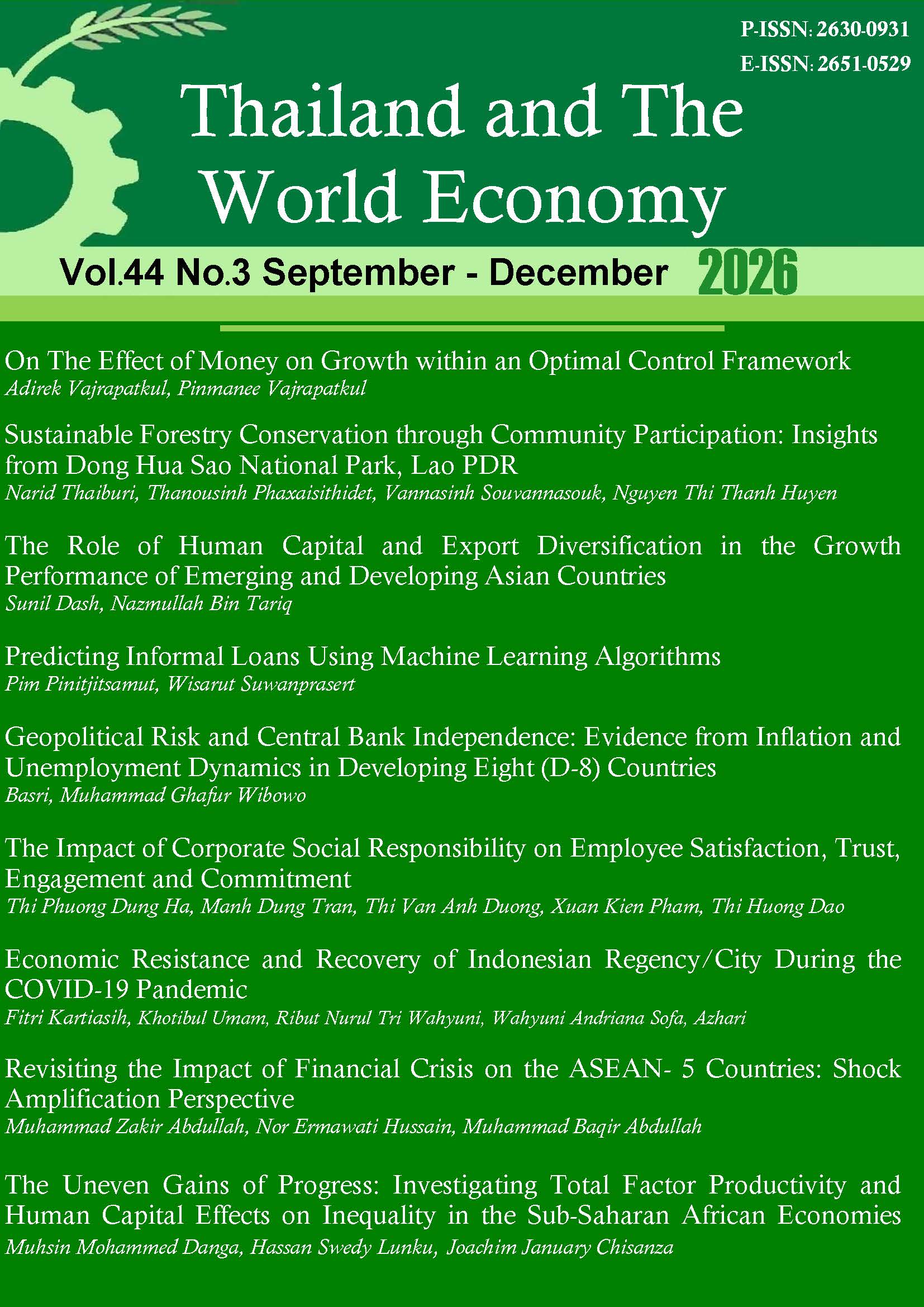
The Impact of Corporate Social Responsibility on Employee Satisfaction, Trust, Engagement and Commitment
DOI:
https://doi.org/10.66445/twe.v44i3.273690Keywords:
Commitment, Corporate Social Responsibility, Engagement, Satisfaction, TrustAbstract
Employees are the most important resource for a company, contributing significantly to its survival and growth. Employee engagement with the company is an emotional factor that creates motivation and enthusiasm for work, serving as a foundation for improving business efficiency and competitiveness, while also enhancing the company's reputation and sustainable development. Conversely, how does the fulfillment of corporate social responsibility affect employee engagement with the company? This study investigates the impact of corporate social responsibility (CSR) on key variables related to employees in Hanoi, Vietnamese companies. Specifically, the study focuses on the relationship between corporate social responsibility and employee engagement with companies through the linking roles of employee satisfaction, trust, and commitment. Partial Least Squares Structural Equation Modeling (PLS-SEM) was used on a sample of 455 employees of companies in Hanoi, Vietnam, to test several hypotheses. The results show that all proposed hypotheses regarding corporate social responsibility are appropriate and supported by employees in Hanoi, Vietnam. Corporate social responsibility is hypothesized to have an impact on satisfaction and trust, and these two variables have a positive impact on creating employee engagement and commitment to companies in Hanoi, Vietnam.
References
Aguilera, R. V., Rupp, D. E., Williams, C. A., & Ganapathi, J. (2007). Putting the S back in corporate social responsibility: A multilevel theory of social change in organizations. Academy of Management Review, 32(3), 836-863.
Aguinis, H., & Glavas, A. (2012). What we know and don’t know about corporate social responsibility. Journal of Management, 38(4), 932-968.
Allen, N. J., & Meyer, J. P. (1996). Affective, continuance, and normative commitment to the organization: An examination of construct validity. Journal of Vocational Behavior, 49(3), 252-276.
Aryal, N. (2014). Comparative study of CSR reporting in Finnish and UK listed. (Degree Thesis, Arcada University of Applied Sciences, Finland) ). Retrieved from https://www.theseus.fi/bitstream/handle/10024/80827/PDF%20Final%20Thesis.pdf?sequence=1
Barakat, S. R., Isabella, G., Boaventura, J. M. G., & Mazzon, J. A. (2016). The influence of corporate social responsibility on employee satisfaction. Management Decision, 54(9), 2325-2339.
Bauman, C. W., & Skitka, L. J. (2012). Corporate social responsibility as a source of employee satisfaction. Research in Organizational Behavior, 32, 63-86.
Bowen, H.R. (1953). Social responsibilities of the businessman. New York City: Harper & Row. Retrieved from https://ia601509.us.archive.org/20/items/
in.ernet.dli.2015.126534/2015.126534.Social-Responsibilities-Of-The-Businessman.pdf Brown, S. P., & Peterson, R. A. (1994). The effect of effort on sales performance and job satisfaction. Journal of Marketing, 58(2), 70-80.
Cho, Y. J., & Park, H. (2011). Exploring the relationships among trust, employee satisfaction, and organizational commitment. Public Management Review, 13(4), 551-573.
Chughtai, A. A., & Buckley, F. (2013). Exploring the impact of trust on research scientists' work engagement: Evidence from Irish science research centres. Personnel Review, 42(4), 396-421.
Dahlsrud, A. (2008). How corporate social responsibility is defined: An analysis of 37 definitions. Corporate Social Responsibility and Environmental Management, 15 (1),1-13.
Dirks, K. T., & Ferrin, D. L. (2001). The role of trust in organizational settings. Organization Science, 12(4), 450-467.
Dung, T.M. (2019). Impact of dividend policy on variation of stock prices: Empirical study of Vietnam. Journal of Economics and Development, 21(Special Issue), 96-106.
Dung, T.M. (2021). How do corporate social responsibility impact on financial performance: Moderate of ethical leadership and firm size. Central Asia and the Caucasus, 22(5), 1259-1282
Fauzan, N., & Jaroenwanit, P. (2024). The link of corporate social responsibility communication towards customer value co-creation: An empirical study in banking business Indonesia. Thailand and The World Economy, 42(1), 196–213.
Ferreira, P., Julia Claxton, D., & Real de Oliveira, E. (2014). Does corporate social responsibility impact on employee engagement?. Journal of Workplace Learning, 26(3/4), 232-247.
Fornell, C., & Larcker, D. F. (1981). Evaluating structural equation models with unobservable variables and measurement error. Journal of Marketing Research, 18(1), 39-50.
Gilbert, J. A., & Tang, T. L.-P. (1998). An examination of organizational trust antecedents. Public Personnel Management, 27(3), 321-338.
Glavas, A. (2016). Corporate social responsibility and employee engagement: Enabling employees to employ more of their whole selves at work. Frontiers in Psychology, 7, 1-10.
Glavas, A., & Kelley, K. (2015). The effects of perceived corporate social responsibility on employee attitudes. Business Ethics Quarterly, 24(2), 165-202.
Global Reporting Initiative- GRI (2013). Sustainability reporting guidelines version G4. Retrieved from https://ifcsia.org/wp-content/uploads/pdf/publications/Global-Reporting-Initiative-G4-Sustainability-Reporting-Guidelines.pdf
Gully, S. M., Phillips, J. M., Castellano, W. G., Han, K., & Kim, A. (2013). A mediated moderation model of recruiting socially and environmentally responsible job applicants. Personnel Psychology, 66(4), 935-973.
Gupta, M. (2015). Corporate social responsibility, employee–company identification, and organizational commitment: Mediation by employee engagement. Current Psychology, 36(1), 101-109.
Ha, T. P. D., & Tran, M. D. (2025a). An analysis of investment demand and the development trend of non-state enterprises in Vietnam.. Financial and Credit Activity Problems of Theory and Practice, 1(60), 273–287.
Ha, T. P. D., & Tran, M. D. (2025b). The impact of audit fees on the quality of audit services of public interest entities in Vietnam.. Financial and Credit Activity Problems of Theory and Practice, 2(61), 168–179.
Ha, T. P. D., Tran, M. D., Phi, V. T., Nguyen, T. L. A., Truong, V. T., & Diep, N. T. T. (2025a). The impact of social responsibility strategy on the performance of listed firms [Special issue]. Corporate & Business Strategy Review, 6(1), 317–326.
Ha, T. P. D. Tran, M. D., Duong, T. V. A., Pham, X. K., Dao, T. H., Phi, V. T., Nguyen, T. L. A., Truong, V. T., Nguyen, T. T. D., Tran, N. D., & Ha, D. H. (2025b). The effect of green human resources management on employees’ environmentally friendly behavior and hotel’s environmental cost performance: A governance and sustainability outlook. Corporate Governance and Sustainability Review, 9(1), 106–114.
Ha, T. P. D., Dao, T. H., Pham, X. K., & Duong, T. V. A. (2025c). Determining the factors affecting the audit quality of Vietnamese liste companies. Financial and Credit Activity Problems of Theory and Practice, 2(61), 155–167.
Ha, T. P. D., Tran, M. D., Duong, T. V. A., Pham, X. K., Dao, T. H., Phi, V. T., Nguyen, T. L. A., Truong, V. T., Nguyen, T. T. D. (2024a). Factors affecting energy enterprises investment demand for machinery and equipment. . International Journal of Business, Economics and Law (IJBEL), 32(1), 151-161.
Ha, T. P. D., Tran, M. D., Duong, T. V. A., Pham, X. K., Dao, T. H., et al. (2024b). The impact of board of directors on the disclosure of sustainable development of listed firms. International Journal of Sustainable Development Research, 10(3), 86-96.
Ha, T. P. D., Tran, N. D., Ha, D. H. (2024c). Factors influencing the capacity to repay loans on time of tea growing households. International Journal of Agricultural Economics, 9(6), 328-339.
Hansen, S. D., Dunford, B. B., Boss, A. D., Boss, R. W., & Angermeier, I. (2011). Corporate social responsibility and the benefits of employee trust: A cross-disciplinary perspective. Journal of Business Ethics, 102(1), 29-45.
Harter, J. K., Schmidt, F. L., & Hayes, T. L. (2002). Business-unit-level relationship between employee satisfaction, employee engagement, and business outcomes: A meta-analysis. Journal of Applied Psychology, 87(2), 268-279.
Huang, Y. -H., Lee, J., McFadden, A. C., Murphy, L. A., Robertson, M. M., Cheung, J. H., & Zohar, D. (2016). Beyond safety outcomes: An investigation of the impact of safety climate on job satisfaction, employee engagement and turnover using social exchange theory as the theoretical framework. Applied Ergonomics, 55, 248-257.
Johns, J. L. (1996). A concept analysis of trust. Journal of Advanced Nursing, 24(1), 76-83.
Jones, D. A. (2010). Does serving the community also serve the company? Using organizational identification and social exchange theories to understand employee responses to a volunteerism programme. Journal of Occupational and Organizational Psychology, 83(4), 857-878.
Khoury, G., Rostami, J., & Turnbull, P.T. (1999). Corporate social responsibility: Turning words into action Ottawa. Conference Board of Canada.1999. Retrieved from https://books.google.com.vn/books/about/Corporate_Social_Responsibility.html?id=3tzs0QEACAAJ&redir_esc=y
Lin, C. P. (2010). Modeling corporate citizenship, organizational trust, and work engagement based on attachment theory. Journal of Business Ethics, 94(4), 517-531.
Nagib, S. B., Marie, K., Geoff S. (2012). An empirical study of the relationship between corporate social responsibility disclosure and organizational performance: evidence from Libya. International Journal of Management and Marketing Research, The Institute for Business and Finance Research, 5(3), 69-82.
Mathieu, J. E., & Hamel, K. (1989). A causal model of the antecedents of organizational commitment among professionals and nonprofessionals. Journal of Vocational Behavior, 34(3), 299-317.
Mathieu, J. E., & Zajac, D. M. (1990). A review and meta-analysis of the antecedents, correlates, and consequences of organizational commitment. Psychological Bulletin, 108(2), 171-191.
Moon, J., & Matten, D. (2004). Corporate social responsibility education in Europe. Journal of Business Ethics, 54, 323-337.
Mowday, R. T., Porter, L. W., & Steers, R. (1982). Organizational linkages: The psychology of commitment, absenteeism, and turnover. New York: Academic Press.
Pivato, S., Misani, N., & Tencati, A. (2008). The impact of corporate social responsibility on consumer trust: the case of organic food. Business Ethics: A European Review, 17(1), 3-12.
Saks, A. M. (2006). Antecedents and consequences of employee engagement. Journal of Managerial Psychology, 21(7), 600-619.
Schaufeli, W. B., Salanova, M., González-Romá, V., & Bakker, A. B. (2002). The measurement of engagement and burnout: A two sample confirmatory factor analytic approach. Journal of Happiness Studies, 3(1), 71-92.
Spence Laschinger, H. K., Finegan, J., & Shamian, J. (2002). The impact of workplace empowerment, organizational trust on staff nurses' work satisfaction and organizational commitment. In M. R. Buckley, J. R. B. Halbesleben, & A. R. Wheeler (Eds.), Advances in health care management (Vol. 3, pp. 59–85). Emerald Group Publishing Limited.
Sweeney, L. (2009). A study of current practice of corporate social responsibility (CSR) and an examination of the relationship between CSR and financial performance using structural equation modelling (SEM). (Doctoral dissertation, Dublin Institute of Technology, Ireland). Retrieved from https://arrow.tudublin.ie/cgi/
viewcontent.cgi?params=/context/appadoc/article/1022/&path_info=Lorraine_Sweeney__PhD.pdf
Turker, D. (2009). How corporate social responsibility influences organizational commitment. Journal of Business Ethics, 89(2), 189-204.
Usman, B., Nurazi, R., Zoraya, I., & Yennita. (2024). Firm performance: A longitudinal study of corporate social responsibility and its societal impact. Thailand and The World Economy, 42(3), 105–137.
Vlachos, P. A., Panagopoulos, N. G., & Rapp, A. A. (2013). Feeling good by doing good: Employee CSR-induced attributions, job satisfaction, and the role of charismatic leadership. Journal of Business Ethics, 118(3), 577-588. Retrieved from https://link.springer.com/article/10.1007/s10551-012-1590-1
White, G. B. (2009). Sustainability reporting: Managing for wealth and corporate health. New York: Business Expert Press, LLC.
Downloads
Published
How to Cite
Issue
Section
Categories
License
Copyright (c) 2026 Thailand and The World Economy

This work is licensed under a Creative Commons Attribution-NonCommercial-NoDerivatives 4.0 International License.