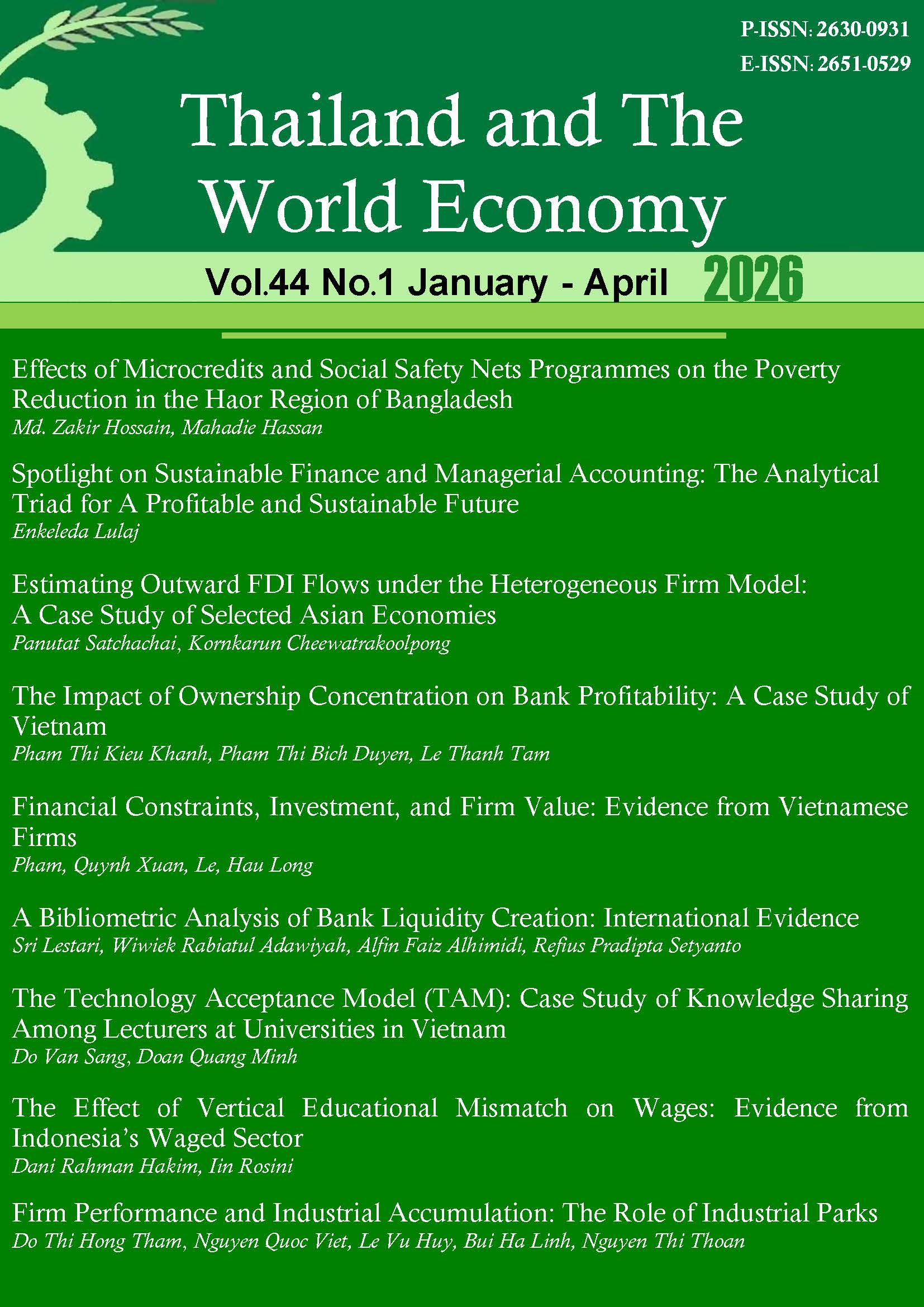
Effects of Microcredits and Social Safety Nets Programmes on the Poverty Reduction in the Haor Region of Bangladesh
Keywords:
Formal and Informal Microcredits, Social Safety Nets Programs, Impact Analysis, Multiple Logistic Regression, Haor Region, BangladeshAbstract
The haor (Ox-bow Lake) region in Bangladesh, comprising seven districts, is rich in fishing, biodiversity, and boro-rice cultivation. However, its people are poorer due to wet monsoon seasonality. This study evaluates the joint impact of microcredit facilities and social safety net programs (SSNPs) on poverty alleviation and vulnerability reduction among Bangladesh’s haor residents. This cross-sectional study gathered primary data from 907 households across 30 rural clusters (Union Parishads). It assessed the consequences of microcredit and SSNPs on poverty conditions using a 'before-after' comparison, coupled with respondents' perceptions and multiple binary logistic regression models. The analysis shows significant improvements in food security and socio-economic conditions among beneficiary households from 2019 to 2022. Overall food security increased remarkably, whereas severe and moderate food insecurity decreased remarkably. Extreme poverty decreased for beneficiaries but increased for non-beneficiaries. The study found that microcredit facilities and SSNPs improved living conditions, job opportunities, working hours, and asset protection. Model-based analysis showed that the likelihood of achieving non-poverty status increased 88% for full beneficiaries (received both SSNPs and microcredits), 56% for microcredit-receiving households, and 13% for SSNP beneficiaries. The probability of reducing hardcore poverty was greater for male-headed households and households with greater asset values, higher expenditure, many dwelling units, and educated heads. Hence, these factors also need to be considered besides extending microcredit facilities and SSNPs to reduce the haor areas' poverty. In conclusion, microcredit facilities and SSNP benefits can reduce poverty by generating income, and policymakers should increase the accessibility and implementation of these initiatives.
References
Adato, M., Ahmed, A., & Francie, L. F. (2020). Linking safety nets, social protection, and poverty reduction — Directions for Africa. 2020 Africa Conference Brief 12, International Food Policy Research Institute. Retrieved from http://www.ifpri.org/2020africaconference.
Ahmed A. U., Quisumbing A.R., Nasreen M., Hoddinott J. F., & Bryan E., (2009). Comparing food and cash transfers to the ultra poor in Bangladesh (Research Monograph 163). International Food Policy Research Institute, Washington DC. Retrieved from https://www.researchgate.net/publication/46442013_
Can’t find this paper online. Can you please provide URL?
Akhter, J. & Cheng, K. (2020). Sustainable empowerment initiatives among rural women through microcredit borrowings in Bangladesh. Sustainability, MDPI, 12(6),1-19.
Andile, S. (2024). The effectiveness of social safety nets in reducing extreme poverty. International Journal of Developing Country Studies, 6(2), 40–54.
Asma, K. M., Misu, F., & Islam, M. A. (2023). The impact of social safety net programs on poverty, food security and standard of living in Bangladesh. The International Journal of Community and Social Development, 5(1), 71-96.
Badhan, S., Haque, S., Akteruzzaman, M., Zaman, N., Nahar, K., & Yeasmin, F. (2019). Role of social safety net programmes for ensuring food security and reducing poverty in char area of Jamalpur district in Bangladesh. Progressive Agriculture, 30(1), 75–85.
BBS (2019). Report of the household income & expenditure survey 2016. Planning Division, Ministry of Planning, Dhaka, Bangladesh.
BBS (2023). Report of the household income & expenditure survey 2022. Planning Division, Ministry of Planning, Dhaka, Bangladesh.
Begum, I.A., Akter, S., & Alam, M.J., & Rahmatullah, N.M. (2014). Social safety nets and productive outcomes: Evidence and implications for Bangladesh. Food Planning and Monitoring Unit, Ministry of Food, Bangladesh. Retrieved from 10.13140/2.1.1392.7041.
BIDS (2018). Implication of employment generation programme for the poorest (egpp) to reduce disaster and gender vulnerability. Ministry of Disaster Management and Relief (MODMR), GoB, Institute of Development Studies, Bangladesh
Bilenkisi, F., Gungor, M.S, & Tapşın, G. (2015). The impact of household heads’ education levels on the poverty risk: the evidence from Turkey. Educational Sciences: Theory & Practice. 15(2).
CEGIS (2012). Master plan of haor area. Centre for Environmental and Geographic Information Centre, Ministry of Haor Resources, Bangladesh Haor and Wetland Development Board.
Chakraborty B., Darak S., & Haisma H. (2020). Maternal and child survival in haor region in Bangladesh. An analysis of fathers' capabilities to save the future. International Journal of Environmental Research and Public Health, 17(16).
Chikwira C., Vengesai E., & Mandude P.(2022). The impact of microfinance institutions on poverty alleviation. Journal of Risk and Financial Management, 15(9).
Choudhary, S.R. (2013). Impact of old age allowance among rural aged: an empirical investigation. International Journal of Sociology and Anthropology, 5(7), 262- 268.
Chowdhury, A. (2014). Factors affecting productivity and efficiency of rice production in haor area in Bangladesh: Likely impact on food security (Master Thesis, Department of Agricultural Statistics, Bangladesh Agricultural University, Mymensingh. Retrieved from https://catalog.ihsn.org/citations/42191.
Devereux, S. (2002). Can social safety nets reduce chronic poverty?. Development Policy Review, 20(5), 657-675.
Dhaka Tribune. (2024, September 10). Microfinance institutions now want 12.75% flat lending rate. Retrieved from https://www.dhakatribune.com/business/commerce/
/microfinance-institutions-now-want-12.75%25-flat
Ernest, A. (2011). Informal finance for private sector development in Sub-Saharan Africa. Journal of Microfinance, 7 (1), 14-37.
Félix, E.G.S., & Belo, T.F. (2019). The impact of microcredit on poverty reduction in eleven developing countries in south-east Asia. Journal of Multinational Financial Management, 52–53.
GoB (2020). 8th Five Year Plan (July 2020 - June 2025). General Economics Division (GED), Bangladesh Planning Commission, Government of the People’s Republic of Bangladesh, Sher-e-Bangla Nagar, Dhaka-1207. Retrieved from https://plancomm.gov.bd/sites/default/files/files/plancomm.portal.gov.bd/files/68e32f08_13b8_4192_ab9b_abd5a0a62a33/2021-02-03-17-04-ec95e78e452a813808a483b3b22e14a1.pdf
Graham, C. (2020). Social safety nets and poverty reduction: A global perspective. Journal of Development Studies, 56(4), 674-689.
Hossain, M.Z. (2020). Measurement of food insecurity and poverty by different methods - does the method matter?. International Journal of Statistical Sciences, 20(1), 79-96.
Hossain, M.Z., & Ahmed, J.U. (2017). Targeting effectiveness and productive outcomes of the social safety net programs in rural Bangladesh: An evaluation. [unpublished research report], Department of Statistics, SUST, Bangladesh.
Hossain, M.Z., Rahman, F., & Majumder, R.R. (2021a). Impact of major promotional safety net programmes in Bangladesh: A quantitative assessment for graduation from poverty. SUST Journal of Social Sciences (SUST JSS), 32(2), 9-32.
Hossain, M.Z., Rahman, F., & Majumder, R.R. (2021b). Consequences of the benefits from promotional safety net programmes in Bangladesh and factors for not graduating from poverty, Indian Journal of Population and Development, 1(1),107-120. http://www.mlcfoundation.org.in/#assets/ijpd/2021-1/IJPD_
Vol_1_1_8.pdf
Hossain, M.Z., Begum, R., & Kaiser, M.A. (2021c). Consequences of social safety nets benefits and causes for not included in the targeted programmes –a multivariate approach. International Journal of Statistical Sciences, 21(1), 1-16. Retrieved from https://www.ru.ac.bd/stat/wp-content/uploads/sites/23/2025/04/Vol21i1-1.pdf.
Hussain, A.K.M.G., Nargis, N., Ashiquzzaman, S.M., & Khalil, F. (2019). The employment impact of microcredit program participation in Bangladesh: Evidence from a longitudinal household survey. World Development Perspectives. 13, 34-49. Retrieved from 13. 10.1016/j.wdp.2019.02.009.
Institute of Microfinance (2015). Interest rates in Bangladesh microcredit market. [Policy Brief]. Retrieved from https://inm.org.bd/wp-content/uploads/2016/01/Interest-Rate.pdf
Islam, M.N., Islam, S., & Ornob, M.S.S. (2024). Comparative impact of formal and informal microcredits on poverty alleviation in the HAOR region of Bangladesh: A socioeconomic analysis. Asian Journal of Economics, Business and Accounting, 24(6), 371–388. Retrieved from https://journalajeba.com/index.php
/AJEBA/article/view/1368/2727.
Kazal, M.M.H., Rahman, S. & Hossain, M.Z. (2017). Poverty profiles and coping strategies of the haor (ox-bow lake) households in Bangladesh. Journal of Poverty Alleviation and International Development, 8(1), 167-191.
Khalily, M.A.B., Khandker, S.R., & Samad, H. A. (2016). Beyond ending poverty: The dynamics of microfinance in Bangladesh. Retrieved from The World Bank http://hdl.handle.net/10986/24669
Khan, A. A., Khan, S. U., Fahad, S., Ali, M. A., Khan, A., & Luo, J. (2020). Microfinance and poverty reduction: New evidence from Pakistan. International Journal and Finance & Economics, 26(3), 4723-4733.
Khandker, S.R. (1998). Fighting poverty with microcredit: Experience in Bangladesh. Oxford, UK: Oxford University Press.
Khandker, S.R., & Samad, H.A. (2014). Dynamic effects of microcredit in Bangladesh. The World Bank Policy Research Working Paper No. 6821, Development Research Group Agriculture and Rural Development Team. Retrieved from https://documents1.worldbank.org/curated/en/456521468209682097/pdf/WPS6821.pdf.
Khandker, S.R., Khalily, M.A., & Samad, H.A. (2015). Non-borrowing effects of microcredit participation: Evidence using long panel survey data in Bangladesh. Institute of Microfinance (InM) Working Paper No. 41, Dhaka, Bangladesh. Retrieved from https://inm.org.bd/wp-content/uploads/2016/01/
Workingpaper41.pdf
Khuda, B. (2011). Social safety net programmes in Bangladesh: A review. The Bangladesh Development Studies, 34 (2), 87-108.
Liton, M.R.I, Sadekin, M.N., & Muzib, M.M. (2014). Micro-credit as a tool for poverty reduction in Bangladesh. Journal of Economics and Sustainable Development, 5(25), 30–38. Retrieved from https://www.iiste.org/Journals/index.php/
JEDS/article/view/17524.
Mallick, D. (2012). Microfinance and moneylender interest rate: Evidence from Bangladesh. World Development, 40(6), 1181-1189.
Mamun, M. (2019). The impact of social safety net programmes on poverty reduction in Bangladesh: An evidence from old age allowance. Bangladesh Journal of Public Administration, 27(1), 63-78.
Maxwell, D., & Caldwell, R. (2008). The coping strategies index: Field methods manual (2nd ed.). TANGO International and Feinstein International Center, Tufts University. Retrieved from https://www.indikit.net/document/9-the-coping-strategies-index-field-methods-manual
Msuha, B., & Kissoly, L. D. (2024). Impact of productive social safety net on households’ vulnerability to food insecurity in Tanzania. Cogent Economics & Finance, 12(1).
Pitt, M.M., & Khandker, S.R. (1996). Household and intrahousehold impact of the grameen bank and similar targeted credit programs in Bangladesh. World Bank Discussion Papers No. 320, Washington D.C. Retrieved from https://ideas.repec.
org/p/fth/wobadi/320.html
Pitt, M.M., Khandker, S.R., & Cartwright, J. (2006). Empowering women with micro finance: Evidence from Bangladesh. Economic Development and Cultural Change, 54(4), 791-831.
Pomi, S.S. (2019). Impact of microcredit on rural poverty alleviation in the context of Bangladesh. International Journal of Economics and Finance, 11(6), 70-82.
Sahu, T.N., Agarwala, V., & Maity, S. (2021). Effectiveness of microcredit in employment generation and livelihood transformation of tribal women entrepreneurs: Evidence from PMMY. Journal of Small Business & Entrepreneurship, 36(1), 53–74.
Turner A.G., Magnani, R.J., & Shuaib, M. (1996). A not quite as quick but much cleaner alternative to the expanded programme on immunization (EPI) cluster survey design. International Journal of Epidemiology, 25(1),198-203. Retrieved from https://academic.oup.com/ije/article/25/1/198/815602?login=false.
Wang, J. S. H., Cai, Y., & Gao, Q. (2021). How effective are social safety net programs in reducing poverty risks? A comparative study of Taiwan and Southeast China. Journal of Asian Public Policy, 15(3), 338–373.
World Bank (2006). Social safety nets in Bangladesh: An assessment. Bangladesh Development Series, Paper No. 9. World Bank Office, Dhaka, Country. Retrieved from https://socialprotection.gov.bd/wp-content/uploads/2017/06/WB-Assessment-of-Safety-Nets-2.pdf
Yin, S., Chen, X., Zhou, X., Chen, C., & Liu, J.(2023). Effect of micro-credit for poverty alleviation on income growth and poverty alleviation—Empirical evidence from rural areas in Hebei, China. Agriculture 2023, 13(5).
Zohir, S., Mallik, B.A., Zabeen, S., & Ahsan, G. (2010). Strengthening social safety nets for mitigating adverse impacts of food crisis in Bangladesh. Economic Research Group, Dhaka, Bangladesh. Retrieved from https://researchnow.flinders.edu.au/
en/publications/strengthening-social-safety-nets-for-mitigating-adverse-impacts-o.
Downloads
Published
How to Cite
Issue
Section
Categories
License
Copyright (c) 2025 Thailand and The World Economy

This work is licensed under a Creative Commons Attribution-NonCommercial-NoDerivatives 4.0 International License.