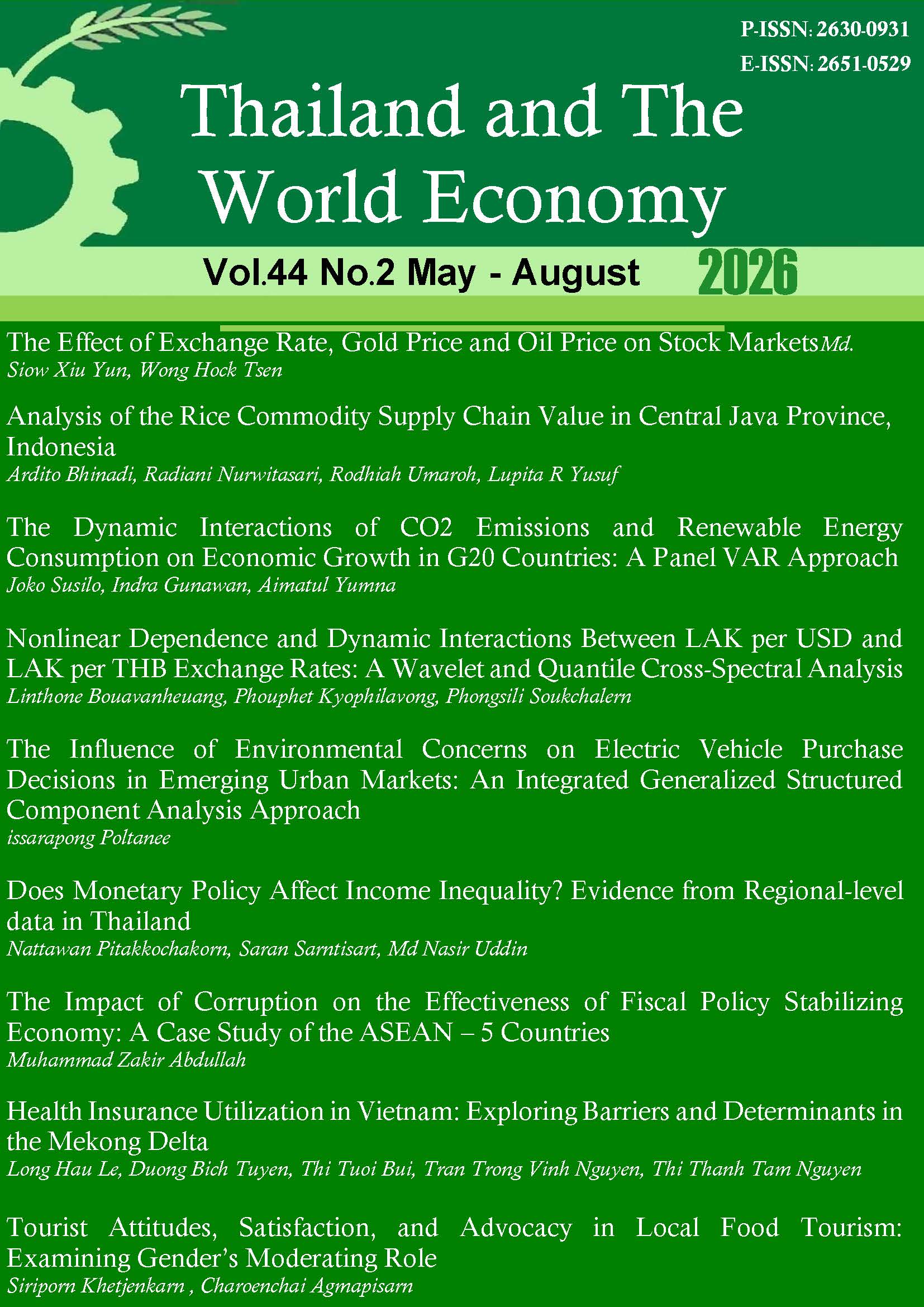
The Effect of Exchange Rate, Gold Price and Oil Price on Stock Markets
DOI:
https://doi.org/10.66445/twe.v44i2.274669Keywords:
REER, Real Gold Price, Real Oil Price, Real Stock Market, Cumulative Dynamic MultipliersAbstract
This study examines the effects of the real effective exchange rate (REER), real gold price, and real oil price on real stock markets in Malaysia, Thailand, Indonesia, Singapore, and South Korea from January 2005 to August 2025 using linear Autoregressive Distributed Lag (ARDL) and Nonlinear Autoregressive Distributed Lag (NARDL) models. The findings indicate that fluctuations in the REER and real oil price generally depress stock markets in Singapore, Thailand, Indonesia, and South Korea, while enhancing Malaysia’s stock market performance. Changes in real gold prices increase stock market returns in Malaysia, Singapore, and Thailand but reduce them in Indonesia and South Korea. An appreciation of REER benefits Malaysia’s stock market but adversely affects the other economies, whereas a depreciation of REER supports Malaysia and Singapore’s stock markets while harming stock markets of the other economies. Rising and falling real gold prices generally elevate stock markets across all countries. This study offers valuable guidance for policymakers in the management of stock market risk, including through hedging strategies using futures and options.
References
Afşar, M., Polat, O., Afşar, A., & Kahraman, G. Ö. (2025). Dynamic interlinkages between oil price shocks and stock markets: A quantile-on-quantile connectedness analysis in emerging economies. Applied Economics, 58(11), 2188–2204.
Agboola, E., Chowdhury, R., & Yang, B. (2024). Oil price fluctuations and their impact on oil-exporting emerging economies. Economic Modelling, 132.
Ahmadian-Yazdi, F., Sokhanvar, A., Roudari, S., & Tiwari, A. K. (2025). Dynamics of the relationship between stock markets and exchange rates during quantitative easing and tightening. Financial Innovation, 11(1).
Aladwani, J. (2025). Asymmetric reactions of the crude oil and natural gas markets on Vietnamese stock markets. Journal of Economics and Development, 27(1), 87–109.
Arisandhi, V. D., & Robiyanto, R. (2022). Exchange rate, gold price and stock price correlation in ASEAN-5: Evidence from the COVID-19 era. Jurnal Manajemen dan Kewirausahaan [Journal of Management and Entrepreneurship], 24(1), 22–32.
Athari, S. A., Kirikkaleli, D., & Adebayo, T. S. (2023). World pandemic uncertainty and German stock market: Evidence from Markov regime-switching and Fourier based approaches. Qual Quant, 57(2), 1923-1936.
Bahmani-Oskooee, M., & Saha, S. (2015). On the relation between stock prices and exchange rates: A review article. Journal of Economic Studies, 42(4), 707–732.
Bhandari, A. (2020, July 20). Key difference between R-squared and adjusted R-squared for regression analysis. Retrieved from Analytics Vidhya https://www.analyticsvidhya.com/blog/2020/07/difference-between-r-squared-and-adjusted-r-squared/
Bhattacharjee, A., & Das, J. (2021a). Investigating the effect of broad money supply on stock market index and market capitalization: Evidence from liberalized India. Jindal Journal of Business Research, 10(2), 185–198.
Bhattacharjee, A., & Das, J. (2021b). Investigating the long-run and the short-run relationship between domestic macroeconomic forces and Indian equity market: Evidence based on ARDL bounds testing approach. Paradigm, 25(1), 61–76.
Bhowmik, R., Debnath, G. C., Debnath, N. C., & Wang, S. (2022). Emerging stock market reactions to shocks during various crisis periods. PLoS ONE, 17(9).
Büyükkara, Z. G., Özgüler, İ. C., & Hepsen, A. (2025). Relationship between housing, oil, gold and stock markets: Evidence from UK and Norway. International Journal of Housing Markets and Analysis, 18(2), 518–545.
Cheah, S.P., Yiew, T.H. ,& Ng, C.F. (2017). A nonlinear ARDL analysis on the relation between stock price and exchange rate in Malaysia, Economics Bulletin, 37(1), 336–346.
Dang, V.C., Le, T.L., Nguyen, Q.K. ,& Tran, D.Q. (2020). Linkage between exchange rate and stock prices: Evidence from Vietnam. The Journal of Asian Finance, Economics and Business, 7(12), 95–107.
Danila, N., Bunyamin, D., Djalaluddin, A., & Fathony, Y. (2023). Do foreign fund flows influence the stock market index? Evidence from Indonesia. SAGE Open, 13(4).
Delgado, N. A. B., Delgado, E. B. D., & Saucedo, E. (2018). The relationship between oil prices, the stock market and the exchange rate: Evidence from Mexico. North American Journal of Economics and Finance, 45, 266–275.
Dharani, M., Hassan, M. K., Huda, M., & Abedin, M. Z. (2023). Covid-19 pandemic and stock returns in India. Journal of Economics and Finance, 47(1), 251–266.
Dong, Q., Du, Q., & Min Du, A. (2024). Interplay between oil prices, country risks and stock returns in the context of global conflict: A PVAR approach. Research in International Business and Finance, 72.
El-Diftar, D. (2023). The impact of exchange rates on stock market performance of the Emerging 7. Journal of Capital Markets Studies, 7(2), 125–139.
Erdoğan, L., Ceylan, R., & Abdul-Rahman, M. (2022). The impact of domestic and global risk factors on Turkish stock market: Evidence from the NARDL approach. Emerging Markets Finance and Trade, 58(7), 1961–1974.
Frost, J. (2019). How to interpret adjusted R-squared and predicted R-squared in regression analysis. Statistics by Jim. https://statisticsbyjim.com/regression/
interpret-adjusted-r-squared-predicted-r-squared/
Fu, S., Liu, C., & Wei, X. (2021). Contagion in global stock markets during the COVID‐19 crisis. Global Challenges, 5(10).
Habibullah, M. S., & Baharumshah, A. Z. (1996). Money, output and stock prices in Malaysia: An application of the cointegration tests. International Economic Journal, 10(2), 121–130.
Hadi, N. K. A., & Robiyanto, R. (2025). Volatility of gold and oil prices on the Indonesian stock market in geopolitical crisis. Among Makarti, 18(1).
Hajilee, M., & Al Nasser, O. M. (2014). Exchange rate volatility and stock market development in emerging economies. Journal of Post Keynesian Economics, 37(1), 163–180.
Harnphattananusorn, S. (2024). Spillover effects between oil, gold, stock and exchange rate returns in Thailand: An extended joint connected TVP-VAR approach. International Journal of Energy Economics and Policy, 14(5), 62–72.
Hashmi, S. M., & Chang, B. H. (2023). Asymmetric effect of macroeconomic variables on the emerging stock indices: A quantile ARDL approach. International Journal of Finance and Economics, 28(1), 1006–1024.
Hashmi, S. M., Chang, B. H., Huang, L., & Uche, E. (2022). Revisiting the relationship between oil prices, exchange rate and stock prices: An application of quantile ARDL model. Resources Policy, 75 .
Huang, Q., Li, M., & Wang, B. (2023). The dynamic causality between Chinese and ASEAN stock markets. Heliyon, 9(12).
Ibrahim, M. H. (2015). Oil and food prices in Malaysia: A nonlinear ARDL analysis. Agricultural and Food Economics, 3(1).
Jiang, W., & Liu, Y. (2021). The asymmetric effect of crude oil prices on stock prices in major international financial markets. North American Journal of Economics and Finance, 56.
Javangwe, K. Z., & Takawira, O. (2022). Exchange rate movement and stock market performance: An application of the ARDL model. Cogent Economics & Finance, 10(1), 2075520.
Joo, Y. C., & Park, S. Y. (2021). The impact of oil price volatility on stock markets: Evidences from oil-importing countries. Energy Economics, 101.
Khan, M. A., Husnain, M. I. U., Abbas, Q., & Shah, S. Z. A. (2019). Asymmetric effects of oil price shocks on Asian economies: A nonlinear analysis. Empirical Economics, 57(4), 1319–1350.
Khan, M. K., Teng, J. Z., & Khan, M. I. (2019). Cointegration between macroeconomic factors and the exchange rate USD/CNY. Financial Innovation, 5(1).
Lee, G. H., & Kim, Y. M. (2025). Oil price uncertainty shock and Korean sectoral stock market: The role of common factor and asymmetry. Research in International Business and Finance, 78.
Liang, C. C., Troy, C., & Rouyer, E. (2020). U.S. uncertainty and Asian stock prices: Evidence from the asymmetric NARDL model. North American Journal of Economics and Finance, 51.
Liu, L., Bashir, T., Abdalla, A. A., Salman, A., Ramos-Meza, C. S., Jain, V., & Shabbir, M. S. (2024). Can money supply endogeneity influence bank stock returns? A case study of South Asian economies. Environment, Development and Sustainability, 26(2), 2775–2787.
Lohana, S., Yadav, M. P., & Rekha, A. G. (2024). Volatility spillover from the Chinese stock market to the G20 stock markets in the wake of the pandemic COVID-19. Review of Pacific Basin Financial Markets and Policies, 27(2).
Long, S., Zhang, M., Li, K., & Wu, S. (2021). Do the RMB exchange rate and global commodity prices have asymmetric or symmetric effects on China’s stock prices?. Financial Innovation, 7(1).
Loo, A. (2023). 2008–2009 global financial crisis. Corporate Finance Institute. https://corporatefinanceinstitute.com/resources/economics/2008-2009-global-financial-crisis/
Luchtenberg, K. F., & Vu, Q. V. (2015). The 2008 financial crisis: Stock market contagion and its determinants. Research in International Business and Finance, 33, 178–193.
Maghyereh, A. I., Awartani, B., & Sweidan, O. D. (2019). Oil price uncertainty and real output growth: New evidence from selected oil-importing countries in the Middle East. Empirical Economics, 56(5),1601-1621.
Mensi, W., Ziadat, S. A., Rababa’a, A. R. Al, Vo, X. V., & Kang, S. H. (2024). Oil, gold and international stock markets: Extreme spillovers, connectedness and its determinants. Quarterly Review of Economics and Finance, 95, 1–17.
Musa, D., Awolaja, O., Jerry, K., Okedina, I., Uduakobong, E. E., & Olayinka, I. (2022). Is the influence of oil prices changes on oil and gas stock prices in Nigeria symmetric or asymmetric?. Cogent Economics and Finance, 10(1).
Naidoo, D., Moores-Pitt, P. B. D., & Akande, J. O. (2025). The exchange rates volatilities impact on the stock and real estate markets in South Africa. International Journal of Housing Markets and Analysis, 18(3), 598–620.
Neelam, H., Rajeswari, B., Ramyasri, A., & Kumar, K. K. (2025). An empirical study with panel data: The impact of forex rates, brent crude oil and gold prices on the Indian stock indices. In B. Alareeni (Ed.), Big data in finance: Transforming the financial landscape (pp. 607–614). Cham:Springer.
Nguyen, H., Nguyen, H., & Pham, A. (2020). Oil price declines could hurt U.S. financial markets: The role of oil price level. The Energy Journal, 41(5), 1–22.
O’Neill, A. (2023). Countries with the largest gross domestic product (GDP) in 2022 [Chart]. Retrieved from Statista https://www.statista.com/statistics/268173/
countries-with-the-largest-gross-domestic-product-gdp/
Omoregie, O. K., Olofin, S. A., & Ikpesu, F. (2020). Foreign exchange and the capital market dynamics: New evidence from non-linear autoregressive distributed lag model. International Journal of Management, Economics and Social Sciences, 9(1), 1-23.
Pala, F., Görgün, M. R., Torusdağ, M., Demirtaş, F., & Barut, A. (2025). The impact of uncertainty in global gold and oil prices on stock market index returns: The case of the MIST countries. Kafkas Üniversitesi İktisadi ve İdari Bilimler Fakültesi Dergisi [Kafkas University Journal of the Faculty of Economics and Administrative Sciences], 16(31), 550–577.
Pata, U. K., Usman, O., Olasehinde-Williams, G., & Ozkan, O. (2023). Stock returns, crude oil and gold prices in Turkey: Evidence from rolling window-based nonparametric quantile causality test. Asia-Pacific Financial Markets, 31(3), 779-797.
Pesaran, M. H., & Shin, Y. (1998). An autoregressive distributed lag modelling approach to cointegration analysis. In S. Strøm (Ed.), Econometrics and economic theory in the 20th century: The Ragnar Frisch centennial symposium (pp.371-413). Cambridge University Press.
Prananta, B., & Alexiou, C. (2024). Exchange rates, bond yields and the stock market: Nonlinear evidence of Indonesia during the COVID-19 period. Asian Journal of Economics and Banking, 8(1), 83–99.
Rady, A., Essam, F., Yahia, H., & Shalaby, M. (2024). The dynamic relationship between exchange rate volatility and stock prices in the Egyptian real estate market and the moderating effect of interest rates. European Journal of Business and Management Research, 9(5), 31–44.
Rahim, F., & Hamid, Z. (2020). The effects of crude oil price volatility, stock price, exchange rate and interest rate on Malaysia’s economic growth. In N. Tsounis & A. Vlachvei (Eds.), Advances in cross-section data methods in applied economic research: ICOAE 2019 (pp. 717-731). Switzerland: Springer.
Ramelli, S., & Wagner, A. F. (2020). Feverish stock price reactions to COVID-19. The Review of Corporate Finance Studies, 9(3), 622–655.
Razi, U., Cheong, C. W. H., Afshan, S., & Sharif, A. (2025). The ripple effects of energy price volatility on equity and debt markets: A Morlet wavelet analysis. Eurasian Economic Review, 15(1), 197–223.
Rehman, M. Z., & Karimullah. (2023). Black swan events and stock market behaviour in Gulf countries: A comparative analysis of financial crisis (2008) and COVID-19 pandemic. Arab Gulf Journal of Scientific Research, 42(3), 805–824.
Reinganum, M. R. (1981). The arbitrage pricing theory: Some empirical results. Journal of Finance, 36(2), 313–321.
Ro, E., & Oh, H. (2025). Foreign exchange market stress and stock market herding: Evidence from South Korea. Global Economic Review, 54(3), 270–284.
Rodini, L. (2022). What was the great recession? How did it affect the world? The Street. https://www.thestreet.com/dictionary/g/great-recession
Sahay, N., Gupta, N., & Rai, K. (2025). Volatility spillovers between exchange rates and stock markets in the BRICS economies: New evidence from COVID-19 and Russian-Ukrainian war. International Journal of System Assurance Engineering and Management.
Sahu, T. N., & Pandey, K. D. (2020). Money supply and equity price movements during the liberalized period in India. Global Business Review, 21(1), 108–123.
Salisu, A. A., Ebuh, G. U., & Usman, N. (2020). Revisiting oil–stock nexus during COVID-19 pandemic: Some preliminary results. International Review of Economics and Finance, 69, 280–294.
Shabbir, A., Kousar, S., & Batool, S. A. (2020). Impact of gold and oil prices on the stock market in Pakistan. Journal of Economics, Finance and Administrative Science, 25(50), 279–294.
Sharma, U., & Karmakar, M. (2023). Are gold, USD and Bitcoin hedge or safe haven against stock? The implication for risk management. Review of Financial Economics, 41(1), 43–64.
Sheikh, U. A., Asad, M., Israr, A., Tabash, M. I., & Ahmed, Z. (2020). Symmetrical cointegrating relationship between money supply, interest rates, consumer price index, terroristic disruptions and Karachi stock exchange: Does global financial crisis matter?. Cogent Economics & Finance, 8(1).
Shin, Y., Yu, B., & Greenwood-Nimmo, M. (2014). Modelling asymmetric cointegration and dynamic multipliers in a nonlinear ARDL framework. In R. Sickles & W. Horrace (Eds.), Festschrift in honor of Peter Schmidt (pp. 281–314). Springer, New York, NY: Springer.
Silva, T. C., Wilhelm, P. V. B., & Tabak, B. M. (2023). The effect of interconnectivity on stock returns during the global financial crisis. The North American Journal of Economics and Finance, 67.
Singh, S., Singh, M., & Attri, S. (2026). Dynamic volatility linkages among crude oil, exchange rate, interest rate, gold and equity markets: An empirical Asian perspective. Managerial Finance, 52(1), 160–182. volume(issue if used), pages.
Singhal, S., Choudhary, S., & Biswal, P. C. (2019). Return and volatility linkages among international crude oil price, gold price, exchange rate and stock markets: Evidence from Mexico. Resources Policy, 60, 255–261.
Siow, I. W., Leow, H., & Abdul Majed, M. K. (2023). Macroeconomic determinants on Malaysian stock market performance. E3S Web of Conferences, 389.
Sokhanvar, A., Çiftçioğlu, S., & Hammoudeh, S. (2024). Comparative analysis of the exchange rates–stock returns nexus in commodity-exporters and -importers before and during the war in Ukraine. Research in International Business and Finance, 67.
Tan, S.-R., & Yeap, X. W. (2026). Asymmetric relationships between crude oil price, palm oil price, and exchange rate: The case of Malaysia. In H. H. Lean & J. H. Chan (Eds.), Energy economics, finance, and management in developing and emerging economies (pp. 211–224). Amsterdam, Netherlands: Elsevier.
Wahyudi, S. T., & Rahmawati, A. (2025). Examining the link between world oil price volatility and sectoral stock performance in Indonesia. Cogent Economics & Finance, 13(1).
Tursoy, T. (2019). The interaction between stock prices and interest rates in Turkey: Empirical evidence from ARDL bounds test cointegration. Financial Innovation, 5(1).
Verma, R. K., & Bansal, R. (2021). Impact of macroeconomic variables on the performance of stock exchange: A systematic review. International Journal of Emerging Markets, 16(7), 1291–1329.
Vo, X. V., & Tran, T. T. A. (2020). Modelling volatility spillovers from the US equity market to ASEAN stock markets. Pacific-Basin Finance Journal, 59.
Wang, B., & Xiao, Y. (2023). Risk spillovers from China’s and the US stock markets during high-volatility periods: Evidence from East Asian stock markets. International Review of Financial Analysis, 86.
Wang, Z., Xing, T., & Wang, X. (2025). Economic uncertainty and stock market asymmetric volatility: Analysis based on the asymmetric GARCH-MIDAS model. International Journal of Emerging Markets, 20(8), 3488–3511.
Weinberg, J. (2012). The great recession and its aftermath. Retrieved from Federal Reserve History https://www.federalreservehistory.org/essays/great-recession-and-its-aftermath
Wengerek, S. T., Uhde, A., & Hippert, B. (2025). Share price reactions to tariff imposition announcements during the first Trump administration. Finance Research Letters, 80.
Wong, H. T. (2017). Real exchange rate returns and real stock price returns. International Review of Economics and Finance, 49, 340–352.
Wong, H. T. (2022). The impact of real exchange rates on real stock prices. Journal of Economics, Finance and Administrative Science, 27(54), 262–276.
World Health Organization. (2020, March 11). WHO Director-General’s opening remarks at the media briefing on COVID-19. Retrieved from World Health Organization https://www.who.int/news-room/speeches/item/who-director-general-s-opening-remarks-at-the-media-briefing-on-covid-19---11-march-2020
World Health Organization. (2023, May 5). WHO Director-General’s opening remarks at the media briefing. Retrieved from World Health Organization https://www.who.int/news-room/speeches/item/who-director-general-s-opening-remarks-at-the-media-briefing---5-may-2023
Zuo, J. (2025). Impact of monetary policy on the stock market volatility: A GARCH-MIDAS approach in Malaysian economy. Cogent Economics & Finance, 13(1).
Downloads
Published
How to Cite
Issue
Section
Categories
License
Copyright (c) 2026 Thailand and The World Economy

This work is licensed under a Creative Commons Attribution-NonCommercial-NoDerivatives 4.0 International License.