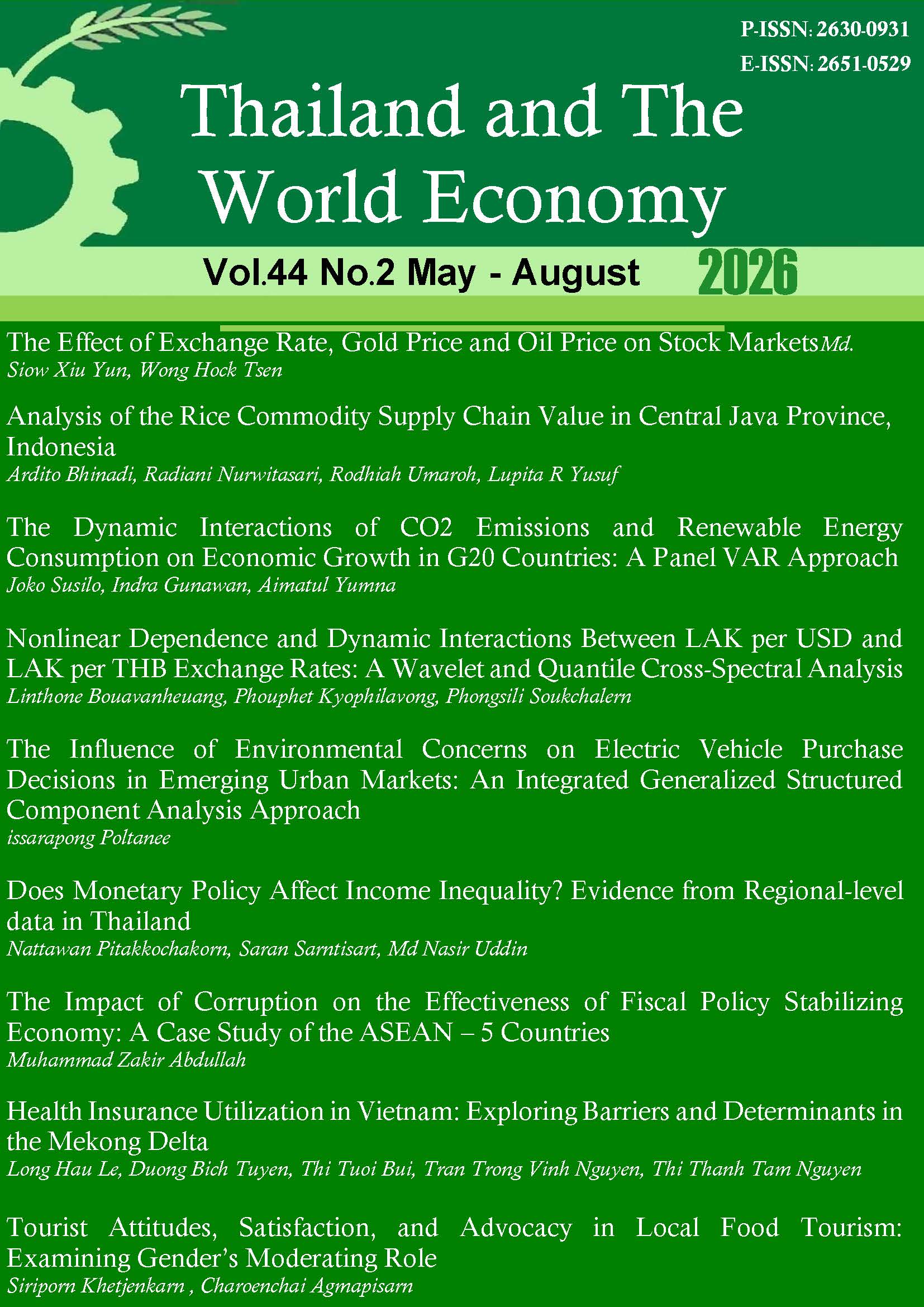
The Dynamic Interactions of CO2 Emissions and Renewable Energy Consumption on Economic Growth in G20 Countries: A Panel VAR Approach
DOI:
https://doi.org/10.66445/twe.v44i2.274783Keywords:
GDP, C02 Emissions, Renewable Energy Consumption, Panel VAR, G20 CountriesAbstract
The interactions among CO2 emissions, renewable energy consumption, and economic growth are highly interconnected, especially among the G20 countries, and significantly impact global CO2 emissions and the global economy. Therefore, we need a more comprehensive understanding to take action to harmonize economic growth with sustainable development. This research will examine the dynamic interaction between C02 emissions and renewable energy consumption on economic growth in G20 countries. In addition, this study uses Panel Vector Autoregression (VAR) methodology over the period 1990 to 2022 and includes several critical phases. This included unit root tests to assess the statistical validity of the data, cointegration tests to determine temporal changes among the variables, and impulse response function tests along with variance decomposition to determine the impact of shocks to one variable on another. The study findings show a correlation between emissions, renewable energy consumption, and economic growth in G20 countries. The results show that CO2 emissions have a favorable short-term effect, boosting GDP growth and economic activity. In contrast, C02 emissions and GDP show negative consequences in the long run. In addition, we confirm that the short-term correlation between renewable energy consumption and GDP is negative. However, the utilization of renewable energy sources has a positive impact in the long run. Therefore, G20 countries should implement renewable energy policies to promote economic growth, achieve sustainable development goals, and mitigate C02 emissions in the short and long term.
References
Abrigo, M. R. M., & Love, I. (2016). Estimation of Panel Vector Autoregression in Stata. The
Stata Journal: Promoting Communications on Statistics and Stata, 16(3), 778–804.
https://doi.org/10.1177/1536867X1601600314
Adebayo, T. S., Rjoub, H., Akinsola, G. D., & Oladipupo, S. D. (2022). The asymmetric effects
of renewable energy consumption and trade openness on carbon emissions in Sweden: New
evidence from quantile-on-quantile regression approach. Environmental Science and
Pollution Research, 29(2), 1875–1886. https://doi.org/10.1007/s11356-021-15706-4
Alajlan, N., & Alreshaidi, A. (2022). The nexus of carbon dioxide emissions, economic growth,
and urbanization in Saudi Arabia. Environmental Research Communications, 4(12),
https://doi.org/10.1088/2515-7620/acabb6
Alakbarov, N., Gündüz, M., & Şaşmaz, M. Ü. (2024). Exploring the link between economic
growth, energy consumption, and environmental pollution in G20. Natural Resources
Forum, 1477-8947.12440. https://doi.org/10.1111/1477-8947.12440
Alyasari, H. H. A., & Alzawbaee, O. M. M. (2020). Panel Data Evidence on the Relationship
between Economic Growth, Electricity Consumption and CO 2 Emissions in the GCC. The
Scientific Journal of Cihan University – Sulaimanyia, 4(1), 33–37.
http://dx.doi.org/10.25098/4.1.24
Aye, G. C., & Edoja, P. E. (2017). Effect of economic growth on CO2 emission in developing
countries: Evidence from a dynamic panel threshold model. Cogent Economics & Finance,
(1), 1379239. https://doi.org/10.1080/23322039.2017.1379239
Bery, S., Biondi, F., & Brekelmans, S. (2019). Twenty years of the G20: Has it changed global
economic governance? Russian Journal of Economics, 5(4), 412–440.
https://doi.org/10.32609/j.ruje.5.49435
Bhuiyan, M. A., Zhang, Q., Khare, V., Mikhaylov, A., Pinter, G., & Huang, X. (2022). Renewable
Energy Consumption and Economic Growth Nexus—A Systematic Literature Review.
Frontiers in Environmental Science, 10, 878394.
https://doi.org/10.3389/fenvs.2022.878394
Feriansyah, F., Nugroho, H., Larre, A. A., Septiavin, Q., & Nisa, C. K. (2022a). Economic Growth
and CO2 Emission in ASEAN: Panel-ARDL Approach. 68(2).
Feriansyah, F., Nugroho, H., Larre, A. A., Septiavin, Q., & Nisa, C. K. (2022b). Economic Growth
and CO2 Emission in ASEAN: Panel-ARDL Approach. UI Scholars Hub, 68(2).
https://scholarhub.ui.ac.id/efi/vol68/iss2/4
Gillani, S., & Sultana, B. (2020). Empirical Relationship between Economic Growth, Energy
Consumption and CO2 Emissions: Evidence from ASEAN Countries. iRASD Journal of
Energy & Environment, 1(2), 83–93. https://doi.org/10.52131/jee.2020.0102.0008
González-Álvarez, M. A., & Montañés, A. (2023). CO2 emissions, energy consumption, and
economic growth: Determining the stability of the 3E relationship. Economic Modelling,
, 106195. https://doi.org/10.1016/j.econmod.2023.106195
Grossman, G. M., & Krueger, A. B. (1995). Economic Growth and the Environment. The
Quarterly Journal of Economics, 110(2), 353–377. https://doi.org/10.2307/2118443
Islam, R., Bhatti, M. K., Sundas, Hassan, A., & Shaukat, S. (2023). The Effect of Non-Renewable
and Renewable Energy Consumption on CO2 Emissions: Evidence from Pakistan. iRASD
Journal of Economics, 5(3), 776–785. https://doi.org/10.52131/joe.2023.0503.0160
Khoshnevis Yazdi, S., & Dariani, A. G. (2019). CO2 emissions, urbanisation and economic
growth: Evidence from Asian countries. Economic Research-Ekonomska Istraživanja,
(1), 510–530. https://doi.org/10.1080/1331677X.2018.1556107
Khoshnevis Yazdi, S., & Shakouri, B. (2017). Renewable energy, nonrenewable energy
consumption, and economic growth. Energy Sources, Part B: Economics, Planning, and
Policy, 12(12), 1038–1045. https://doi.org/10.1080/15567249.2017.1316795
Lütkepohl, H. (2005). New introduction to multiple time series analysis. New York : Springer.
Mardani, A., Streimikiene, D., Nilashi, M., Arias Aranda, D., Loganathan, N., & Jusoh, A. (2018).
Energy Consumption, Economic Growth, and CO2 Emissions in G20 Countries:
Application of Adaptive Neuro-Fuzzy Inference System. Energies, 11(10), 2771.
https://doi.org/10.3390/en11102771
Marinaș, M.-C., Dinu, M., Socol, A.-G., & Socol, C. (2018). Renewable energy consumption and
economic growth. Causality relationship in Central and Eastern European countries. PLOS
ONE, 13(10), e0202951. https://doi.org/10.1371/journal.pone.0202951
Mendoza, A. A., Garret T. Reyes, K. D., D. Soriano, P. A., & Cabauatan, R. (2021). The Impact
of CO2 Emissions on the GDP per Capita, Employment Rate and Energy Consumption ofChina, Korea and Japan. Malaysian Journal of Social Sciences and Humanities (MJSSH),
(11), 315–333. https://doi.org/10.47405/mjssh.v6i11.1134
Mitić, P., Fedajev, A., Radulescu, M., & Rehman, A. (2022). The relationship between CO2
emissions, economic growth, available energy, and employment in SEE countries.
Environmental Science and Pollution Research, 30(6), 16140–16155.
https://doi.org/10.1007/s11356-022-23356-3
Niyonzima, P., Yao, X., & Ofori, E. K. (2022). How Do Economic Growth and the Emissions of
Carbon Dioxide Relate? OALib, 09(03), 1–16. https://doi.org/10.4236/oalib.1108516
Ntanos, S., Skordoulis, M., Kyriakopoulos, G., Arabatzis, G., Chalikias, M., Galatsidas, S.,
Batzios, A., & Katsarou, A. (2018). Renewable Energy and Economic Growth: Evidence
from European Countries. Sustainability, 10(8), 2626. https://doi.org/10.3390/su10082626
Osobajo, O. A., Otitoju, A., Otitoju, M. A., & Oke, A. (2020). The Impact of Energy Consumption
and Economic Growth on Carbon Dioxide Emissions. Sustainability, 12(19), 7965.
https://doi.org/10.3390/su12197965
Pata, U. K., Dam, M. M., & Kaya, F. (2022). How effective are renewable energy, tourism, trade
openness, and foreign direct investment on CO2 emissions? An EKC analysis for ASEAN
countries. Environmental Science and Pollution Research, 30(6), 14821–14837.
https://doi.org/10.1007/s11356-022-23160-z
Pertiwi, R., Asngari, I., Melliny, V. D., Febrian, & Gustriani. (2024). Do the G20 Countries’
Increased Economic Growth, Foreign Direct Investment, Industry Value-added, and
Population Change Contribute to CO2 Emissions? Jurnal Ekonomi Pembangunan, 21(2),
–174. https://doi.org/10.29259/jep.v21i2.22984
Saidi, K., & Hammami, S. (2015). The impact of CO2 emissions and economic growth on energy
consumption in 58 countries. Energy Reports, 1, 62–70.
https://doi.org/10.1016/j.egyr.2015.01.003
Shahbaz, M., Raghutla, C., Chittedi, K. R., Jiao, Z., & Vo, X. V. (2020). The effect of renewable
energy consumption on economic growth: Evidence from the renewable energy country
attractive index. Energy, 207, 118162. https://doi.org/10.1016/j.energy.2020.118162
Shahbaz, M., Sbia, R., Hamdi, H., & Ozturk, I. (2014). Economic growth, electricity consumption,
urbanization and environmental degradation relationship in United Arab Emirates.
Ecological Indicators, 45, 622–631. https://doi.org/10.1016/j.ecolind.2014.05.022
Sucahyo, R., & Arsala Rahmani, A. (2023, September 5). G20 Per Capita Coal Power Emissions
https://ember-climate.org/app/uploads/2023/09/G20-Per-Capita-Coal-Power-
Emissions-2023.pdf
Suproń, B., & Myszczyszyn, J. (2023). Impact of Renewable and Non-Renewable Energy
Consumption and CO2 Emissions on Economic Growth in the Visegrad Countries.
Energies, 16(20), 7163. https://doi.org/10.3390/en16207163
Taylan, O., Alkabaa, A. S., & Yılmaz, M. T. (2022). Impact of COVID-19 on G20 countries:
Analysis of economic recession using data mining approaches. Financial Innovation, 8(1),
https://doi.org/10.1186/s40854-022-00385-y
UNDP. (2021, October 25). The G20 Peoples’ Climate Vote 2021 [Https://www.undp.org/].
https://www.undp.org/publications/g20-peoples-climate-vote-2021
Vo, A., Vo, D., & Le, Q. (2019). CO2 Emissions, Energy Consumption, and Economic Growth:
New Evidence in the ASEAN Countries. Journal of Risk and Financial Management,
(3), 145. https://doi.org/10.3390/jrfm12030145
Wang, L., Javeed Akhtar, M., Naved Khan, M., Asghar, N., Rehman, H. U., & Xu, Y. (2024).
Assessing the environmental sustainability gap in G20 economies: The roles of economic
growth, energy mix, foreign direct investment, and population. Heliyon, 10(4), e26535.
https://doi.org/10.1016/j.heliyon.2024.e26535
Yan, K., Gupta, R., & Wong, V. (2022). CO2 Emissions in G20 Nations through the Three-Sector
Model. Journal of Risk and Financial Management, 15(9), 394.
https://doi.org/10.3390/jrfm15090394
Zhang, S., Lundgren, T., & Zhou, W. (2015). Environmental Investment and Firm Performance:
A Panel VAR Approach. SSRN Electronic Journal. https://doi.org/10.2139/ssrn.2687978
Downloads
Published
How to Cite
Issue
Section
Categories
License
Copyright (c) 2026 Thailand and The World Economy

This work is licensed under a Creative Commons Attribution-NonCommercial-NoDerivatives 4.0 International License.