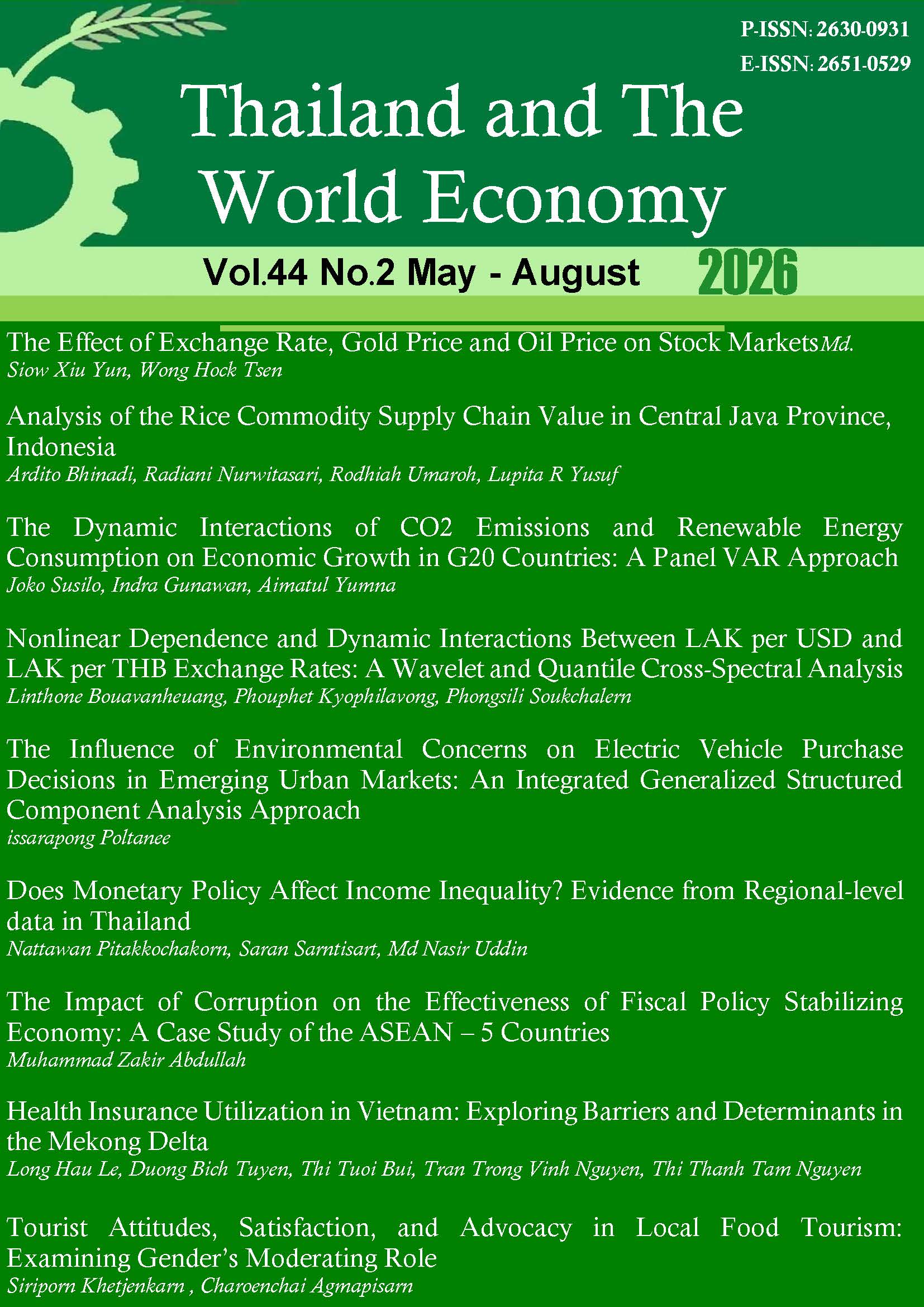
The Influence of Environmental Concerns on Electric Vehicle Purchase Decisions in Emerging Urban Markets: An Integrated Generalized Structured Component Analysis Approach
DOI:
https://doi.org/10.66445/twe.v44i2.275969Keywords:
Electric Vehicles, Consumer Behavior, IGSCA, Purchase Decision, Perception of needsAbstract
This study examines the factors influencing electric vehicle (EV) purchase decisions in Bangkok, employing Integrated Generalized Structured Component Analysis (IGSCA) to test a causal relationship model. We investigated the mediating roles of Information Search and Evaluation of Alternatives in the relationship between Perception of Needs and the final Purchase Decision (modeled as Vehicle Brand preference). Data were collected from potential EV buyers using a validated questionnaire. The analysis utilized IGSCA for its ability to handle mixed-factor component models, complemented by confirmatory factor analysis to validate the measurement model. Additionally, we employed moderation analysis to examine the interaction effects between key variables. The structural equation modeling revealed significant mediation effects, with the model demonstrating robust fit and explaining a substantial portion of Vehicle Brand variance. Notably, the hypothesized moderating role of Evaluation of Alternatives was statistically significant (β = 0.108, p < 0.001), revealing that EA strengthens the relationship between Information Search and Vehicle Brand. These findings suggest a paradigm shift in EV marketing strategies, emphasizing the importance of engaging consumers in comprehensive evaluation processes. For policymakers, our results underscore the need for a holistic approach to EV promotion, integrating consumer education with infrastructure development. This research advances the understanding of consumer behavior in emerging technology markets, providing a valuable framework for future studies on sustainable transportation adoption. Our methodological approach offers a robust template for analyzing complex consumer decision-making processes in high-involvement purchases.
References
Axsen, J., & Kurani, K. S. (2013). Connecting plug-in vehicles with green electricity through consumer demand. Environmental Research Letters, 8(1).
Benitez, J., Henseler, J., Castillo, A., & Schuberth, F. (2020). How to perform and report an impactful analysis using partial least squares: Guidelines for confirmatory and explanatory IS research. Information & Management, 57(2).
Bi, C., Jin, S., Li, S., & Li, Y. (2023). Can green advertising increase consumers’ purchase intention of electric vehicles? An Experimental study from China. Journal of Cleaner Production, 419(2).
Buhmann, K. M., & Rialp Criado, J. (2023). Consumers' preferences for electric vehicles: The role of status and reputation. Transportation Research Part D: Transport and Environment, 114.
Chakraborty, D., Bunch, D. S., Lee, J. H., & Tal, G. (2019). Demand drivers for charging infrastructure: Charging behavior of plug-in electric vehicle commuters. Transportation Research Part D: Transport and Environment, 76, 255–272.
Cho, G., Hwang, H., Sarstedt, M., & Ringle, C. (2020). Cutoff criteria for overall model fit indexes in generalized structured component analysis. Journal of Marketing Analytics, 8(4), 189–202.
Chen, C. F., Rubins, P. D., Noel, L., Kester, J., & Sovacool, B. K. (2020). Assessing the socio-demographic, technical, economic and behavioral factors of Nordic electric vehicle adoption and the influence of vehicle-to-grid preferences. Renewable and Sustainable Energy Reviews, 121.
Chen, Y., Cao, W., & Wang, K. (2025). Purchase intention of new energy vehicles: A comprehensive analysis considering total cost of ownership and personality traits. Transportation Research Part F: Traffic Psychology and Behaviour, 114, 701–720.
Dutta, B., & Hwang, H.-G. (2021). Consumers purchase intentions of green electric vehicles: The influence of consumers technological and environmental considerations. Sustainability, 13(21).
Energy Policy and Planning Office. (2023). Thailand electric vehicle usage situation in 2022. Ministry of Energy, Thailand. Retrieved from https://www.eppo.go.th/index.php/th/conservation/ev-content
Fu, X. (2024). Understanding the adoption intention for electric vehicles: The role of hedonic-utilitarian values. Energy, 301.
Gold, A. H., Malhotra, A., & Segars, A. H. (2001). Knowledge management: An organizational capabilities Perspective. Journal of Management Information Systems, 18(1), 185-214.
Hardman, S., Jenn, A., Tal, G., Axsen, J., Beard, G., Daina, N., Figenbaum, E., Jakobsson, N., Jochem, P., Kinnear, N., Plötz, P., Pontes, J., Refa, N., Sprei, F., Turrentine, T., & Witkamp, B. (2018). A review of consumer preferences of and interactions with electric vehicle charging infrastructure. Transportation Research Part D: Transport and Environment, 62, 508–523
Hair, J. F., Black, W. C., Babin, B. J., & Anderson, R. E. (2010). Multivariate data analysis (7th ed.). Upper Saddle River, NJ: Prentice Hall.
Hair, J. F., Jr., Ringle, C. M., & Sarstedt, M. (2015). PLS-SEM: Indeed a silver bullet. Journal of Marketing Theory and Practice, 19(2), 123–146.
Hair Jr, J. F., Howard, M. C., & Nitzl, C. (2020). Assessing measurement model quality in PLS-SEM using confirmatory composite analysis. Journal of Business Research, 109, 101-110.
Hahnel, U. J., Ortmann, C., Korcaj, L., & Spada, H. (2014). What is green worth to you? Activating environmental values lowers price sensitivity towards electric vehicles. Journal of Environmental Psychology, 40, 306-319.
Hayes, A. F. (2022). Introduction to mediation, moderation, and conditional process analysis: A regression-based approach (3rd ed.). New York, NY:The Guilford Press.
Henseler, J., Ringle, C. M., & Sarstedt, M. (2015). A new criterion for assessing discriminant validity in variance-based structural equation modeling. Journal of the Academy of Marketing Science, 43, 115-135.
Hu, X., Yusof, R. N. R., & Mansor, Z. D. (2025). Consumers’ purchase intentions towards new energy vehicles based on the theory of planned behaviour on perceived value: An empirical survey of China. World Electric Vehicle Journal, 16(3).
Hwang, H., Cho, G., Jung, C. F., Flake, J. K., Jin, M. K., & Lee, S. H. (2020). An approach to structural equation modeling with both factors and components: Integrated generalized structured component analysis. Psychological Methods, 26(3), 273–294.
Hwang, H., Sarstedt, M., Cho, G., Choo, H., & Ringle, C. M. (2023). A primer on integrated generalized structured component analysis. European Business Review, 35(3), 261–284.
International Energy Agency. (2023). Global EV outlook 2023: Catching up with climate ambitions. Paris, France: IEA. Retrieved from https://www.iea.org/reports/global-ev-outlook-2023
Irfan, M., & Ahmad, M. (2021). Relating consumers' information and willingness to buy electric vehicles: Does personality matter?. Transportation Research Part D: Transport and Environment, 100.
Kotler, P., Keller, K. L., & Chernev, A. (2021). Marketing management (16th ed.). Hoboken, NJ: Pearson Education.
Lazzeroni, P., Cirimele, V., & Canova, A. (2021). Economic and environmental sustainability of dynamic wireless power transfer for electric vehicles supporting reduction of local air pollutant emissions. Renewable and Sustainable Energy Reviews, 138.
Li, L., Wang, Z., & Wang, Q. (2020). Do policy mix characteristics matter for electric vehicle adoption? A survey-based exploration. Transportation Research Part D: Transport and Environment, 87.
Manosuthi, N., Lee, J. S., & Han, H. (2022). Investigating residents’ support for Muslim tourism: The application of IGSCA-SEM and fsQCA. Journal of Travel & Tourism Marketing, 39(4), 412-431.
Meise, J.N., Rudolph, T., Kenning, P., & Phillips, D.M. (2014). Feed them facts: Value perceptions and consumer use of sustainability-related product information. Journal of Retailing and Consumer Services, 21, 510–519.
Meliana, M., & Pangaribuan, C. H. (2024). Analysis of factors that influence the purchase intention of electric vehicles in Indonesia: An extended theory of planned behavior approach. Journal of Social Science, 3(12), 2019–2039.
Patt, A., Aplyn, D., Weyrich, P., & van Vliet, O. (2019), Availability of private charging infrastructure influences readiness to buy electric cars. Transportation Research Part A:Policy and Practice, 125, 1-7.
Plananska, J., Wüstenhagen, R., & Del Bellis, E. (2023). Perceived lack of masculinity as a barrier to adoption of electric cars? An empirical investigation of gender associations with low-carbon vehicles. Travel Behavior and Society, 32.
Richter, N. F., Hauff, S., Ringle, C. M., & Gudergan, S. P. (2022). The use of partial least squares structural equation modeling and complementary methods in international management research. Management International Review, 62(4), 449-470.
Reuters. (2025, January 31). Thai EV output set to jump, sparking a price war in a bruised market. Retrieved from Reuters. https://www.reuters.com/business/autos-transportation/thai-ev-output-set-jump-sparking-price-war-bruised-market-2025-01-31/
Rasoolimanesh, S. M. (2022). Discriminant validity assessment in PLS-SEM: A comprehensive composite-based approach. Data Analysis Inspective Journal, 3(2), 1-8.
Raza, S., & Masmoudi, M. (2020). Consumer vehicle purchase decision-making during COVID-19. In 2020 International Conference on Decision Aid Sciences and Application (DASA). University of Bahrain, Sakheer, Bahrain.
Rezvani, Z., Jansson, J., & Bodin, J. (2015). Advances in consumer electric vehicle adoption research: A review and research agenda. Transportation Research Part D: Transport and Environment, 34, 122-136.
Sanguesa, J.A., Torres-Sanz, V., Garrido, P., Martinez, F.J., & Marquez-Barja, J.M. (2021). A Review on electric vehicles: Technologies and challenges. Smart Cities, 4(1), 372-404.
Samarasinghe, D., Kuruppu, G. N., & Dissanayake, T. (2024). Factors influencing the purchase intention toward electric vehicles; A nonuser perspective. South Asian Journal of Marketing, 5(2), 149–165.
Singh, V., Singh, V., & Vaibhav, S. (2020). A review and simple meta-analysis of factors influencing adoption of electric vehicles. Transportation Research Part D: Transport and Environment, 86.
Srivastava, A., Gautam, V., & Sharma, V. (2023). Does consideration for future consequences matter in consumer Decision to rent electric vehicles?. Energy Policy, 181.
Teo, T. S., Srivastava, S. C., & Jiang, L. (2008). Trust and electronic government success: An empirical study. Journal of Management Information Systems, 25(3), 99-132.
Trope, Y., & Liberman, N. (2010). Construal-level theory of psychological distance. Psychological Review, 117(2), 440–463.
Yeğin, T., & Ikram, M. (2022). Analysis of consumers' electric vehicle purchase intentions: An expansion of the theory of planned behavior. Sustainability, 14(19).
Yin, Y.-R., Li, Y., & Zhang, Y. (2022). Influencing factor analysis of household electric vehicle purchase intention of HaiNan Free Trade Port under the background of low-carbon lifestyle. Energy Reports, 8, 569–579.
Zhang, T., Gensler, S., & Garcia, R. (2011). A study of the diffusion of alternative fuel vehicles: An agent-based modeling approach. Journal of Product Innovation Management, 28(2), 152-168.
Zhang, W., Wang, S., Wan, L., Zhang, Z., & Zhao, D. (2022). Information perspective for understanding consumers' perceptions of electric vehicles and adoption intentions. Transportation Research Part D: Transport and Environment, 102.
Downloads
Published
How to Cite
Issue
Section
Categories
License
Copyright (c) 2026 Thailand and The World Economy

This work is licensed under a Creative Commons Attribution-NonCommercial-NoDerivatives 4.0 International License.