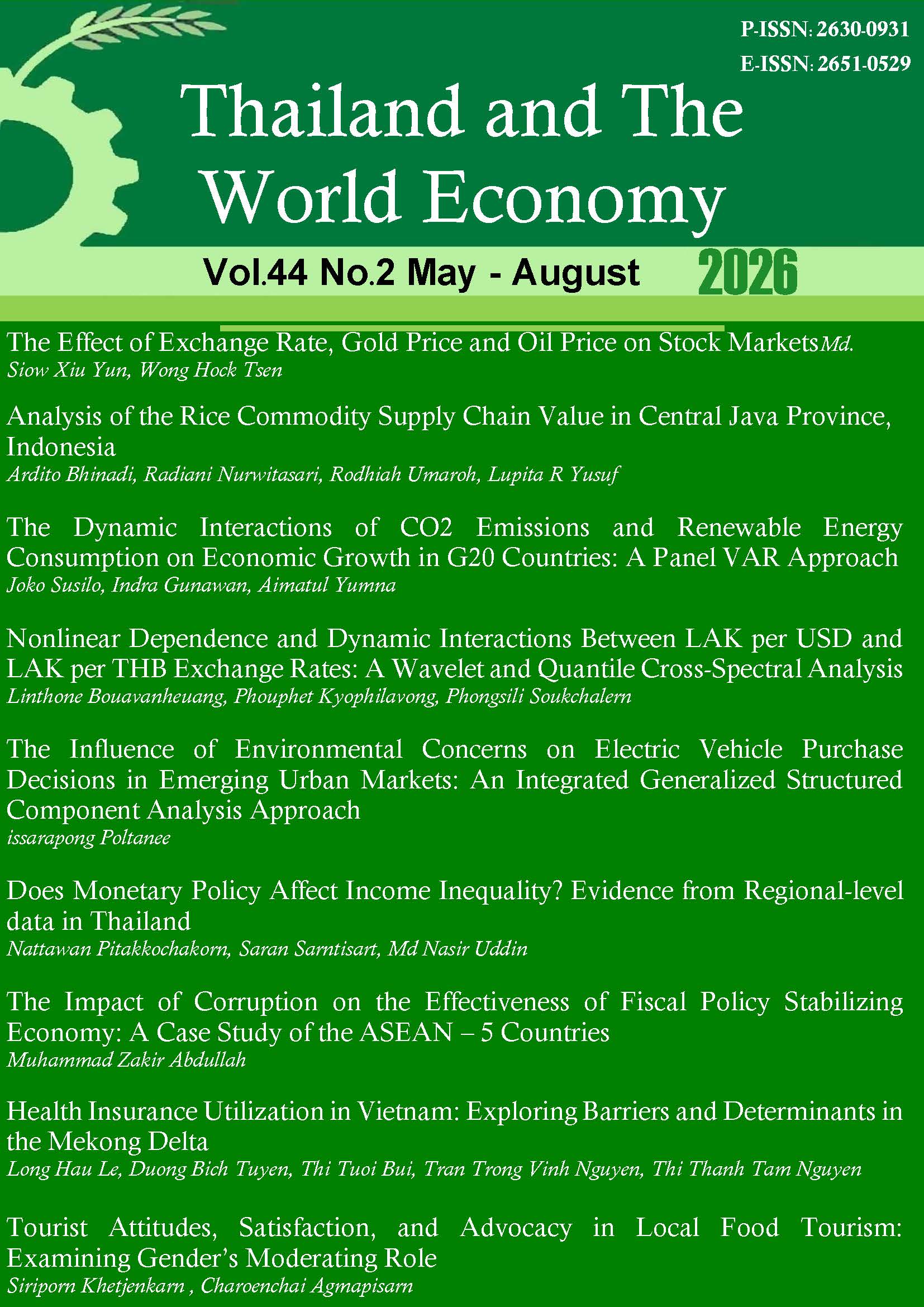
Does Monetary Policy Affect Income Inequality? Evidence from Regional-level data in Thailand
DOI:
https://doi.org/10.66445/twe.v44i2.276004Keywords:
Monetary Policy, Income Inequality, Regional-level Model in Thailand, ARDL Approach, SUR EstimatesAbstract
This study investigates whether monetary policy affects regional income inequality in Thailand through different channels. The study uses regional-level data from 2011 to 2022 and employs a panel ARDL approach, FGLS and SUR estimates. Monetary policy effectively propagates regional income inequality through aggregate income channels, housing price channels, and interest rate channels. Those channels show that easing monetary policy can mitigate regional income inequality. A negative coefficient is found for the housing price channel, indicating that the easing of monetary policy induces an increase in housing prices but a decrease in rental prices, so the low-end distribution, who mostly cannot afford the house would benefit from a lower rental rate. In addition, Bangkok Metropolitan Region is more sensitive to changes in monetary policy than other regions. These findings suggest new insights for policymakers and the government an easing monetary measure can mitigate regional inequality via economic stimulation through various channels. Therefore, the central bank may need to consider the impacts of monetary policy on regional disparities, as each region has distinct characteristics that lead to varying effects.
References
Adam, K., & Zhu, J. (2016). Price-level changes and the redistribution of nominal wealth across the Euro Area. Journal of the European Economic Association, 14(4), 871-906.
Ahiadorme, J. W. (2022). Monetary policy transmission and income inequality in Sub-Saharan Africa. Economic Change and Restructuring, 55(3), 1555-1585.
Ahiadorme, E. K., & Worlani, E. V. (2020). Monetary policy, income inequality and earnings heterogeneity in Sub-Saharan Africa. Journal of African Economies, 29(4), 427-456. https://doi.org/10.1093/jae/ejaa012
Aiyar, S., Calomiris, C. W., & Wieladek, T. (2014). Does macro‐prudential regulation leak? Evidence from a UK policy experiment. Journal of Money, Credit and Banking, 46(s1), 181-214.
Ali, A. F. M. (2019). Difference between income and expenditure method in measuring poverty in Kelantan, Malaysia. International Journal of Economics, Management and Accounting, 27(1), 1-40.
Albanesi, S. (2007). Inflation and inequality. Journal of monetary Economics, 54(4), 1088-1114.
Albert, J.-F., Peñalver, A., & Perez-Bernabeu, A. (2020). The effects of monetary policy on income and wealth inequality in the US Exploring different channels. Structural Change and Economic Dynamics, 55, 88-106.
Albuquerque, B., Iseringhausen, M., & Opitz, F. (2024). The housing supply channel of monetary policy. SSRN 4807945. Retrieved from https://ssrn.com/abstract=4807945
Alves, J., & Silva, T. (2021). An empirical assessment of monetary policy channels in income and wealth disparities. Comparative Economic Studies, 63, 432-449.
Amaral, P. S. (2017). Monetary policy and inequality. Economic Commentary(2017-01). Retrieved from https://www.clevelandfed.org/publications/economic-commentary/2017/ec-201701
Ampudia, M., Georgarakos, D., Slacalek, J., Tristiani, O., Vermeulen, P., & Violante, G. L. (2018). Monetary policy and household inequality. ECB Working Paper No. 2170. Retrieved from https://www.ecb.europa.eu/pub
/pdf/scpwps/ecb.wp2170.en.pdf
Auclert , A. (2019). Monetary policy and the redistribution channel. American Economic Review, 109(6), 2333-2367.
Aye, G. C., Harris, L., & Chiweza, J. T. (2020). Monetary policy and wealth inequality in South Africa: Evidence from tax administrative data. WIDER Working Paper No. 2020/174. Retrieved from European Central Bank https://www.econstor.eu/handle/10419/229398
Battistini, N., Falagiarda, M., Hackmann, A., & Roma, M. (2022). Navigating the housing channel of monetary policy across euro area regions (ECB Working Paper Series No. 2752). Retrieved from European Central Bank https://www.ecb.europa.eu/pub/pdf/scpwps/ecb.wp2752~efbdb19d8b.en.pdf
Bellù, L. G., & Liberati, P. (2006). Inequality analysis: The Gini index (EASYPol Module 040). Retrieved from Food and Agriculture Organization of the United Nations https://openknowledge.fao.org/items/5ef3c84d-b904-4500-b81f-ab3de28bfd90
Bonnet, O., Bono, P. H., de La Chapelle, G. F., & Wasmer, E. (2014). Does housing capital contribute to inequality? A comment on Thomas Piketty’s Capital in the 21st Century. Sciences Po LIEPP Working Paper No. 2014-07. Retrieved from https://sciencespo.hal.science/hal-03460508
Binder, C. (2019). Inequality and the inflation tax. Journal of Macroeconomics, 61.
Carpenter, S. B., & Rodgers III, W. M. (2004). The disparate labor market impacts of monetary policy. Journal of Policy Analysis and Management, 23(4), 813-830.
Casiraghi, M., Gaiotti, E., Rodano, L., & Secchi, A. (2018). A “reverse Robin Hood”? The distributional implications of non-standard monetary policy for Italian households. Journal of International Money and Finance, 85, 215-235.
Cerutti, E., Claessens, S., & Laeven, L. (2017). The use and effectiveness of macroprudential policies: New evidence. Journal of financial stability, 28, 203-224.
Claessens, S., Ghosh, S. R., & Mihet, R. (2013). Macro-prudential policies to mitigate financial system vulnerabilities. Journal of International Money and Finance, 39, 153-185.
Claeys, G., Darvas, Z. M., Leandro, A., & Walsh, T. (2015). The effects of ultra-loose monetary policies on inequality. Bruegel Policy Contribution No. 2015/09. Retrieved from https://www.bruegel.org/system/files/wp_attachments/pc_2015_09-.pdf
Chiu, Y. B., & Lee, C. C. (2019). Financial development, income inequality, and country risk. Journal of International Money and Finance, 93, 1-18.
Coibion, O., Gorodnichenko, Y., Kueng, L., & Silvia, J. (2017). Innocent Bystanders? Monetary policy and inequality. Journal of monetary Economics, 88, 70-89.
Colciago, A., Samarina, A., & de Haan, J. (2019). Central bank policies and income and wealth inequality: A survey. Journal of Economic Surveys, 33(4), 1199-1231.
Crowe, C. (2006). Inflation, inequality, and social conflict. IMF Working Paper No. 06/158. Retrieved from International Monetary Fund https://www.imf.org/external/pubs/ft/wp/2006/wp06158.pdf
da Silva, L. A. P. (2022). Inequality hysteresis and the effectiveness of macroeconomic stabilisation policies. Bank for International Settlements. Retrieved from https://www.bis.org/publ/othp50.pdf
Davtyan, K. (2017). The distributive effect of monetary policy: The top one percent makes the difference. Economic modelling, 65, 106-118.
de Groot, O., Hauptmeier, S., Holm-Hadulla, F., & Nikalexi, K. (2020). Monetary policy and regional inequality. European Central Bank Working Paper Series, No. 2385. Retrieved from https://www.ecb.europa.eu/pub/pdf/scpwps/ecb.wp2385~bc63eeb13b.en.pdf
Doepke, M., & Schneider, M. (2006). Inflation and the redistribution of nominal wealth. Journal of Political Economy, 114(6), 1069-1097.
Domanski, D., Scatigna, M., & Zabai, A. (2016). Wealth inequality and monetary policy. BIS Quarterly Review, March, 45-56.
El Herradi, M., & Leroy, A. (2019). Monetary policy and the top one percent: Evidence from a century of modern economic history. International Journal of Central Banking, 17(5), 169-217.
Erosa, A., & Ventura, G. (2002). On inflation as a regressive consumption tax. Journal of monetary Economics, 49(4), 761-795.
Feldkircher, M., & Kakamu, K. (2022). How does monetary policy affect income inequality in Japan? Evidence from grouped data. Empirical Economics, 62(5), 2307-2327.
Friedman, M. (1968). The role of monetary policy. In S. Estrin & A. Marin (Eds.), Essential Readings in Economics (pp. 215-231). London: Macmillan Education UK.
Frost, J., & Van Stralen, R. (2018). Macroprudential policy and income inequality. Journal of International Money and Finance, 85, 278-290.
Furceri, D., Loungani, P., & Zdzienicka, A. (2018). The effects of monetary policy shocks on inequality.Journal of International Money and Finance, 85, 168-186.
Galbraith, J. K. (1998). With economic inequality for all. Nation, 267(7), 24-26.
Galli, R. van der Hoeven (2001). Is inflation bad for income inequality, ILO Employment Paper, (19). Retrieved from http://www.ilo.org/public/english/employment/papers/2001/p19.htm
Georgescu, O.-M., & Vila Martín, D. (2021). Do macroprudential measures increase inequality? Evidence from the euro area household survey. ECB Working Paper Series No. 2567. Retrieved from European Central Bank. https://www.ecb.europa.eu/pub/pdf/scpwps/ecb.wp2567~92c5048dbb.en.pdf
Glawe, L., & Wagner, H. (2024). Inflation and inequality: New evidence from a dynamic panel threshold analysis. International Economics and Economic Policy, 21(2), 297-309.
Granger, H., Abramovsky, L., & Pudussery, J. (2022). Fiscal policy and income inequality: The role of taxes and social spending. Retrieved from Overseas Development Institute (ODI) https://odi.cdn.ngo/media/documents/ODI_Report_Fiscal_policy_and_income_inequality_the_role_of_taxes_and_social_sp_GwknCLd.pdf
Greenwood, J., & Jovanovic, B. (1990). Financial development, growth, and the distribution of income. Journal of political Economy, 98(5, Part 1), 1076-1107.
Haughton, J., & Khandker, S. R. (2009). Handbook on poverty and inequality. Retrieved from World Bank https://openknowledge.worldbank.org/handle/10986/25595
Huang, B., Morgan, P. J., & Yoshino, N. (2019). Demystifying rising inequality in Asia. Retrieved from Asian Development Bank Institutehttps://www.adb.org/publications/demystifying-rising-inequality-asia
Heathcote, J., Perri, F., & Violante, G. L. (2010). Unequal we stand: An empirical analysis of economic inequality in the United States, 1967–2006. Review of Economic dynamics, 13(1), 15-51.
Konstantinou, P., Rizos, A., & Stratopoulou, A. (2023). The dynamic effect of macroprudential policies on income inequality: Some evidence. Economics and Business Letters, 12(3), 248-265.
Laokulrach, M. (2011). The impacts of fiscal and monetary policies on employment: A study of Thailand from 1983-2008. Unpublished doctoral thesis, National Institute of Development Administration, Bangkok, Thailand. Retrieved from http://libdcms.nida.ac.th/thesis6/2011/b171111.pdf
Lenza, M., & Slacalek, J. (2024). How does monetary policy affect income and wealth inequality? Evidence from quantitative easing in the Euro area. Journal of Applied Econometrics , 39(5), 746-765.
Lewis-Beck, M. S., Bryman, A., & Liao, T. F. (Eds.) (2003). The SAGE encyclopedia of social science research methods (Vols. 1-3). Thousand Oaks, CA: Sage publications.
Liu, E., Guo, L., & Hu, T. (2024). Macroprudential policies and income inequality in China. Available at SSRN 4698096 https://papers.ssrn.com/sol3
/papers.cfm?abstract_id=4698096
Inui, M., Sudo, N., & Yamada, T. (2017). The effects of monetary policy shocks on inequality in Japan. BIS Working Papers No. 642. Retrieved from Bank for International Settlementshttps://www.bis.org/publ/work642.pdf
Magwedere, M. R., & Marozva, G. (2022). Monetary policy and inequality links: Should central banks be concerned?. Global Business Review. Retrieved from https://doi.org/10.1177/09721509221115227
Malovaná, S., Janků, J., & Hodula, M. (2023). Macroprudential policy and income inequality: The trade-off between crisis prevention and credit redistribution. Czech National Bank, Economic Research Department. Retrieved from https://www.cnb.cz/en/economic-research/research-publications/cnb-working-paper-series/Macroprudential-Policy-and-Income-Inequality-The-Trade-off-Between-Crisis-Prevention-and-Credit-Redistribution-00001/
Maneethai, P. (2021). Does increasing inflation lead to income inequality in Thailand and south-east Asia?. (Master's thesis, Chulalongkorn University, Bangkok, Thailand). Retrieved from https://digital.car.chula.ac.th/cgi/viewcontent.cgi?article=8621&context=chulaetd
Meh, C. A., Ríos-Rull, J.-V., & Terajima, Y. (2010). Aggregate and welfare effects of redistribution of wealth under inflation and price-level targeting. Journal of Monetary Economics, 57(6), 637-652.
Mumtaz, H., & Theophilopoulou, A. (2017). The impact of monetary policy on inequality in the UK. An empirical analysis. European Economic Review, 98, 410-423.
National Economic and Social Development Council. (2021). Rai-ngan sathannakan khwam lueam lam thang sangkhom lae setthakit khong prathet Thai Phoso 2564 [Report on the poverty and inequality situation in Thailand, 2021]. Retrieved from https://www.nesdc.go.th/download/report-on-the-analysis-of-poverty-and-inequality-situation-in-thailand-2021/
National Economic and Social Development Council. (2015). Rai-ngan sathannakan khwam lueam lam thang sangkhom lae setthakit khong prathet Thai Phoso 2558 [Report on the poverty and inequality situation in Thailand, 2015]. Retrieved from https://www.nesdc.go.th/download/report-on-the-analysis-of-poverty-and-inequality-situation-in-thailand-2015/
Park, J. (2021). Monetary policy and income inequality in Korea. Journal of the Asia Pacific Economy, 26(4), 766-793.
Pesaran, M. H. (2006). Estimation and inference in large heterogeneous panels with a multifactor error structure. Econometrica, 74(4), 967-1012.
Punzi, M. (2020). The distributional impact of monetary policy in SEACEN economies. Retrieved from SEACEN Research and Training Centre. https://www.seacen.org/research-papers/rp106-the-distributional-impact-of-monetary-policy-in-seacen-economies/
Romer, C. D., & Romer, D. H. (1998). Monetary policy and the well-being of the poor. NBER Working Paper No. 6793. National Bureau of Economic Research.
Retrieved from https://www.nber.org/papers/w6793.
Ruankham, W., & Sethapramote, Y. (2023). Distributional effects of monetary policy on income inequality: Evidence from Thailand. Southeast Asian Journal of Economics, 11(1), 1–42.
Samarina, A., & Nguyen, A. D. (2019). Does monetary policy affect income inequality in the euro area?. Journal of Money, Credit and Banking, 51(6), 941-981.
Sarntisart, I. (2020). Income inequality and conflicts: A Gini decomposition analysis. The Economics of Peace and Security Journal, 15(2), 66-82.
Singh, R., Kpodar, K., & Ghura, D. (2009). Financial deepening in the CFA Franc zone: The role of institutions. IMF Working Paper No. 09/113. Retrieved from International Monetary Fund https://www.imf.org/external/pubs/ft/wp/2009/wp09113.pdf
Tapasanan, P., & Ronaparp, P. (2020). The impact of monetary policy on income and wealth distribution: A case of Thailand. In M. T. Punzi (Ed.), The distributional impact of monetary policy in SEACEN member economies (pp. 163-196). SEACEN Research and Training Centre. Retrieved from
https://www.seacen.org/publications/RStudies/2020/RP106/Chapter_7-Thailand-DIST_IMPACT.pdf
Uddin, M. N., & Sarntisart, S. (2019). Human capital inequality and economic growth: evidence with sub-national data from Thailand. International Journal of Social Economics, 46(7), 938-956.
van der Hoeven, R. (2019). Income inequality in developing countries, past and present. In M. Nissanke & J. A. Ocampo (Eds.), The Palgrave Handbook of Development Economics: Critical Reflections on Globalisation and Development, (pp. 335-376). Switzerland : Palgrave Macmillan.
Zungu, L. T., & Greyling, L. (2022). Exploring the dynamic shock of unconventional monetary policy channels on income inequality: A panel VAR approach. Social Sciences, 11(8), 369.
Downloads
Published
How to Cite
Issue
Section
Categories
License
Copyright (c) 2026 Thailand and The World Economy

This work is licensed under a Creative Commons Attribution-NonCommercial-NoDerivatives 4.0 International License.