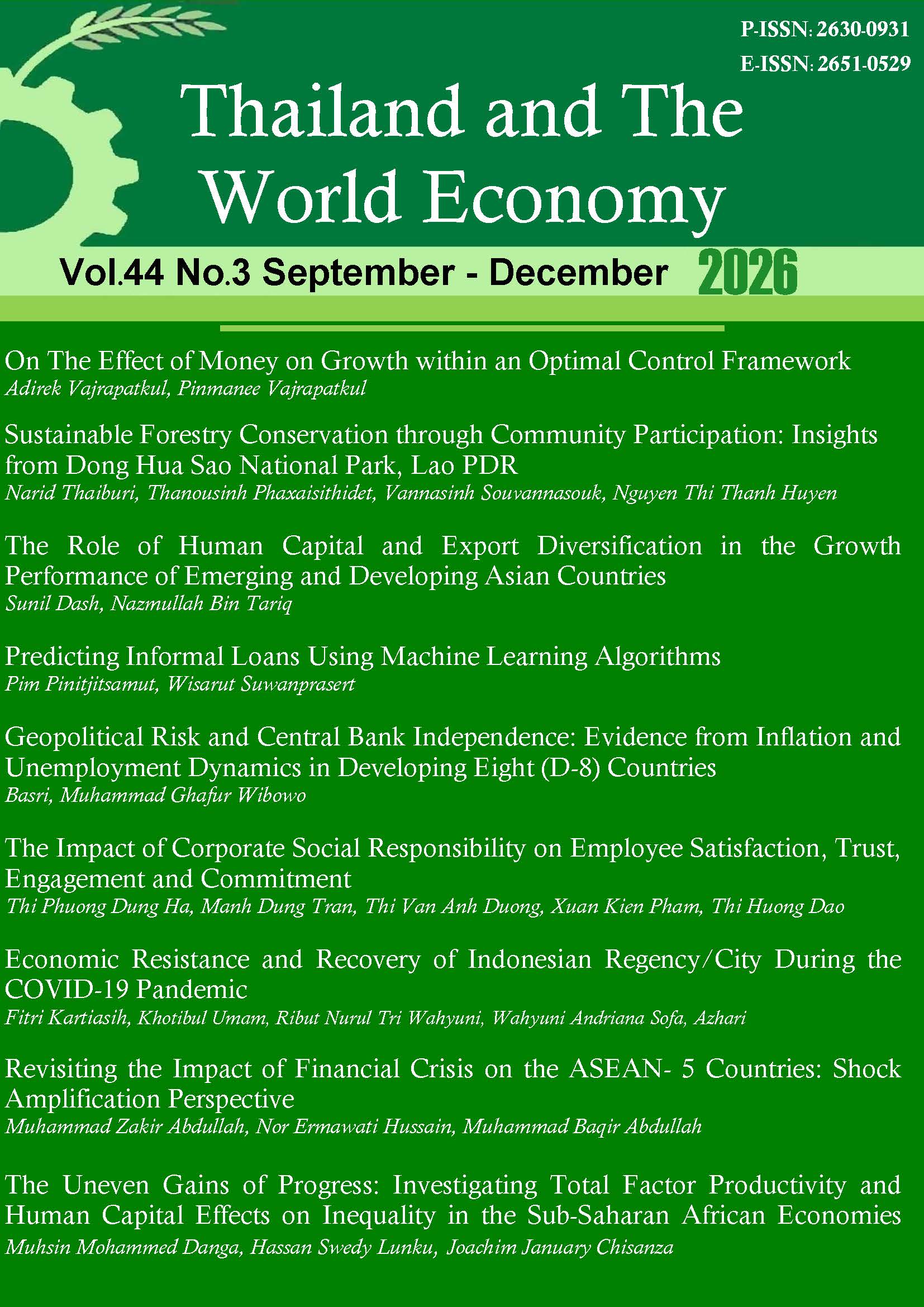
Sustainable Forestry Conservation through Community Participation: Insights from Dong Hua Sao National Park, Lao PDR
DOI:
https://doi.org/10.66445/twe.v44i3.276908Keywords:
Villager’s Participation, Sustainability Forestry Conservation, Protected Area Management, Dong Hua Sao National ParkAbstract
This study investigates the role of community participation in sustainable forestry conservation in Dong Hua Sao National Park, Lao PDR, using Structural Equation Modeling (SEM). Data were collected from 748 households across five villages, selected through stratified random sampling based on socio-economic diversity. Robustness checks using ordinary least squares (OLS) regression confirm the consistency of these results across methods. Results show that villagers’ participation significantly enhances forest resource management (β = 0.919, p < 0.001) and indirectly contributes to sustainable conservation outcomes (β = 0.684, p < 0.01). Confirmatory factor analysis confirmed the reliability and validity of the constructions. A supplementary robustness check using multiple regression supported the SEM findings. These results highlight the critical role of community engagement in strengthening conservation practices and ensuring the sustainability of protected areas. The study provides policy implications for participatory conservation strategies in Lao PDR and offers insights for comparative research in other protected areas across Southeast Asia.
References
Allendorf, T. D., Aung, M., & Songer, M. (2012). Using residents' perceptions to improve park-people relationships in Chatthin Wildlife Sanctuary, Myanmar. Journal of Environmental Management, 99, 36-43.
Alounsavath Master, P., & Kim, S. B. (2021). Economic feasibility of a sustainable production forest management system in Xaibouathong forest management area, Khammouan province, Lao PDR. Forest Science and Technology, 17(3), 119-124.
Anderson, J. C., & Gerbing, D. W. (1988). Structural equation modeling in practice: A review and recommended two-step approach. Psychological bulletin, 103(3), 411- 423. https://psycnet.apa.org/doi/10.1037/0033-2909.103.3.411
Arbuckle, J., & Wothke, W. (1999). AMOS 4.0 user’s guide. Chicago: Smallwaters Corporation.
Arbuckle, J. L. (2014). IBM® SPSS® Amos™ 23 User’s Guide. Chicago, IL: IBM Corporation.
Awung, N. S., & Marchant, R. (2016). Investigating the role of the local community as co-managers of the Mount Cameroon National Park Conservation Project. Environments, 3(4).
Belay, S., Amsalu, A., & Abebe, E. (2013). Awash National Park, Ethiopia: Use policy, ethnic conflict and sustainable resources conservation in the context of decentralization. African Journal of Ecology, 51(1), 122-129.
Berkmüller, K., Evans, T., Timmins, R., & Vongphet, V. (1995). Recent advances in nature conservation in the Lao PDR. Oryx, 29(4), 253-260.
Bisong, T. L., & Ogbonna, K. I. (2018). Socio-economic analysis of citizens’ participation in forest conservation in Ikom Agricultural Zone of Cross River State, Nigeria. Global Journal of Agricultural Sciences, 17(1), 65-69.
Bisong, T. L., Ogbonna, K. I., & Kyari, I. U. (2017). Effect of community participation in forest conservation in Ikom Agricultural Zone of Cross River State. Global Journal of Agricultural Sciences, 16(1), 31-35.
Boyle, J., Tappeiner II, J., Waring, R., & Smith, C. T. (2016). Sustainable forestry: Ecology and silviculture for resilient forests. Reference Module in Earth Systems and Environmental Sciences. Elsevier.
Buffum, B. (2020). Community forestry: Sustainability and equity issues. In Y. Wang (Ed.), Terrestrial ecosystems and biodiversity (2nd ed., pp. 135–142). Boca Raton, FL: CRC Press.
Chazdon, R. L., Gutierrez, V., Brancalion, P. H., Laestadius, L., & Guariguata, M. R. (2020). Co-creating conceptual and working frameworks for implementing forest and landscape restoration based on core principles. Forests, 11(6).
Chiwaya, C., & Mzuza, M. K. (2022). Factors influencing community participation in forestry management in Chiradzulu district, Malawi. Open Journal of Forestry, 12(2), 177-184.
Dinh, T. S., & Van Pham, T. (2023). Non-timber forest products in Cat Tien: Local use and sustainable management. Jurnal Manajemen Hutan Tropika, 29(1), 79-87.
Fischer, H. W., Chhatre, A., Duddu, A., Pradhan, N., & Agrawal, A. (2023). Community forest governance and synergies among carbon, biodiversity and livelihoods. Nature Climate Change, 13(12), 1340-1347.
Franklin, J. F., & Johnson, K. N. (2012). A restoration framework for federal forests in the Pacific Northwest. Journal of Forestry, 110(8), 429-439.
Fujita, Y., & Phanvilay, K. (2008). Land and forest allocation in Lao People's Democratic Republic: comparison of case studies from community-based natural resource management research. Society and Natural Resources, 21(2), 120-133.
Graham, J. W. (2009). Missing data analysis: Making it work in the real world. Annual Review of Psychology, 60, 549-576.
He, S., & Su, Y. (2022). Understanding residents’ perceptions of the ecosystem to improve park–people relationships in Wuyishan National Park, China. Land, 11(4), 532.
Htay, T. (2020). Community dependency and perceptions of a protected area in a threatened ecoregion of Myanmar. International Journal of Biodiversity and Conservation, 12(4), 240-252.
Inanç, S. (2017). Forest conservation knowledge-community perception within protected areas: the case of Karagöl-Sahara National Park. International Journal of Environment, Agriculture and Biotechnology, 2(6).
Khuu, D. T., Jones, P. J., & Ekins, P. (2021). A governance analysis of Con Dao National Park, Vietnam. Marine Policy, 127.
Kimaro, P. J. (2023). Community participation in sustainable forest management: A case of Nsieni forest in Hai District, Tanzania. East African Journal of Education and Social Sciences, 4(2), 169–174.
Kline, R. B. (2018). Response to Leslie Hayduk’s review of principles and practice of structural equation modeling. Canadian Studies in Population [ARCHIVES],
(3-4), 188-95.
Liu, J., & Innes, J. (2015). Participatory forest management in China: Key challenges and ways forward. International Forestry Review, 17(4), 477-484.
Lomax, R. G. (2004). A beginner's guide to structural equation modeling. Lawrence Erlbaum Associates, Publishers; Mahwah, New Jersey London.
Mäntymaa, E., Jokinen, M., Juutinen, A., Lankia, T., & Louhi, P. (2021). Providing ecological, cultural and commercial services in an urban park: A travel cost–contingent behavior application in Finland. Landscape and Urban Planning, 209.
Masozera, M. K., Alavalapati, J. R., Jacobson, S. K., & Shrestha, R. K. (2006). Assessing the suitability of community-based management for the Nyungwe Forest Reserve, Rwanda. Forest Policy and Economics, 8(2), 206-216.
Mendez, G., Galárraga, L., & Chiluiza, K. (2021, May). Showing academic performance predictions during term planning: Effects on students’ decisions, behaviors, and preferences. In Proceedings of the 2021 CHI conference on human factors in computing systems (pp. 1-17). https://doi.org/10.1145/3411764.3445718
Menzies, N. (1994). Forest and land management in Imperial China. Springer.
Muthmainnah, D., Rais, A. H., & Sibouthong, D. (2019). Developing habitat conservation suitable for Nam Xouang Reservoir, Vientiane Province, Lao PDR. Sriwijaya Journal of Environment, 4(2), 78-84.
Nyirarwasa, A., Han, F., Pan, X., Mind’je, R., Maniraho, A. P., Gasirabo, A., Udahogora, M., Mtewele, Z. F., & Umwali, E. D. (2020). Evaluating the relationship between National Park Management and local communities’ perceptions based on survey, a case of Nyungwe National Park, Rwanda. Journal of Geoscience and Environment Protection, 8(12), 108 -126
Olujobi, O., & Olajuyigbe, B. (2020). Socio-Economic contributions of forest products to rural livelihood: A Case study of Aramoko Forest Reserve Ekiti-State. Journal of Agriculture and Crops, 6(8), 105-112.
Persson, J., Ford, S., Keophoxay, A., Mertz, O., Nielsen, J. Ø., Vongvisouk, T., & Zörner, M. (2021). Large differences in livelihood responses and outcomes to increased conservation enforcement in a protected area. Human Ecology, 49, 597-616.
Persson, J., Andersson, K., & Fors, H. (2021). Scaling up community-based conservation: Challenges and recommendations. Conservation & Society, 19(2), 125–136.
Pham, T. T., Nguyen, T. D., Dao, C. T., Hoang, L. T., Pham, L. H., Nguyen, L. T., & Tran, B. K. (2021). Impacts of payment for forest environmental services in Cat Tien National Park. Forests, 12(7).
Pham, M., Sengdala, S., & Phanthanousone, K. (2021). Forest governance and community participation in Dong Hua Sao National Park, Laos. Environmental Policy and Law, 51(5), 312–324.
Phong, L. T. (2014). Good governance and tourism development in protected areas: The case of Phong Nha-Ke Bang National Park, Central Vietnam. Koedoe: African Protected Area Conservation and Science, 56(2), 1-10.
Sarr, D. A., & Puettmann, K. J. (2008). Forest management, restoration, and designer ecosystems: Integrating strategies for a crowded planet. Ecoscience, 15(1), 17-26.
Sawathvong, S. (2004). Experiences from developing an integrated land-use planning approach for protected areas in the Lao PDR. Forest Policy and Economics, 6(6), 553-566.
Sheng, C., Wang, Y., & Ye, S. (2020). Discussion on the national park management mode under China's National Park System: A case of Wuyishan National Park System Pilot Area. International Journal of Geoheritage and Parks, 8(4), 230-234.
Sheng, L., Qian, X., & Li, Q. (2020). Community-based forest management: Sustainability outcomes in protected areas. Ecosystem Services, 42.
Sirivongs, K., & Tsuchiya, T. (2012). Relationship between local residents' perceptions, attitudes and participation towards national protected areas: A case study of Phou Khao Khouay National Protected Area, central Lao PDR. Forest Policy and Economics, 21, 92-100.
Souwideth, J., Phiapalath, P., Thanh, H. D., Brakels, P., Van, T. P., & Luiselli, L. (2021). Ecology and conservation of the Laotian langur Trachypithecus laotum in a protected area of Laos (Southeast Asia). Diversity, 13(6).
Su, L., Wen, D., & Fu, L. (2022). Research on the boundary delimitation method of national park based on cultural service protection. Polish Journal of Environmental Studies, 31(1), 843-855.
Su, L., Niu, D., & Li, J. (2022). Community participation and conservation effectiveness in Lao PDR’s protected areas. Journal of Environmental Management, 312.
Tabot, A., Owuor, O., & Migosi, J. (2020). Influence of participatory project initiation on sustainable forest management in Saboti, Trans‐Nzoia County, Kenya. International Journal of Forestry Research, 2020(1).
Tang, X., & Adesina, J. A. (2022). Biodiversity conservation of national parks and nature-protected areas in West Africa: The case of Kainji National Park, Nigeria. Sustainability, 14(12).
Tang, R., & Adesina, O. (2022). Enhancing people’s participation in forest resource conservation: Lessons from Southeast Asia. Trees, Forests and People, 9.
Tomićević, J., Shannon, M. A., & Milovanović, M. (2010). Socio-economic impacts on the attitudes towards conservation of natural resources: Case study from Serbia. Forest Policy and Economics, 12(3), 157-162.
Truong, D. D. (2021). Villagers’ perception and attitude toward wetland values and conservation in Vietnam: A case study of Xuan Thuy Ramsar National Park. Frontiers in Sociology, 6.
Wang, M., & Li, S. (2020). Analysis on the construction path of Shennongjia National Park System Pilot Area. International Journal of Geoheritage and Parks, 8(4), 235-238.
Zhong, J., Cui, L., Deng, Z., Zhang, Y., Lin, J., Guo, G., & Zhang, X. (2024). Long-term effects of ecological restoration projects on ecosystem services and their spatial interactions: A case study of Hainan Tropical Forest Park in China. Environmental Management, 73(3), 493-508.
Downloads
Published
How to Cite
Issue
Section
License
Copyright (c) 2026 Thailand and The World Economy

This work is licensed under a Creative Commons Attribution-NonCommercial-NoDerivatives 4.0 International License.