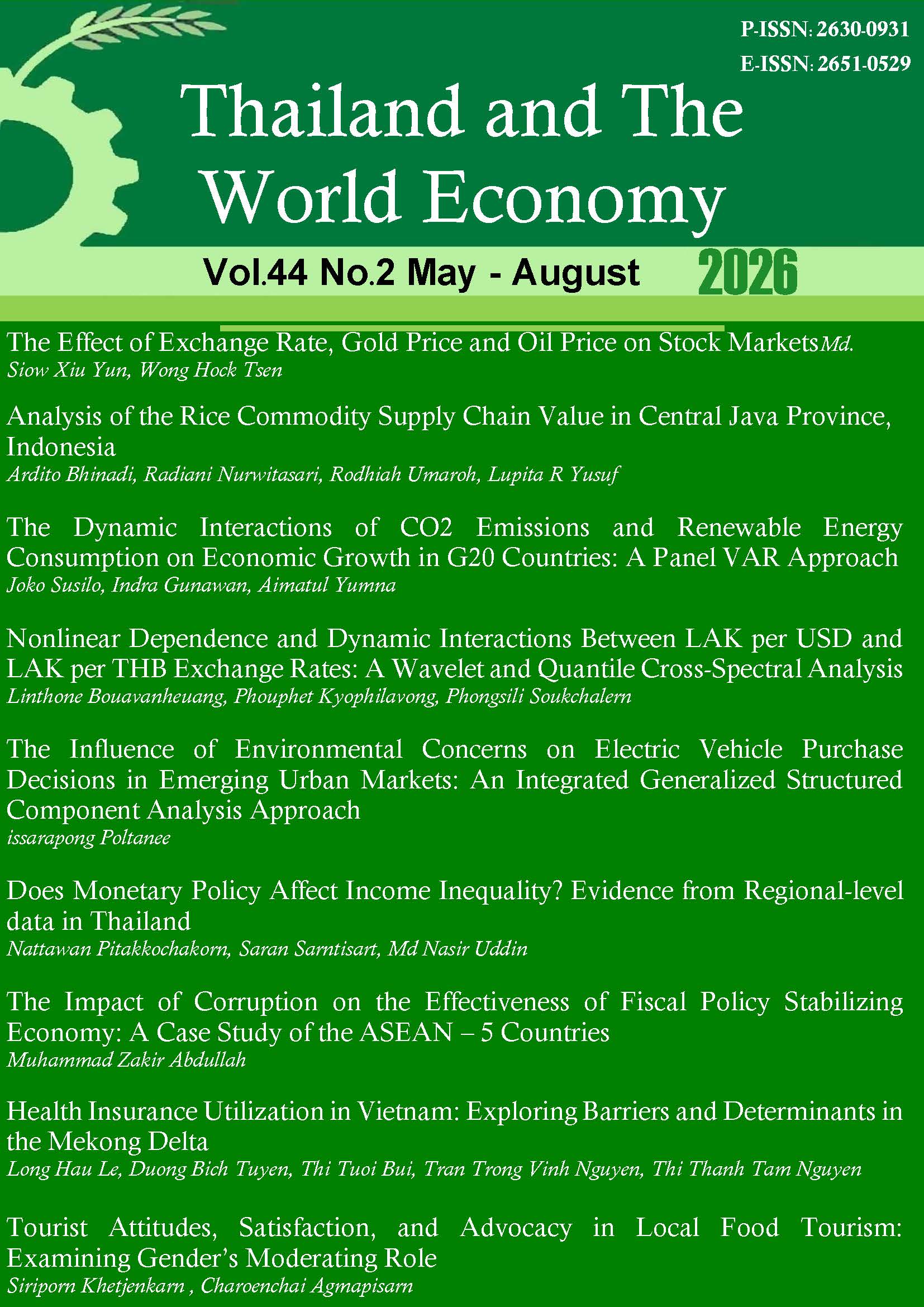
The Impact of Corruption on the Effectiveness of Fiscal Policy Stabilizing Economy: A Case Study of the ASEAN – 5 Countries
DOI:
https://doi.org/10.66445/twe.v44i2.278091Keywords:
Fiscal Policy, Business Fluctuations, Cycles, Institutions and GrowthAbstract
This study aims to examine the effectiveness of fiscal policy in stabilizing output fluctuation in the business cycle by taking account of corruption level for five countries (Malaysia, Singapore, Thailand, the Philippines, and Indonesia) in the Association of Southeast Asian Nations (ASEAN) from 1996 to 2019. Based on voracity effect theory, a poor institutional quality due to high corruption levels put more pressure on government spending during economic booms which limited fiscal space during economic recessions. This effect could reduce the effectiveness of fiscal stabilization on output fluctuation in business cycle. This study utilizes Fully Modified Ordinary Least Square (FMOLS), where the results address fiscal stabilization in the long run perspective. The result suggests that discretionary fiscal policy is countercyclical and can stabilize output fluctuation by 7 percent. When the interaction term of discretionary fiscal with corruption variables is included, the stabilizing effect reduces from 0.7 percent to 0.36 percent. The result shows there is a small reduction in countercycle response for Singapore, contrary to Malaysia, which has a large reduction in countercycle response, as the interaction terms are included. Meanwhile, fiscal stabilization for Indonesia, Thailand, and the Philippines is slightly reduced to a small and insignificant effect.
References
Achim, M. V., Borlea, S. N., & Anghelina, A. M. (2018). The impact of fiscal policies on corruption: A panel analysis. South African Journal of Economic and Management Sciences, 21(1).
Afonso, A., & Carvalho, F. T. (2022). Time-varying cyclicality of fiscal policy: The case of the Euro area. North American Journal of Economics and Finance, 62.
Agoba, A.M., Abor, J.Y., Osei, K., Sa-Aadu, J., Amoah, B., & Dzeha, G.C.O. (2019). Central bank independence, elections and fiscal policy in Africa: Examining the moderating role of political institutions. International Journal of Emerging Markets, 14(5), 809-830.
Ahmad, A., McManus, R., & Ozkan, F. G. (2021). Fiscal space and the procyclicality of fiscal policy: The case for making hay while the sun shines. Economic Inquiry, 59(4), 1687–1701.
Ahmmed, S., & Jonaed, F. (2020). Cyclical fluctuation, growth, and stabilization: An empirical investigation of dual policy objectives in Bangladesh. Journal of Economics and Business, 3(4), 1304-1315.
Ain, S. Q., & Mumtaz, M. (2022). The effects of volatility, fiscal policy cyclicality and financial development on growth in South Asia. International Journal of Management Research and Emerging Sciences, 12(4), 58-68.
Akitoby, B., Clements, B., Gupta, S., & Inhauste, G. (2006). Public spending, voracity, and Wagner’s law in developing countries. European Journal of Political Economy, 22(4), 908–924.
Aldama, P., & Creel, J. (2022). Real-time fiscal policy responses in the OECD from 1997 to 2018: Procyclical but sustainable?. European Journal of Political Economy, 73.
Alesina, A., Tabelline, G., & Campante, F. R. (2008). Why is fiscal policy often procyclical?. Journal of the European Economic Association, 6(5), 1006–1036.
Alt, J. E., & Lassen, D.D. (2006). Fiscal transparency, political parties, and debt in OECD countries. European Economic Review, 5(6), 1403 – 1439.
Andersen, A. L., & Nielsen, L. H. W. (2010). Fiscal transparency and procyclical fiscal policy. EPRU Working Paper Series No. 2010–01, 1–51. Economic Policy Research Unit (EPRU), Department of Economics, University of Copenhagen.
Arčabić, V., & Banić, F. (2021). Characteristics of fiscal policy in Croatia: Does it depend on the phase of the business cycle?. Public Sector Economics, 45(4), 433–457.
Asian Development Bank (2022). Key Indicators for Asia and the Pacific. Manila: Asian Development Bank.
Calderón, C., & Schmidt-Hebbel, K. (2008). Business cycles and fiscal policies: The role of institutions and financial market. Working Papers Central Bank of Chile 481, 1–68. Central Bank of Chile.
Carneiro, F., & Garrido, L. (2016). New evidence on the cyclicality of fiscal policy. World Bank Policy Research Working Paper No. 7293, 1-45. World Bank, Washington DC, United States.
Carole I. (2021). Corruption, public debt and economic growth – evidence from developing countries. International Journal of Development Issues, 20 (1), 24-37.
Cavoli, T., & Wilson, J. K. (2015). Corruption, central bank (in)dependence and optimal monetary policy in a simple model. Journal of Policy Modeling, 37(3), 501-509.
Çiçekçi, C., & Gaygısız, E. (2023). Procyclicality of fiscal policy in oil-rich countries: roles of resource funds and institutional quality. Resources Policy, 85
Combes, J., Minea, A., & Sow, M. (2017). Is fiscal policy always counter- (pro-) cyclical? The role of public debt and fiscal rules. Economic Modelling, 65, 138-146.
Debrun, X., & Kapoor, R. (2010). Fiscal policy and macroeconomic stability: Automatic stabilizer work, always and everywhere. IMF Working Paper No. 10/111, 1-47. International Monetary Fund, Washington, DC, United States.
Debrun, X., Pisani-Ferry, J., & Sapir, A. (2008). Government size and output volatility: Should we forsake automatic stabilization? IMF Working Paper No. 08/122, 1-55. International Monetary Fund, Washington, DC, United States.
Dincă, G., Dincă, M. S., Dauti, B., Baba, M. C., & Popione, C. (2020). Cyclicality of fiscal policy in the European Union. Journal for Economic Forecasting, 23(1), 75-96.
Drezner, D. W., Farrell, H., & Newman, A. L. (2021). The uses and abuses of weaponized interdependence. Washington, DC: Brookings Institution Press.
Duval, R., Elmeskov, J., & Vogel, L. (2007). Structural policies and economic resilience to shocks. SSRN Electronic Journal, 1-40.
El-Khishin, S., & Zaky, M. (2021). The impact of budgetary and political institutions on fiscal cyclicality: Evidence from Egypt. Journal of Governance & Regulation, 10(3), 72–84.
Eller, M., Fidrmuc, J., & Fungáčová, Z. (2016). Fiscal policy and regional output volatility: Evidence from Russia. Regional Studies, 50(11), 1849–1862.
Eskesen, L. (2009). The role for counter- cyclical fiscal. IMF Working Paper 09/08, 1-18. International Monetary Fund, Washington, DC, United States.
Fatás, A., & Mihov, I. (2001). Fiscal policy and business cycles: An empirical investigation. Moneda y Crédito, 212, 167–210.
Fatás, A. & Mihov, I. (2012). Fiscal Policy as a stabilization tool. The B.E. Journal of Macroeconomics, 12(3), 1-66.
Frankel, J. A., Vegh, C. A., & Vuletin, G. (2013). On graduation from fiscal procyclicality. Journal of Development Economics, 100, 32–47.
Galí, J., & Perotti, R. (2003). Fiscal policy and monetary integration in Europe. NBER Working Paper Series No. 9773, 1–45. National Bureau of Economic Research, Cambridge, MA, United States.
Gauthier, B., & Goyette, J. (2016). Fiscal policy and corruption. Social Choice and Welfare, 46(1), 57-79.
Gechert, S., Horn, G., & Paetz, C. (2019). Long-term effects of fiscal stimulus and austerity in Europe. Oxford Bulletin of Economics and Statistics, 81(3), 647-666.
Ghosh, S., & Neanidis, K. C. (2017). Corruption, fiscal policy, and growth: A unified approach. The B.E. Journal of Macroeconomics, 17(2).
Haan, J. d. and Gootjes, B. (2023). What makes discretionary counter-cyclical fiscal policy so difficult? an analysis of 32 OECD countries. Cesifo Economic Studies, 69(1), 1-20.
Heimberger, P. (2023). The cyclical behavior of fiscal policy: A meta-analysis. Economic Modelling, 123(106259), 1-13.
Herrera, S., Kouame, W. A., & Mandon, P. (2019). Why some countries can escape the fiscal pro-cyclicality trap and others cannot?. The World Bank Policy Research Working Paper, No.8963, 1-54. World Bank, Washington DC, United States.
Hussain, T., Mahmood, H., Iqbal, A., Mustafa, G., & Furqan, M. (2021). Fiscal policy cyclicality, governance, and quality of institutions nexus in Ireland. Montenegrin Journal of Economics, 17(3), 111-119.
Invanya, M., Moumouras, A., & Ranzagas, P. (2016). The culture of corruption, tax evasion, and economic growth. Economic Inquiry, 54(1), 520–542.
Ismahene, Y., & Najeh, B. (2021). The long-run relationship between ODA, growth and governance: An application of FMOLS and DOLS approaches. African Development Review, 33(1), 38-54.
Kassouri, Y., & Altıntaş, H. (2021). Cyclical drivers of fiscal policy in sub-Saharan Africa: New insights from the time-varying heterogeneity approach. Economic Analysis and Policy, 70, 51-67.
Khan, N. S. (2011). Cyclical behavior of macroeconomic policies and capital flows: A study of Asian Countries. Bangladesh Development Studies, 34(2), 49–83.
Mawejje, J., & Odhiambo, N. M. (2022). The determinants and cyclicality of fiscal policy: Empirical evidence from East Africa. International Economics, 169, 55–70.
Munir, K, & Riaz, N. (2019). Fiscal policy and macroeconomic stability in South Asian countries. Revista Hacienda Pública Española, 228(1), 13-33.
Nguyen, P. C. (2018). The effectiveness of fiscal policy: Contributions from institutions and external debts. Journal of Asian Business and Economic Studies, 25(1), 50 – 66.
Nguyen, C. P., Schinckus, C., Su, T. D., & Ling, F. C. (2020). Tackling fiscal deficits: The role of control of corruption in Asia Pacific countries. Review of Development Finance, 10(1), 1-16.
Nuru, N. Y., & Gereziher, H. Y. (2022). The effect of fiscal policy on economic growth in South Africa: A nonlinear ARDL model analysis. Journal of Economic and Administrative Sciences, 38(2), 229-245.
Olakojo, S. A., Onanuga, A. T., & Onanuga, O. T. (2020). Cyclical fluctuations of economic growth and monetary policy. Journal of Contemporary African Studies, 39(1), 1-22.
Olaoye, O. O., Okorie, U. U., Eluwole, O., & Fawwad, M. B. (2021). Government spending shocks and economic growth: Additional evidence from cyclical behavior of fiscal policy. Journal of Economic and Administrative Sciences, 37(4), 419-437.
Owyang, M. T., & Sekhposyan, T. (2012). Okun’s law over business cycle: Was the great recession all that different?. Federal Reserve Bank of St. Louis Review, 94(5), 399–418.
Pappa, E., Sajedi, R., & Vella, E. (2015). Fiscal consolidation with tax evasion and corruption. Journal of International Economics, 96, 56–75.
Pereira, L. D. H., & Lee, G. H. Y. (2013). Have economic growth and institutional quality contributed to poverty and inequality reduction in Asia?. Journal of Asian Economics, 27, 71–86.
Puron-Cid, G., Reddick, C.G., Ganapati, S. (2019). Public value of online financial transparency: Financial sustainability and corruption of public officials in the US state governments. International Journal of Public Sector Management, 32(5), 467-488.
Temsumrit, N. (2022). Democracy, institutional quality and fiscal policy cycle: Evidence from developing countries. Applied Economics, 54(1), 75–98.
Thornton, J. (2008). Explaining procyclical fiscal policy in African countries. Journal of African Economies, 17(3), 451-464.
Tornell, A., & Lane, P. R. (1999). The voracity effect. American Economic Review, 89(1), 22–46.
Transparency International. (2023). The ABCs of the CPI: How the corruption perceptions index is calculated. Retrieved from https://www.transparency.org/ en/news/ how-cpi-scores-are-calculated
Transparency International. (2012). Corruption perceptions index 2012. Retrieved from https://www.transparency.org/en/cpi/2012
Transparency International. (2019). Corruption perceptions index 2019. Retrieved from https://www.transparency.org/en/cpi/2019
World Bank. (2023). World Bank metadata glossary. Retrieved from https://databank.worldbank.org/metadataglossary/worldwide-governance-indicators/series/CC.EST
Downloads
Published
How to Cite
Issue
Section
Categories
License
Copyright (c) 2026 Thailand and The World Economy

This work is licensed under a Creative Commons Attribution-NonCommercial-NoDerivatives 4.0 International License.