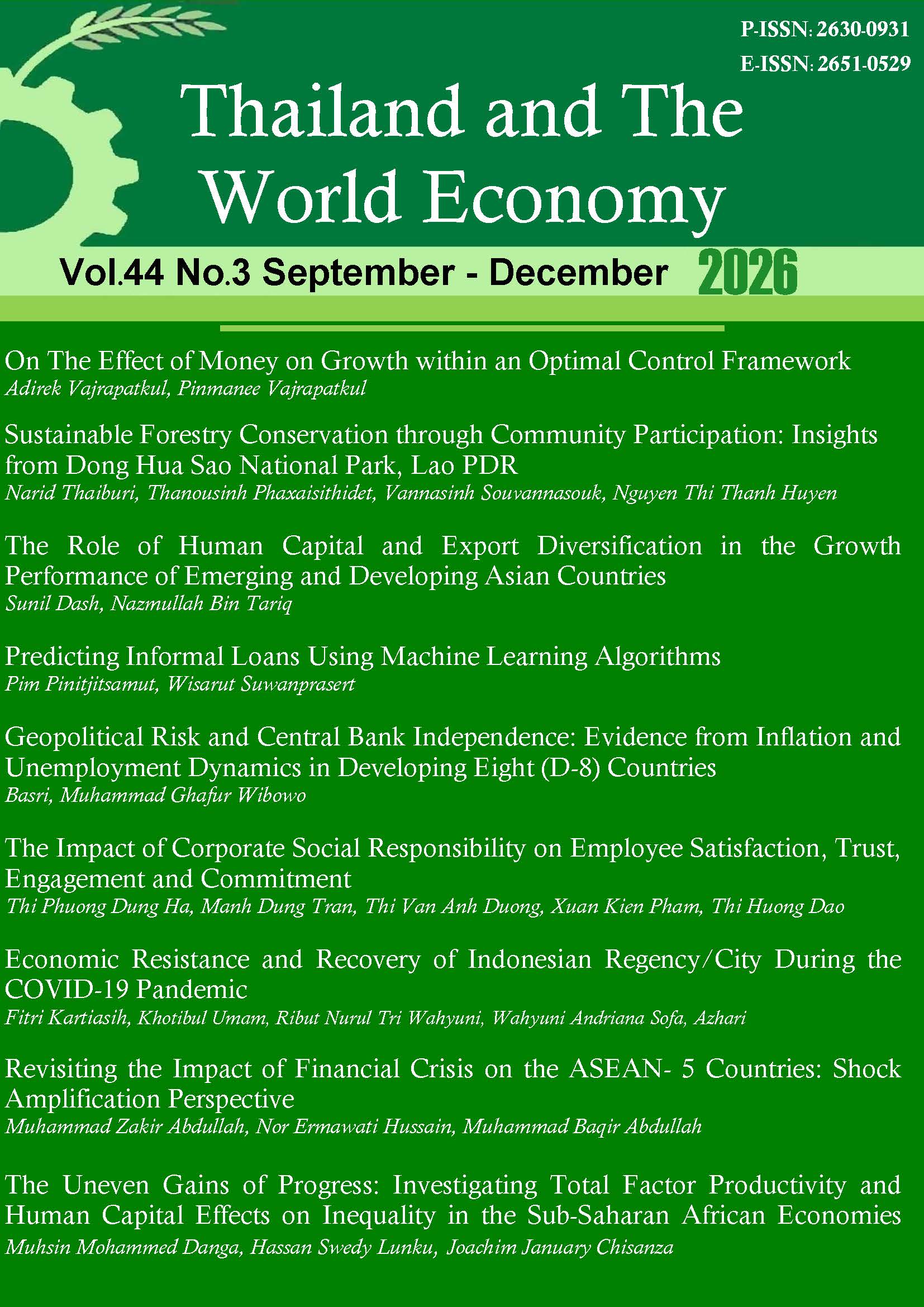
Predicting Informal Loans Using Machine Learning Algorithms
DOI:
https://doi.org/10.66445/twe.v44i3.278817Keywords:
Informal Loans, Machine Learning, Random Forest, Predictive Modeling, ThailandAbstract
This paper applies machine learning methods to predict informal borrowing participation and informal loan amounts in Thailand, using individual-level survey data covering approximately 4,800 respondents across six regions. We evaluate the performance of K-Nearest Neighbors (KNN), Random Forest, and Gradient Boosting (XGBoost) models and benchmark their predictive accuracy against a standard logistic regression. XGBoost achieves the highest accuracy in predicting informal borrowing participation, while Random Forest performs best in predicting loan amounts. To move beyond predictive performance, we incorporate interpretable machine learning tools to examine how key socioeconomic characteristics contribute to model predictions. Correlation and interpretability analyses reveal clear segmentation between formal and informal credit markets: households with lower income and limited access to formal loans face substantially higher informal borrowing costs. Our results show that accurate prediction is possible using a relatively small set of observable socioeconomic indicators. The findings highlight how interpretable machine learning can complement traditional economic analysis and provide practical tools for identifying households vulnerable to high-cost informal credit in data-scarce environments.
References
Chaengkham, S., & Wianwiwat, S. (2021). Stock market index prediction using machine learning: Evidence from leading Southeast Asian countries. Thailand and the World Economy, 39(2), 56–64.
Chemin, M. (2008). The benefits and costs of microfinance: Evidence from Bangladesh. Journal of Development Studies, 44(4), 463–484.
Dutt, P., & Tsetlin, I. (2020). Income distribution and economic development: Insights from machine learning. Economics & Politics, 33(1), 1–36.
Fenz, K., Mitterling, T., Martinez, A. M. Jr., Bulan, J. A. N. M., Durante, R. L. S., Martillan, M. A., Addawe, M. B., & Roitner-Fransecky, I. (2024). Compiling granular population data using geospatial information. Asian Development Review, 41(1), 263–300.
Guirkinger, C. (2008). Understanding the coexistence of formal and informal credit markets in Piura, Peru. World Development, 36(8), 1436–1452.
Jeromi, P. D. (2007). Regulation of informal financial institutions: A study of money lenders in Kerala. Reserve Bank of India Occasional Papers, 28(1), 1–32.Kaboski, J., & Townsend, R. (2005). Policies and impact: An analysis of village-level microfinance institutions. Journal of the European Economic Association, 3(1), 1–50.
Karaivanov, A., & Kessler, A. (2018). (Dis)advantages of informal loans – Theory and evidence. European Economic Review, 102, 100–128.
Kislat, C. (2015). Why are informal loans still a big deal? Evidence from Northeast Thailand. The Journal of Development Studies, 51(5), 569–585.
Kislat, C., Menkhoff, L., & Neuberger, D. (2017). Credit market structure and collateral in rural Thailand. Economic Notes, 46, 587–632.
Klühs, T., Koch, M., & Stein, W. (2019). Don’t expect too much: High income expectations and over-indebtedness. Rationality and Competition Discussion Paper Series, 200, CRC TRR 190 Rationality and Competition.
Kusonkhum, W., Srinavin, K., Leungbootnak, N., & Chaitongrat, T. (2022). Using a machine learning approach to predict the Thailand underground train’s passenger. Journal of Advanced Transportation, 2022.
Liu, E., & Roth, B. (2022). Contractual restrictions and debt traps. Review of Financial Studies, 35(3), 1141–1182.
Mathen, C. K., Chattopadhyay, S., Sahu, S., & Mukherjee, A. (2024). Which nighttime lights data better represent India’s economic activities and regional inequality? Asian Development Review, 41(2), 193–217.
Mohieldin, M., & Wright, P. W. (2000). Formal and informal credit markets in Egypt. Economic Development and Cultural Change, 48(3), 657–670.
Pinitjitsamut, P., & Suwanprasert, W. (2022). Informal loans in Thailand: Stylized facts and empirical analysis (Discussion Paper No. 173). Puey Ungphakorn Institute for Economic Research. Retrieved from https://www.pier.or.th/dp/173/
Pitt, M., & Khandker, S. (1998). The impact of group-based credit programs on poor households in Bangladesh: Does the gender of participants matter? Journal of Political Economy, 106(5), 958–996.
Puttanapong, N., Prasertsoong, N., & Peechapat, W. (2023). Predicting provincial gross domestic product using satellite data and machine learning methods: A case study of Thailand. Asian Development Review, 40(2), 39–85.
Siamwalla, A., Pinthong, C., Poapongsakorn, N., Satsanguan, P., Nettayarak, P., Mingmaneenakin, W., & Tubpun, Y. (1990). The Thai rural credit system: Public subsidies, private information, and segmented markets. The World Bank Economic Review, 4(3), 271–295.
Suwanprasert, W. (2025). The gender gaps in informal loan markets. Applied Economics,1-18.
Tanomchat, W., & Sampattavanija, S. (2018). Dependence of informal interest rates and level of lenders’ influence in the informal loan market in Thailand. International Advances in Economic Research, 24(1), 47–63.
Downloads
Published
How to Cite
Issue
Section
Categories
License
Copyright (c) 2026 Thailand and The World Economy

This work is licensed under a Creative Commons Attribution-NonCommercial-NoDerivatives 4.0 International License.