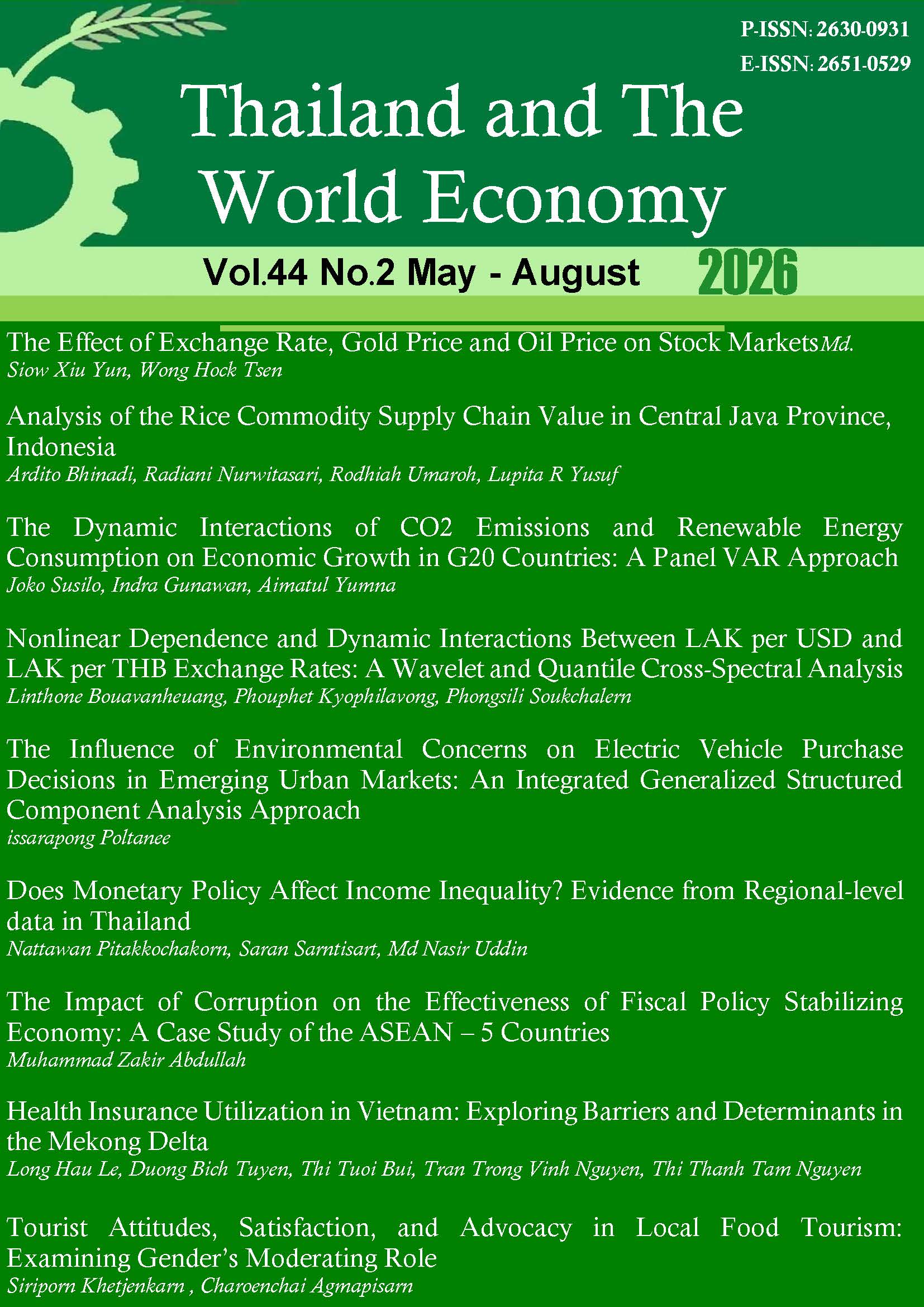
Health Insurance Utilization in Vietnam: Exploring Barriers and Determinants in the Mekong Delta
DOI:
https://doi.org/10.66445/twe.v44i2.279792Keywords:
Health Insurance Card, Health Services, International Hospital, Binary Logistic RegressionAbstract
Health insurance constitutes a vital component of social security policies, intended to protect residents’ health and well-being. Nevertheless, despite its widespread availability, the use of health insurance cards among patients in Vietnam remains limited, influenced by a range of objective and subjective factors. This study aims to investigate the key determinants shaping patients’ decisions to utilize health insurance cards for medical examination and treatment. Data were gathered through structured interviews with 400 patients at a distinguished private hospital in the Mekong Delta, utilizing a pre-designed questionnaire and a convenience sampling method. The binary logit regression analysis reveals several significant findings. Notably, older patients demonstrate a greater propensity to rely on health insurance to mitigate medical expenses, reflecting heightened health concerns with age. Additionally, the occupation of patients plays a pivotal role in their decision-making process; individuals employed in sectors such as education, training, and retail trade exhibit a markedly higher likelihood of using health insurance compared to those in other fields, possibly due to stable income or job-related healthcare requirements. Furthermore, as patients transition from low-income to middle-income status, the probability of health insurance utilization rises, suggesting that modest income improvements enhance access to insured services. Drawing on these insights, the study proposes targeted recommendations to bolster patients’ engagement with health insurance for medical examination and treatment in hospital contexts, aiming to address barriers and optimize policy effectiveness.
References
Abimbola, S., Ukwaja, K. N., Onyedum, C. C., Negin, J., Jan, S., & Martiniuk, A. L. (2015). Transaction costs of access to health care: Implications of the care-seeking pathways of tuberculosis patients for health system governance in Nigeria. Global Public Health, 10(9), 1060-1077.
Andersen, R. M. (1995). Revisiting the behavioral model and access to medical care: Does it matter?. Journal of Health and Social Behavior, 36(1), 1–10.
Arrow, K. J. (1963). Uncertainty and the welfare economics of medical care (American Economic Review, 1963). In P.J. Hammer, D. Haas-Wilson, W. M. Sage & M. A. Peterson (Eds.), Uncertain Times: Kenneth Arrow and the Changing Economics of Health Care (pp. 1-34). New York, USA: Duke University Press.
Atinga, R. A., Abiiro, G. A., & Kuganab‐Lem, R. B. (2015). Factors influencing the decision to drop out of health insurance enrolment among urban slum dwellers in Ghana. Tropical Medicine & International Health, 20(3), 312-321.
Ayanore, M. A., Pavlova, M., Kugbey, N., Fusheini, A., Tetteh, J., Ayanore, A. A., ... & Groot, W. (2019). Health insurance coverage, type of payment for health insurance, and reasons for not being insured under the National Health Insurance Scheme in Ghana. Health Economics Review, 9(1).
Becker, G. S. (1976). The economic approach to human behavior. Chicago: University of Chicago Press.
Besley, T., Hall, J., & Preston, I. (1999). The demand for private health insurance: Do waiting lists matter?. Journal of Public Economics, 72(2), 155–181.
Cai, J. (2023). A robust health system to achieve universal health coverage in Vietnam. The Lancet Regional Health – Western Pacific, 37.
Chankova, S., Sulzbach, S., & Diop, F. (2008). Impact of mutual health organizations: evidence from West Africa. Health Policy and Planning, 23(4), 264-276.
Chaudhuri, A., & Roy, K. (2008). Changes in out-of-pocket payments for healthcare in Vietnam and its impact on equity in payments, 1992–2002. Health Policy, 88(1), 38-48.
Cohn, R. A., Lewellen, W. G., Lease, R. C., & Schlarbaum, G. G. (1975). Individual investor risk aversion and investment portfolio composition. The Journal of Finance, 30(2), 605-620.
Croson, R., & Gneezy, U. (2009). Gender differences in preferences. Journal of Economic Literature, 47(2), 448-474.
Do, N., Oh, J., & Lee, J. S. (2014). Moving toward universal coverage of health insurance in Vietnam: barriers, facilitating factors, and lessons from Korea. Journal of Korean Medical Science, 29(7), 919-925.
Dohmen, T., Falk, A., Huffman, D., Sunde, U., Schupp, J., & Wagner, G. G. (2011). Individual risk attitudes: Measurement, determinants, and behavioral consequences. Journal of the European Economic Association, 9(3), 522-550.
Dong, H., Gbangou, A., De Allegri, M., Pokhrel, S., & Sauerborn, R. (2008). The differences in characteristics between health-care users and non-users: implication for introducing community-based health insurance in Burkina Faso. The European Journal of Health Economics, 9(1), 41-50.
Donkers, B., Melenberg, B., & Van Soest, A. (2001). Estimating risk attitudes using lotteries: A large sample approach. Journal of Risk and Uncertainty, 22(2), 165-195.
Duku, S. K. O. (2018). Differences in the determinants of health insurance enrolment among working-age adults in two regions in Ghana. BMC Health Services Research, 18(1), 1-16.
Eckel, C. C., & Grossman, P. J. (2008). Forecasting risk attitudes: An experimental study using actual and forecast gamble choices. Journal of Economic Behavior & Organization, 68(1), 1-17.
Fitzgerald, J. (1987). The effects of social security on life insurance demand by married couples. Journal of Risk and Insurance, 54(1), 86–99.
Gandolfi, A. S., & Miners, L. (1996). Gender-based differences in life insurance ownership. Journal of Risk and Insurance, 63(6), 683-693.
Giang, L. T., Pham, T. H. T., Phi, P. M., & Nguyen, N. T. (2023). Healthcare services utilisation and financial burden among Vietnamese older people and their households. International Journal of Environmental Research and Public Health, 20(12).
Guiso, L., & Paiella, M. (2008). Risk aversion, wealth, and background risk. Journal of the European Economic Association, 6(6), 1109–1150.
Gutter, M. S., & Hatcher, C. B. (2008). Racial differences in the demand for life insurance. Journal of Risk and Insurance, 75(3), 677-689.
Halek, M., & Eisenhauer, J. G. (2001). Demography of risk aversion. Journal of Risk and Insurance, 68(1), 1–24.
Harrison, G. W., Lau, M. I., & Rutström, E. E. (2007). Estimating risk attitudes in Denmark: A field experiment. The Scandinavian Journal of Economics, 109(2), 341-368.
Hartog, J., Ferrer‐i‐Carbonell, A., & Jonker, N. (2002). Linking measured risk aversion to individual characteristics. Kyklos, 55(1), 3-26.
Hoang, A. T., Trinh, T. N. N., Nguyen, Đ. T., Do, X. T., & Nguyen, V. H. (2022). Đánh giá sự hài lòng của người bệnh đối với hoạt động cấp phát thuốc bảo hiểm y tế ngoại trú tại bệnh viện Trung ương Quân Đội 108 năm 2021 [Assessing patient satisfaction with outpatient health insurance drug dispensing activities at 108 Military Central Hospital in 2021]. Vietnam Public Health Association, 514(2).
Jianakoplos, N. A., & Bernasek, A. (1998). Are women more risk averse?. Economic Inquiry, 36(4), 620-630.
Levy, H., & Janke, A. (2016). Health Literacy and Access to Care. Journal of Health Communication, 21(Suppl 1), 43-50.
Modigliani, F., & Brumberg, R. (1954). Utility analysis and the consumption function: An interpretation of cross-section data. In K. K. Kurihara (Ed.), Post-Keynesian economics (pp. 388–436). New Brunswick, USA: Rutgers University Press.
Nguyen, T. T. T. (2020). Impact of health insurance on healthcare utilisation patterns in Vietnam: A survey-based analysis with propensity score matching method. BMJ Open, 10(10).
Nutbeam, D. (2008). The evolving concept of health literacy. Social Science & Medicine, 67(12), 2072–2078.
Outreville, J. F. (2015). The relationship between relative risk aversion and the level of education: A survey and implications for the demand for life insurance. Journal of Economic Surveys, 29(1), 97–111.
Papke, L. E., & Wooldridge, J. M. (1996). Econometric methods for fractional response variables with an application to 401 (k) plan participation rates. Journal of Applied Econometrics, 11(6), 619-632.
Pham, V. H., Tran, T. L. H., & Vo, T. A. L. (2022). Thực trạng tham gia và sử dụng thẻ bảo hiểm y tế hộ gia đình tại thành phố Gia Nghĩa, tỉnh Đắk Nông, 2017 – 2019 [Current status of participation and use of household health insurance cards in Gia Nghia city, Dak Nong province, 2017 – 2019]. Vietnam Journal of Preventive Medicine, 32 (3), 136-142.
Phan, D.K., Ngoc, P. M., Luong, N. T., & Phuong, N. T. K. (2019). Quyết định sử dụng bảo hiểm y tế của người dân ở Việt Nam [The decision to use health insurance of people in Vietnam]. Journal of Open University Science Ho Chi Minh City-Economics and Business Administration, 14(1), 101-113.
Propper, C., Burgess, S.,& Green, K. (2004) Does competition between hospitals improve the quality of care? Hospital death rates and the NHS internal market. Journal of Public Economics, 88(7–8), 1247–1272.
Rapi, K., Priyarsono, D. S., Jahroh, S., & Bakhtiar, T. (2025). The non-monotonic relationship between income and life insurance demand: A case study of forty-one countries. Economies, 13(1), 4.
Vuong, Q. H., La, V. P., Nguyen, M. H., Nguyen, T. H. T., & Ho, M. T. (2021). Good budget or good care: The dilemma of social health insurance in Vietnam. SAGE Open Medicine, 9.
Downloads
Published
How to Cite
Issue
Section
Categories
License
Copyright (c) 2026 Thailand and The World Economy

This work is licensed under a Creative Commons Attribution-NonCommercial-NoDerivatives 4.0 International License.