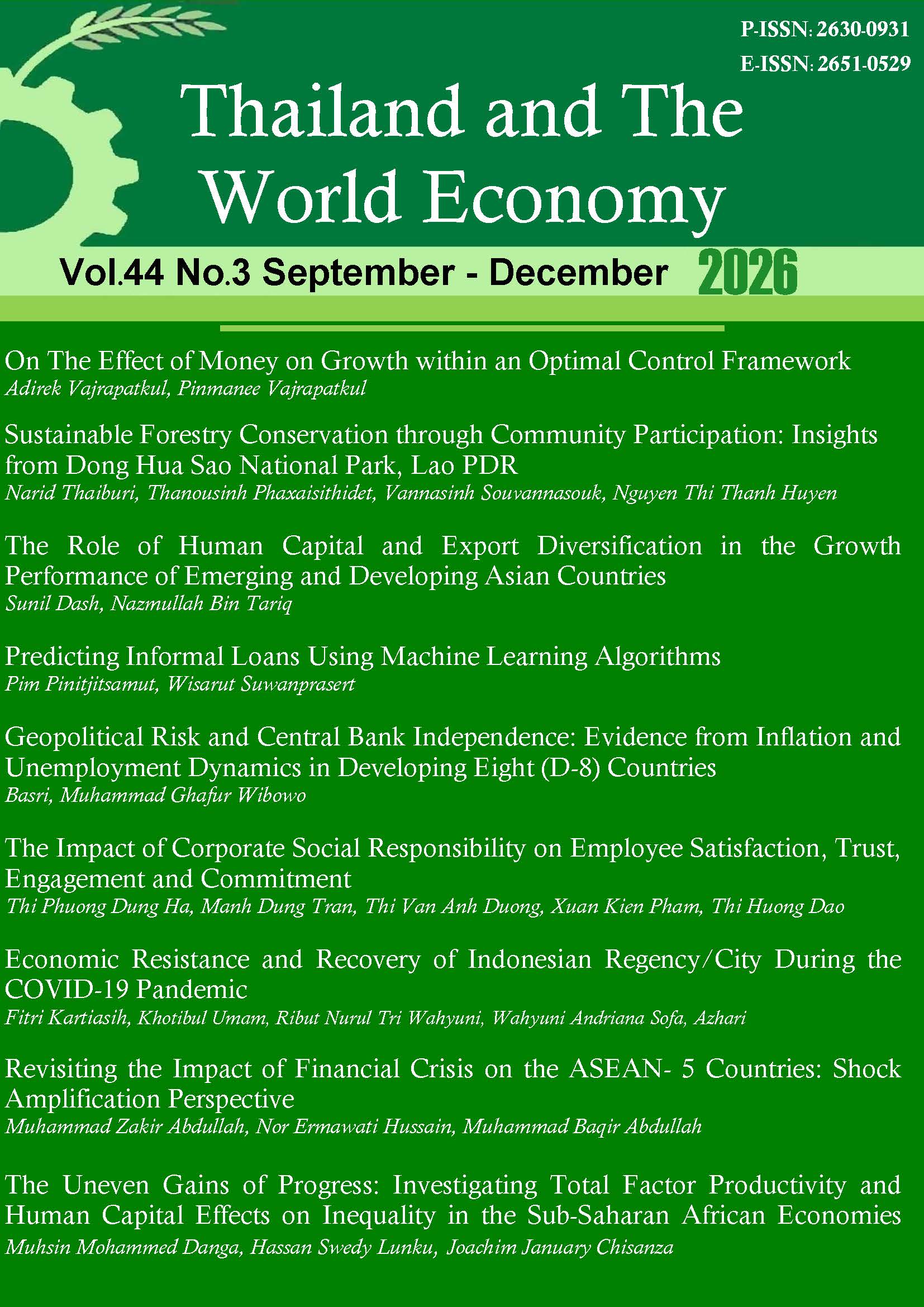
Economic Resistance and Recovery of Indonesian Regency/City During the COVID-19 Pandemic
DOI:
https://doi.org/10.66445/twe.v44i3.281216Keywords:
COVID-19, Recession, Resilience, Herfindahl Index, ICT, Income InequalityAbstract
The COVID-19 pandemic severely disrupted Indonesia’s regional economies, exposing disparities in their ability to withstand and recover from shocks. This study explores the economic resilience of 514 regencies and cities across Indonesia during 2020–2022 by measuring two dimensions of resilience—resistance (ability to withstand contraction) and recovery (ability to rebound afterward). Using national socioeconomic and labor data, the analysis identifies key factors influencing regional resilience. The findings reveal that regions demonstrating stronger resistance during the crisis also tended to recover more rapidly. Income inequality and population size were found to weaken both resistance and recovery, while a higher share of workers using information and communication technology (ICT) enhanced post-pandemic recovery. These results highlight that improving digital inclusion and reducing income inequality are crucial policy priorities for strengthening regional resilience to future economic shocks. Strengthened coordination between central and local governments is essential to build a more adaptive and equitable economic structure nationwide.
References
Adwendi, S. J., & Kartiasih, F. (2016). Penggunaan error correction mechanism dalam analisis pengaruh investasi langsung luar negeri terhadap pertumbuhan ekonomi Indonesia [The use of the error correction mechanism in analyzing the impact of foreign direct investment on Indonesia’s economic growth]. Statistika: Journal of Theoretical Statistics and Its Applications, 16(1), 17–27.
Annoni, P., de Dominicis, L., & Khabirpour, N. (2019). Location matters: A spatial econometric analysis of regional resilience in the European Union. Growth and Change, 50(3), 824–855.
Bailey, D., Clark, J., Colombelli, A., Corradini, C., De Propris, L., Derudder, B., Fratesi, U., Fritsch, M., Harrison, J., Hatfield, M., Kemeny, T., Kogler, D. F., Lagendijk, A., Lawton, P., Ortega-Argilés, R., Otero, C. I., & Usai, S. (2020). Regions in a time of pandemic. Regional Studies,54 54(9), 1163–1174.
Bourdin, S., Jeanne, L., Nadou, F., & Noiret, G. (2021). Does lockdown work? A spatial analysis of the spread and concentration of Covid-19 in Italy. Regional Studies, 55(7), 1182–1193.
BPS. (2020). Pertumbuhan ekonomi Indonesia triwulan IV-2020 [Indonesia’s economic growth in the fourth quarter of 2020]. Berita Resmi Statistik BPS, Jakarta. Retrived from https://www.bps.go.id/id/pressrelease/2021/02/05/1811/ekonomi-indonesia-2020-turun-sebesar-2-07-persen
BPS. (2022). Laporan perekonomian Indonesia 2022 [Indonesia economic report 2022]. BPS, Jakarta. Retrived from https://www.bps.go.id/id/publication/2022/09/16/2ff6faa58654862615a92019/laporan-perekonomian-indonesia-2022.html
Briguglio, L., Cordina, G., Farrugia, N., & Vella, S. (2009). Economic vulnerability and resilience: Concepts and measurements. Oxford Development Studies, 37(3), 229–247.
Castells-Quintana, D., & Royuela, V. (2017). Tracking positive and negative effects of inequality on long-run growth. Empirical Economics, 53(4), 1349–1378.
Chen, J., Guo, X., Pan, H., & Zhong, S. (2021). What determines city’s resilience against epidemic outbreak: Evidence from China’s COVID-19 experience. Sustainable Cities and Society, 70.
Crescenzi, R., Luca, D., & Milio, S. (2016). The geography of the economic crisis in Europe: National macroeconomic conditions, regional structural factors and short-term economic performance. Cambridge Journal of Regions, Economy and Society, 9(1), 13–32.
Cuadrado-Roura, J. R., & Maroto, A. (2016). Unbalanced regional resilience to the economic crisis in Spain: A tale of specialisation and productivity. Cambridge Journal of Regions, Economy and Society, 9(1), 153–178.
Davoudi, S., Shaw, K., Haider, L. J., Quinlan, A. E., Peterson, G. D., Wilkinson, C., Fünfgeld, H., McEvoy, D., & Porter, L. (2012). Resilience: A bridging concept or a dead end? “reframing” resilience: Challenges for planning theory and practice interacting traps: resilience assessment of a pasture management system in northern afghanistan urban resilience: What does it mean in planning practice? Resilience as a useful concept for climate change adaptation? The politics of resilience for planning: A cautionary note. Planning Theory and Practice 13( 2),299–333.
Di Caro, P. (2015). Recessions, recoveries and regional resilience: Evidence on Italy. Cambridge Journal of Regions, Economy and Society, 8(2), 273–291.
Dong, Y., Dong, Y., Mo, X., Hu, Y., Qi, X., Jiang, F., Jiang, Z., Jiang, Z., Tong, S., Tong, S., & Tong, S. (2020). Epidemiology of COVID-19 among children in China. Pediatrics, 145(6).
Eraydin, A. (2016). Attributes and characteristics of regional resilience: Defining and measuring the resilience of Turkish regions. Regional Studies, 50(4), 600–614.
Geelhoedt, F., Royuela, V., & Castells-Quintana, D. (2021). Inequality and employment resilience: An analysis of Spanish municipalities during the great recession. International Regional Science Review, 44(1), 113–141.
Gong, H., Hassink, R., Tan, J., & Huang, D. (2020). Regional resilience in times of a pandemic crisis: The case of COVID-19 in China. Tijdschrift Voor Economische En Sociale Geografie [Journal of Economic and Human Geography], 111(3), 497–512.
Hawari, R., & Kartiasih, F. (2017). Kajian aktivitas ekonomi luar negeri Indonesia terhadap pertumbuhan ekonomi Indonesia periode 1998-2014 [An assessment of Indonesia’s external economic activities and their impact on economic growth, 1998–2014]. Media Statistika, 9(2), 119-132.
Holm, J. R., & Østergaard, C. R. (2015). Regional employment growth , shocks and regional industrial resilience : A quantitative analysis of the Danish ICT sector. Regional Studies, 49(1), 95–112.
Hu, M., Roberts, J. D., Azevedo, G. P., & Milner, D. (2021). The role of built and social environmental factors in Covid-19 transmission: A look at America’s capital city. Sustainable Cities and Society, 65.
Kartiasih, F. (2019a). Dampak infrastruktur transportasi terhadap pertumbuhan ekonomi di indonesia menggunakan regresi data panel [The impact of transportation infrastructure on economic growth in Indonesia using panel data regression]. Jurnal Ilmiah Ekonomi Dan Bisnis, 16(1), 67–77.
Kartiasih, F. (2019b). Transformasi struktural dan ketimpangan antardaerah di provinsi Kalimantan Timur [Structural transformation and interregional inequality in East Kalimantan Province]. INOVASI: Jurnal Ekonomi, Keuangan Dan Manajemen, 15(1), 105–113.
Kartiasih, F., Djalal Nachrowi, N., Wisana, I. D. G. K., & Handayani, D. (2023). Inequalities of Indonesia’s regional digital development and its association with socioeconomic characteristics: A spatial and multivariate analysis. Information Technology for Development, 29(2–3), 299–328.
Kartiasih, F., Nachrowi, N. D., Wisana, I. D. G. K., & Handayani, D. (2023a). Potret ketimpangan digital dan distribusi pendapatan di Indonesia: Pendekatan regional digital development index [A portrait of digital inequality and income distribution in Indonesia: A regional digital development index approach]. Jakarta: UI Publishing.
Kartiasih, F., Nachrowi, N. D., Wisana, I. D. G. K., & Handayani, D. (2023b). Towards the quest to reduce income inequality in Indonesia: Is there a synergy between ICT and the informal sector?. Cogent Economics & Finance, 11(2), 1–18.
Kartiasih, F., & Setiawan, A. (2020). Aplikasi error correction mechanism dalam analisis dampak pertumbuhan ekonomi, konsumsi energi dan perdagangan internasional terhadap emisi CO2 di Indonesia [The application of the error correction mechanism in analyzing the impact of economic growth, energy consumption, and international trade on CO₂ emissions in Indonesia]. Media Statistika, 13(1), 104–115.
Kusumasari, A., & Kartiasih, F. (2017). Aglomerasi industri dan pengaruhnya terhadap pertumbuhan ekonomi Jawa Barat 2010-2014 [Industrial agglomeration and its impact on economic growth in West Java, 2010–2014]. Jurnal Aplikasi Statistika & Komputasi Statistik, 9(2), 28–41.
Martin, R. (2012). Regional economic resilience, hysteresis and recessionary shocks. Journal of Economic Geography, 12(1), 1–32.
Martin, R., & Gardiner, B. (2019). The resilience of cities to economic shocks: A tale of four recessions (and the challenge of Brexit). Papers in Regional Science, 98(4), 1801–1833.
Martin, R., & Sunley, P. (2015). On the notion of regional economic resilience: Conceptualization and explanation. Journal of Economic Geography, 15(1), 1–42.
Martin, R., Sunley, P., Gardiner, B., & Tyler, P. (2016). How regions react to recessions: Resilience and the role of economic structure. Regional Studies, 50(4), 561–585.
Masten, A. S., & Obradovic, J. (2008). Disaster preparation and recovery: Lessons from research on resilience in human development. Ecology and Society, 13(1), 1–16.
Miharja, M., Salim, E., Nachrawi, G., Putranto, R. D., & Hendrawan, A. (2021). Implementation of emergency public activity restrictions (ppkm) in accordance with human rights and pancasila principles. Budapest International Research and Critics Institute-Journal, 4(3), 6855–6866.
Ningsih, Y. P., & Kartiasih, F. (2019). Dampak guncangan pertumbuhan ekonomi mitra dagang utama terhadap indikator makroekonomi Indonesia [The impact of economic growth shocks in major trading partners on Indonesia’s macroeconomic indicators]. Jurnal Ilmiah Ekonomi Dan Bisnis, 16(1), 78–92.
Olivia, S., Gibson, J., & Nasrudin, R. (2020). Indonesia in the time of Covid-19. Bulletin of Indonesian Economic Studies, 56(2), 143–174.
Pratiwi, Y. R. (2022, February 24). Pemulihan perekonomian indonesia setelah kontraksi akibat pandemi Covid-19 [Indonesia’s economic recovery after the contraction caused by the COVID-19 pandemic]. Retrived from https://www.djkn.kemenkeu.go.id/kpknl-banjarmasin/baca-artikel/14769/
Pemulihan-Perekonomian-Indonesia-Setelah-Kontraksi-AkibatPandemi-Covid-19.html
Sensier, M., Bristow, G., & Healy, A. (2016). Measuring regional economic resilience across Europe: Operationalizing a complex concept. Spatial Economic Analysis, 11(2), 128–151.
Simmie, J., & Martin, R. (2010). The economic resilience of regions: Towards an evolutionary approach. Cambridge Journal of Regions, Economy and Society, 3(1), 27–43.
Van Treeck, T. (2012). Did inequality cause the US financial crisis?. Journal of Economics Survey, 28(3), 421–448. https://doi.org/10.1111/joes.12028
Yamali, F. R., & Putri, R. N. (2020). Dampak Covid-19 terhadap ekonomi Indonesia [The impact of COVID-19 on Indonesia’s economy]. Ekonomis: Journal of Economics and Business, 4(2)-388.
Downloads
Published
How to Cite
Issue
Section
Categories
License
Copyright (c) 2026 Thailand and The World Economy

This work is licensed under a Creative Commons Attribution-NonCommercial-NoDerivatives 4.0 International License.