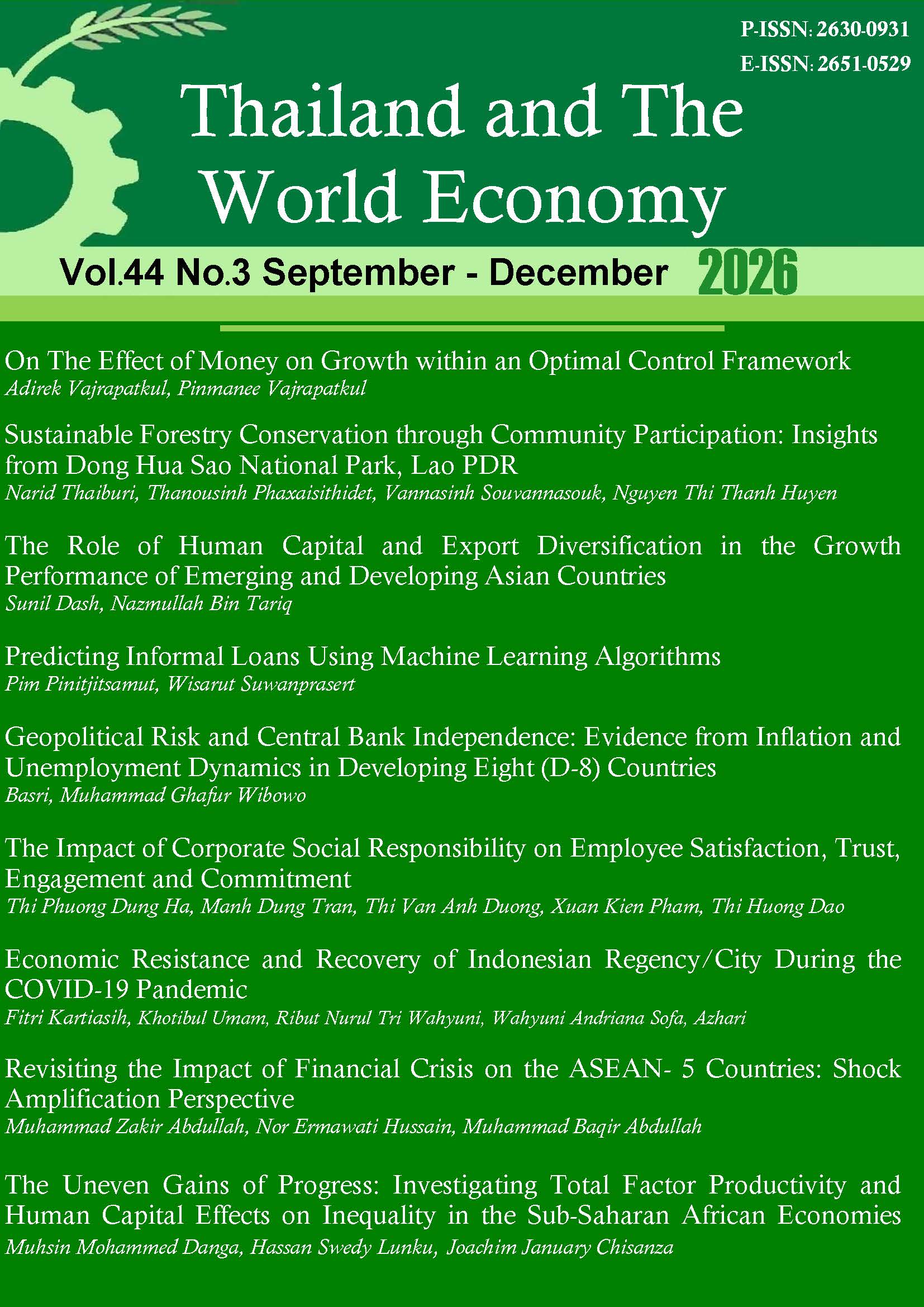
Geopolitical Risk and Central Bank Independence: Evidence from Inflation and Unemployment Dynamics in Developing Eight (D-8) Countries
DOI:
https://doi.org/10.66445/twe.v44i3.281736Keywords:
Central Bank Independence, Geopolitical Risk, Inflation, Unemployment, GMMAbstract
Recurring external shocks and domestic institutional constraints increasingly test macroeconomic stabilization in developing economies. This study examines how central bank independence (CBI) and geopolitical risk (GPR) shape inflation–unemployment dynamics in the Developing Eight (D-8) countries, Bangladesh, Egypt, Indonesia, Iran, Malaysia, Nigeria, Pakistan, and Turkey over 2012–2023. Using a two-step dynamic panel GMM approach with Windmeijer-corrected standard errors and collapsed instruments, we estimate multiple specifications for inflation and unemployment that incorporate monetary (interest rate, money supply), fiscal (public debt, government expenditure, tax revenue), and macro-structural controls (e.g., growth, productivity, oil prices), alongside governance and external-sector controls. The results suggest that conventional policy levers remain relevant but operate conditionally in D-8 settings characterized by import dependence, exchange-rate pass-through, shallow financial markets, and heterogeneous institutional credibility. Higher interest rates are associated with lower inflation but higher unemployment, while public debt is consistently linked to higher macroeconomic stress. CBI does not emerge as a uniformly strong direct determinant; instead, its role is more visible through policy-transmission channels, where stronger CBI can alter the effectiveness of interest-rate and fiscal actions. A salient finding is that GPR is often associated with lower inflation, consistent with an uncertainty-driven demand-contraction channel. At the same time, its labor-market effects appear more interaction-dependent (e.g., amplifying the unemployment implications of specific fiscal responses). Overall, the evidence indicates that stabilizing inflation and unemployment in D-8 economies requires credible monetary policy complemented by budgetary discipline and shock-resilience strategies, particularly during periods of elevated geopolitical uncertainty.
References
Ademola, A. S., & Badiru, A. (2016). The impact of unemployment and inflation on economic growth in Nigeria (1981-2014). International Journal of Business and Economic Sciences Applied Research (IJBESAR), 9(1), 47–55.
Agénor, P.-R., & Montiel, P. J. (2015). Development macroeconomics (4th ed.). Princeton, New Jersey: Princeton University Press.
Andreev, M., Peiris, M. U., Shirobokov, A., & Tsomocos, D. P. (2024). Commodity cycles and financial instability in emerging economies. Annals of Finance, 20, 167–197.
Arnone, M., & Romelli, D. (2013). Dynamic central bank independence indices and inflation rate: A new empirical exploration. Journal of Financial Stability, 9(3), 385–398.
Asab, N. A. (2025). Are supply shocks a key driver of global inflation? Evidence from CPI and GDP deflator analysis. Research in Globalization, 10.
Asadollah, O., Carmy, L. S., Hoque, M. R., & Yilmazkuday, H. (2024). Geopolitical risk, supply chains, and global inflation. The World Economy, 47(8), 3450–3486.
Asafo-Adjei, E., Qabhobho, T., & Adam, A. M. (2023). Conditional effects of local and global risk factors on the co-movements between economic growth and inflation: Insights into G8 economies. Heliyon, 9(9).
Aytaç, A., Korkmaz, M., & Yücel, A. S. (2024). The impact of unemployment and inflation on economic growth in Tukey. International Refereed Journal of Humanities and Academic Sciences, 33, 1–11.
Baker, S. R., Bloom, N., & Davis, S. J. (2016). Measuring economic policy uncertainty. The Quarterly Journal of Economics, 131(4), 1593–1636.
Blinder, A. S., Ehrmann, M., De Haan, J., & Jansen, D.-J. (2024). Central bank communication with the general public: Promise or false hope? Journal of Economic Literature, 62(2), 425–457.
Bloom, N. (2009). The impact of uncertainty shocks. Econometrica, 77(3), 623–685.
Blundell, R., & Bond, S. (1998). Initial conditions and moment restrictions in dynamic panel data models. Journal of Econometrics, 87(1), 115–143.
Bouri, E., Gabauer, D., Gupta, R., & Kinateder, H. (2023). Global geopolitical risk and inflation spillovers across European and North American economies. Research in International Business and Finance, 66.
Caldara, D., & Iacoviello, M. (2022). Measuring geopolitical risk. American Economic Review, 112 (4), 1194–1225.
Crump, R. K., Eusepi, S., Giannoni, M., & Şahin, A. (2024). The unemployment–inflation trade-off revisited: The Phillips curve in COVID times. Journal of Monetary Economics, 145.
Cukierman, A., & Lippi, F. (1999). Central bank independence, centralization of wage bargaining, inflation and unemployment: Theory and some evidence. European Economic Review, 43(7), 1395–1434.
Dincer, N., Eichengreen, B., & Geraats, P. (2022). Trends in monetary policy transparency: Further updates. International Journal of Central Banking, 18(1), 331–348.
Eichengreen, B., & Rose, A. K. (1999). Contagious currency crises: Channels of conveyance. In T. Ito & A. O. Krueger (Eds.), Changes in exchange rates in rapidly developing countries: Theory, practice, and policy issues (pp. 29–56). Chicago, IL: University of Chicago Press
Friedman, M. (1963). Inflation: Causes and consequences. Bombay, India: Asia Publishing House
Garriga, A. C., & Rodriguez, C. M. (2023). Central bank independence and inflation volatility in developing countries. Economic Analysis and Policy, 78, 1320–1341.
Glick, R., & Taylor, A. M. (2010). Collateral damage: Trade disruption and the economic impact of war. The Review of Economics and Statistics, 92 (1), 102–127
Goodfriend, M. (2007). How the world achieved consensus on monetary policy. Journal of Economic Perspectives, 21(4), 47–68.
Gordon, R. J. (1997). The time-varying NAIRU and its implications for economic policy. Journal of Economic Perspectives, 11(1), 11–32.
Ha, J., Kose, M. A., Ohnsorge, F., & Yilmazkuday, H. (2024). What explains global inflation. IMF Economic Review, 73 (2), 1–34.
Lucas Jr, R. E. (1976). Econometric policy evaluation: A critique. Carnegie-Rochester Conference Series on Public Policy, 1, 19–46.
Mankiw, N. G. (2013). Macroeconomics (8th ed.). New York, NY: Worth Publishers
Masciandaro, D., & Romelli, D. (2018a). Beyond the central bank independence veil: new evidence. BAFFI CAREFIN Centre Research Paper, 2018–71.
Masciandaro, D., & Romelli, D. (2018b). Central bankers as supervisors: Do crises matter? European Journal of Political Economy, 52, 120–140.
Mishkin, F. S. (2004). Can inflation targeting work in emerging market countries?. NBER Working Paper No. 10646. Cambridge, MA: National Bureau of Economic Research.
Mishkin, F. S. (2008). How should we respond to asset price bubbles. Financial Stability Review, 1265–74.
Okun, A. M. (1962). Potential GNP: Its measurement and significance. In Proceedings of the Business and Economic Statistics Section of the American Statistical Association (pp. 98–103). Alexandria, VA: American Statistical Association.
Phelps, E. S. (1967). Phillips curves, expectations of inflation and optimal unemployment over time. Economica, 34 (135), 254–281.
Phillips, A. W. (1958). The relation between unemployment and the rate of change of money wage rates in the United Kingdom, 1861-1957. Economica, 25(100), 283–299.
Piazza, M. R. (2018). Is there a Phillips curve? A full information partial equilibrium approach. IMF Working Paper No. 18/83. Washington, DC: International Monetary Fund.
Rodrik, D. (2009). The Turkish economy after the crisis. Discussion Paper No. 2009-1. Cambridge, MA: Harvard University.
Agénor, P.-R., & Montiel, P. J. (2015). Development Macroeconomics. In Development Macroeconomics. degruyter.com. https://doi.org/10.1515/9781400866267
Andreev, M., Peiris, M. U., Shirobokov, A., & Tsomocos, D. P. (2024). Commodity cycles and financial instability in emerging economies. Annals of Finance, 20(2), 167–197.
Asab, N. A. (2025). Are supply shocks a key driver of global inflation? Evidence from CPI and GDP deflator analysis. Research in Globalization, 10, 1–12.
Asadollah, O., Carmy, L. S., Hoque, M. R., & Yilmazkuday, H. (2024). Geopolitical risk, supply chains, and global inflation. The World Economy, 47(8), 3450–3486.
Baker, S. R., Bloom, N., & Davis, S. J. (2016). Measuring economic policy uncertainty. The Quarterly Journal of Economics, 131(4), 1593–1636.
Bloom, N. (2009). The impact of uncertainty shocks. Econometrica, 77(3), 623–685.
Blundell, R., & Bond, S. (1998). Initial conditions and moment restrictions in dynamic panel data models. Journal of Econometrics, 87(1), 115–143. https://doi.org/https://doi.org/10.1016/S0304-4076(98)00009-8
Caldara, D., & Iacoviell, M. (2022). Measuring Geopolitical Risk. In American Economic Review (Vol. 112, Issue 4). https://doi.org/10.1257/aer.20191823
Cukierman, A., & Lippi, F. (1999). Central bank independence, centralization of wage bargaining, inflation and unemployment:: Theory and some evidence. European Economic Review, 43(7), 1395–1434.
Data, O. W. in. (2024). Inflation and Unemployment Data.
Dincer, N., Eichengreen, B., & Geraats, P. (2022). Trends in monetary policy transparency: further updates. International Journal of Central Banking, 18(1), 331–348.
Glick, R., & Taylor, A. M. (2010). Collateral Damage: Trade Disruption and The Economic Impact of War. The Review of Economics and Statistics, 92(1), 102–127. http://www.jstor.org/stable/25651393
Lucas Jr, R. E. (1976). Econometric policy evaluation: A critique. Carnegie-Rochester Conference Series on Public Policy, 1, 19–46.
Masciandaro, D., & Romelli, D. (2018a). Beyond the central bank independence veil: new evidence. BAFFI CAREFIN Centre Research Paper, 2018–71.
Masciandaro, D., & Romelli, D. (2018b). Central bankers as supervisors: Do crises matter? European Journal of Political Economy, 52, 120–140.
Mishkin, F. S. (2004). Can inflation targeting work in emerging market countries? National Bureau of Economic Research Cambridge, Mass., USA.
Mishkin, F. S. (2008). How should we respond to asset price bubbles. Financial Stability Review, 12(1), 65–74.
Okun, A. M. (1963). Potential GNP: its measurement and significance. Cowles Foundation for Research in Economics at Yale University.
Rodrik, D. (2009). The Turkish economy after the crisis. Discussion Paper.
Samuelson, P. A., & Solow, R. M. (1960). Analytical aspects of anti-inflation policy. The American Economic Review, 50(2), 177–194
Siyan, P., Adegoriola, A. E., & Adolphus, J. A. (2016). Unemployment and Inflation: Implication on Poverty Level in Nigeria. In Journal of Development and Society (Vol. 3, Issue 4). mpra.ub.uni-muenchen.de. https://mpra.ub.uni-muenchen.de/id/eprint/79765
Yilmazkuday, H. (2022). Drivers of Turkish inflation. The Quarterly Review of Economics and Finance, 84, 315–323.
Yilmazkuday, H. (2025). Navigating geopolitical risks: shipping costs and policy implications. Maritime Policy & Management, 1–17.
Siyan, P., Adegoriola, A. E., & Adolphus, J. A. (2016). Unemployment and inflation: Implication on poverty level in Nigeria. Journal of Development and Society, 3 (4), 1–15. Retrieved from https://mpra.ub.uni-muenchen.de/79765/
Stockhammer, E., & Sturn, S. (2012). The impact of monetary policy on unemployment hysteresis. Applied Economics, 44(21), 2743–2756.
Taheri Hosseinkhani, N. (2025). Geopolitical turmoil, supply-chain realignment, and inflation: Commodity shocks, trade fragmentation, and policy responses. Retrieved from SSRN https://papers.ssrn.com/sol3/papers.cfm?abstract_id
=5448354
Taylor, J. B. (1993). Discretion versus policy rules in practice. Carnegie-Rochester Conference Series on Public Policy, 39, 195–214.
Yilmazkuday, H. (2022). Drivers of Turkish inflation. The Quarterly Review of Economics and Finance, 84, 315–323.
Yilmazkuday, H. (2025). Navigating geopolitical risks: Shipping costs and policy implications. Maritime Policy & Management, 1–17.
Downloads
Published
How to Cite
Issue
Section
Categories
- E Macroeconomics and Monetary Economics
- E0 General
- E1 General Aggregative Models
- E2 Consumption, Saving, Production, Investment, Labor Markets, and Informal Economy
- E4 Money and Interest Rates
- E5 Monetary Policy, Central Banking, and the Supply of Money and Credit
- E6 Macroeconomic Policy, Macroeconomic Aspects of Public Finance, and General Outlook
- E7 Macro-Based Behavioral Economics
- F International Economics
License
Copyright (c) 2026 Thailand and The World Economy

This work is licensed under a Creative Commons Attribution-NonCommercial-NoDerivatives 4.0 International License.