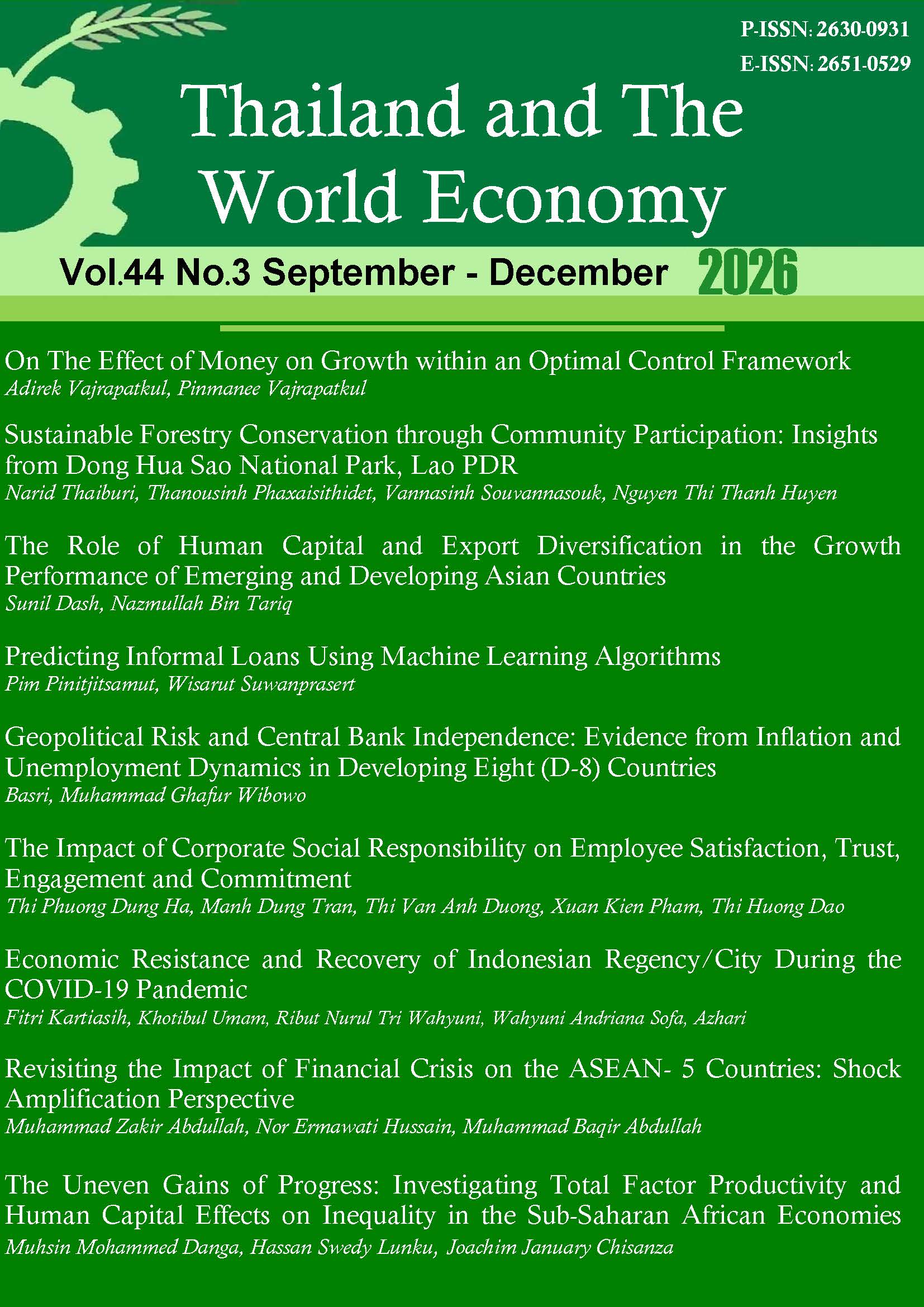
The Uneven Gains of Progress: Investigating Total Factor Productivity and Human Capital Effects on Inequality in the sub-Saharan African Economies
DOI:
https://doi.org/10.66445/twe.v44i3.282683Keywords:
Total factor productivity, Human capital accumulation, Income inequality, SDGsAbstract
In a world shaped by rapid technological advancements and evolving human capital landscapes, the issue of income inequality stands as a critical challenge with far-reaching implications in sub-Saharan Africa (SSA). This paper investigates the impact of human capital and total factor productivity on a panel of 23 SSA economies from 1980 to 2019. The dynamic common correlated effect on the mean group (DCCE-MG) estimator deployed on a heterogeneous, large N and/or T panel data. Contrary to expectations, the findings indicate that the increase in human capital, technological advancements, and their interactions have exacerbated income inequality rather than reducing it. Human capital accumulation might suggest that the level of educational attainment has reached a plateau, with no significant increase or improvement in educational outcomes. The study recommends several policy measures, such as investing in affordable and quality education with integration of technological changes to strengthen human capital accumulation on reducing income inequality, and accomplish the Sustainable Development Goals (SDGs).
References
Acemoglu, D. (1998). Why do new technologies complement skills? Directed technical change and wage inequality. The Quarterly Journal of Economics, 113(4), 1055–1089.
Acemoglu, D. & Robinson, J. A. (2012). Why nations fail: The origins of power, prosperity, and poverty. New York: Crown Publishing Group-A Division of Random House, Inc.,
Acemoglu, D. (2015). Localized and biased technologies: Atkinson and Stiglitz’s new view, induced innovations, and directed technological change. The Economic Journal, 125(583), 443–463.
Acemoglu, D., & Autor, D. (2012). What does human capital do? A review of Goldin and Katz's the race between education and technology. Journal of Economic Literature, American Economic Association, 50(2), 426-463.
Adeleye, B. N. (2024). Income inequality, human capital and institutional quality in sub-Saharan africa. Social Indicators Research, 171(1), 133–157.
Aghion, P., & Howitt, P. (1998). Endogenous growth theory. Cambridge, MA: MIT Press.
Arendt, Ł., & Grabowski, W. (2019). Technical change and wage premium shifts among task-content groups in Poland. Economic Research-Ekonomska Istraživanja, 32(1), 3398–3416.
Asongu, S. A., & Odhiambo, N. M. (2023). Foreign direct investment, information technology and total factor productivity dynamics in Sub-Saharan Africa. Information Technology and Total Factor Productivity Dynamics in Sub-Saharan Africa. World Affairs, 186(2),469-506.
Autor, D. H., Levy, F., & Murnane, R. J. (2003). The skill content of recent technological change: An empirical exploration. The Quarterly Journal of Economics, 118(4), 1279–1333.
Bai, J. (2009). Panel data models with interactive fixed effects. Econometrica, 77(4), 1229–1279.
Berisha, E., Meszaros, J., & Olson, E. (2018). Income inequality, equities, household debt, and interest rates: Evidence from a century of data. Journal of International Money and Finance, 80, 1-14.
Berman, E., Bound, J., & Machin, S. (1998). Implications of skill-biased technological change: International evidence. The Quarterly Journal of Economics, 113(4), 1245–1279.
Bloom, D. E., Canning, D., & Sevilla, J. (2004). The effect of health on economic growth: A production function approach. World Development, 32(1), 1-13.
Breitung, J. (2000). The local power of some unit root tests for panel data. In Baltagi, B., Fomby T.B., and Hill, R.C. (Ed), Nonstationary panels, panel cointegration, and dynamic panels, advances in econometrics, (Advances in Econometrics, Vol. 15, pp. 161-178). Amsterdam, Netherlands: JAI.
Chetty, R., Hendren, N., Kline, P., & Saez, E. (2014). Where is the land of opportunity? The geography of intergenerational mobility in the United States. The Quarterly Journal of Economics,129(4), 1553-1623.
Chetty, R., Hendren, N., Jones, M. R., & Porter, S. R. (2020). Race and economic opportunity in the United States: An intergenerational perspective. The Quarterly Journal of Economics, 135(2), 711–783,
Chudik, A., & Pesaran, M. H. (2015). Common correlated effects estimation of heterogeneous dynamic panel data models with weakly exogenous regressors. Journal of Econometrics, 188(2), 393–420.
Corak, M. (2016). Inequality from generation to generation: The United States in comparison. IZA Discussion Papers 9929, IZA Network @ LISER. Germany. Retrieved from https://www.iza.org/publications/dp/9929/inequality-from-generation-to-generation-the-united-states-in-comparison
De Gregorio, J. D., & Lee, J. W. (2002). Education and income inequality: New evidence from cross-country data. Review of Income and Wealth, 48(3), 395–416.
Ditzen, J. (2018). Estimating dynamic common-correlated effects in stata. The Stata Journal: Promoting Communications on Statistics and Stata, 18(3), 585–617.
Dumitrescu, E.-I., & Hurlin, C. (2012). Testing for Granger non-causality in heterogeneous panels. Economic Modelling, 29(4), 1450–1460.
Eberhardt, M., & Bond, S. (2009). Cross-section dependence in nonstationary panel models: A novel estimator. MPRA Paper 17692, University Library of Munich, Germany. Retrieved from https://mpra.ub.uni-muenchen.de/17870/2/
MPRA_paper_17870.pdf
Espoir, D. K., & Ngepah, N. (2021). Income distribution and total factor productivity: A cross-country panel cointegration analysis. International Economics and Economic Policy, 18(4), 661–698.
Feenstra, R. C., Inklaar, R., & Timmer, M. P. (2015). The next generation of the penn world table. American Economic Review, 105(10), 3150-82.
Galor, O., & Moav, O. (2004). From physical to human capital accumulation: Inequality and the process of development. The Review of Economic Studies, 71(4), 1001–1026.
Galor, O., & Tsiddon, D. (1997). Technological progress, mobility and economic growth. American Economics Review, 87(3), 363–382.
Galor, O., & Zeira, J. (1993). Income distribution and macroeconomics. The Review of Economic Studies, 60(1), 35-52.
Goos, M., Manning, A., & Salomons, A. (2014). Explaining job polarization: Routine-biased technological change and offshoring. American Economic Review, 104(8), 2509–2526.
Hashem Pesaran, M., & Yamagata, T. (2008). Testing slope homogeneity in large panels. Journal of Econometrics, 142(1), 50–93.
Hu, Z. (2021). The effect of income inequality on human capital inequality: Evidence from China. Structural Change and Economic Dynamics, 58, 471–489.
Ibengwe, L. J., Onyango, P. O., Hepelwa, A. S., & Chegere, M. J. (2022). Regional trade integration and its relation to income and inequalities among Tanzanian marine dagaa fishers, processors and traders. Marine Policy, 137.
Im, K.S., Pesaran, M.H., & Shin, Y. (2003) Testing for unit roots in heterogeneous panels. Journal of Econometrics, 115, 53-74.
IMF, & World Bank. (2020). Enhancing access to opportunities. Retrieved from https://www.imf.org/external/np/g20/pdf/2020/061120.pdf
Juodis, A., Karavias, Y., & Sarafidis, V. (2021). A homogeneous approach to testing for Granger non-causality in heterogeneous panels. Empirical Economics, 60(1), 93-112.
Kapetanios, G., Pesaran, M., & Yamagata, T. (2011). Panels with non-stationary multifactor error structures. Journal of Econometrics, 160(2), 326–348.
Karni, E., & Zilcha, I. (1995). Technological progress and income inequality. Economic Theory, 5(2), 277–294.
Kim, H. (2022). Education, wage dynamics, and wealth inequality. Review of Economic Dynamics, 43, 217–240.
Kiviet, J. F. (1995). On bias, inconsistency, and efficiency of various estimators in dynamic panel data models. Journal of Econometrics, 68(1), 53-78.
Kuznets, S. (1955). Economic growth and income inequality. The American Economic Review, 45, 1-28
Levin, A., Lin, C. F., & Chu, C. S. J. (2002). Unit root tests in panel data: Asymptotic and finite-sample properties. Journal of Econometrics, 108(1), 1-24.
Maddala, G. S., & Wu, S. (1999). A comparative study of unit root tests with panel data and a new simple test. Oxford Bulletin of Economics and Statistics, 61, 631-652.
Madsen, J., & Strulik, H. (2020). Technological change and inequality in the very long run. European Economic Review, 129.
Marrero, G. A., & Servén, L. (2022). Growth, inequality and poverty: A robust relationship?. Empirical Economics, 63(2), 725-791.
Mincer, J. (1958). Investment in human capital and personal income distribution. Journal of Political Economy, 66(4), 281–302.
Moon, H. R., & Weidner, M. (2013). Dynamic linear panel regression models with interactive fixed effects. Institute of Fiscal Studies. Retrieved from https://doi.org/10.1920/wp.cem.2013.6313
Ntegwa, M. J., & Olan’g, L. S. (2024). Explaining the rise of economic and rural-urban inequality in clean cooking fuel use in Tanzania. Heliyon, 10(1).
Pedroni, P. (2001). Fully modified OLS for heterogeneous cointegrated panels. In B. H. Baltagi, T. B. Fomby, & R. Carter Hill (Eds.), Nonstationary panels, panel cointegration, and dynamic panels (Advances in Econometrics, Vol. 15,pp. 93-130). Bingley: Emerald Group Publishing Limited.
Pesaran, M. H. (2004). General diagnostic tests for cross section dependence in panels. CESifo Working Papers No. 1229, Center for Economic Studies & Ifo Institute for Economic Research, Germany
Pesaran, M. H. (2006). Estimation and inference in large heterogeneous panels with a multifactor error structure. Econometrica, 74(4), 967–1012.
Pesaran, M. H. (2015). Testing weak cross-sectional dependence in large panels. Econometric Reviews, 34(6-10), 1089-1117.
Pesaran, M. H. (2021). General diagnostic tests for cross section dependence in panels. SSRN Electronic Journal Retrieved from https://doi.org/10.2139/ssrn.572504
Pesaran, M. H., & Tosetti, E. (2011). Large panels with common factors and spatial correlation. Journal of Econometrics, 161(2), 182–202.
Pesaran, M. H., & Zhao, Z. (1999). Bias reduction in estimating long-run relationships from dynamic heterogeneous panels. In C. Hsiao, M. H. Pesaran, K. Lahiri, & L. F. Lee (Eds.), Analysis of panels and limited dependent variable models (pp. 297–322). Cambridge: Cambridge University Press.
Paul, O., Arvind, A., & Surender, M, (2023). The determinants of the intention to use autonomous vehicles. African Journal of Science, Technology, Innovation and Development,15(5), 650-660.
Romer, P.M. (1990). Endogenous technological change. Journal of Political Economy, 98(5 part 2), S71-S102.
Sawadogo, R., & Semedo, G. (2021). Financial inclusion, income inequality, and institutions in sub-Saharan Africa: Identifying cross-country inequality regimes. International Economics, 167, 15–28.
Sethi, P., Bhattacharjee, S., Chakrabarti, D., & Tiwari, C. (2021). The impact of globalization and financial development on India’s income inequality. Journal of Policy Modeling, 43(3), 639–656.
Stiglitz, J. E. (2018). Globalization and its discontents revisited: Anti-globalization in the era of Trump. New York: W.W. Norton & Company.
Surender, M., Sonu, M., & Chhikara, R. (2020). The risk-seeking propensity of Indian entrepreneurs: A study using GEM data. Strategic Change,29(3),311-319.
Surender, M., Sonu, M., Archer, G. R., & Arvind, A. (2020). Survival of the smallest: A study of microenterprises in Haryana, India. Millennial Asia, 11(1), 57-78.
Surender, M., Nadiya, P., Martina Rani, K., & Arvind, A. (2024). What influences innovation score for countries at different levels of development? Examining the effects of teaching, research and knowledge transfer. FIIB Business Review, 1–18.
Surender, M., Anju, R., & Arvind, A. (2024). Entrepreneurship versus intrapreneurship: Are the antecedents similar? A cross-country analysis. Journal of Innovation Economics & Management, 45(3), 247-282.
Sylwester, K. (2002). A model of public education and income inequality with a subsistence constraint. Southern Economic Journal, 69(1), 144-158.
Teal, F., & Eberhardt, M. (2010). Productivity analysis in global manufacturing production. Economics Series Working Papers No. 515. Department of Economics, University of Oxford, United Kingdom. Retrieved from https://EconPapers.repec.org/RePEc:oxf:wpaper:515
Wang, J., Pei, Z. K., Wang, Y., & Qin, Z. (2024). An investigation of income inequality through autoregressive integrated moving average and regression analysis. Healthcare Analytics, 5.
Westerlund, J. (2007). Testing for error correction in panel data. Oxford Bulletin of Economics and Statistics, 69(6), 709–748.
World Bank. (2019). Human capital: The real wealth of a nation (Issue 12). Retrieved from The World Bank https://documents1.worldbank.org/curated/en/
/pdf/Tanzania-Economic-Update-Human-Capital-The-Real-Wealth-of-Nations.pdf
World Bank. (2021). The world development indicators (producer and distributor), Washington, D.C. Retrieved from World Bank. https://datacatalog.worldbank.org/search/dataset/0037712/world-development-indicators
Downloads
Published
How to Cite
Issue
Section
Categories
License
Copyright (c) 2026 Thailand and The World Economy

This work is licensed under a Creative Commons Attribution-NonCommercial-NoDerivatives 4.0 International License.