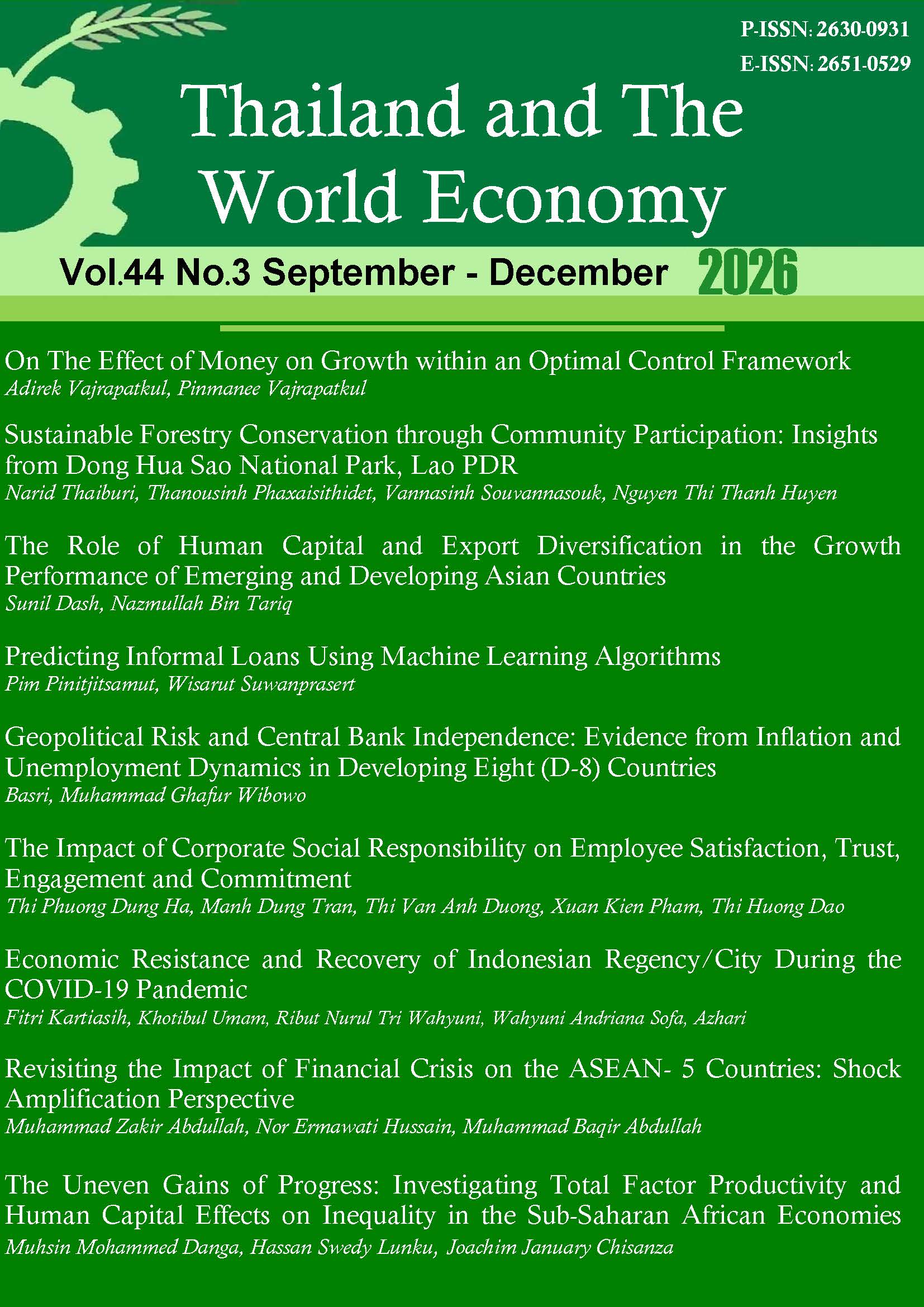
The Role of Human Capital and Export Diversification in the Growth Performance of Emerging and Developing Asian Countries
DOI:
https://doi.org/10.66445/twe.v44i3.282917Keywords:
Export Diversification, Margins, Economic Growth, Human CapitalAbstract
Using balanced panel data of 14 emerging and developing Asian countries over the period 1980-2013, this paper examines the importance of human capital in the relationship between export diversification, margins, and growth. Estimates from the Arellano-Bond panel GMM estimator reveal that at the aggregate level, export concentration has a positive impact on economic growth. The interaction coefficient between export diversification and human capital reveals that a higher level of human capital magnifies the positive impact of export concentration on growth. At the margin level, we found that the intensive margin of concentration has an overall positive impact on growth. The interaction coefficient between the extensive margin and human capital reveals that a higher level of human capital magnifies the positive impact of the extensive margin of diversification on growth. The complementarity between the intensive margin of diversification and human capital in impacting growth is inconclusive. Our findings are robust when an alternative estimate, such as the fixed effects estimator, is used. We also assess the credibility of statistical conclusions by testing whether the estimated relationships are sensitive to the choice of the dependent variable. Similar outcomes are obtained when growth in GDP per capita is used as an alternate indicator of economic growth in place of GDP growth. To fully benefit from knowledge spillovers within the framework of growth returns from international trade, it is recommended that policymakers in the sampled countries focus more on the development of their human capital.
References
Adaramola, A. O., & Dada, O. (2020). Impact of inflation on economic growth: Evidence from Nigeria. Investment Management & Financial Innovations, 17(2), 1-13.
Aditya, A., & Acharyya, R. (2013). Export diversification, composition, and economic growth: Evidence from cross-country analysis. The Journal of International Trade & Economic Development, 22(7), 959-992.
Agosin, M. R. (2009). Export diversification and growth in emerging economies. Cepal Review, 97(April 2009), 115-131.
Agosin, M. R., Alvarez, R., & Bravo‐Ortega, C. (2012). Determinants of export diversification around the world: 1962–2000. The World Economy, 35(3), 295-315.
Agrawal, G., & Khan, M. A. (2011). Impact of FDI on GDP: A comparative study of China and India. International Journal of Business and Management, 6(10), 71-80.
Alvarez‐Cuadrado, F., Van Long, N., & Poschke, M. (2017). Capital–labor substitution, structural change, and growth. Theoretical Economics, 12(3), 1229-1266.
Amurgo-Pacheco, A. (2008). Patterns of export diversification in developing countries. Policy Research Working Paper No. 4473. World Bank Publications. Washington, D.C.
Anand, R., Cheng, M. K. C., Rehman, S., & Zhang, M. L. (2014). Potential growth in emerging Asia. Working Paper No.2014/002. International Monetary Fund. Washington, D.C.
Arellano, M., & Bond, S. (1991). Some tests of specification for panel data: Monte Carlo evidence and an application to employment equations. The Review of Economic Studies, 58(2), 277-297.
Awokuse, T. O. (2008). Trade openness and economic growth: Is growth export-led or import-led?. Applied Economics, 40(2), 161-173.
Badinger, H., & Tondl, G. (2003). Trade, human capital and innovation: The engines of European regional growth in the 1990s. In: Fingleton, B. (eds). European regional growth (pp. 215-239). Springer, Berlin, Heidelberg.
Baharumshah, A. Z., Slesman, L., & Wohar, M. E. (2016). Inflation, inflation uncertainty, and economic growth in emerging and developing countries: Panel data evidence. Economic Systems, 40(4), 638-657.
Bhattacharjee, J., & Haldar, S. (2015). Economic growth of selected South Asian countries: Does institution matter. Asian Economic and Financial Review, 5(2), 356-370.
Bhavan, T. (2017). Human capital as a pushing factor of export: The case of four South Asian economies. Asian Development Policy Review, 5(4), 299-306.
Bista, R., & Sheridan, B. J. (2021). Economic growth takeoffs and the extensive and intensive margins of trade. Review of Development Economics, 25(3), 1373-1396.
Bittencourt, M. (2012). Inflation and economic growth in Latin America: Some panel time-series evidence. Economic Modelling, 29(2), 333-340.
Borensztein, E., De Gregorio, J., & Lee, J.-W. (1998). How does foreign direct investment affect economic growth?. Journal of International Economics, 45(1), 115-135.
Brunner, H.-P., & Calì, M. (2006). The dynamics of manufacturing competitiveness in South Asia: An analysis through export data. Journal of Asian Economics, 17(4), 557-582.
Cadot, O., Carrère, C., & Strauss-Kahn, V. (2011). Export diversification: What’s behind the hump?. Review of Economics and Statistics, 93(2), 590-605.
Canh, N. P., & Thanh, S. D. (2022). The dynamics of export diversification, economic complexity and economic growth cycles: Global evidence. Foreign Trade Review, 57(3), 234-260.
Chang, H.-J., & Zach, K. (2019). Industrialization and development. In K. S. Jomo, A. Chowdhury, A. K. M. A. Azad, & G. M. A. W. C. (Eds.), Asian transformations: An inquiry into the development of nations (pp. 67–100). Helsinki, Finland: UNU-WIDER.
Easton, B. (2008). Does poverty affect health? In K. Dew & A. Matheson (Eds.), Understanding health inequalities in Aotearoa New Zealand (pp. 97–106). Dunedin, New Zealand: Otago University Press.
Chude, D. I., & Chude, N. P. (2015). Impact of inflation on economic growth in Nigeria (2000-2009). International Journal of Business and Management Review, 3(5), 26-34.
Deb, K. (2022). Trade structure and economic growth in emerging and developing Asia: A dynamic panel analysis. Journal of Quantitative Economics, 20(3), 601-628.
Dennis, A., & Shepherd, B. (2011). Trade facilitation and export diversification. The World Economy, 34(1), 101-122.
Eggoh, J. C., & Khan, M. (2014). On the nonlinear relationship between inflation and economic growth. Research in Economics, 68(2), 133-143.
Espoir, L. M. (2020). Determinant of export diversification: An empirical analysis in the case of SADC countries. International Journal of Research in Business and Social Science, 9(7), 130-143.
Fatima, S., Chen, B., Ramzan, M., & Abbas, Q. (2020). The nexus between trade openness and GDP growth: Analyzing the role of human capital accumulation. Sage Open, 10(4).
Feenstra, R. C., Inklaar, R., & Timmer, M. P. (2015). The next generation of the Penn World Table. The American Economic Review, 105(10), 3150-3182.
Gao, Y., Whalley, J., & Ren, Y. (2014). Decomposing China’s export growth into extensive margin, export quality and quantity effects. China Economic Review, 29, 19-26.
Giri, R., Quayyum, M. S. N., & Yin, R. (2019). Understanding export diversification: Key drivers and policy implications. Working Paper No. 19/105. International Monetary Fund. Washington, D.C.
Golo, Y. N. (2023). Foreign direct investment, human capital and export diversification in Africa: A panel smooth transition regression (PSTR) model analysis. The Journal of International Trade & Economic Development, 33 (7), 1371-1396.
Grossman, G. M., & Helpman, E. (1991). Trade, knowledge spillovers, and growth. European Economic Review, 35(2-3), 517-526.
Handoyo, R. D., & Ibrahim, K. H. (2021). Determinants of export diversification in developing countries. Industrial Engineering & Management Systems, 20(4), 720-731.
Haq, M., & Luqman, M. (2014). The contribution of international trade to economic growth through human capital accumulation: Evidence from nine Asian countries. Cogent Economics & Finance, 2(1).
Herzer, D., & Klasen, S. (2008). In search of FDI-led growth in developing countries: The way forward. Economic Modelling, 25(5), 793-810.
Hidalgo, C. A., & Hausmann, R. (2009). The building blocks of economic complexity. Proceedings of the National Academy of Sciences, 106(26), 10570-10575.
IMF. (2024). Export Diversification and Quality. Retrieved from https://www.imf.org/external/datamapper/datasets/SPRLU#:~:text=The%20toolkit%20includes%20indices%20of,version%20of%20Hallak%20(2006)
IMF. (2025). Classification of economies in the World Economic Outlook (WEO). Retrieved from https://www.imf.org/en/Publications/WEO/weo-database/2025/april/groups-and-aggregates#da
Jongwanich, J. (2020). Export diversification, margins and economic growth at industrial level: Evidence from Thailand. The World Economy, 43(10), 2674-2722.
Kalaitzi, A. S. (2018). The causal effects of trade and technology transfer on human capital and economic growth in the United Arab Emirates. Sustainability, 10(5).
Kasidi, F., & Mwakanemela, K. (2013). Impact of inflation on economic growth: A case study of Tanzania. Asian Journal of Empirical Research, 3(4), 363-380.
Keho, Y. (2017). The impact of trade openness on economic growth: The case of Cote d’Ivoire. Cogent Economics & Finance, 5(1).
Kim, D. H., Lin, S. C., & Suen, Y. B. (2011). Nonlinearity between trade openness and economic development. Review of Development Economics, 15(2), 279-292.
Kwon, D.-B. (2009). Human capital and its measurement. Paper presented at the 3rd OECD World Forum on “Statistics, Knowledge and Policy”: Charting Progress, Building Visions, Improving life. Paris, France. Retrieved from https://www.academia.edu/24595168/The_3rd_OECD_World_Forum_on_Statistics_Knowledge_and_Policy_HUMAN_CAPITAL_AND_ITS_MEASUREMENT_KWON_DAE_BONG
Levin, A., & Raut, L. K. (1997). Complementarities between exports and human capital in economic growth: Evidence from the semi-industrialized countries. Economic Development and Cultural Change, 46(1), 155-174.
Li, X., & Liu, X. (2005). Foreign direct investment and economic growth: An increasingly endogenous relationship. World Development, 33(3), 393-407.
Luqman, M., & Soytas, U. (2023). Asymmetric role of human capital and trade liberalization in the economic growth of Pakistan: Fresh evidence from the nonlinear analysis. The Journal of International Trade & Economic Development, 32(3), 475-493.
M, S., & Sridharan, P. (2022). Determinants of export diversification: Evidence from fractional logit estimation model. Foreign Trade Review, 57(2), 160-177.
Mau, K. (2016). Export diversification and income differences reconsidered: the extensive product margin in theory and application. Review of World Economics, 152(2), 351-381.
Mincer, J. (1984). Human capital and economic growth. Economics of Education Review, 3(3), 195-205.
Mkhatshwa, Z., Tijani, A., & Masuku, M. (2015). Analysis of the relationship between inflation, economic growth and agricultural growth in Swaziland from 1980-2013. Journal of Economics and Sustainable Development, 6(18), 189-204.
Mora, J., & Olabisi, M. (2021). Economic development and the margins of trade: Are the least developed countries different?. Economic Inquiry, 59(2), 600-621.
Neeliah, H., & Seetanah, B. (2016). Does human capital contribute to economic Growth in Mauritius?. European Journal of Training and Development, 40(4), 248-261.
Nouira, R., & Saafi, S. (2022). What drives the relationship between export upgrading and growth? The role of human capital, institutional quality, and economic development. Journal of the Knowledge Economy, 13(3), 1944-1961.
O’Sullivan, A., Sheffrin, S. M., & Swan, K. (2003). Prentice Hall Economics: Principles in Action. New Jersey, United States: Prentice-Hall, Inc.
Otani, I., & Villanueva, D. (1989). Theoretical aspects of growth in developing countries: External debt dynamics and the role of human capital. IMF Staff Papers, 36(2), 307-342.
Raghutla, C. (2020). The effect of trade openness on economic growth: Some empirical evidence from emerging market economies. Journal of Public Affairs, 20(3).
Romer, P. M. (1990a). Capital, labor, and productivity. Brookings Papers on Economic Activity: Microeconomics, 1990, 337-367.
Romer, P. M. (1990b). Endogenous technological change. Journal of Political Economy, 98(5, Part 2), S71-S102.
Romer, P. M. (1990c). Human capital and growth: Theory and evidence. Carnegie-Rochester Conference Series on Public Policy, 32(1), 251-286.
Rondeau, F., & Roudaut, N. (2014). What diversification of trade matters for economic growth of developing countries. Economics Bulletin, 34(3), 1485-1497.
Soukiazis, E., & Antunes, M. (2012). Foreign trade, human capital and economic growth: An empirical approach for the European Union countries. The Journal of International Trade & Economic Development, 21(1), 3-24.
Vakataki‘Ofa, S., Spence, M., & Mevel, S. (2016). Export diversification and intra-industry trade in Africa. In S. Kayizzi-Mugerwa, A. Shimeles, A. Lusigi, & A. Moummi (Eds). Inclusive growth in Africa (pp. 142-175). Routledge. London
World Bank. (2026). World development indicators [DataBank]. Retrieved from The World Bank https://databank.worldbank.org/source/world-development-indicators
World Bank. (2025). World development indicators [DataBank]. Retrieved from The World Bank https://databank.worldbank.org/source/world-development-indicators
World Trade Organization. (2017). Special topic: Export diversification. Retrieved from https://www.wto.org/english/res_e/statis_e/wtp2017_special_topic_e.pdf
Wu, L., Chen, G., & Peng, S. (2021). Human capital expansion and global value chain upgrading: Firm‐level evidence from China. China & World Economy, 29(5), 28-56.
Young, A. O. (2024). Intensive and extensive margins of export diversification as strategies for sustainable economic growth: Evidence from the Nigerian economy. Foreign Trade Review, 59(2), 187-224.
Zhou, Y. (2018). human capital, institutional quality and industrial upgrading: Global insights from industrial data. Economic Change and Restructuring, 51(1), 1-27.
Downloads
Published
How to Cite
License
Copyright (c) 2026 Thailand and The World Economy

This work is licensed under a Creative Commons Attribution-NonCommercial-NoDerivatives 4.0 International License.