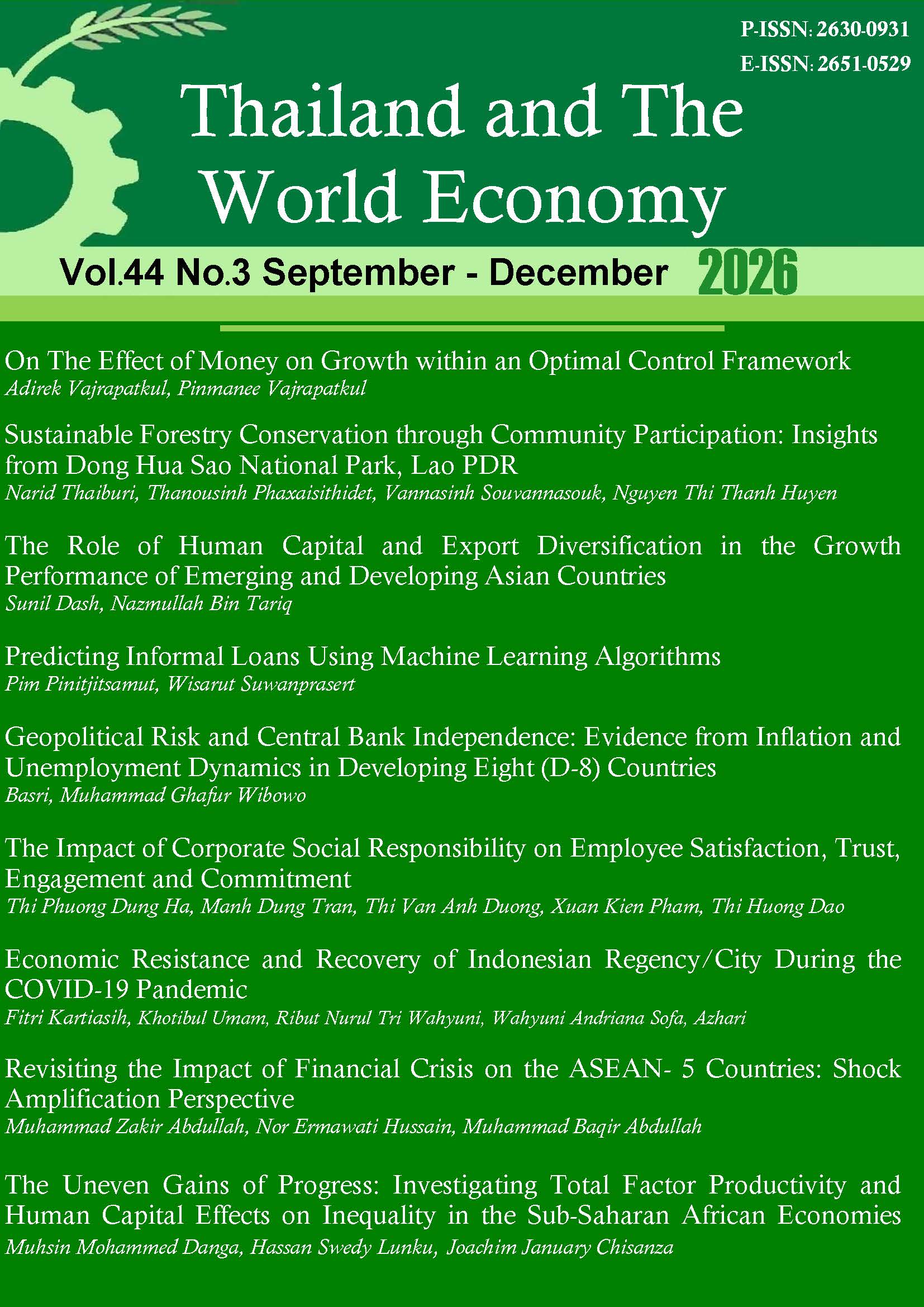
Revisiting the Impact of Financial Crisis on the ASEAN- 5 Countries: Shock Amplification Perspective
DOI:
https://doi.org/10.66445/twe.v44i3.282947Keywords:
Business Fluctuations, Financial Markets and the Macroeconomy, Financial CrisesAbstract
This study aims to revisit the impact of the Asian Financial Crisis (AFC) and Global Financial Crisis (GFC) in the ASEAN-5 countries from 1990 to 2020. By addressing the long-run economic trajectory, the size of shock amplification is manifested by the divergence of aggregate output from potential output in the business cycle due to an economic shock. This study utilizes Fully Modified Ordinary Least Squares (FMOLS), where the results indicate that both crises generated negative output gaps at the group level, with the Global Financial Crisis producing a substantially larger long-run deviation from potential output than the Asian Financial Crisis. The interaction analysis further shows that while monetary policy acted as a shock absorber during the Asian Financial Crisis, key macroeconomic variables, particularly trade openness and financial development, served as important channels of shock amplification during the Global Financial Crisis. At the individual country level, the results reveal pronounced heterogeneity in shock amplification across the ASEAN-5 economies. Indonesia experienced the largest amplification during the Asian Financial Crisis, whereas Singapore recorded the strongest amplification during the Global Financial Crisis. The results highlight that the differences in economic structure, financial exposure, and external integration shape the transmission and amplification of crises across countries and periods. Strengthening financial sector resilience and managing exposure to external trade shocks are crucial for reducing long-run output losses during future global financial disruptions.
References
Afonso, A., Alves, J., & Leal, F. S. (2025). Government scale as a stabilizer: Effects on output volatility and losses. CESifo Working Paper No. 11993. Retrieved from https://www.econstor.eu/handle/10419/324984
Ari, A., Chen, S., & Ratnovski, L. (2021). The dynamics of non-performing loans during banking crises: A new database with post-COVID-19 implications. Journal of Banking & Finance, 133.
Armstrong, H., & Read, R. (2020). Size and sectoral specialization: The asymmetric cross-country impacts of the 2008 crisis and its aftermath. Journal of International Development, 32(6), 891-921.
Asteriou, D., & Spanos, K. (2021). The mechanisms linking the finance-growth relationship in view of the financial crisis: An empirical investigation of the EU countries. Journal of Economic Studies, 49(7), 1240–1268.
Balavac, M. & Pugh, G. (2016). The link between trade openness, export diversification, institutions and output volatility in transition countries. Economic Systems, 40(2), 273-287.
Barro, R. (2001). Economic growth in East Asia before and after the financial crisis. National Bureau of Economic Research Working Paper No. 8330, Cambridge, MA, United States. Retrieved from https://www.nber.org/system/files/working _papers/w8330/w8330.pdf
Becker, T. I., & Mauro, P. (2006). Output drops and the shocks that matter. International Monetary Fund Working Paper No. 172, International Monetary Fund, Washington, DC, United States. Retrieved from https://www.imf.org/ external/pubs/ft/wp/2006/wp06172.pdf
Bianco, S., Amini, C., & Signorelli, M. (2016). The impact of the global financial crisis and the role of external and internal factors in emerging economies. Emerging Markets Finance and Trade, 53(2), 229 - 249.
Blanchard, O., & Leigh, D. (2013). Growth forecast errors and fiscal multipliers. American Economic Review, 103(3), 117-120.
Briguglio, L., & Piccinino, S. (2012). Growth with resilience in East Asia and the 2008-2009 global recession. Asian Development Review, 29(2), 183-206.
Briguglio, L., Cordina, G., Farrugia, N., & Vella, S. (2009). Economic vulnerability and resilience: Concepts and measurements. Oxford Development Studies, Taylor & Francis Journals, 37(3), 231-247.
Caro, P. (2017). Testing and explaining economic resilience with an application to Italian regions. Papers in Regional Science, 96(1), 93-114.
Casey, E. (2019). Inside the “upside down”: Estimating Ireland’s output gap. The Economic and Social Review, 50(1, Spring), 5–34.
Cecchetti, S. G., Kohler, M., & Upper, C. (2009). Financial crises and economic activity. National Bureau of Economic Research Working Paper No. w15379, Cambridge, MA, United States. Retrieved from https://www.nber.org/papers/w15379
Cerra, M. V., Hakamada, M., & Lama, M. R. (2021). Financial crises, investment slumps, and slow recoveries. International Monetary Fund Working Paper No. 48, International Monetary Fund, Washington, DC, United States. Retrieved from https://www.imf.org/en/publications/wp/issues/2021/06/25/financial-crises-investment-slumps-and-slow-recoveries-461271
Cerra, V., & Saxena, S. C. (2005). Did output recover from the Asian crisis?. International Monetary Fund Working Paper No. 48, International Monetary Fund, Washington, DC, United States. Retrieved from https://www.imf.org/
external/pubs/ft/wp/2003/wp0348.pdf
Cerra, V., & Saxena, S. C. (2008). Growth dynamics: The myth of economic recovery. American Economic Review, 98(1), 439–457.
Cerra, V., Fatás, A., & Saxena, S. C. (2023). Hysteresis and business cycles. Journal of Economic Literature, 61(1), 181–225.
Chletsos, M., & Sintos, A. (2020). The effect of financial fragility on employment. Economic Modelling, 94, 104-120.
Corbacho, A., & Peiris, S. J. (2018). Chapter 10: The future of ASEAN-5 financial integration. In A. Corbacho & S. J. Peiris (Eds.), The ASEAN Way: Sustaining growth and stability (pp. 257-278). International Monetary Fund.
Creal, D. D., & Wu, J. C. (2017). Monetary policy uncertainty and economic fluctuations. International Economic Review, 58(4), 1317–1354.
Crotty, J. (2009). Structural causes of the global financial crisis: A critical assessment of the ‘new financial architecture’. Cambridge Journal of Economics, 33, 563-580.
Curran, L., & Zignago, S. (2011). The financial crisis and trade—key impacts, interactions, and outcomes. Thunderbird International Business Review, 53(2), 115-128.
Dada, J. T., Abanikanda, E. O., Tabash, M. I., Ray, S., & Al-Faryan, M. A. S. (2025). Financial globalization and macroeconomic volatility in Sub-Saharan African countries: Do economic and political institutions matter?. Journal of Financial Economic Policy, 18(1), 64–85.
Debrun, X., & Kapoor, R. (2010). Fiscal policy and macroeconomic stability: Automatic stabiliser work, always and everywhere. International Monetary Fund Working Paper No. 111, International Monetary Fund, Washington, DC, United States. Retrieved from https://www.imf.org/en/publications/wp/issues/2016/12/31/fisca l-policy-and-macroeconomic-stability-automatic-stabilizers-work-always-and-everywhere-23818
Debrun, X., Pisani-Ferry, J., & Sapir, A. (2008). Government size and output volatility: Should we forsake automatic stabilisation?. International Monetary Fund Working Paper No. 122, International Monetary Fund, Washington, DC, United States. Retrieved from https://www.imf.org/en/publications/wp/issues/2016 /12/31/government-size-and-output-volatility-should-we-forsake-automatic-stabilization-21947
Dekle, R., Hsiao, C., & Wang, S. (2001). Do high interest rates appreciate exchange rates during crisis? The Korean evidence. Oxford Bulletin of Economics and Statistics, 63(3), 359-380.
Dellink, R., Lanzi, E., Château, J., Bosello, F., Parrado, R., & Bruin, K. (2014). Consequences of climate change damages for economic growth. OECD Economics Department Working Papers No. 1135. OECD Publishing, Paris, France. Retrieved from https://www.oecd.org/content/dam/oecd/en/publications /reports/2014/06/consequences-of-climate-change-damages-for-economic-grow th_g17a24 e4/5jz2bxb8kmf3-en.pdf
di Giovanni, J., & Levchenko, A. A. (2009). Trade openness and volatility. The Review of Economics and Statistics, 91(3), 558–585.
Doraisami, A. (2004). From crisis to recovery: The motivations for and effects of Malaysian capital controls. Journal of International Development, 16(2), 241–254.
Duncan, R. (2014). Institutional quality, the cyclicality of monetary policy and macroeconomic volatility. Journal of Macroeconomics, 39, 113-155.
Duval, R., Elmeskov, J., & Vogel, L. (2007). Structural policies and economic resilience to shocks. OECD Economics Department Working Papers No. 567. OECD Publishing, Paris, France. Retrieved from https://www.oecd.org/content /dam/oecd/en/publications/reports/2007/07/structural-policies-and-economic-res ilience-to-shocks_g17a199c/140152385131.pdf
Easterly, W., Islam, R., & Stiglitz, J. E. (2000). Shaken and stirred: Explaining growth volatility. Annual World Bank Conference on Development Economics, 2000. Washington, DC, United States: The World Bank.
Ebeke, C., & Siminitz, J. (2018). Trade uncertainty and investment in the euro area. IMF Working Papers, 2018/281. International Monetary Fund, Washington, DC, United States. Retrieved from https://www.imf.org/-/media/files/publications/wp /2018 /wp18281.pdf
Eller, M., Fidrmuc, J., & Fungáčová, Z. (2016). Fiscal policy and regional output volatility: Evidence from Russia. Regional Studies, 50(11), 1849–1862.
Faggian, A., Gemmiti, R., Jaquet, T., & Santini, I. (2018). Regional economic resilience: The experience of the Italian local labor systems. The Annals of Regional Science, 60, 393-410.
Fatàs, A., & Mihov, I. (2012). Long- term effects of the great recession. The B.E. Journal of Macroeconomics,12(3), 1-68.
Fingleton, B., Garretsen, H., & Martin, R. (2012). Recessionary shocks and regional employment: Evidence on the resilience of U.K regions. Journal of Regional Science, 52(1), 109-133.
Fritsche, U., & Kuzin, V. (2005). Declining output volatility in Germany: Impulses, propagation, and the role of monetary policy. Applied Economics, 37(21), 2445–2457.
Fujii, E. (2017). Government size, trade openness, and output volatility: A case of fully integrated economies. Open Economies Review, 28(4), 661-684.
Furceri, D., & Mourougane, A. (2012). The effect of financial crises on potential output: New empirical evidence from OECD countries. Journal of Macroeconomics, 34(3), 822-832.
Furceri, D., & Zdzienicka, A. (2010). The real effect of financial crises in the European transition economies. Economics of Transition, 19(1), 1-25.
Giovanni, J. d., & Levchenko, A. A. (2009). Trade openness and volatility. Review of Economics and Statistics, 91(3), 558-585.
Grigoli, F., Herman, A., Swiston, A., & Bella, G. D. (2015). Output gap uncertainty and real-time monetary policy. Russian Journal of Economics, 1(4), 329–358.
Guillaumont, P. (2009). An economic vulnerability index: Its design and use for international development policy. Oxford Development Studies, 37(3), 193-228.
Gunay, S., & Can, G. (2022). The source of financial contagion and spillovers: An evaluation of the covid-19 pandemic and the global financial crisis. PLoS One, 17(1).
Hall, R. E. (2011). The long slump. American Economic Review, 101(2), 431–469.
Hall, E. R. (2015). Macroeconomics of persistent slumps. National Bureau of Economic Research Working Paper No. 22230, Cambridge, MA, United States. https://www.nber.org/system/files/working_papers/w22230/w22230.pdf
Heimberger, P. (2023). The cyclical behavior of fiscal policy: A meta-analysis. Economic Modelling, 123.
Hill, E., Wial, H., & Wolman, H. (2008). Exploring regional economic resilience. Institute of Urban and Regional Development Working Paper No. 2008-04, Institute of Urban and Regional Development (IURD), CA, United States. Retrieved from https://www.econstor.eu/bitstream/10419/59420/1/59285994 0.pdf
Hor, B., & Lim, S. (2025). The impact of non- performing loans on credit growth of commercial banks in Cambodia. Journal of Risk and Financial Management, 18(11).
Illes, A., Lombardi, M., & Mizen, P. (2019). The divergence of bank lending rates from policy rates after the financial crisis: The role of bank funding costs. Journal of International Money and Finance, 93, 117–141.
Irandoust, M. (2020). The effectiveness of monetary policy and output fluctuations: An asymmetric analysis. Australian Economic Papers, 59(2), 161–181.
Iseringhausen, M., & Vierke, H. (2019). What drives output volatility? The role of demographics and government size revisited. Oxford Bulletin of Economics and Statistics, 81(4), 849–867.
Isnawangsih, A., Klyuev, V., & Zhang, L. (2013). The big split: Why did output trajectories in the ASEAN-4 diverge after the global financial crisis?. International Monetary Fund Working Papers No. 222. International Monetary Fund, Washington, DC, United States. Retrieved from https://www.imf.org/-/media/websites/imf/imported-full-text-pdf/external/pubs/ft/wp/2013/_wp1322 2.pdf
Iyke, B. N. (2019). Real output and oil price uncertainty in an oil producing country. Bulletin of Monetary Economics and Banking. 22(2), 163-176.
Johnson, S., Boone, P., Breach, A., & Friedman, E. (2000). Corporate governance in the Asian financial crisis. Journal of Financial Economics, 58(1-2), 141-186.
Jordà, Ò., Schularick, M., & Taylor, A. M. (2013). When Credit Bites Back. Journal of Money Credit and Banking, 45(s2), 3–28.
Kapp, D., & Vega, M. (2014). Real output costs of financial crises: A loss distribution approach. Cuadernos de Economía, 37(103), 13-28.
Kong, Q., Peng, D., Ni, Y., Jiang, X., & Wang, Z. (2021). Trade openness and economic growth quality of China: Empirical analysis using ARDL model. Finance Research Letters, 38.
Ksantini, M., & Boujelbène, Y. (2014). Impact of financial crises on growth and investment: An analysis of panel data. Journal of International and Global Economic Studies, 7(1), 32-57.
Li, L., Liu, S., Li, C., Zhang, P., & Lo, K. (2022). What matters for regional economic resilience amid multi shock situations: Structural or agency? Evidence from resource-based cities in China. Sustainability, 14(9), 1 – 18.
Löscher, A., & Kaltenbrunner, A. (2022). Climate change and macroeconomic policy space in developing and emerging economies. Journal of Post Keynesian Economics, 46, 113-141.
Ma, Y., Jiang, Y., & Yao, C. (2022). Trade openness, financial openness, and macroeconomic volatility. Economic Systems, 46(1), 1 – 19.
Majeed, M. T., & Noreen, A. (2018). Financial development and output volatility: a cross-sectional panel data analysis. The Lahore Journal of Economics, 23(1), 97-141.
Mallick, D. (2014). Financial development, shocks, and growth volatility. Macroeconomic Dynamics, 18(3), 651–688.
Marimuthu, M., Khan, H., & Bangash, R. (2021). Is the fiscal deficit of ASEAN alarming? Evidence from fiscal deficit consequences and contribution towards sustainable economic growth. Sustainability, 13(18), 1 -19.
Martin, R., Sunley, P., Gardiner, B., & Tyler, P. (2016). How regions react to recessions: Resilience and the role of economic structure. Regional Studies, 50(4), 561-585.
Mina, A., & Santoleri, P. (2021). The effect of the Great Recession on the employment growth of young vs. small firms in the Eurozone. Structural Change and Economic Dynamics, 56, 184-194.
Mireku, K., Animah Agyei, E., & Domeher, D. (2017). Trade openness and economic growth volatility: An empirical investigation. Cogent Economics and Finance, 5(1).
Mishkin, F. S. (2002). The role of output stabilization in the conduct of monetary policy. International Finance, 5(2), 213-227.
Mittenzwei, K., Persson, T., Höglind, M., & Kværnø, S. (2017). Combined effects of climate change and policy uncertainty on the agricultural sector in Norway. Agricultural Systems, 153, 118-126.
Mokoena, K., & Tweneboah, G. (2025). Government size and output volatility in Sub-Saharan African countries: Do threshold levels exist?. Cogent Social Sciences, 11(1), 2482887.
Mourougane, A. (2017). Crisis, potential output, and hysteresis. International Economics, 149, 1-14.
Munir, K., & Riaz, N. (2019). Fiscal policy and macroeconomic stability in South Asian countries. Review of Public Economics, 228(1), 13-33.
Murray, J. (2014). Output gap measurement: Judgement and uncertainty. Office for Budget Responsibility Working Paper No. 5, Office for Budget Responsibility, London, United Kingdom. Retrieved from https://obr.uk/docs/dlm_uploads/ WorkingPaperNo5.pdf
Oyèkọ́lá, Ọ. (2022). How resilient is the U.S economy to foreign disturbances?. Mathematics, 10(9), 1404.
Oz-Yalaman, G., Sevinc, D., & Sevil, G. (2019). The impact of government size on output volatility: Evidence from world economies. Business and Economics Research Journal, 10(4), 761-776.
Park, D. (2010). The role of fiscal policy in rebalancing developing Asia's growth. Asian Development Bank Economic Working Paper Series No. 412. Manila, Philippines.
Quast, J., & Wolters, M. (2020). Reliable real- time output gap estimates based on a modified Hamilton Filter. Journal of Business & Economic Statistics, 40, 152 - 168.
Raheem, I. D., Ajide, K. B., & Adeniyi, O. (2016). The role of institutions in output growth volatility-financial development nexus. Journal of Economic Studies, 43(6), 910-927.
Raheem, I. D., Bello Ajide, K., & Adeniyi, O. (2016). The role of institutions in output growth volatility-financial development nexus: A worldwide study. Journal of Economic Studies, 43(6), 910–927.
Raj, F. J., & Roy, S.J. (2014). Impact of financial crisis in Asia. Procedia – Social and Behavioural Sciences, 133, 336-345.
Rasiah, R., Xiao-Shan, Y., & Govindaraju, C. (2014). Crisis effects on the electronics industry in Southeast Asia. Journal of Contemporary Asia, 44, 645 - 663. https://doi.org/10.1080/00472336.2014.923637.
Raz, A. F., Indra, T. P., Artikasih, D. K., & Citra, S. (2012). Global financial crises and economic growth: Evidence from East Asian economies. Buletin Ekonomi Moneter dan Perbankan, 15(2), 35-54.
Reinhart, C. M., & Rogoff, K. S. (2009). The Aftermath of Financial Crises. The American Economic Review, 99(2), 466–472.
Romer, C. D., & Romer, D. (2017). New evidence on the aftermath of financial crises in advanced countries. American Economic Review, 107(10), 3072-3118.
Samsi, S., Cheok, C., & Yusof, Z. (2019). Financial crisis, stock market and economic growth: Evidence from ASEAN-5. Journal of Southeast Asian Economies (JSEAE), 36, 37-56.
Sedita, S., Noni, I., & Pilotti, L. (2017). Out of the crisis: An empirical investigation of place-specific determinants of economic resilience. European Planning Studies, 25, 155-180.
Şen, H., & Kaya, A. (2021). Output-volatility reducing effects of automatic stabilizers: Policy implications for EMU member states. Journal of Policy Modeling, 43(6), 1388–1414.
Sghaier, I. M. (2021). The role of institutional quality in finance-growth nexus: Evidence from North African countries. Journal of the Knowledge Economy, 13(4), 3472–3491.
Simmie, J., & Martin, R. (2010). The economic resilience of regions: Towards an evolutionary approach. Cambridge Journal of Regions Economy and Society, 3(1), 27–43.
Singh, V. K., Abosedra, S., Fakih, A., Ghosh, S., & Kanjilal, K. (2023). Economic volatility and financial deepening in Sub-Saharan Africa: Evidence from panel cointegration with cross-sectional heterogeneity and endogenous structural breaks. Empirical Economics, 65(5), 2013–2038.
Soufi, H. R., Esfahanipour, A., & Shirazi, M. A. (2022). A quantitative approach for analysis of macroeconomic resilience due to socio-economic shocks. Socio-Economic Planning Sciences, 79, 101101.
Sutherland, D., & Hoeller, P. (2014). Growth policies and macroeconomic stability. OECD Policy Paper No.8, OECD Publishing, Paris, France. Retrieved from https://www.oecd.org/content/dam/oecd/en/publications/reports/2014/02/growth-policies-and-macroeconomic-stability_g17a2460/5jz8t849335d-en.pdf
Thangavelu, S., & Chongvilaivan, A. (2007). Post-crisis investment performance of ASEAN countries: impact of FDI. East Asia Bureau of Economics Research Working Paper Series No. 13, Canberra, Australia. Retrieved from https://eaber.org/publications/post-crisis-investment-performance-of-asean-countries-impact-of-fdi
Tiryaki, S. (2012). Interest rates and real business cycles in emerging markets. The B.E. Journal of Macroeconomics, 11(1), 1-30.
Wahidin, D., Akimov, A., & Roca, E. (2021). The impact of bond market development on economic growth before and after the global financial crisis: Evidence from developed and developing countries. International Review of Financial Analysis, 77.
Wan, C., & Jin, Y. (2014). Output recovery after financial crises: An empirical study. Emerging Markets Finance and Trade, 50(6), 209-228.
Wang, K., Wang, Z., Liu, H., & Li, X. (2023). Economic policy uncertainty and geopolitical risk: evidence from China and Southeast Asia. Asian-Pacific Economic Literature, 37(2), 96–118.
Xia, Y., Kong, Y., Ji, Q., & Zhang, D. (2019). Impacts of China-US trade conflicts on the energy sector. China Economic Review, 58.
Xiao, Y., & Drucker, J. (2013). Does economic diversity enhance regional disaster resilience?. Journal of the American Planning Association, 79(2), 148-159.
Yazdani, M., & Nikzad, M. (2021). Output losses from currency crises and the role of central bank. Journal of Central Banking Theory and Practice, 10(3), 79-97.
Yong, M., & Song, K. (2017). Financial development and macroeconomic volatility. Bulletin of Economic Research, 70(3), 205-225.
Yu, J., & Meng, S. (2023). How does trade openness affect output growth? A perspective from the input diversity. Sustainability 2023, 15(11).
Zhong, Y., & Liu, J. (2021). Correlations and volatility spillovers between China and Southeast Asian stock markets. The Quarterly Review of Economics and Finance, 81, 57–69.
Ziemann, V. (2013). Do structural policies affect macroeconomic stability?. OECD Economics Department Working Papers No. 1075, OECD Publishing, Paris, France. Retrieved from https://www.oecd.org/content/dam/oecd/en/publications /reports/2013/07/do-structural-policies-affect-macroeconomic-stability_g17a232 e/5 k43krfllgxt-en.pdf
Downloads
Published
How to Cite
Issue
Section
Categories
License
Copyright (c) 2026 Thailand and The World Economy

This work is licensed under a Creative Commons Attribution-NonCommercial-NoDerivatives 4.0 International License.