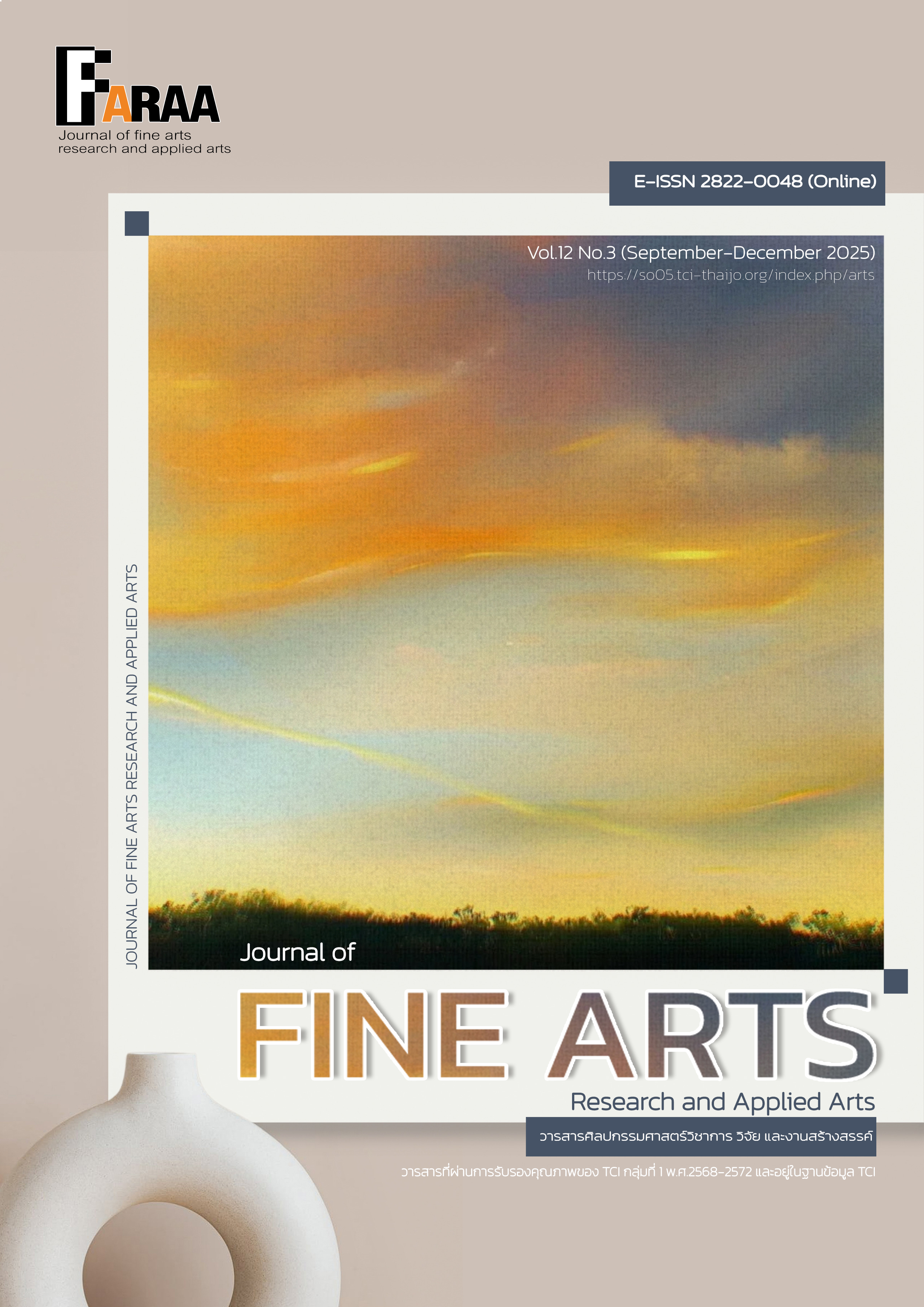
Guidelines for Creating Art for Sale in the NFT Marketplace
DOI:
https://doi.org/10.60101/faraa.2025.274983Keywords:
NFT, Digital Art, Cryptocurrency, Blockchain, EtherAbstract
Non-Fungible Tokens (NFTs) are unique digital assets that cannot be substituted and can be traded through blockchain technology, which securely stores data and verifies ownership of digital assets. The NFT phenomenon gained widespread attention during 2020–2021 due to its high market value, leading digital art in the form of NFTs to emerge as a new creative and commercial channel for contemporary artists. This research, Guidelines for Creating Art for Sale in the NFT Marketplace, aims to examine conceptual approaches, creative processes, and presentation strategies for NFT-based digital artworks in response to target audience demands and current market conditions, investigate the structure of the NFT market including production and trading processes, and develop an understanding of the current NFT ecosystem in Thailand. The study employs a qualitative research methodology, collecting data through in-depth interviews with six prominent Thai NFT artists selected using purposive sampling based on sales performance and social media followings. The findings indicate that successful NFT creation requires a strong emphasis on artistic uniqueness, work quality, and consistent presentation aligned with market expectations. At the marketplace level, the NFT ecosystem functions as a highly competitive platform market, while individual NFT artworks represent non-substitutable digital assets with exclusive ownership. Furthermore, although the NFT market in Thailand is currently experiencing a period of decline, it continues to demonstrate potential for future development and growth through artistic adaptation and ongoing technological advancement.
References
Agrawal, S. & Sandhu, M. (2022). A Comprehensive Study on the Evolution of the NFT Market & Future Prospects. International Journal of Innovative Research in Science, Engineering and Technology (IJIRSET), 11(4), 3485-3491.
Farhia, Y. & Zahra, A. (2022). Art History towards Digital Acculturation in a Non-Fungible Token (NFT) Art. In 3rd Asia Pacific International Conference on Industrial Engineering and Operations Management. doi: 10.46254/AP03.20220588
Fattahi Dare Shir, M. & Asadollahi, M. (2014). The Position of Motion Graphic in Communication Media. Indian Journal of Scientific Research, 7(1), 815-819.
Fortnow, M. & Terry, Q. (2022). The NFT Handbook How to Create, Sell and Buy Non-Fungible Tokens. Wiley Publishing company.
Leemakdej, A. (2021). Cryptocurrency Valuation Guideline. Journal of Multidisciplinary Academic Research and Development, 3(2), 1-11. [in Thai]
Miller, R., Davis, W. & Wilson, J. (2023). Empowering Decentralized Creativity: Hooked AI's Journey in Visual Identity. Doi: 10.13140/RG.2.2.16003.89126.
ZIPMEX. (2022). What is NFT Art? Technology that will change the modern art world. Zipmex. https://zipmex.com/th/learn/nft-art/. [in Thai]
Downloads
Published
How to Cite
Issue
Section
License
Copyright (c) 2025 Journal of fine arts research and applied arts

This work is licensed under a Creative Commons Attribution-NonCommercial-NoDerivatives 4.0 International License.