
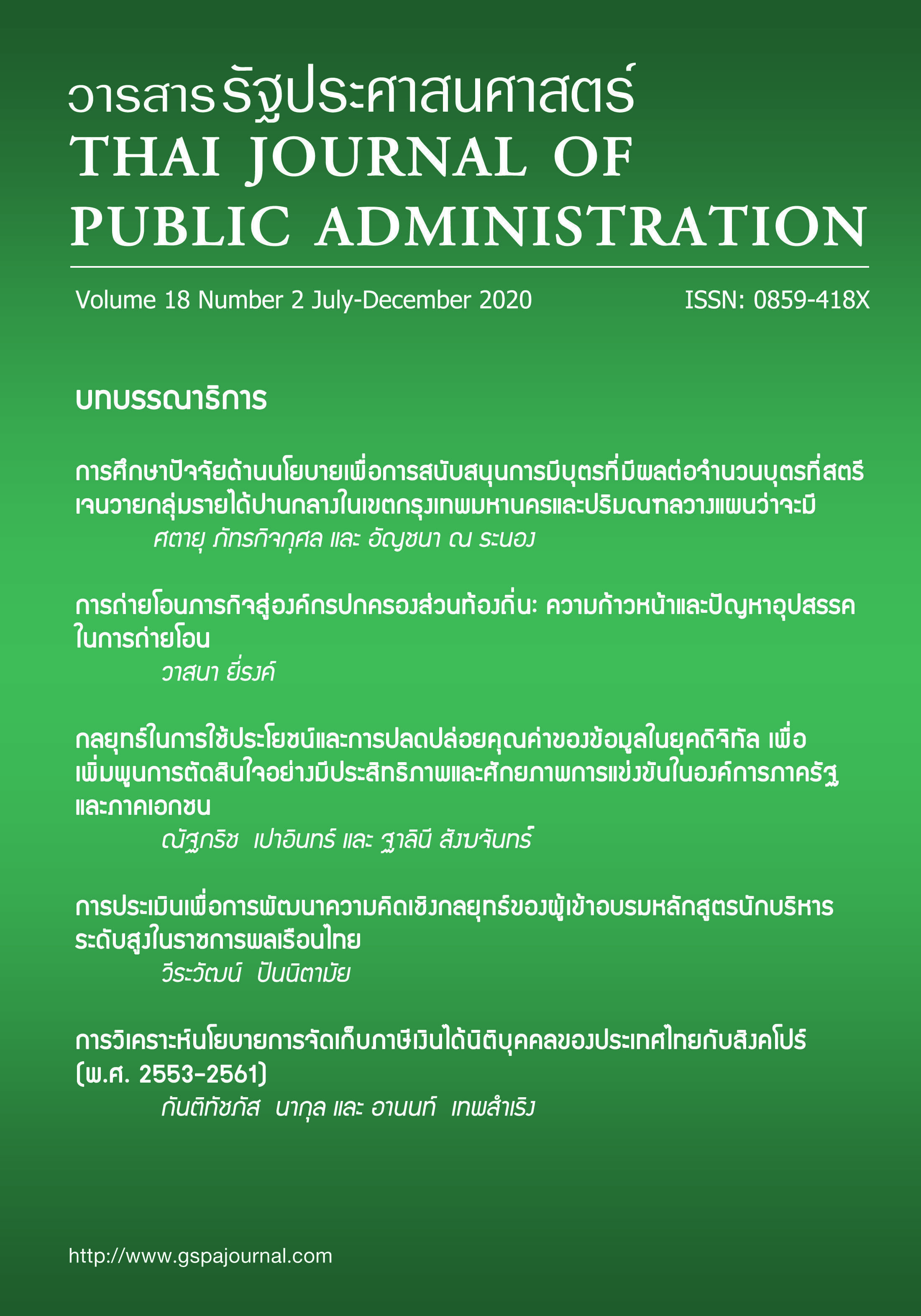
Study on factors relating to policies to support pregnancy and the middle-income Generation-Y women’s decisions to have children in Bangkok and its vicinities
คำสำคัญ:
สังคมผู้สูงอายุ นโยบายการเกิด เจนวาย กลุ่มรายได้ปานกลาง, Ageing Society, Fertility Policy, Generation-Y, Middle-Income Earnerบทคัดย่อ
บทความนี้เป็นการศึกษาความสัมพันธ์ระหว่างปัจจัยนโยบายเพื่อการสนับสนุนการมีบุตรที่มีผลต่อจำนวนบุตรที่สตรีเจนวายกลุ่มรายได้ปานกลางในเขตกรุงเทพมหานครและปริมณฑลวางแผนว่าจะมี โดยมีวัตถุประสงค์เพื่อศึกษาอิทธิพลของนโยบาย ได้แก่ 1) ค่าใช้จ่ายเพื่อการฝากครรภ์และคลอดบุตร 2) สิทธิลาคลอด 3) สิทธิลดหย่อนภาษี 4) ค่าใช้จ่ายเพื่อการศึกษาของบุตร 5) ค่ารักษาพยาบาลและการป้องกันโรคของบุตร และ 6) เงินสงเคราะห์บุตร ที่มีผลต่อจำนวนบุตรที่สตรี ฯ วางแผนว่าจะมี จากการศึกษาไม่พบนัยสำคัญทางสถิติของความสัมพันธ์ระหว่างตัวแปรนโยบายที่ 1 – 5 ต่อตัวแปรตาม ส่วนนัยทางสถิติที่เงินสงเคราะห์บุตรมีต่อกลุ่มตัวอย่างสามารถคาดการณ์ได้ว่า กลุ่มตัวอย่างมีบุตรโดยเฉลี่ย 1.393 คน และเมื่อระดับเงินสงเคราะห์บุตรเพิ่มขึ้นเป็น 11,240.74 หรือ 29,759.26 บาทต่อเดือน กลุ่มตัวอย่างจะมีบุตรเพิ่มขึ้นเป็น 2 และ 3 คนตามลำดับ ในการกระตุ้นให้เพิ่มอัตราการเกิด ผู้กำหนดนโยบายควรกำหนดนโยบายที่ที่มีลักษณะเป็นผลประโยชน์ตอบแทนระยะยาวและต่อเนื่อง เพราะจะกระตุ้นพฤติกรรมของกลุ่มเป้าหมานโยบายได้ดีกว่านโยบายที่มีลักษณะให้เป็นรายครั้ง นอกจากนั้นถ้าหากผู้กำหนดนโยบายไม่สามารถหาทางเพิ่มรายได้ให้แก่กลุ่มเป้าหมายนโยบายได้ ผู้กำหนดนโยบายควรหาทางลดค่าใช้จ่ายอันเกิดจากการมีบุตร เพราะค่าใช้จ่ายต่อการมีบุตรหนึ่งคนครองสัดส่วนถึง 1 ใน 3 ของรายได้มารดา
เอกสารอ้างอิง
Cai, Y. (2010). China's below- replacement fertility government policy or socioeconomic development? Population and development review, 36(3), 419-440. doi:10.1111/j.1728-4457.2010.00341.x
Chen, D. (2011). Can countries reverse fertility decline? Evidence from France’s marriage and baby bonuses, 1929–1981. International Tax and Public Finance, 18(3), 253-272. doi:10.1007/s10797-010-9156-6
Christoph, B. (2008). On the structural value of children and its implication on intended fertility in Bulgaria. Demographic Research, 18, 20.
Cigno, A. (1986). Fertility and the tax- benefit system: a reconsideration of the theory of family taxation. Economic Journal, 96, 1035.
Davia, M. A., & Legazpe, N. (2014). The Role of Education in Fertility and Female Employment in Spain: A Simultaneous Approach. Journal of Family Issues, 35(14), 1898-1925. doi:10.1177/0192513X13490932
Day, R. H. (1971). Rational choice and economic behavior. Theory and Decision, 1(3), 229-251. doi:10.1007/bf00139569
Fehr, H., & Ujhelyiova, D. (2013). Fertility, Female Labor Supply, and Family Policy. German Economic Review, 14(2), 138-165. doi:10.1111/j.1468-0475.2012.00568.x
Fraser, C. D. (2001). Income Risk, the Tax- Benefit System and the Demand for Children. Economica, 68(269), 105-125.
Furtado, D. (2016). Fertility Responses of High-Skilled Native Women to Immigrant Inflows. Demography, 53(1), 27-53. doi:10.1007/s13524-015-0444-8
Goedele Van Den, B., & Miet, M. (2015). Female employment reduces fertility in rural Senegal. PLoS ONE, 10(3), e0122086. doi:10.1371/journal.pone.0122086
Haan, P., & Wrohlich, K. (2011). Can child care policy encourage employment and fertility?: Evidence from a structural model. Labour Economics, 18(4), 498-512. doi:10.1016/j.labeco.2010.12.008
Ishida, R., Oguro, K., & Takahata, J. (2015). Child benefit and fiscal burden in the endogenous fertility setting. Economic Modelling, 44(C), 252-265. doi:10.1016/j.econmod.2014.10.027
Krejcie, R. V., & Morgan, D. W. (1970). Determining sample size for research activities. Educational and Psychological Measurement, 30(3), 607-610.
Laroque, G., & Salanié, B. (2014). IDENTIFYING THE RESPONSE OF FERTILITY TO FINANCIAL INCENTIVES. Journal of Applied Econometrics, 29(2), 314-332. doi:10.1002/jae.2332
Liu, J., & Lummaa, V. (2019). Whether to have a second child or not? An integrative approach to women's reproductive decision-making in current China. Evolution and Human Behavior, 40(2), 194-203. doi:10.1016/j.evolhumbehav.2018.11.004
Masaya, Y. (2013). CAN CHILD-CARE SUPPORT POLICIES HALT DECREASING FERTILITY? International Journal of Economics and Financial Issues, 3(2), 409-419.
McNown, R., & Ridao-cano, C. (2004). The Effect of Child Benefit Policies on Fertility and Female Labor Force Participation in Canada. Review of Economics of the Household, 2(3), 237-254. doi:10.1007/s11150-004-5646-6
Office of the National Economic and Social Development Board. (1966). The direction of the eleventh national economic and social development plan (1967-1971). Retrieved from http://www.nesdb.go.th/ewt_dl_link.php?nid=3777
Prifti, E., & Vuri, D. (2013). Employment protection and fertility: Evidence from the 1990 Italian reform. Labour Economics, 23(C), 77-88. doi:10.1016/j.labeco.2013.04.003
Raymo, J., & Shibata, A. (2017). Unemployment, Nonstandard Employment, and Fertility: Insights From Japan’s “Lost 20 Years”. Demography, 54(6), 2301-2329. doi:10.1007/s13524-017-0614-y
Ridao-Cano, C., & McNown, R. (2005). The effect of tax- benefit policies on fertility and female labor force participation in the United States. Journal of Policy Modeling, 27(9), 1083-1096. doi:10.1016/j.jpolmod.2005.07.001
Snopkowski, K., & Sear, R. (2012). Kin influences on fertility in Thailand: Effects and mechanisms. Evolution and Human Behavior, 34(2). doi:10.1016/j.evolhumbehav.2012.11.004
Strategy and Evaluation Department, Bangkok Metropolitan Administration. (2016). Statistical Profile of Bangkok Metropolitan Administration 2016. Bangkok: Religious Affairs Printing Press Office of National Buddhism.
The Japan Times. (2019a). Jetstar Japan to cancel 70 flights in June due to pilot shortage. Retrieved from https://www.japantimes.co.jp/news/2019/06/04/national/jetstar-japan-cancel-70-flights-june-due-pilot-shortage
The Japan Times. (2019b). Seven-Eleven Japan to test shorter operating hours at 10 corporate-run stores. Retrieved from https://www.japantimes.co.jp/news/2019/03/02/business/seven-eleven-japan-test-shorter-operating-hours-10-corporate-run-stores
United Nations, Department of Economic and Social Affairs, Population Division. (2002). World population ageing, 1950-2050. New York: United Nations.
United Nations, Department of Economic and Social Affairs, Population Division. (2013). World Population Ageing 2013. New York: The United Nations.
World Bank. (2018). Fertility rate, total (births per woman). Retrieved from https://data.worldbank.org/indicator/SP.DYN.TFRT.IN?locations=TH&name_desc=true
World Bank. (2018). Fertility rate, total (births per woman). Retrieved from https://data.worldbank.org/indicator/SP.DYN.TFRT.IN?locations=TH&name_desc=true
Zabin, L. S. (1983). The effect of administration family planning policy on maternal and child health. Journal of public health policy, 4(3), 268. doi:10.2307/3342109
Zhang, J., Quan, J., & Van Meerbergen, P. (1994). The Effect of Tax- Transfer Policies on Fertility in Canada, 1921-88. The Journal of Human Resources, 29(1), 181-201. doi:10.2307/146061
Zhao, S., & Gao, Y. (2014). Can adjustments of china's family planning policy truly relieve pressures arising from population aging? International Journal of China Studies, 5(3), 657-680.
กรมกิจการผู้สูงอายุ. (2018). สถิติผู้สูงอายุ ปี 2560. Retrieved from http://www.dop.go.th/th/know/1/125
สำนักงานสถิติแห่งชาติ. (2018). การสำรวจภาวะเศรษฐกิจและสังคมของครัวเรือน พ.ศ. 2560 กรุงเทพมหานคร นนทบุรี ปทุมธานี และสมุทรปราการ. กรุงเทพมหานคร: กองสถิติประชากร สำนักงานสถิติแห่งชาติ.
ดาวน์โหลด
เผยแพร่แล้ว
รูปแบบการอ้างอิง
ฉบับ
ประเภทบทความ
สัญญาอนุญาต
ลิขสิทธิ์ (c) 2020 วารสารรัฐประศาสนศาสตร์

อนุญาตภายใต้เงื่อนไข Creative Commons Attribution-NonCommercial-NoDerivatives 4.0 International License.


