
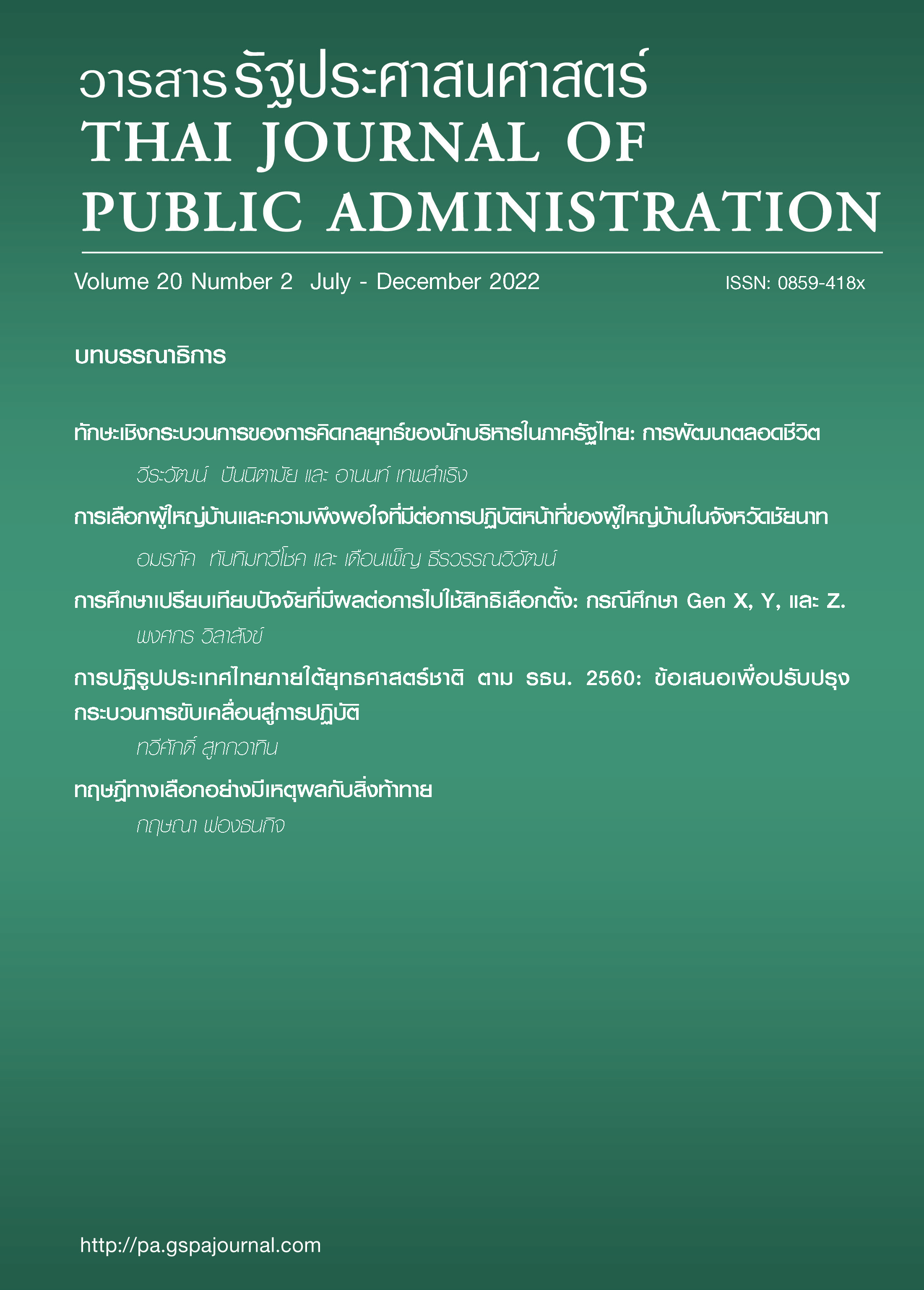
ทักษะเชิงกระบวนการของการคิดกลยุทธ์ของนักบริหารในภาครัฐไทย: การพัฒนาตลอดทั้งชีวิต
คำสำคัญ:
การคิดกลยุทธ์, ทักษะเชิงกระบวนของการคิดกลยุทธ์, การพัฒนานักบริหารบทคัดย่อ
นักบริหารระดับสูงในภาครัฐถือเป็นกลุ่มข้าราชการที่มีบทบาทสำคัญในการขับเคลื่อนนโยบายพัฒนาประเทศชาติ ด้วยเจตนาที่ดี ความรู้และประสบการณ์ในงานอันสูงส่ง ผนวกกับ ความสามารถคิดเชิงกลยุทธ์ของผู้บริหารระดับสูงในภาครัฐจึงมีความสำคัญจำเป็นอย่างยิ่งต่อประสิทธิผลในการบริหารงานภาครัฐ การวิจัยนี้มุ่งประเมินและเปรียบเทียบทักษะเชิงกระบวนการการคิดกลยุทธ์ใน 6 ด้านกับ 3 กลุ่มตัวอย่างจำนวนรวม 547 คน ที่มาจากบริบทวัฒนธรรมการจัดการที่แตกต่างกัน กล่าวคือ 1. กลุ่มผู้เข้ารับการอบรมหลักสูตรนักบริหารระดับสูง (นบส. 1) และ ผู้เข้ารับการอบรมหลักสูตรเสริมนักบริหารระดับสูง (ส.นบส.) รวมจำนวน 371 คน 2. กลุ่มตัวอย่างผู้เข้าอบรมหลักสูตรนักบริหารระดับกลางการไฟฟ้าส่วนภูมิภาค(กฟภ.) จำนวน 121 คน 3. กลุ่มตัวอย่างนักบริหารท้องถิ่นระดับสูง จำนวน 55 คน
ผลการศึกษาบ่งชี้ว่า นักบริหารกลุ่มตัวอย่างมีระดับสมรรถนะการคิดกลยุทธ์ทั้ง 6 ด้านที่สูง ได้แก่พฤติกรรมที่เกี่ยวกับ การคาดคะเน การท้าทาย การตีความ การตัดสินใจ ด้านการสร้างเอกภาพ และ ด้านการเรียนรู้ ในระดับสูง การคาดคะเนและด้านการเรียนรู้อยู่ในระดับสูงสุด (ค่าเฉลี่ยระหว่าง = 5.15 – 5.66 ใน 7 ช่วงค่าลิเคอร์ท) โดยที่แสดงพฤติกรรมด้านการตัดสินใจต่ำที่สุดในทุกกลุ่ม ผลการวิเคราะห์ ANOVA พบความแตกต่างอย่างมีนัยสำคัญใน 2 ด้าน คือ ด้านการคาดคะเนและด้านการสร้างเอกภาพ (F = 3.598, p = .05; F = 5.290, p = 0.01) ผลการวิเคราะห์รายคู่พบว่านักบริหารผู้เข้าอบรมหลักสูตรนักบริหารของสำนักงาน ก.พ. มีคะแนนเฉลี่ยทั้ง 2 ด้านสูงกว่า นักบริหารหลักสูตรของ กฟภ.อย่างมีนัยสำคัญ ผลการทดสอบด้วยสถิติ t-test ยังพบยืนยันความแตกต่างของค่าเฉลี่ยทักษะการคิดกลยุทธ์ 3 ด้านที่นักบริหารชายมีคะแนนเหนือกว่านักบริหารสตรีอย่างมีนัยสำคัญใน 3 ด้าน คือ ด้านการท้าทาย การตัดสินใจ และ ด้านเอกภาพ ( t-test = 3.045, p = 0.01; 3.873, p = 0.00; = 2.215, p = 0.05) ซึ่งสอดคล้องกับผลการศึกษาก่อนหน้านี้ของผู้วิจัย
การศึกษาครั้งนี้ได้เสนอแนะโมเดลเชิงกระบวนการเพื่อพัฒนาการคิดกลยุทธ์ใน 3 ระดับผ่านความแตกต่างมิติเพศ ทีม และ วัฒนธรรมองค์การในบริบทหน่วยงานราชการ โดยเฉพาะการออกแบบ กระบวนการ และอุปสรรคปัญหา ในการพัฒนาเชิงกระบวนการทั้ง 6 ด้านของสมรรถนะการคิดกลยุทธ์ของนักบริหารที่จะสร้างการเปลี่ยนแปลง การวิจัยครั้งนี้ได้รายงานถึงข้อจำกัด และ เสนอแนะแนวทางของการศึกษาวิจัยในครั้งต่อไป
เอกสารอ้างอิง
Amitabh, M. (2012). Strategic Thinking: Is Leadership the Missing Link? Retrieved September 28, 2017 from https://www.iitk.ac.in/infocell/announce/.
Andrews, M., & Manning, N. (2015). A Study of Peer Learning in the Public Sector: Experience, Experiments, and Ideas to Guide Public Practice. Retrieved from https://www.effectiveinstitutions.org/.../Peer_learning_study_final_p5v0.
Benito - Ostolaza, J. M., & Sanchis - Llopis, J. A. (2014). Training strategic thinking: Experimental evidence. Journal of Business Research, 67(5), 785-789.
Dragoni, L., Oh, I., Tesluk, P. E., Moore, O. A., VanKatwyk, P., & Hazucha, J. (2014). Developing leaders’ strategic thinking through global work experience: The moderating role of cultural distance. Journal of Applied Psychology, 99(5), 867-882.
Goldman, E. F., Schlumpf, K. S., & Scott, A. R. (2017). Combining practice and theory to assess strategic thinking. Journal of Strategy and Management, 10(4), 488-504.
Groysberg, B., Lee, J., Price, J., & Cheng, J. Y. (2018). The leader’s guide to corporate culture: How to manage the eight critical elements of organizational life. Harvard Business Review, January-February, 44-52.
Haycock, K., Cheadle, A., & Bluestone, K. S. (2012). Strategic thinking: Lessons for leadership from the literature. Library Leadership & Management, 26(3), 1-18.
Hughes, R. L., Beatty, K. C., & Dinwoodie, D. L. (2014). Becoming a Strategic Leader: Your Role in Your Organization's Enduring Success. San Francisco, CA: Jossey Bass.
Mascarenhas, O. A. J. (2011). Business Transformation Strategies: The Strategic Leader as Innovation Manager. Los Angeles, CA: The SAGE Publication.
Nuntamanop, P., Kauranen, I., & Igel, B. (2013). A new model of strategic thinking competency. Journal of Strategy and Management, 6(3), 242-264.
Olson, A. K., & Simerson, B. K. (2015). Leading with Strategic Thinking: Four Ways Effective Leaders Gain Insight, Drive Change and Get Results. New York: Wiley.
Pannont, T., Chanbanchong, C., & Udomrat, T. (B.E.2559). A model for the development of strategic thinking competency in the deputy directors of primary education area offices. Narasuan University Journal of Education, 18(4), 128-142.
Punnitamai, W. (B.E.2559). An empirical competency analysis of senior executive program participants under the Office of the Civil Service Commission. A research paper proceeding presented on April 1 on the 50th anniversary of National Institute of Development Administration.
_____________. (B.E.2564). Leadership Development: Paradoxes, Principles, & Practices. Nontaburi: Rattanatrai Publishing.
Rumelt, R. (2011). Good Strategy, Bad Strategy: The Difference and Why It Matters. New York: Crown Business.
Sarfraz, H. (2017). Strategic leadership development: Simplified with Bloom’s taxonomy. Industrial and Commercial Training, 49(1), 40-47.
Schoemaker, P.H., Krupp, S., & Howland, S. (2013). Strategic Leadership: The essential skills, Harvard Business Review, January-February, 131-134.
Somdet Phra Buddhachosacariya (Bhikkhu P.A. Payutto). (B.E.2559). Buddhadhamma: The Laws of Nature and Their Benefits to Life. Translated by Robin Moore. Bangkok: Buddhaadham Foundation.
Zabriskie, N. B., & Huellmantel, A. B. (1991). Developing strategic thinking in senior management. Long Range Planning, 24(6), 25-32.
ดาวน์โหลด
เผยแพร่แล้ว
รูปแบบการอ้างอิง
ฉบับ
ประเภทบทความ
สัญญาอนุญาต

อนุญาตภายใต้เงื่อนไข Creative Commons Attribution-NonCommercial-NoDerivatives 4.0 International License.


