
Digital Government and the Transformation of Thailand’s Public Sector: Trends and Challenges
Article Sidebar
Main Article Content
Abstract
DOI : 10.14456/pnuhuso.2026.16
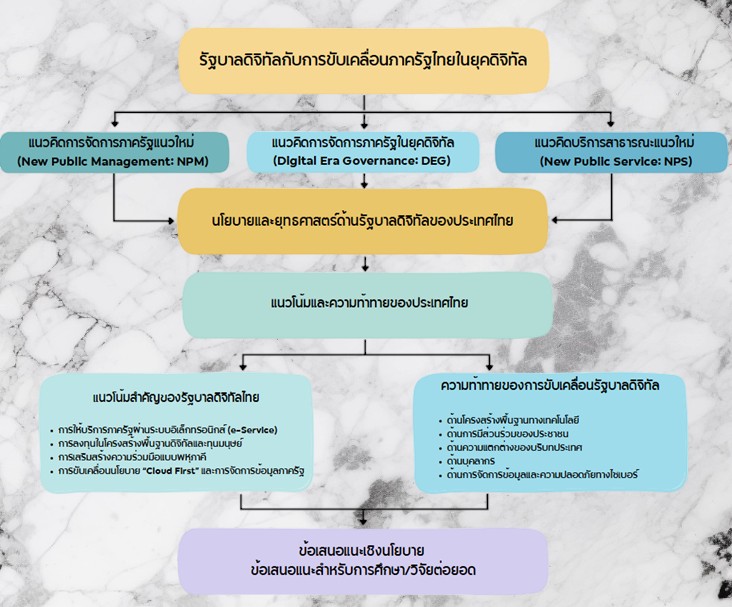
This article aims to analyze the key trends and major challenges in the development of digital government in Thailand. Amidst the transformations of the 21st century, digital technologies play an inevitable role in reshaping economic, social, and public administration structures. Thailand has emphasized enhancing efficiency, transparency, and citizen-centered public services. This has been pursued through digital government policies and strategies, with the Digital Government Development Agency (Public Organization) serving as the primary driving force. This article examines the development of Thailand’s digital government, from the IT 2000 Master Plan to the Digital Government Development Plan (2023–2027), within the framework of modern public administration concepts. It also presents key trends, including the development of e-Services, investment in digital infrastructure and human capital, fostering multi-stakeholder collaboration, and the adoption of modern technologies.
However, Thailand still faces several challenges. These include disparities in digital infrastructure, low levels of public participation, contextual differences, personnel constraints, rigid organizational culture, and cybersecurity threats. The article therefore proposes policy approaches for sustainable advancement. These include promoting accessible e-Services, systematic data management, investment in infrastructure and human capital, strengthening cross-sectoral collaboration, enhanced cybersecurity, and transforming organizational culture to be more adaptive and responsive to change. These efforts aim to create a modern bureaucracy that is transparent, flexible, and truly citizen-centered.
Article Details

This work is licensed under a Creative Commons Attribution-NonCommercial-NoDerivatives 4.0 International License.
References
กระทรวงดิจิทัลเพื่อเศรษฐกิจและสังคม. (2565). รายงานประจำปี 2565 กระทรวงดิจิทัลเพื่อเศรษฐกิจและสังคม. https://www.mdes.go.th/ebook/detail/6376รายงานประจำปี-2565
ธีระ กุลสวัสดิ์. (2555). การวิเคราะห์ความล้มเหลวและอุปสรรคของรัฐบาลอิเล็กทรอนิกส์ไทย. วารสารการเมือง การบริหาร และกฎหมาย, 4(1), 159-195.
สำนักงานคณะกรรมการดิจิทัลเพื่อเศรษฐกิจและสังคมแห่งชาติ. (2567). ประวัติสำนักงานคณะกรรมการดิจิทัลเพื่อเศรษฐกิจและสังคมแห่งชาติ. https://www.onde.go.th/view/1/%E0%B8%9B%E0% B8%A3%E0%B8%B0%E0%B8%A7%E0%B8%B1%E0%B8%95%E0%B8%B4_%E0%B8%AA%E0%B8%94%E0%B8%8A/TH-TH
สำนักงานพัฒนาธุรกรรมทางอิเล็กทรอนิกส์ (องค์การมหาชน). (2567). รายงานประจำปี 2567 สำนักงานพัฒนาธุรกรรมทางอิเล็กทรอนิกส์ (องค์การมหาชน). https://www.etda.or.th/th/UsefulResour ce/publications/Annual-Report-2024.aspx
สำนักงานพัฒนารัฐบาลดิจิทัล (องค์การมหาชน). (2564). รายงานดัชนีรัฐบาลดิจิทัลของประเทศไทย พ.ศ. 2564. https://www.dga.or.th/document-sharing/dg2021
สำนักงานพัฒนารัฐบาลดิจิทัล (องค์การมหาชน). (2566). แผนพัฒนารัฐบาลดิจิทัลของประเทศไทย พ.ศ. 2566-2570. https://www.dga.or.th/th/ebook/ebook-download/ebook-2023-01-25-11-0 1-42.html
สำนักงานพัฒนารัฐบาลดิจิทัล (องค์การมหาชน). (2568). ประวัติความเป็นมาของสำนักงานพัฒนารัฐบาลดิจิทัล (องค์การมหาชน). https://www.dga.or.th/about-us/our-history
สำนักงานพัฒนารัฐบาลดิจิทัล (องค์การมหาชน). (2568). การสำรวจระดับความพร้อมรัฐบาลดิจิทัลหน่วยงานภาครัฐของประเทศไทย ประจำปี 2568. https://www.dga.or.th/policy-standard/policy-regulation/dg-readiness-survey/readinesssurvey68/118345
สำนักงานเลขาธิการสภาผู้แทนราษฎร. (2559). ภาครัฐไทยกับการก้าวเข้าสู่รัฐบาลดิจิทัล. สำนักงานเลขาธิการสภาผู้แทนราษฎร.
องค์การกระจายเสียงและแพร่ภาพสาธารณะแห่งประเทศไทย. (2567). ความท้าทายรัฐบาลดิจิทัลต้องยึดประชาชนเป็นศูนย์กลาง. https://policywatch.thaipbs.or.th/article/government-66
องค์การกระจายเสียงและแพร่ภาพสาธารณะแห่งประเทศไทย. (2567). พอร์ทัลกลาง กับความท้าทายรัฐบาลดิจิทัล. https://policywatch.thaipbs.or.th/article/government-90
Chaudhary, K. (2019). Unit III: Strategic and competitive opportunities. https://www.ckundan. com.np/2019/01/strategic-and-competitive-opportunities.html
Cochrane, A. (2000). Local government: Managerialism and modernisation. In J. Clarke, S. Gewirtz, & E. McLaughlin (Eds.), New managerialism, new welfare? (pp. 122-136). Sage.
Denhardt, J., & Denhardt, R. B. (2007). The new public service: Serving, not steering. M. E. Sharpe.
Dunleavy, P., Margetts, H., Bastow, S., & Tinkler, J. (2006). New Public Management Is Dead: Long Live Digital-Era Governance. Journal of Public Administration Research and Theory, 16(3), 467-494.
Ferlie, E., Ashburner, L., Fitzgerald, L., & Pettigrew, A. (1996). The new public management in action. Oxford University Press.
Jongwanich, J. (2025). The digital economy in Thailand: Potential and policies. In L. Y. Ing (Ed.), ASEAN digital community 2045: Country perspectives (pp. 123–138). Economic Research Institute for ASEAN and East Asia.
Kjær, A. M. (2004). Governance. Polity Press.
Meijer, A. J., Curtin, D., & Hillebrandt, M. (2018). E-government and public service delivery: The impact of digital transformation on public services. Government Information Quarterly, 35(1), 1-10.
OECD. (2020). Digital Government Index: 2019 results. https://www.oecd.org/contentdam/ oecd/en/publications/reports/2020/10/digital-government-index_cec25265/4de9f5bb -en.pdf
OECD. (2022). Open and connected government review of Thailand. OECD Publishing.
OpenGovAsia. (2024). Digital future: Thailand pioneering digital governance. https://open govasia.com
United Nations. (2022). UN E Government Survey 2022. https://publicadministration.un.org/ egovkb/en-us/reports/un-e-government-survey-2022
World Bank. (2025). Digital Transformation Overview: Development news. https://www.world
bank.org/en/topic/digital/overview
