Personality, Innovation Acceptance, and Communication Skills Influencing the Work Effectiveness of Life Insurance Agents in The Digital Era
Article Sidebar
Main Article Content
Abstract
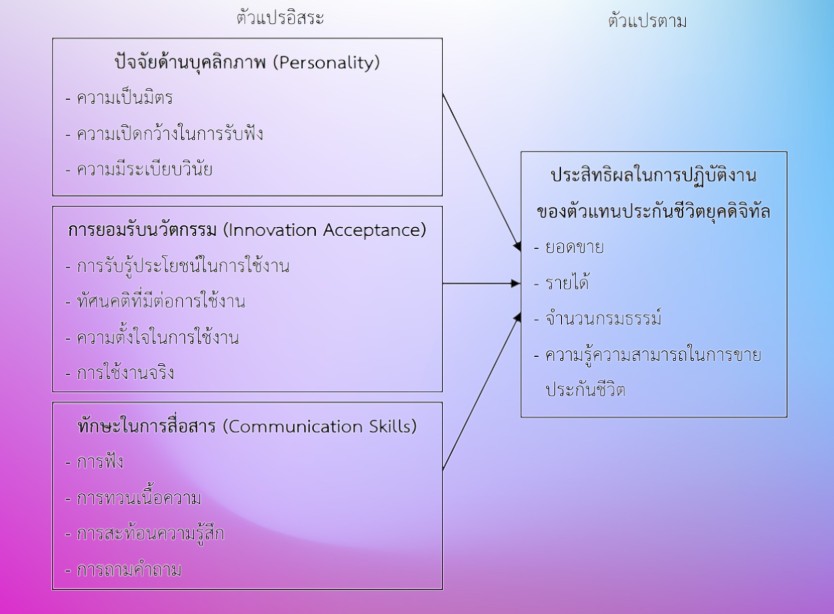
This research aims to: (1) examine the personality traits affecting the work effectiveness of life insurance agents; (2) investigate the level of innovation acceptance influencing their work effectiveness; and (3) study the communication skills affecting their work effectiveness. The population of this study consisted of life insurance agents from the Namchoke Group, FWD Thailand, residing in Songkhla Province. The sample comprised 300 life insurance agents selected through simple random sampling. Data were collected using a structured questionnaire. The statistical techniques employed included frequency, percentage, mean, standard deviation, Pearson’s correlation analysis, and multiple regression analysis.
The findings revealed that: (1) personality traits—namely friendliness, openness to listening, and conscientiousness—significantly influenced the work effectiveness of life insurance agents, accounting for 27.6% of the variance; (2) innovation adoption, particularly actual usage, had a significant effect on work effectiveness, explaining for 25.6% of the variance; and (3) communication skills, including listening, questioning, and paraphrasing, significantly influenced work effectiveness, accounting for 30.4% of the variance. Based on these findings, it is recommended that life insurance companies emphasize the development of agents’ personality traits, promote innovation adoption through practical usage, and enhance communication skills, as these factors play a critical role in improving the work effectiveness of life insurance agents.
Article Details

This work is licensed under a Creative Commons Attribution-NonCommercial-NoDerivatives 4.0 International License.
References
กัลยา วานิชย์บัญชา. (2561). สถิติสำหรับงานวิจัย (พิมพ์ครั้งที่ 12). สามลดา.
จันทมา ช่างสลัก. (2565). เข้าใจ 4 บุคลิกของเพื่อนร่วมงาน ตามแนวคิดจิตวิทยา DISC Model. https://www.istrong.co/single-post/disc-model?srsltid=AfmBOopewTIFyF6TVoPlWNsHjH-E4OTfH8g_X1kiSvE84KhmbkgmAO_1
ณิชาดา นพรัตน์. (2565). การยอมรับนวัตกรรมการให้บริการที่ส่งผลต่อประสิทธิภาพการทำงานของพนักงานธนาคารกรุงเทพ สาขาจังหวัดปทุมธานี ช่วงสถานการณ์การแพร่ระบาดของโรคโควิด-19 [วิทยานิพนธ์ปริญญามหาบัณฑิต]. มหาวิทยาลัยศิลปากร.
ธนภัทร ธรรมากัลยากุล, อนันต์ ธรรมชาลัย และปัญญวัฒน์ จุฑามาศ. (2566). แนวทางการพัฒนาสมรรถนะของตัวแทนขายประกันชีวิตในประเทศไทย. วารสารวิชาการสังคมศาสตร์เครือข่ายวิจัยประชาชื่น, 5(2), 99-117.
ธิดารัตน์ เวชประสิทธิ์, บุษกร วัฒนบุตร, วิโรชน์ หมื่นเทพ และสยาม อัจฉริยประภา. (2565). แนวทางการพัฒนาทีมงานประกันชีวิต: กรณีศึกษาบริษัท XXX. วารสารวิทยาลัยสงฆ์นครลำปาง, 11(3), 18-26.
บุญชม ศรีสะอาด. (2556). การวิจัยเบื้องต้น (พิมพ์ครั้งที่ 9). สุวีริยาสาส์น.
เพ็ญพิชา สร้างการนอก และภัทรธิรา ผลงาม. (2566). การพัฒนารูปแบบกิจกรรมส่งเสริมคุณค่าทุนมนุษย์ของตัวแทนประกันชีวิตในยุคดิจิทัล. วารสารสังคมศาสตร์และวัฒนธรรม, 7(9), 40-50.
พรประภา ศรีราพร. (2567). การพัฒนาขีดความสามารถตามบุคลิกภาพพนักงานจากแบบวัดบุคลิกภาพของไมเยอร์ บริกจ์ (MBTI): กรณีศึกษา บริษัท ไทยรุ่งยูเนี่ยนคาร์จำกัด (มหาชน). วารสารเศรษฐศาสตร์และบริหารธุรกิจ มหาวิทยาลัยทักษิณ, 16(1), 56-70.
ภัทรธิรา ผลงาม และภูมพัฒก์ สำรวยสินธุ์. (2566). การพัฒนานวัตกรรมส่งเสริมสุขภาวะของแรงงานข้ามชาติในธุรกิจร้านอาหาร จังหวัดชลบุรี. วารสารสังคมศาสตร์และวัฒนธรรม, 7(7), 205-215.
มนณกร อรชร และเจษฎา วงศ์แสนสุขเจริญ. (2566). การบริหารการเปลี่ยนแปลง การยอมรับเทคโนโลยี และการยอมรับนวัตกรรมที่มีต่อการปรับตัวของพนักงานสถาบันการเงินเฉพาะกิจของรัฐ การให้บริการทางการเงินดิจิทัล (Digital Banking) ในภาคตะวันออก. Journal of Modern Learning Development, 9(4), 441-457.
ยุทธ ไกยวรรณ์. (2561). หลักสถิติวิจัยและการใช้โปรแกรม SPSS (พิมพ์ครั้งที่ 5). สำนักพิมพ์แห่งจุฬาลงกรณ์มหาวิทยาลัย.
วัฒนลักษมิ์ เวชประสิทธิ์, บุษกร วัฒนบุตร และวิโรชน์ หมื่นเทพ. (2565). แนวทางการพัฒนาสมรรถนะตัวแทนประกันชีวิตกรณีศึกษา สํานักงานตัวแทน บริษัท กรุงไทย-แอกซ่า ประกันชีวิต จํากัด (มหาชน) สาขานวลจันทร์ กรุงเทพมหานคร. วารสารพุทธนวัตกรรมและการจัดการ, 5(2), 92-106.
วิโรจน์ สุวรรณประไพ. (2565). ทัศนคติที่ส่งผลต่อประสิทธิผลการปฏิบัติงานของบุคลากรภาครัฐในหน่วยงานเทศบาลเมืองกระบี่ [วิทยานิพนธ์ปริญญามหาบัณฑิต]. มหาวิทยาลัยสงขลานครินทร์.
ศุภกิจ ยงวิทัสถิต. (2566). ประสิทธิภาพกับประสิทธิผล ใครว่าไม่ต่างคุณใช้ถูกหรือยัง?. https://job.optimi stichr.com/blog/ประสิทธิภาพ-กับ-ประสิทธิ/
สมาคมประกันชีวิตไทย. (2568). ภาพรวมธุรกิจประกันชีวิตครึ่งปีแรก 2568. https://tlaa.org/page_bx.ph p?cid=23&cno=2067&cno2=&show=0
สำนักงานคณะกรรมการกำกับและส่งเสริมการประกอบธุรกิจประกันภัย. (2556). คู่มือหรือมาตรฐานการให้บริการ (คู่มือประชาชน). https://www.oic.or.th/th/manual-or-service-standard
โสภณ แย้มกลิ่น. (2567). การยอมรับนวัตกรรม (Innovation Adoption) คืออะไร. https://www.sophon y.co/business-model-innovation/innovation-adoption-คืออะไร/
อานันท์ กุลปิยะวาจา. (2567). Communication Skills คืออะไร. https://www.baseplayhouse.co/blog/ 5-communication-skills
เอฟดับบลิวดี ประเทศไทย. (2568). ตัวแทนประกันชีวิตของบริษัทเครือนำโชคกรุ๊ปเอฟดับพลิวดีจังหวัดสงขลา. https://www.fwd.co.th/th/
Alshurideh, M., Al Kurdi, B., Salloum, S. A., Arpaci, I., & Al-Emran, M. (2023). Predicting the actual use of digital transformation: Evidence from service organizations. Information Systems Frontiers, 25(3), 835–852.
Chatterjee, S., Rana, N. P., Tamilmani, K., & Sharma, A. (2021). The effect of AI-based CRM on sales performance: An empirical analysis. Journal of Business Research, 124, 586–597.
Davis, F. D. (1989). Perceived usefulness, perceived ease of use, and user acceptance of information technology. MIS Quarterly.
Dwivedi, Y. K., Rana, N. P., Tamilmani, K., & Raman, R. (2022). A meta-analysis based modified UTAUT model for technology adoption. Information Systems Frontiers, 24(3), 721–734.
Isidro, J., Borges, V., Pinto, M., Sobral, D., João Santos, J. D., Nunes, A., Mixão, V., Ferreira, R., Santos, D., Duarte, S., Vieira, L., Borrego, M. J., Núncio, S., Carvalho, I. L, Pelerito, A.,Cordeiro, R., & Gomes, J. P. (2022). Phylogenomic characterization and signs of microevolution in the 2022 multi-country outbreak of monkeypox virus. Nature Medicine, 28(2022), 1569–1572.
Janowski, T. (2022). Digital government evolution: From transformation to contextualization. Government Information Quarterly, 32(3), 221-236.
Jansen, G., Qi, T., Latora, V., Amoutzias, G. D., Delneri, D., Oliver, S. G., & Nicosia, G., (2024). Minimisation of metabolic networks defines a new functional class of genes. Nat Commun, 15(1), 9076.
Johnson, L., & Johnson, R. (2021). Effective listening in professional consultations: Performance outcomes and client satisfaction. Communication Research Journal, 47(2), 120–145.
Kim, S., & Park, J. (2023). Empathy and performance in high-pressure service sectors. Asian Journal of Service Management, 15(3), 198–216.
Krejcie, R.V., & D.W. Morgan. (1970). Determining Sample Size for Research Activities. Educational and Psychological Measurement, 30(3), 607–610.
Lee, J., & Kim, H. (2024). From intention to performance: The mediating role of actual system use. International Journal of Information Management, 74, 102692.
Lee, M., & Lee, T. (2022). Questioning competence and job outcome in sales interactions. Journal of Applied Communication Studies, 39(1), 79–98.
McCrae, R. R., & Costa, P. T. (2021). The five-factor theory of personality. Guilford Press.
Miao, Q., Schwarz, S., & Schwarz, G. (2021). Responding to COVID-19: Community volunteerism and coproduction in China. World Development, 137(2021), 1-6.
Nguyen, T. T., Pham, Q. T., & Le, H. M. (2023). Digital tools usage and job performance in service sales. Journal of Asian Business and Economic Studies, 30(2), 145–162.
Pletzer, B., Crepaz, K. W., & Hillerer, M. K. (2023). Progesterone and contraceptive progestin actions on the brain: A systematic review of animal studies and comparison to human neuroimaging studies. Frontiers in Neuroendocrinology, 69(2023), 1-31.
Smith, J., Chen, R., & Wu, M. (2023). Listening and questioning skills in service encounters: Effects on performance. Service Industries Journal, 43(5–6), 567–589.
Wihler, A., Ute R. Hülsheger, Reb, J., & Jochen I. Menges. (2022). It’s so boring – or is it? Examining the role of mindfulness for work performance and attitudes in monotonous jobs. Mindfulness in Monotonous Jobs, 1-33.
