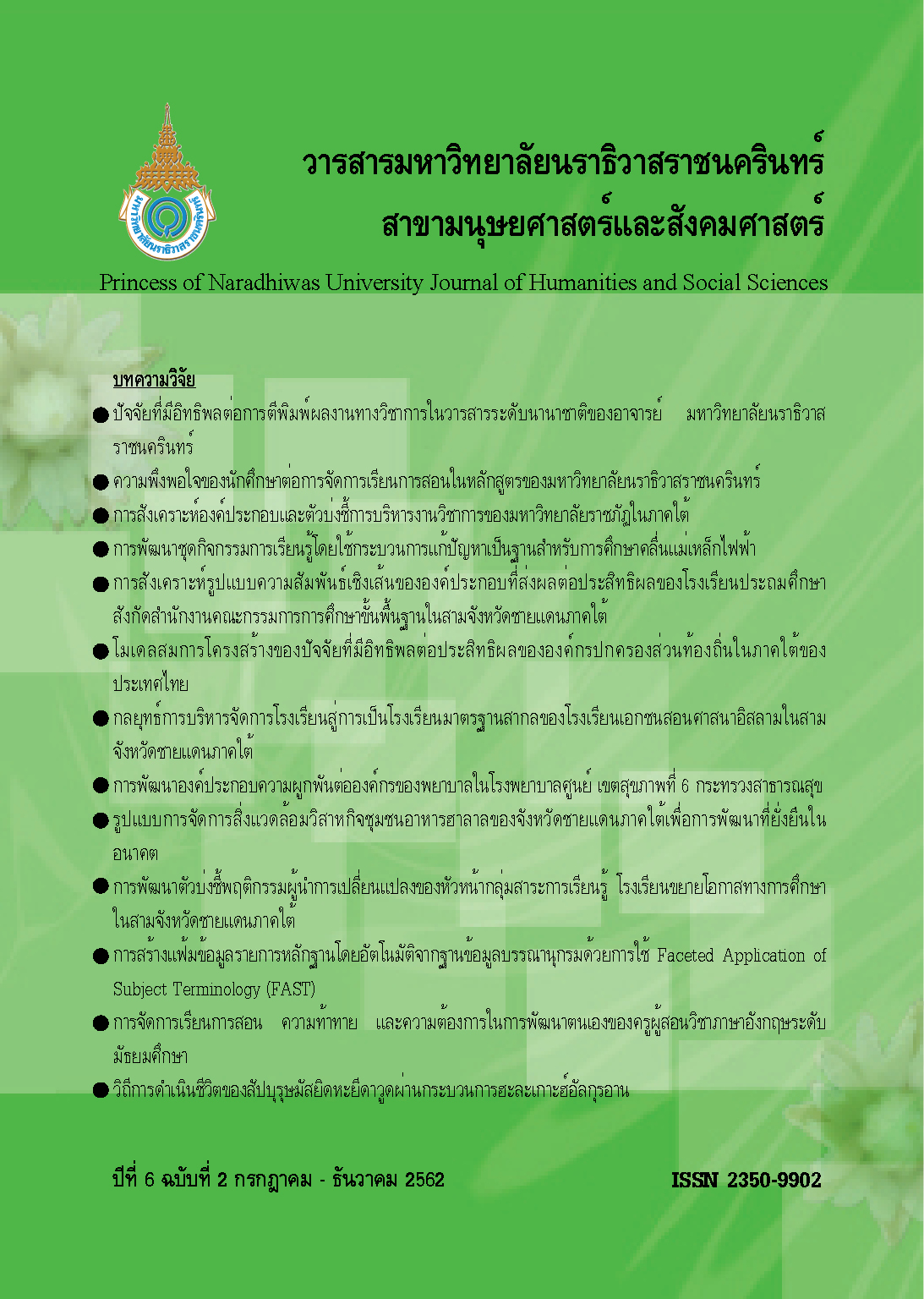
การจัดการเรียนการสอน ความท้าทาย และความต้องการในการพัฒนาตนเองของครูผู้สอนวิชาภาษาอังกฤษระดับมัธยมศึกษา
Article Sidebar
Main Article Content
บทคัดย่อ
การวิจัยเชิงคุณภาพในครั้งนี้มีวัตถุประสงค์เพื่อที่จะศึกษาการจัดการเรียนการสอนในชั้นเรียนของครูผู้สอนวิชาภาษาอังกฤษ ใน 4 ประเด็นหลักคือ ภูมิหลังทางการศึกษา การจัดการเรียนการสอนภาษาอังกฤษของครู ความท้าทายในการจัดการเรียนการสอน และลักษณะของการอบรมที่ครูต้องการ โดยกลุ่มตัวอย่างในการศึกษาในครั้งนี้คือ ครูสุภาพสตรีผู้สอนวิชาภาษาอังกฤษระดับชั้นมัธยมศึกษาในจังหวัดนราธิวาส ซึ่งสมัครใจเข้าร่วมการศึกษาในครั้งนี้ จำนวนทั้งสิ้น 8 คน สังกัดโรงเรียนมัธยมศึกษาของรัฐบาลในเขตอำเภอเมืองจำนวน 6 คน และอำเภอตากใบ จำนวน 2 คน ซึ่งกลุ่มตัวอย่างทั้งหมดมีประสบการณ์ในการสอนภาษาอังกฤษระหว่าง 5-20 ปี และผ่านการอบรมเพื่อพัฒนาตนเองมาแล้ว การวิจัยในครั้งนี้เก็บรวบรวมข้อมูลจากการสนทนากลุ่มและนำข้อมูลที่ได้มาวิเคราะห์เนื้อหา
ผลจากการวิจัยพบว่า ครูจัดการเรียนการสอนในชั้นเรียนและแก้ไขปัญหาในการสอนโดยใช้ความรู้จากการเข้ารับการอบรม และประสบการณ์การสอน ครูเชื่อว่าการนำเอาประเด็นทางวัฒนธรรมท้องถิ่นและประเด็นต่างๆของโลกมาใช้ในการเรียนการสอนภาษาอังกฤษ สามารถช่วยพัฒนาทักษะทางภาษาของผู้เรียนและสร้างความเข้าใจในความแตกต่างระหว่างวัฒนธรรมให้กับผู้เรียน นอกจากนี้ครูมีความต้องการที่จะเข้าร่วมการอบรมที่จัดอบรมด้วยวิธีการและกิจกรรมที่หลากหลาย โดยครูส่วนใหญ่เห็นว่าการอบรมเพื่อพัฒนาตนเองของครูไม่เพียงแต่มีผลต่อการพัฒนาในเรื่องความรู้ ความสามารถ และพัฒนาคุณภาพการจัดการเรียนการสอนภาษาอังกฤษของครู แต่ยังสามารถช่วยพัฒนาผลสัมฤทธิ์ทางการเรียนของผู้เรียนอีกด้วย
Article Details
เอกสารอ้างอิง
AL-Qahtani, H. M. (2015). Teacher’s Voice: A Needs Analysis of Teachers’ Needs for Professional Development with the Emergence of the Current English Textbooks. English Language Teaching, 8(8), 128-141.
Atagi, R. (2011). Secondary Teacher Policy Research in Asia: Secondary Teachers in Thailand.
Bangkok: UNESCO.
Burns, R. B. (2000). Introduction to Research Methods (4thed.). London: SAGE.
Creswell, J. W. (2012). Qualitative Inquiry & Research Design: Choosing Among Five Approaches (3rded.). California: SAGE.
Cohen, L., Manion, L. & Morrison, K. (2011). Research Methods in Education (7thed.). Oxfordshire: Routledge.
Corbin, J., & Strauss, A. (1990). Grounded Theory Research: Procedures, Canons, and Evaluative Criteria. Qualitative Sociology, 13(1), 3-21.
Eaton, S. E. (2010). Global Trends in Language Learning in the Twenty-First Century.
Calgary: Onate Press.
González, A., Montoya, C. & Sierra, N. (2002). What do EFL Teachers Seek in Professional Development Program? Voices from Teacher. Ikala, revista de lenguaje y cultura, 7(13), 29-46.
Guskey, T. R. (2000). Evaluating Professional Development. California: Corwin Press.
Glatthorn, A. (1995). Teacher Development. In Anderson, L. (ed.). International Encyclopedia of Teaching and Teacher Education (2nded.). London: Pergamon Press.
Harmer, J. (2007). The Practice of English Language Teaching. United Kingdom: Longman.
Kotharaarsa, W. (2004). Professional Teacher: A Learning System Designer. Journal of Education, 4(4), 31-36.
Kusumoto, Y. (2008). Needs Analysis: Developing a Teacher Training Program for Elementary School Homeroom Teachers in Japan. Second Language Studies, 26(2), 1-44.
Moswela, B. (2006). Teacher professional development for the new school improvement:
Botswana. Journal of Lifelong Education, 25(6), 623-632.
Murray, A. (2010). Empowering Teachers through Professional Development. English Teaching Forum, 1, 2-11.
Matsuda, A., & Friedrich, P. (2010). Selecting an Instructional Variety for an EIL Curriculum. In Matsuda, A. (ed.). Principles and Practices of Teaching English as an International Language (pp. 17-27). United Kingdom: Short Run Press.
Office of Education Council. (2009). Proposal for the 2nd Decade Education Reform (2009–2018). Bangkok: Office of the Prime Minister.
Office of the Education Council. (2017). Education in Thailand. Bangkok: OEC.
Richardson, P. (2012). Teaching with a Global Perspective. The Journal of the Virginia Community Colleges, 17(1), 43-50.
Simsek, M. R. (2017). Confronting Culture in Local and Global English Coursebooks: Student Teachers’ Preferences in Materials Adaptation. Journal of Theory and Practice in Education, 13(2), 277-300.
Sitthitikul, P. (2010). Curriculum Context Analysis to Support Meaningful EFL Reading in
Thailand. Journal of English Studies, 5, 57-71.
Sheffield, R., Blackley, S., & Moro, P. (2018). A Professional Learning Model Supporting Teachers to Integrate Digital Technologies. Issues in Educational Research, 28(2), 487-510.
The Secretariat of the Cabinet. (2005). Government Gazette Vol. 122 Special Part 76D. Bangkok: Cabinet and Royal Gazette.
Timperley, H., Wilson, A., Barrar, H., & Fung, I. (2007). Teacher Professional Learning and Development: Best Evidence Synthesis Literation. New Zealand: Ministry of Education.
Wisetsuwannabhum, K., Inrak, C. & Tangpanitanwat, A. (2013). The Research and Development on Learning Network Innovation of Teachers and Educational Staff to Develop Students’ Quality in the Three Southern Border Provinces. Parichart Journal, 25(2): 81-90.
Zivkovic, P. (2013). Professional Development and Teachers Professional Identity: Self- Assessment
in Republic of Serbia. Journal of Educational and Instructional Studies in the World. 3(1), 150-158.
