
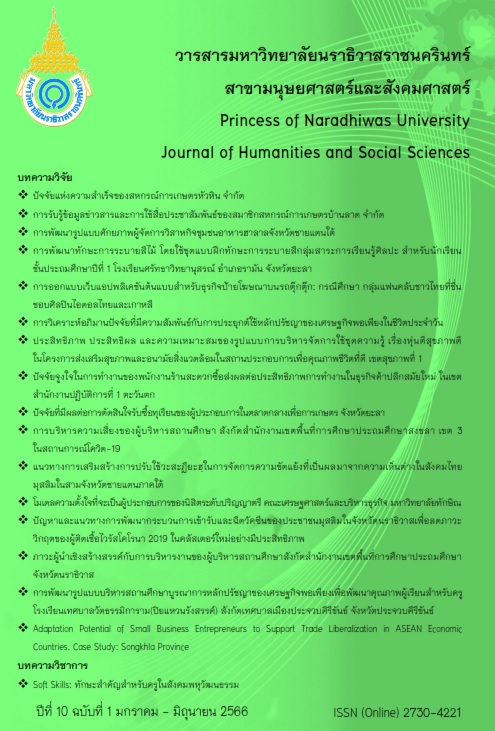
ศักยภาพการปรับตัวของผู้ประกอบการธุรกิจขนาดย่อมเพื่อรองรับการเปิดเสรีทางการค้าในประเทศเศรษฐกิจอาเซียน กรณีศึกษา: จังหวัดสงขลา
Article Sidebar
Main Article Content
บทคัดย่อ
การวิจัยเรื่อง “ศักยภาพการปรับตัวของผู้ประกอบการธุรกิจขนาดย่อมเพื่อรองรับการเปิดเสรีทางการค้าในประเทศเศรษฐกิจอาเซียน กรณีศึกษา: จังหวัดสงขลา” มีวัตถุประสงค์การวิจัยเพื่อศึกษาผลกระทบ และศักยภาพในการปรับตัวของผู้ประกอบการธุรกิจขนาดย่อมจากการเปิดเสรีทางการค้าในประชาคมเศรษฐกิจอาเซียน กรณีศึกษา: จังหวัดสงขลา และมีสมมติฐานการวิจัย 1) ศึกษาข้อมูลพื้นฐานของผู้ประกอบการธุรกิจขนาดย่อมในจังหวัดสงขลา 2) คุณลักษณะของผู้ประกอบการมีอิทธิพลต่อศักยภาพในการปรับตัวของผู้ประกอบการธุรกิจขนาดย่อมในจังหวัดสงขลา 3) ภาวะผู้นำการเปลี่ยนแปลงมีอิทธิพลต่อศักยภาพในการปรับตัวของผู้ประกอบการธุรกิจขนาดย่อม ในจังหวัดสงขลา เป็นการวิจัยเชิงปริมาณเก็บรวบรวมข้อมูลภาคสนามจากแบบสอบถาม จากกลุ่มตัวอย่างเลือกแบบเจาะจงจาก 3 อำเภอ 1) อำเภอเมืองสงขลา 2) อำเภอหาดใหญ่ และ 3) อำเภอสะเดา จังหวัดสงขลา โดยแบ่งเป็นอำเภอละ 100 ตัวอย่าง จาก 3 ประเภทกลุ่มธุรกิจ 1) ธุรกิจบริการ 2) กลุ่มธุรกิจอุตสาหกรรม และ 3) กลุ่มธุรกิจสินค้าอุปโภคบริโภค จำนวนทั้งสิ้น 300 ตัวอย่าง ผลการวิจัยเชิงปริมาณสรุปได้ว่า คุณลักษณะของผู้ประกอบการ และภาวะผู้นำการเปลี่ยนแปลง ของผู้ประกอบการส่งผลต่อศักยภาพการปรับตัวของผู้ประกอบการธุรกิจขนาดย่อมจังหวัดสงขลาเพื่อรองรับการเปิดเสรีทางการค้าในประเทศเศรษฐกิจอาเซียน
Article Details

อนุญาตภายใต้เงื่อนไข Creative Commons Attribution-NonCommercial-NoDerivatives 4.0 International License.
เอกสารอ้างอิง
Ahmad, N. H. (2007) A Cross cultural study of entrepreneurial competencies and entrepreneurial success in SMEs in Australia and Malaysia. PhD Dissertation of University of Adelaide.
Ahmad, N. H., Ramayah, T., Wilson, C., and Kummerow, L. (2010) Is entrepreneurial competency and business success relationship contingent upon business environment?: A study of Malaysian SMEs. International Journal of Entrepreneurial Behavior & Research 16(3): 182–203.
Ayman, R., Chemers, M.M., and Fiedler, F. (1995) The contingency model of leadership effectiveness: Its levels of analysis. The Leadership Quarterly 6(2): 147-167.
Bass, B. M. (1985) Leadership: Good, better, best. Organizational Dynamics 13(3): 26-40.
Blake, R. R., and Mouton, J. S. (1964). The Managerial Grid, Gulf Publishing Company., Houston.
Bird, B. J. (1995) The towards a theory of entrepreneurial competency. In Advances in entrepreneurship, firm emergence, and growth, pp. 51–72. Jai Press,Greenwich, Connecticut.
Boyatzis, R. E. (1982) The competent manager : A model for effective performance, John Wiley & Son,New York.
Burns, J.M. (1978) Leadership. Harper & Row, New York.
Dess, G.G., Lumpkin, G.T. and Covin, J. G. (1998) Entrepreneurial strategy making and firm performance: tests of contingency and configurational models. Strategic management journal 18(9): 677-695.
Fiedler, F. E. (1964) A Contingency Model of Leadership Effectiveness. Advances in Experimental Social Psychology (Vol.1). 149-190. New York: Academic Press.
Fiedler, F.E. (1978) The Contingency model and the dynamics of the leadership process. Advances in Experimental Social Psychology 11: 59-112.
Hellriegel, D., Jackson, S. E. and Slocum, J. W. (2008) Management: A competency-based approach, South-Western College Publisher, Ohio.
Izquierdo, E. and Deshoolmeester, D. (2005) The importance of competencies for entrepreneurship: A view from entrepreneurs and scholars’ perspective.
Li, Y.H., Huang, J.W. and Tsai, M.T. (2009) Entrepreneurial orientation and firm performance: The role of knowledge creation process. Industrial Marketing Management 38: 440-449.
Luthans, F. (1973) The contingency theory of management: A path out of the jungle. Business Horizons 16(3): 67-72.
McClelland, D. C. (1973) Testing for competence rather than for intelligence. American Psychologist 28(1): 1-14.
Meunier, S. and Nicolaidis, K. (2005) The European Union as a trade power. In Proceedings of Archive of European Integration (AEI), Texas, USA.
Mitchell T.R., Biglan, A., Oncken, G.R., and Fiedler, F.E. (1970) The contingency model: Criticism and suggestions. The Academy of Management Journal 13(3): 253-267.
Mitchelmore, S.,and Rowley, J. (2010) Entrepreneurial competencies: a literature review and development agenda. International Journal of Entrepreneurial Behavior & Research 16(2): 92 -111.
Mulder, M., Lans, T., Verstegen, J., Biemans, H. and Meijer, Y. (2007) Competence development of entrepreneurs in innovative horticulture. Journal of Workplace Learning 19(1): 32 – 44.
Muzychenko, O. (2008) Cross-cultural entrepreneurial competence in identifying international business opportunities. European Management Journal 26(6): 366-377.
Singh, M. and Vohra, N. (2009) Level of formalisation of human resource management in small and medium enterprises in India. The Journal of Entrepreneurship 18(1): 95-116.
Spencer, L.M. and Spencer, S.M. (1993) Competence at work: Models for superior performance, John Wiley & Sons, Inc., New York.
Strube, M. J. and Garcia, J. E. (1981) A meta-analytic investigation of Fiedler's contingency model of leadership effectiveness. Psychological Bulletin 90(2): 307-321.
Tate, G. (2009) Entrepreneurship and the environment for rural SMEs in the Shropshire Hills, UK, 1997–2009. The Journal of Entrepreneurship 19(2): 191-207.
Vroom, V.H. and Yetton, P.W. (1973). Leadership and decision-making. Pittsburgh: University of Pittsburgh Press.
