the การพัฒนาความท้าทายนักศึกษาครูพลศึกษาตามทักษะและสมรรถนะแห่งศตวรรษที่ 21
Article Sidebar
Main Article Content
บทคัดย่อ
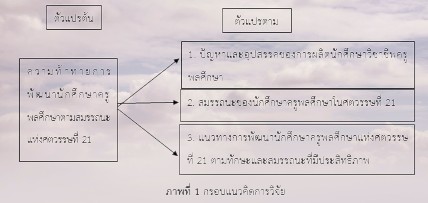
การศึกษาเรื่องความท้าทายในการผลิตนักศึกษาครูพลศึกษาที่มีทักษะและสมรรถนะแห่งศตวรรษ ที่ 21 มีวัตถุประสงค์เพื่อ 1) ศึกษาปัญหาและอุปสรรคในการผลิตนักศึกษาวิชาชีพครูพลศึกษา 2) ศึกษาสมรรถนะของนักศึกษาครูพลศึกษาในศตวรรษที่ 21 และ 3) ศึกษาแนวทางการพัฒนานักศึกษาครูพลศึกษาแห่งศตวรรษที่ 21 ตามทักษะและสมรรถนะที่มีประสิทธิภาพ โดยใช้การวิเคราะห์เชิงเนื้อหา ในการรวบรวมและวิเคราะห์ข้อมูลจากแหล่งข้อมูลวิชาการที่เกี่ยวข้อง
ผลการศึกษา พบว่า 1) ปัญหาและอุปสรรคสำคัญในการผลิตนักศึกษาครูพลศึกษา ได้แก่ การจัดการเรียนรู้ การเรียนการสอน ความรู้ทางวิชาการ การเป็นโค้ชกีฬา การใช้เทคโนโลยี การทำงานเป็นทีม ความคิดสร้างสรรค์ การบูรณาการอัตลักษณ์ท้องถิ่น การขาดแคลนทรัพยากร อุปกรณ์การเรียนการสอนที่ไม่เพียงพอ และความเปลี่ยนแปลงของเทคโนโลยีและสังคมที่รวดเร็ว ซึ่งส่งผลต่อการจัดการเรียนการสอนอย่างมีประสิทธิภาพ 2) ผลการศึกษาด้านสมรรถนะของนักศึกษา พบว่า จำเป็นต้องมีการจัดการเรียนรู้ การเรียน การสอน ความรู้ทางวิชาการ การเป็นโค้ชกีฬา การใช้เทคโนโลยี การทำงานเป็นทีม ความคิดสร้างสรรค์ การบูรณาการอัตลักษณ์ท้องถิ่น ทักษะการใช้เทคโนโลยี ทักษะการออกแบบการเรียนรู้ การประเมินผล และทักษะบริหารจัดการชั้นเรียนเพื่อรองรับการเรียนการสอนในยุคดิจิทัล และ 3) แนวทางการพัฒนานักศึกษาครูพลศึกษาเน้นการพัฒนาการจัดการเรียนรู้ การเรียนการสอน ความรู้ทางวิชาการ การเป็นโค้ชกีฬา การใช้เทคโนโลยี ความคิดสร้างสรรค์ การบูรณาการอัตลักษณ์ท้องถิ่นที่ทันสมัย การสอนเชิงปฏิบัติการ และการสร้างความร่วมมือกับภาคีภายนอก เช่น โรงเรียน ชุมชน และองค์กรกีฬา เพื่อเสริมสร้างทักษะและสมรรถนะที่สอดคล้องกับความต้องการของศตวรรษที่ 21 การวิจัยนี้มีความสำคัญต่อการวางแผนและพัฒนาการผลิตครูพลศึกษาที่มีคุณภาพเพื่อสนับสนุนการพัฒนาการศึกษาและสังคมในอนาคต
Article Details

อนุญาตภายใต้เงื่อนไข Creative Commons Attribution-NonCommercial-NoDerivatives 4.0 International License.
เอกสารอ้างอิง
คณะกรรมการมาตรฐานวิชาชีพ. (2560). มาตรฐานวิชาชีพครู 2560. สำนักงานคณะกรรมการมาตรฐานวิชาชีพ. https://www.ksp.or.th/ksp2018/wp-content/uploads
ภูรี ณรงค์วานิช และนนทนันต์ เผ่าภูรี. (2567). การศึกษาสมรรถนะครูพลศึกษาในศตวรรษที่ 21 ในสังกัดสํานักงานเขตพื้นที่การศึกษามัธยมศึกษานครสวรรค์. Journal of MCU Ubon Review, 9(2), 1967-1980. https://so06.tci-thaijo.org/index.php/mcjou/article/view/275345/185364
ณัฐวุฒิ ฉิมมา. (2566). การพัฒนาหลักสูตรฝึกอบรมเพื่อเสริมสร้างสมรรถนะด้านนวัตกรรมและเทคโนโลยีในการจัดการเรียนรู้พลศึกษา. [วิทยานิพนธ์ปริญญาดุษฏีบัณฑิต, มหาวิทยาลัยนเรศวร]. https://nuir. lib.nu.ac.th/dspace/bitstream/123456789/5836/3/NatthawutChimma.pdf?utm_source =chatgpt.com
ศูนย์ฝึกประสบการณ์วิชาชีพครู คณะครุศาสตร์ มหาวิทยาลัยราชภัฏบุรีรัมย์. (2567). คู่มือการนิเทศฝึกประสบการณ์วิชาชีพครู (ฉบับปี 2567). https://anyflip.com/vvrha/kzku/basic
American Sport Education Program (ASEP). (2020). Preparing physical education teachers for the 21st century: Challenges and recommendations. Human Kinetics.
American Sport Education Program (ASEP). (2021). 21st Century Skills and Challenges in Physical Education Teacher Education. In N. LaVoi, T.
American Sport Education Program (ASEP). (2021). Preparing physical educators for the 21st century: A national agenda.
American Sport Education Program (ASEP). (2021). Preparing 21st century physical education teachers: A standards-based approach. Champaign, IL: Human Kinetics.
Commonwealth of Australia. (1992). Barriers to providing physical education and physical activity in schools: institutional constraints, budget limits, time allocations, lack of facilities and equipment [PDF]. ERIC. https://files.eric.ed.gov/fulltext/EJ910415.pdf
Damanik, D., & Widodo, P. (2024). Exploring teaching creativity in transmitting digital literacy, grit, and instructional quality. Education Sciences, 14(4), 384. https://www.mdpi.com /2227-7102/14/4/384
Department for Education (DfE). (2020). Initial teacher training: physical education. https:// www.gov.uk/government/publications/initial-teacher-training-criteria
Department for Education (DfE). (2021). The skills needed by initial teacher training (ITT) students in physical education (PE) in the 21st century. https://www.gov.uk/govern ment/publications/research-review-series-pe/research-review-series-pe?utm_source= chatgpt.com
Department for Education (DfE). (2023). Physical education curriculum and teacher development strategy. https://www.gov.uk/government/publications
Elo, S., & Kyngäs, H. (2008). The qualitative content analysis process. Journal of Advanced Nursing, 62(1), 107–115. https://doi.org/10.1111/j.1365-2648.2007.04569.x
Finnish National Board of Education (FNBE). (2022). National Curriculum for Physical Education. Helsinki: Finnish National Agency for Education.
Ha, S., & Fan, X. (2025). Technology use among physical education teachers before, during, and after the COVID-19 pandemic: A connectivist approach. ResearchGate. https:// www.researchgate.net/publication/385154274
Hardman, K. (2008). The situation of physical education in schools: A global perspective. Hacettepe Journal of Sport Sciences, 19, 1–22.
Ibragimova, E., Uraimov, S., Baitassov, Y., Yuldasheva, S., Kutlimuratova, D., & Litwinowa, M. (2025). Influence of digital technologies on students’ physical activity and intrinsic motivation for physical activity: experience of using fitness apps. Retos, 67, 1162–1173. https://www.researchgate.net/publication/391559896_Digital_motivation_fitnes s_apps_and_student_physical_activity
LaVoi, N. M., Baghurst, T., Woods, C., & Brown, P. (2021). Preparing physical education teacher candidates for the 21st century: Challenges and solutions. Journal of Teaching in Physical Education, 40(2), 185–196.
Martín-Rodríguez, A., & Madrigal-Cerezo, R. (2025). Technology-Enhanced Pedagogy in Physical Education: Bridging Engagement, Learning, and Lifelong Activity. Education Sciences, 15(4), 409. https://doi.org/10.3390/educsci15040409
Office of Academic and Educational Standards. (2021). Guidelines on teacher competency development for 21st century education. Ministry of Education.
Office of the National Economic and Social Development Board. (2018). The Twelfth National Economic and Social Development Plan (2017–2021). NESDB.
Office of the Secretariat of the Education Council. (2017). Education in Thailand 2017. Ministry of Education.
Organisation for Economic Co-operation and Development (OECD). (2018). The future of education and skills: Education 2030. Author.
Patton, M. Q. (2002). Qualitative research and evaluation methods (3rd ed.). Sage.
Tulyakul, S., & Khun inkeeree, H. (2019). Classroom management strategies and motivation for teaching towards teaching effectiveness among physical education teachers in Southern Thailand (Doctoral dissertation, Universiti Utara Malaysia). https://etd.uum.edu.my/8499/?utm_source=chatgpt.com
Wee, E. H., Cheng, W. F., & Chin, N.-S. (2021). Teachers’ perceived barriers to implementation of physical education: examining the administration of physical education programme and the provision of non-human resources. Collegium Antropologicum, 45(3), 191–200. https://www.researchgate.net/publication/357054273
