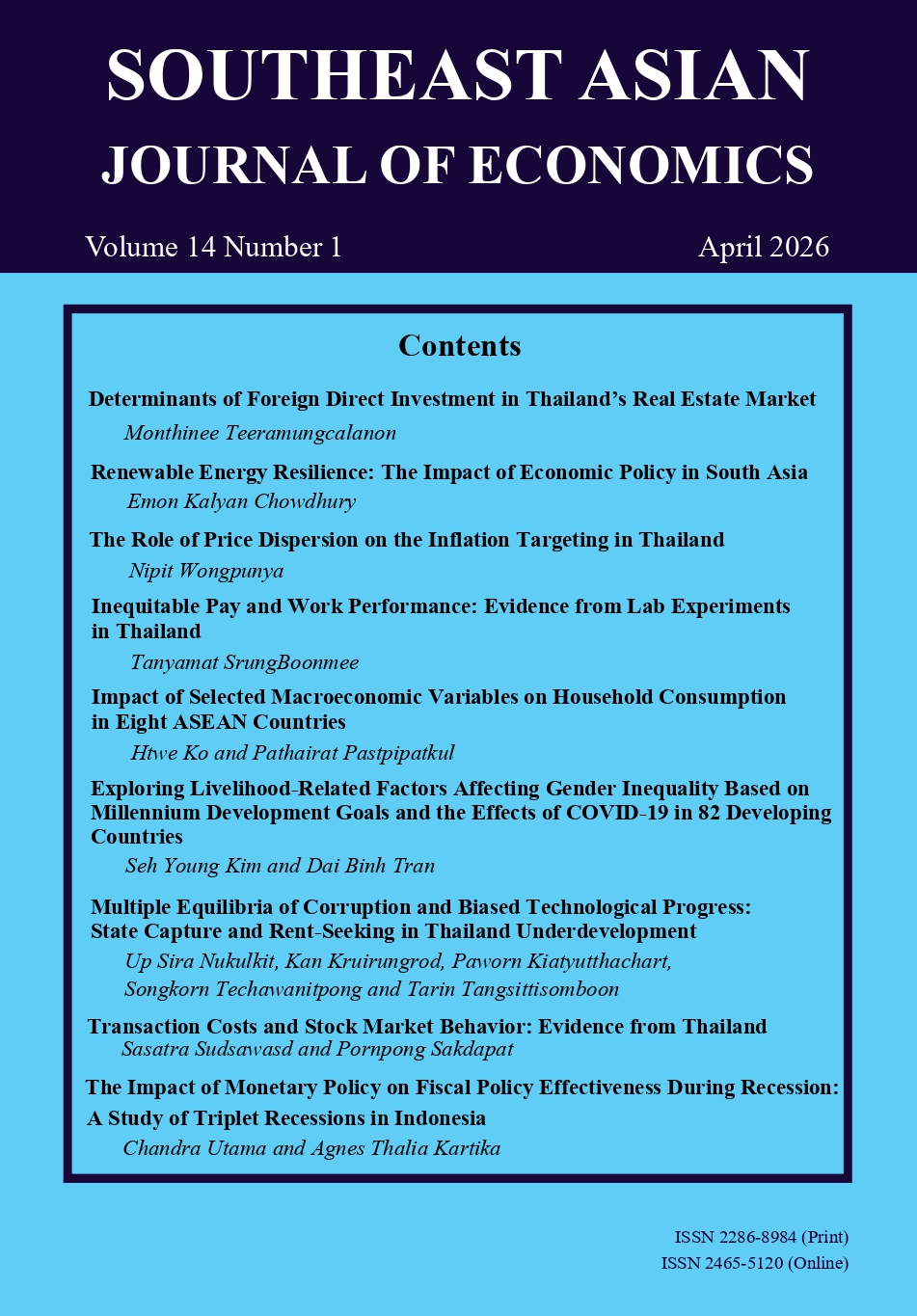
The Role of Price Dispersion on the Inflation Targeting in Thailand
Keywords:
trend inflation, price dispersion, New Keynesian, ThailandAbstract
This paper explores the macroeconomic effects of inflation targeting in Thailand. It uses a closed economy medium-scale New Keynesian model with price dispersion to analyze the Thai monetary policy under inflation targeting. It shows that inflation is more stable, and inflation persistence has fallen after adopting inflation targeting. The Bank of Thailand is more responsive to the deviation of inflation from its target using inflation targeting. Inflation is costly through price dispersion. The larger the inflation targeting rate is set by the Bank of Thailand, the lower the steady state output is from its steady state level, given no trend inflation.
Downloads
Published
How to Cite
Issue
Section
Categories
License
Copyright (c) 2026 SOUTHEAST ASIAN JOURNAL OF ECONOMICS

This work is licensed under a Creative Commons Attribution-NonCommercial-NoDerivatives 4.0 International License.
The submission of a manuscript implies that the paper is an original work and has not been published elsewhere. The author(s) authorize the journal to reproduce or distribute the paper in printed or other electronic forms.