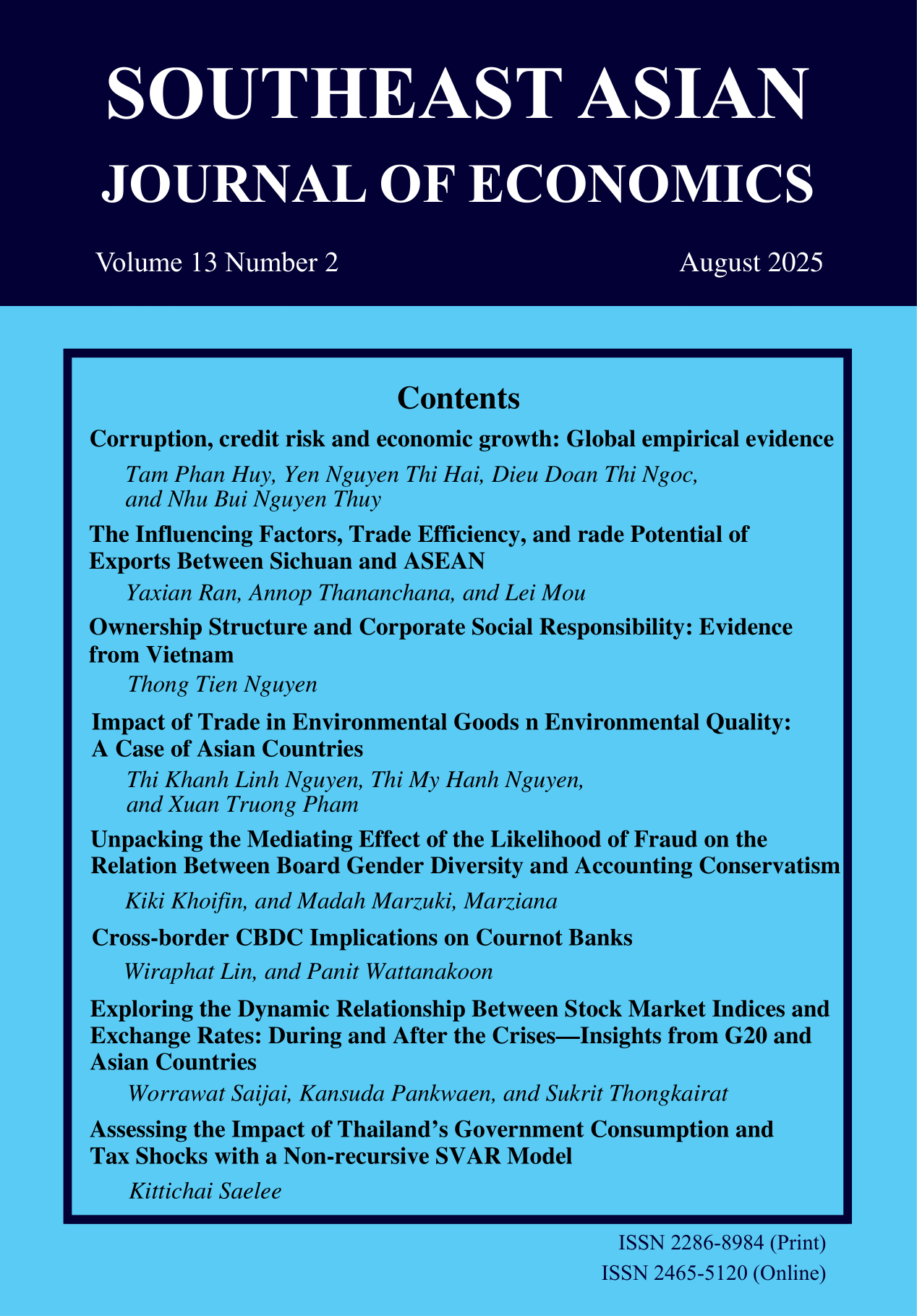
Corruption, credit risk and economic growth: Global empirical evidence
Keywords:
corruption, credit risk, economic growthAbstract
This research investigates the intricate relationship between corruption, credit risk, and economic growth by analyzing data from 218 countries over the period 2000–2022. Employing the Control of Corruption Index and nonperforming loan ratios, we examine how corruption influences banking sector health and, subsequently, economic stability. The study reveals a significant negative correlation, where higher levels of corruption are associated with increased credit risks, manifesting in higher non-performing loan ratios, which in turn dampen economic growth. These findings underscore the detrimental impact of corruption on financial systems and economic development. By highlighting specific pathways through which corruption erodes economic health, this study supports targeted anti-corruption interventions and robust financial regulatory frameworks as critical to fostering sustainable economic growth. Looking forward, addressing corruption could unlock substantial economic potential, making a compelling case for enhanced transparency and governance reforms in financial institutions globally.
Downloads
Published
How to Cite
Issue
Section
Categories
License
Copyright (c) 2025 SOUTHEAST ASIAN JOURNAL OF ECONOMICS

This work is licensed under a Creative Commons Attribution-NonCommercial-NoDerivatives 4.0 International License.
The submission of a manuscript implies that the paper is an original work and has not been published elsewhere. The author(s) authorize the journal to reproduce or distribute the paper in printed or other electronic forms.