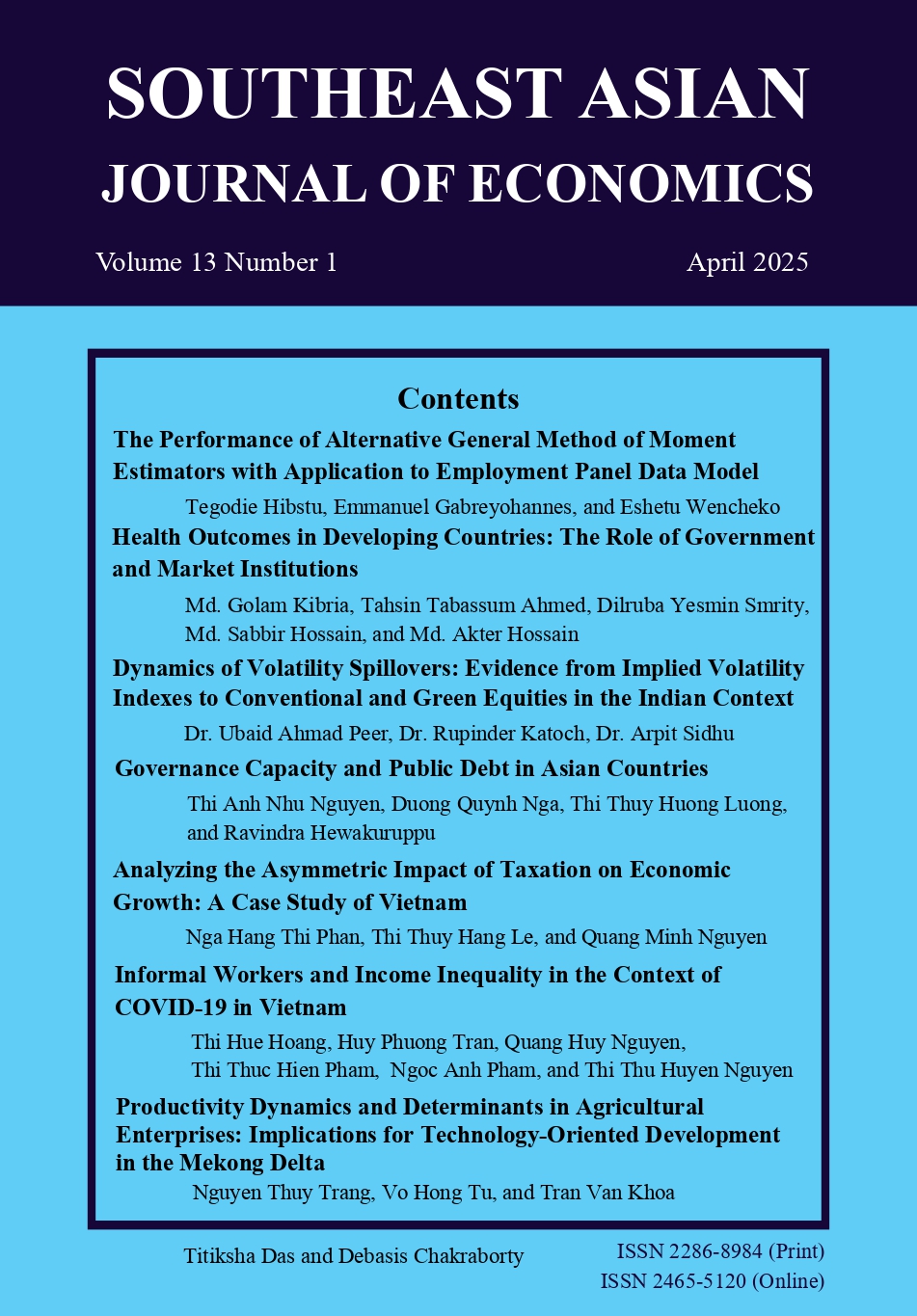
Analyzing the Asymmetric Impact of Taxation on Economic Growth: A Case Study of Vietnam
Keywords:
asymmetric impact, economic growth, taxation, NARDL, VietnamAbstract
Tax revenue can serve as a potential source to control fiscal deficit, but it may also hinder economic growth. Thus, our study is driven by the nonlinear effects between taxation and growth. The literature often overlooks emerging and developing economies, particularly transitional ones. This study investigates the asymmetric impact of taxes on Vietnam’s economic growth using time series data from 1990 to 2020, employing the NARDL framework. The results reveal that changes in tax rates can have asymmetric effects on production in the long run, and increasing tax collection rates will negatively impact economic growth. Specifically, a 1% increase in taxes leads to a 2.518% decrease in economic activity, whereas a 1% reduction in taxes results in a 0.714% increase in economic activity. These findings are significant for the quantitative analysis of taxation through fiscal policies in typical emerging economies.
Downloads
Published
How to Cite
Issue
Section
Categories
- Macroeconomics and Monetary Economics
- General Aggregative Models
- Consumption, Saving, Production, Investment, Labor Markets, and Informal Economy
- Prices, Business Fluctuations, and Cycles
- Money and Interest Rates
- Monetary Policy, Central Banking, and the Supply of Money and Credit
- Macroeconomic Policy, Macroeconomic Aspects of Public Finance, and General Outlook
License
Copyright (c) 2025 SOUTHEAST ASIAN JOURNAL OF ECONOMICS

This work is licensed under a Creative Commons Attribution-NonCommercial-NoDerivatives 4.0 International License.
The submission of a manuscript implies that the paper is an original work and has not been published elsewhere. The author(s) authorize the journal to reproduce or distribute the paper in printed or other electronic forms.