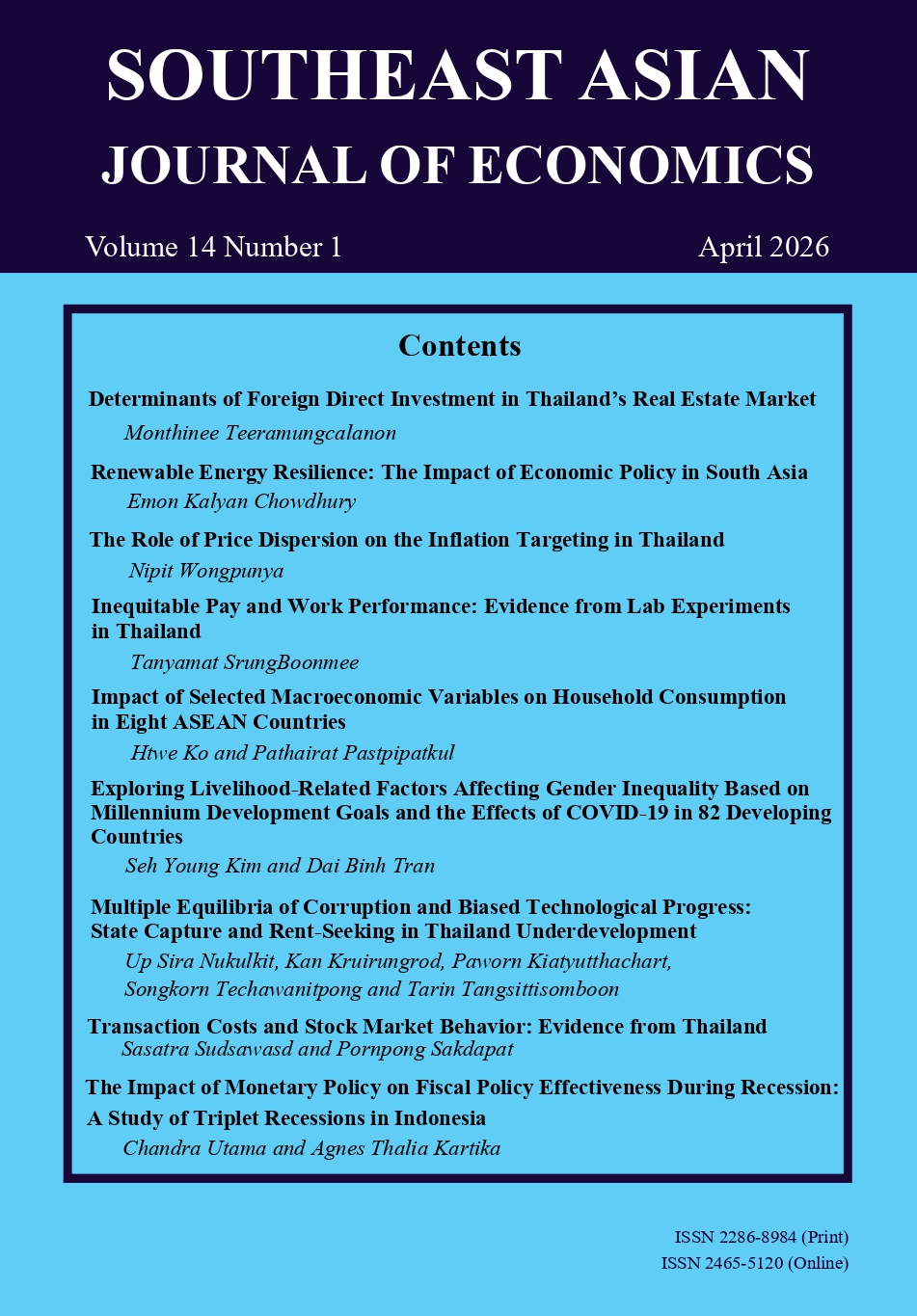
Inequitable Pay and Work Performance: Evidence from Lab Experiments in Thailand
Keywords:
compensation, unequal pay, real effort experiment, work performance, experiments, wage discriminationAbstract
While inequitable pay can hurt morale among disadvantaged workers, it is not clear whether it affects work performance. This paper examines how inequitable compensation affects work performance using lab experiments among university students aged mostly between 18 and 22. Results show that compensation disadvantage improves performance but lowers satisfaction when unequal treatment is arbitrary. The lower satisfaction seems to result from the perception of unfairness, and that perception became clearer after subjects experienced unfair treatment. Disadvantaged subjects seem to try to increase their effort to match the outcome of advantaged peers. When unequal treatment is a result of competition, the performance of disadvantaged subjects is not higher than that of the control group. As such, unequal treatment is undesirable from the perspective of worker satisfaction, but is desirable when considering performance. This evidence supports anti-discrimination policies, as firms have an incentive to improve performance under discriminatory practices that undermine social justice and worker well-being.
Downloads
Published
How to Cite
Issue
Section
Categories
License
Copyright (c) 2026 SOUTHEAST ASIAN JOURNAL OF ECONOMICS

This work is licensed under a Creative Commons Attribution-NonCommercial-NoDerivatives 4.0 International License.
The submission of a manuscript implies that the paper is an original work and has not been published elsewhere. The author(s) authorize the journal to reproduce or distribute the paper in printed or other electronic forms.