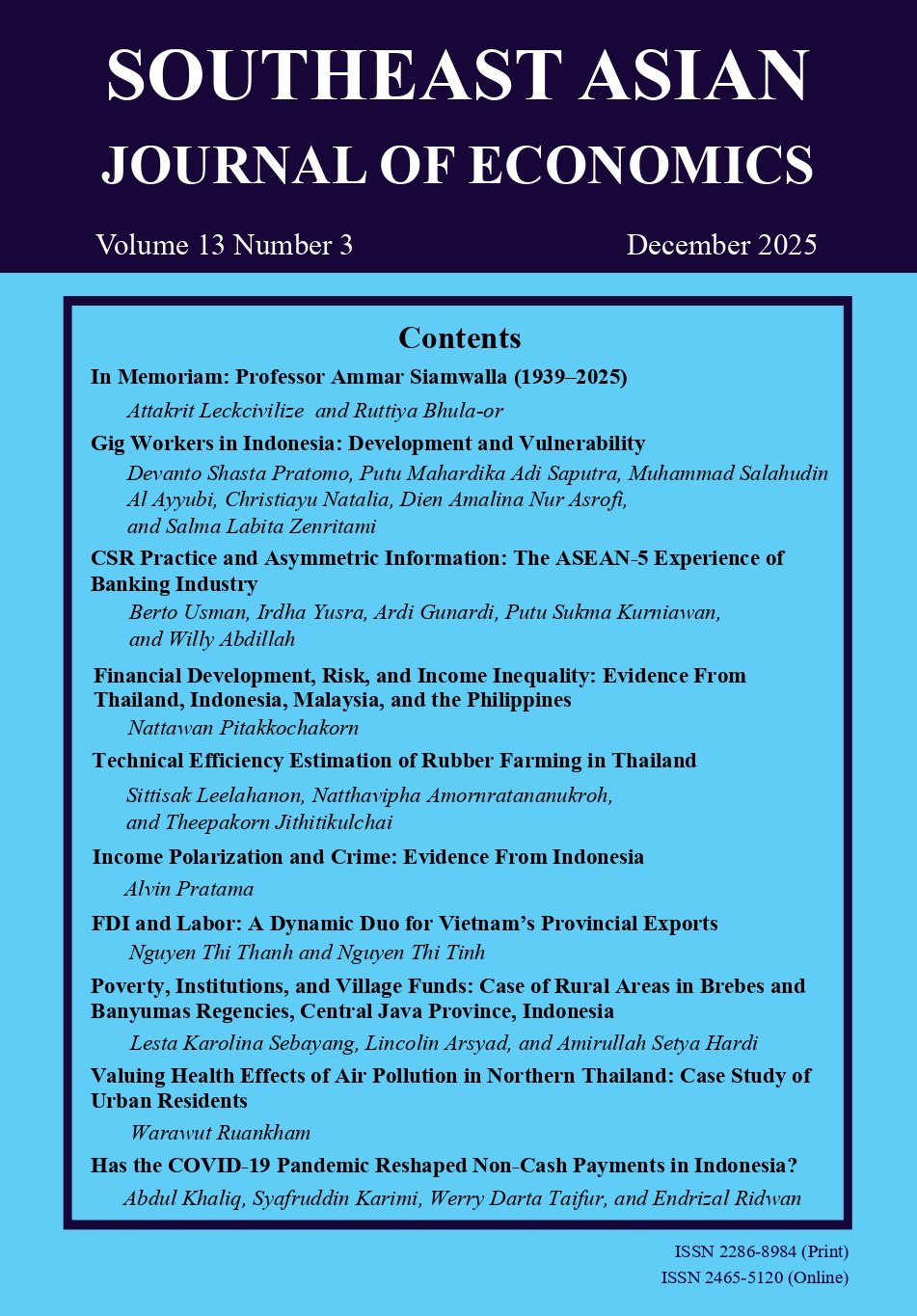
Financial Development, Risk, and Income Inequality: Evidence From Thailand, Indonesia, Malaysia, and the Philippines
Keywords:
financial development, financial and political risk, income inequality, ARDL bound tests, fixed effect modelAbstract
This study investigates the relationship between financial development, financial and political risk, and income inequality in Thailand, Indonesia, Malaysia, and the Philippines by using the World Inequality Database from 1984 to 2022. We employ ARDL bound tests, the fixed effect model, and Generalized Method of Moment to investigate that relationship at the country level and consider them at the regional level in Thailand. Empirical results from each country model indicate that financial development is associated with reducing income inequality in Thailand and the Philippines. In the case of Malaysia, financial development appears to exacerbate income inequality in certain periods. However, the relationship between political risk and income inequality is inconclusive. For the regional model, financial development and regional economic growth are significant and aligned with the country-level model. This finding provides new insights for policymakers at both the country and regional levels and supports the need for consideration of the relationship between financial development and income inequality.
Downloads
Published
How to Cite
Issue
Section
Categories
License
Copyright (c) 2025 SOUTHEAST ASIAN JOURNAL OF ECONOMICS

This work is licensed under a Creative Commons Attribution-NonCommercial-NoDerivatives 4.0 International License.
The submission of a manuscript implies that the paper is an original work and has not been published elsewhere. The author(s) authorize the journal to reproduce or distribute the paper in printed or other electronic forms.