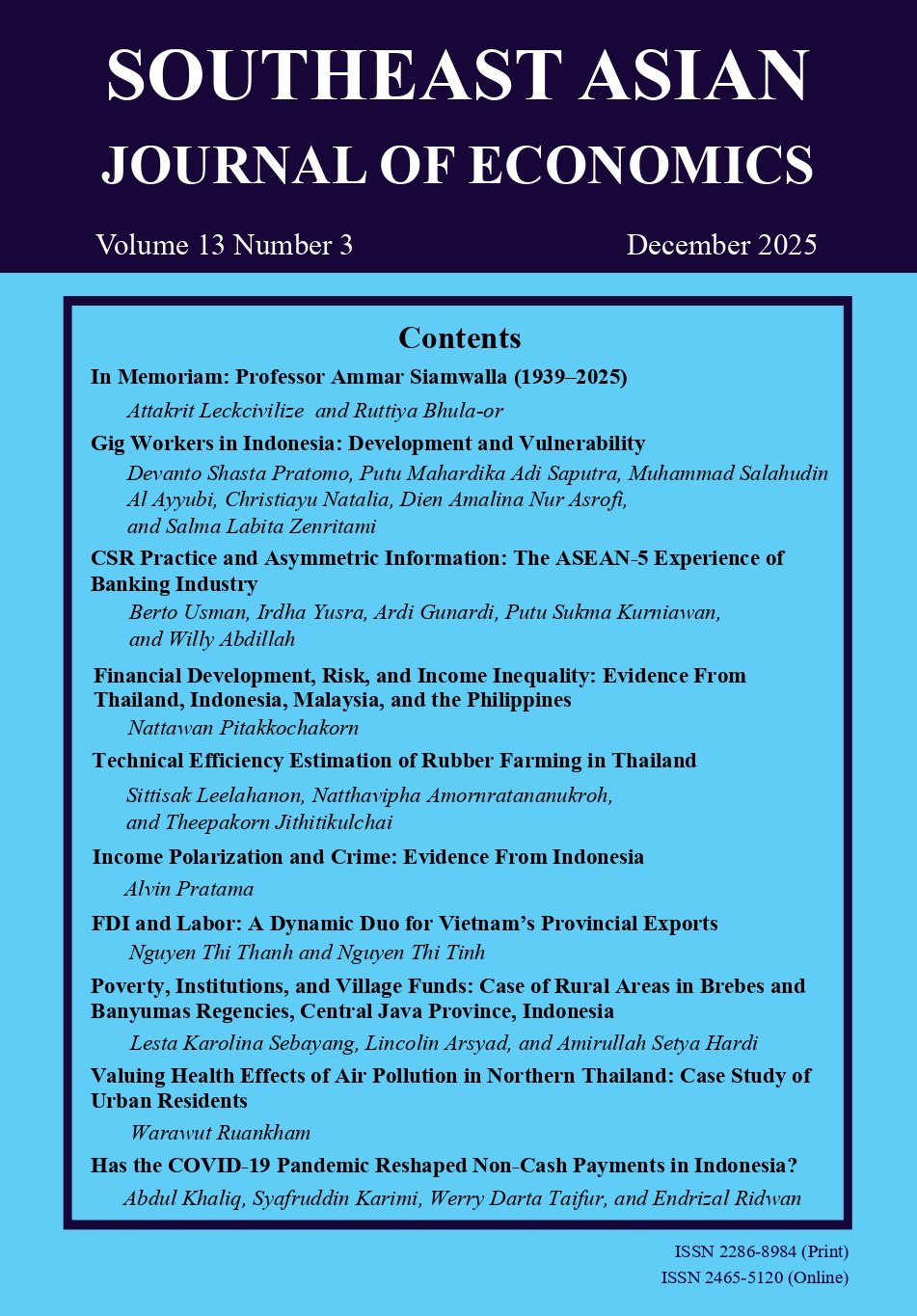
Valuing Health Effects of Air Pollution in Northern Thailand: Case Study of Urban Residents
Keywords:
PM2.5, air pollution, contingent valuation method (CVM), willingness to pay (WTP), financial measures, Northern ThailandAbstract
Air pollution is a critical issue in rapidly developing regions, including Northern Thailand. This study estimates the health effects of air pollution and residents’ willingness to pay (WTP) for respiratory illness prevention. A survey of 480 respondents across eight provinces in Northern Thailand during December 2023 to May 2024, using Contingent Valuation Methods, finds that individual WTP was an average of 367 THB (11 USD) annually for improving air quality and preventing illness. Regional variations in WTP are observed, with Chiang Mai having the highest and Lamphun the lowest. Key factors influencing WTP include gender, age, income, cost of prevention, perception, and pollution acknowledgement. The findings underscore the high value residents place on cleaner air and highlight the need for targeted financial measures, regional smog mitigation, and enhanced public awareness to address air pollution effectively.
Downloads
Published
How to Cite
Issue
Section
License
Copyright (c) 2025 SOUTHEAST ASIAN JOURNAL OF ECONOMICS

This work is licensed under a Creative Commons Attribution-NonCommercial-NoDerivatives 4.0 International License.
The submission of a manuscript implies that the paper is an original work and has not been published elsewhere. The author(s) authorize the journal to reproduce or distribute the paper in printed or other electronic forms.