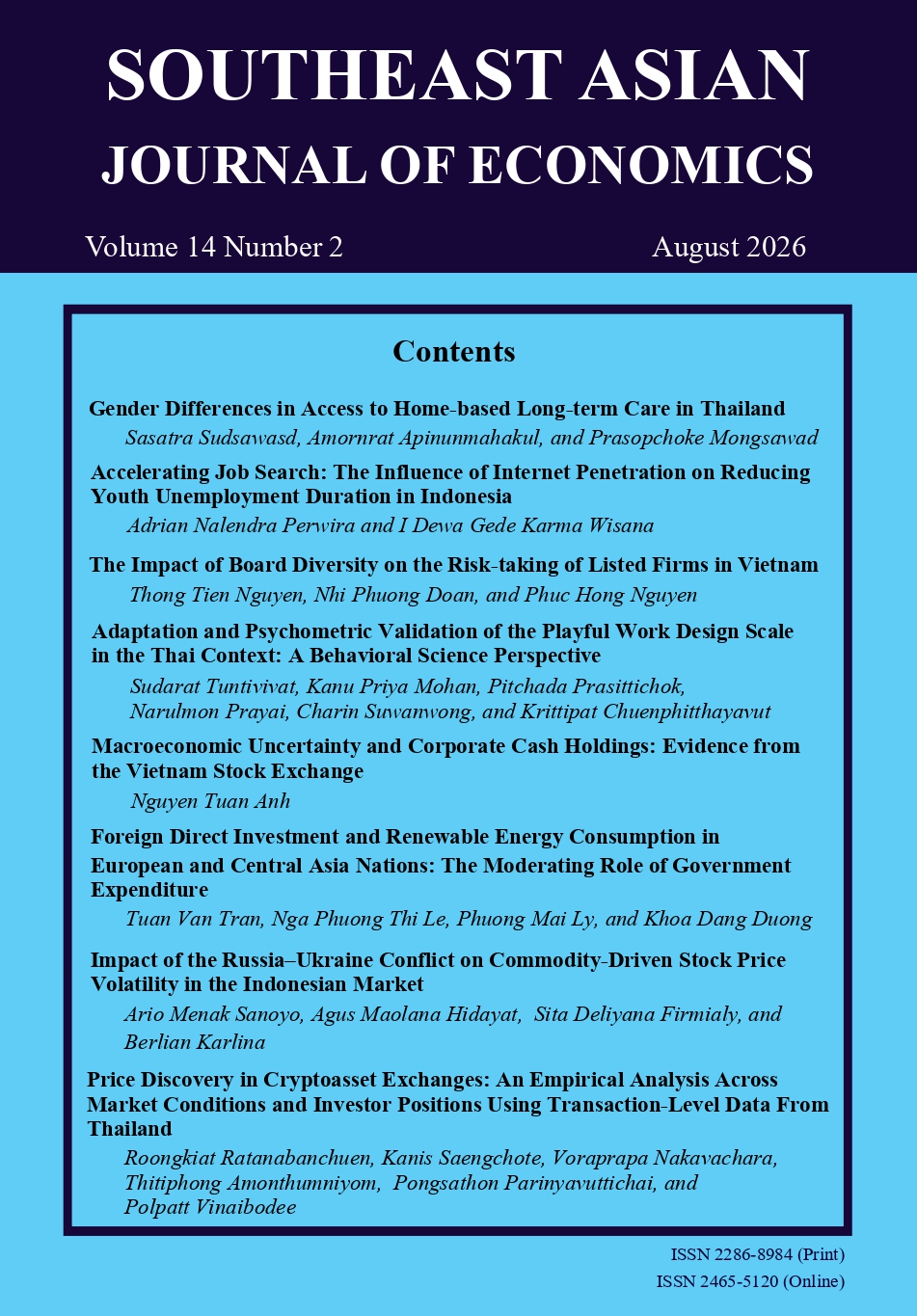
Adaptation and Psychometric Validation of the Playful Work Design Scale in the Thai Context: A Behavioral Science Perspective
Keywords:
Playful Work Design, Designing Fun, Designing Competition, Scale Validation, Confirmatory Factor AnalysisAbstract
Playful work design (PWD) enhances economic outcomes through intrinsic motivation and engagement, with its dimensions of fun and competition. However, a Thai version of the PWD scale was yet to be developed. This research aimed to translate, adapt, and test the psychometric qualities of the PWD scale in the Thai context to make it culturally meaningful. The study employed mixed methods, involving the translation and validation of the scale through 6 expert reviews and 6 cognitive interviews, followed by the testing of its psychometric properties with 200 Thai participants selected via stratified random sampling. Confirmatory factor analysis showed a two-factor model fit the data, confirming the Thai PWD scale mirrors the original's two factors: designing fun (6 items) and designing competition (6 items). Ordinary least squares regression revealed that PWD significantly predicted innovative work behavior (β = 0.72, p < .001). Thus, the adapted scale with twelve-item is a valid and reliable tool, with the potential to predict work behavior.
Downloads
Published
How to Cite
Issue
Section
License
Copyright (c) 2026 SOUTHEAST ASIAN JOURNAL OF ECONOMICS

This work is licensed under a Creative Commons Attribution-NonCommercial-NoDerivatives 4.0 International License.
The submission of a manuscript implies that the paper is an original work and has not been published elsewhere. The author(s) authorize the journal to reproduce or distribute the paper in printed or other electronic forms.