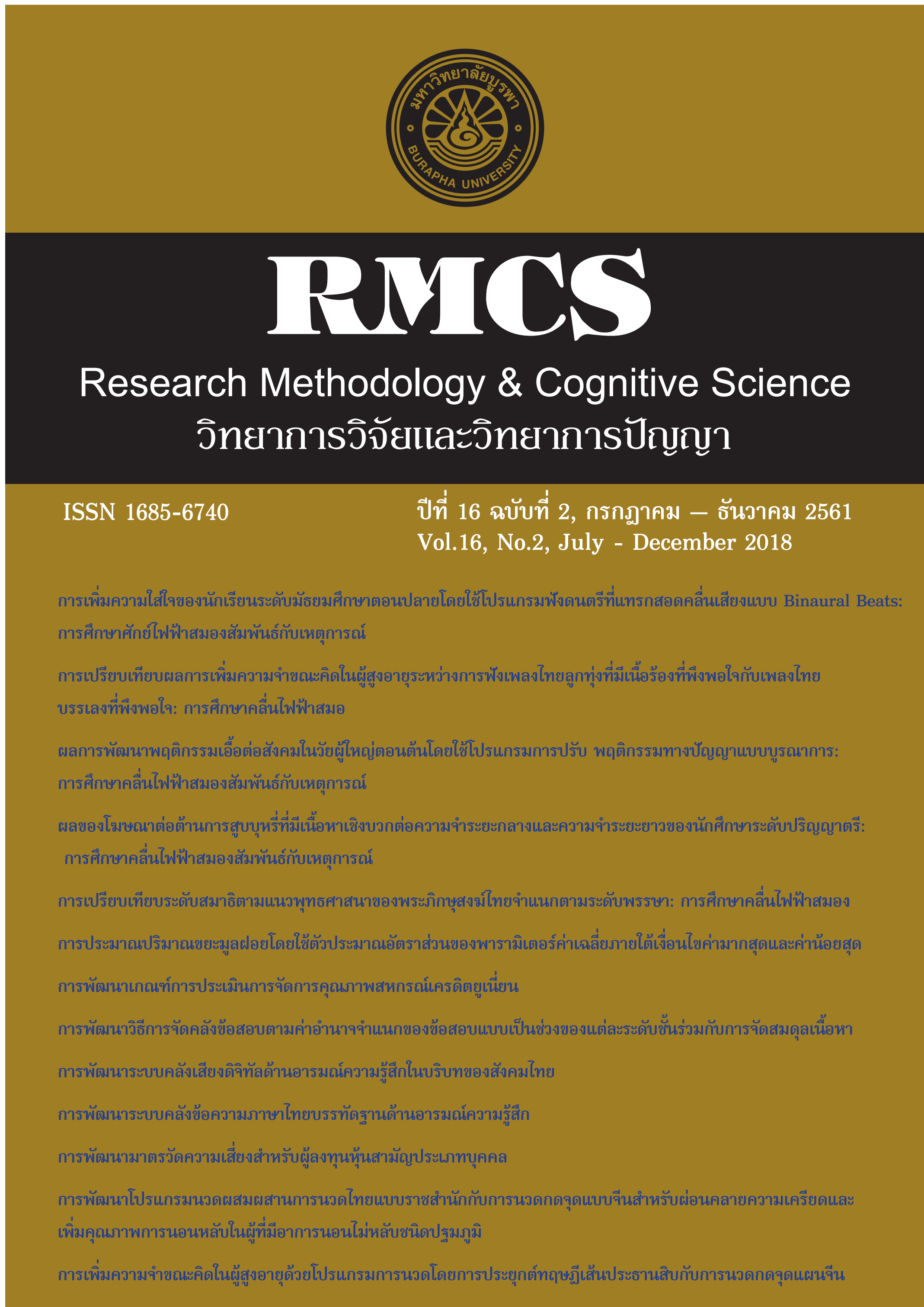
การประมาณปริมาณขยะมูลฝอยโดยใช้ตัวประมาณอัตราส่วนของพารามิเตอร์ค่าเฉลี่ย ภายใต้เงื่อนไขค่ามากสุดและค่าน้อยสุด
Article Sidebar
Main Article Content
บทคัดย่อ
การวิจัยนี้มีวัตถุประสงค์เพื่อ 1) เสนอตัวประมาณอัตราส่วนของพารามิเตอร์ค่าเฉลี่ย ภายใต้เงื่อนไขค่ามากสุดและค่าน้อยสุด 2) เปรียบเทียบประสิทธิภาพ (MSE และ PRE) ของตัวประมาณที่เสนอกับ ตัวประมาณค่าเฉลี่ย ตัวประมาณอัตราส่วน ตัวประมาณค่าเฉลี่ย ภายใต้เงื่อนไขค่ามากสุดและค่าน้อยสุด และตัวประมาณอัตราส่วนของ Subramani and Kumarapandiyan ( ) ด้วยการจำลองสถานการณ์ 60 สถานการณ์ ภายใต้การสุ่มตัวอย่างอย่างง่ายแบบไม่คืนที่ และ 3) ประมาณปริมาณขยะมูลฝอยที่จัดเก็บได้เฉลี่ยต่อปีของสำนักงานเขตพื้นที่ กรุงเทพมหานคร ปีงบประมาณ 2562 โดยใช้ตัวประมาณที่นำเสนอ กำหนดความแม่นยำภายใต้เกณฑ์ค่าร้อยละความคลาดเคลื่อนสัมพัทธ์เฉลี่ย ไม่เกินร้อยละ 10
ผลวิจัยปรากฏว่า
1) ตัวประมาณอัตราส่วนของพารามิเตอร์ค่าเฉลี่ย ภายใต้เงื่อนไขค่ามากสุดและค่าน้อยสุดมีประสิทธิภาพมากกว่าตัวประมาณอื่น ในทุกสถานการณ์ และมีประสิทธิภาพมากขึ้น เมื่อระดับความสัมพันธ์และขนาดตัวอย่างเพิ่มขึ้น
2) การประมาณปริมาณขยะมูลฝอยที่จัดเก็บได้เฉลี่ยต่อปีของสำนักงานเขตพื้นที่ กรุงเทพมหานคร ปีงบประมาณ 2562 โดยใช้ตัวประมาณที่นำเสนอให้ค่าร้อยละความคลาดเคลื่อนสัมพัทธ์เฉลี่ย ร้อยละ 2.95 และปริมาณขยะมูลฝอยที่จัดเก็บได้เฉลี่ยต่อปีของสำนักงานเขตพื้นที่ กรุงเทพมหานคร ปีงบประมาณ 2562 ประมาณ 3,924,107.28 ตันต่อปี
Article Details
เอกสารอ้างอิง
สำนักสิ่งแวดล้อม กรุงเทพมหานคร. (2561). ปริมาณมูลฝอยที่จัดเก็บได้ในแต่ละปีงบประมาณ. วันที่ค้นข้อมูล 10 เมษายน 2561, เข้าถึงได้จาก http://bangkok.go.th/environment.
สำนักสิ่งแวดล้อม กรุงเทพมหานคร. (2558). แผนบริหารจัดการขยะมูลฝอยของกรุงเทพมหานคร พ.ศ. 2558-2562. กรุงเทพ: สำนักสิ่งแวดล้อม กรุงเทพมหานคร.
Cochran, W. G. (1977). Sampling Techniques (3rd ed.). New York: Wiley.
Al-Hossain, A. Y., & Khan, M. (2014). Efficiency of ratio, product, and regression estimators under maximum and minimum values, using two auxiliary variables. Journal of Applied Mathematics, 1-6. doi: 10.1155/2014/693782
Khan, M., & Shabbir, J. (2013). Some Improved Ratio, Product, and Regression Estimators of Finite Population Mean When Using Minimum and Maximum Values. The Scientific World Journal, 2013, 1-7. doi: 10.1155/2013/431868
Khan, M., Ullah, S., Al-Hossain, A. Y., & Bashir, N. (2015). Improved ratio-type estimators using maximum and minimum values under simple random sampling scheme. Hacettepe Journal of Mathematics and Statistics, 44(4), 923-931.
Sarndal, C. E. (1972). Sample Survey Theory vs. General Statistical Theory: Estimation of the Population Mean. International Statistical Institute, 40(1), 1-12.
Sisodia, B., & Dwivedi, V. (1981). Modified ratio estimator using coefficient of variation of auxiliary variable. Journal-Indian Society of Agricultural Statistics, 33(2), 13-18.
Singh, H., & Kakran, M. (1993). A modified ratio estimator using known coefficient of kurtosis of an auxiliary character. unpublished paper.
Singh, H., & Tailor, R. (2003). Use of known correlation coefficient in estimating the finite population mean. Statistics in Transition, 6(4), 555-560.
Subramani, J. (2016). A new median based ratio estimator for estimation of the finite population mean. Statistics in Transition New Series, 17(4), 591-604.
Subramani, J., & Kumarapandiyan, G. (2013). A new modified ratio estimator for estimation of population mean when median of the auxiliary variable is known. Pakistan Journal of Statistics and Operation Research, 9(2), 137-145.
Upadhyaya, L. N., & Singh, H. P. (1999). Use of transformed auxiliary variable in estimating the finite population mean. Biometrical Journal, 41(5), 627-636.
Yan, Z., & Tian, B. (2010). Ratio method to the mean estimation using coefficient of skewness of auxiliary variable. Information Computing and Applications, 103-110. doi: 10.1007/978-3-642-16339-5_14
