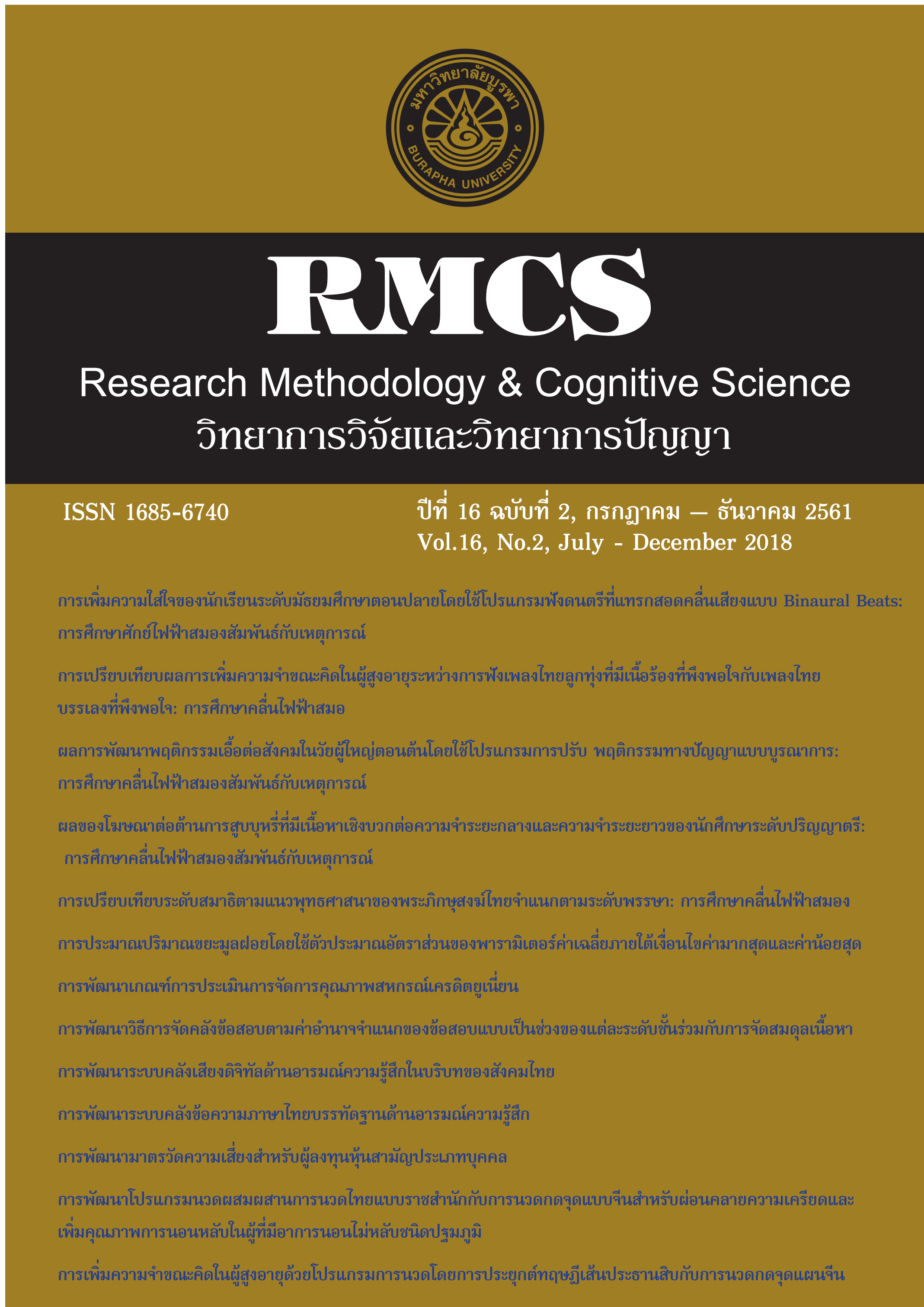
การพัฒนาโปรแกรมนวดผสมผสานการนวดไทยแบบราชสำนักกับการนวดกดจุดแบบจีน สำหรับผ่อนคลายความเครียดและเพิ่มคุณภาพการนอนหลับในผู้ที่มีอาการนอนไม่หลับชนิดปฐมภูมิ
Article Sidebar
Main Article Content
บทคัดย่อ
การนอนหลับเป็นสิ่งสำคัญ ถ้านอนหลับไม่เพียงพอจะส่งผลต่อการเกิดโรคมากมาย การวิจัยนี้มีวัตถุประสงค์เพื่อ 1) พัฒนาโปรแกรมนวดผสมผสานการนวดไทยแบบราชสำนักกับการกดจุดแบบจีน (2) เปรียบเทียบการผ่อนคลายและคุณภาพการนอนหลับ ระหว่างกลุ่มที่ได้รับการนวดตามโปรแกรมที่พัฒนาขึ้นกับกลุ่มควบคุม และวิเคราะห์ความสัมพันธ์ระหว่างความเครียดกับคุณภาพการนอนหลับ กลุ่มตัวอย่างเป็นผู้มีอาการนอนไม่หลับชนิดปฐมภูมิ อายุระหว่าง 15-60 ปี ได้มาโดยการอาสาสมัคร จำนวน 40 คน สุ่มเข้ากลุ่มทดลองและกลุ่มควบคุม กลุ่มละ 20 คน เครื่องมือที่ใช้ในการวิจัย ได้แก่ โปรแกรมนวด เครื่องตรวจการนอนหลับ แบบประเมินคุณภาพการนอนหลับ แบบวัดความเครียดสวนปรุง วิเคราะห์ข้อมูลด้วยสถิติทดสอบทีและสัมประสิทธิ์สหสัมพันธ์
ผลการวิจัยปรากฏว่า 1) โปรแกรมนวดที่พัฒนาขึ้นประกอบด้วย การนวดตามแนวเส้นพื้นฐาน 11 เส้น จุดสัญญาณ 16 จุด และกดจุดจีน 7 จุดใช้เวลานวด 90 นาที มีการลงน้ำหนัก 3 ระดับ คือ 50, 70 และ 90 ปอนด์ 2) การเปรียบเทียบภายในกลุ่มระยะหลังการนวดแสดงให้เห็นว่า ความเครียด คุณภาพการนอนหลับ ประสิทธิภาพการนอนหลับ เวลารวมเฉพาะหลับจริง และเวลาที่เข้านอนจนหลับในกลุ่มทดลองดีขึ้นกว่าก่อนการนวด (p<.01) ส่วนระยะการนอนหลับ NREM3 และ REM ไม่แตกต่างกัน 3) การเปรียบเทียบระหว่างกลุ่มระยะหลังการนวดชี้ให้เห็นว่า ความเครียด คุณภาพการนอนหลับ ประสิทธิภาพการนอนหลับและเวลารวมเฉพาะหลับจริง ในกลุ่มทดลองดีขึ้นกว่ากลุ่มควบคุม (p<.01) ส่วนเวลาเข้านอนจนหลับ ระยะการนอนหลับ NREM3 และ REM ไม่แตกต่างกันและ(4) ระยะก่อนการนวด ความเครียดไม่มีความสัมพันธ์กับคุณภาพการนอนหลับ (r=-.126, p>.05) เนื่องจากกลุ่มตัวอย่างมีความเครียดและคุณภาพการนอนหลับที่คล้ายคลึงกัน แต่แนวโน้มมีความสัมพันธ์ในทิศทางตรงกันข้ามคือถ้ามีความเครียดน้อย คุณภาพการนอนหลับจะดี สรุปได้ว่าโปรแกรมนวดที่พัฒนาขึ้นนี้ สามารถนำไปใช้ส่งเสริมคุณภาพการนอนหลับในผู้ที่มีอาการนอนไม่หลับชนิดปฐมภูมิให้มีคุณภาพการนอนหลับที่ดีขึ้นและลดความเครียดลง
Article Details
เอกสารอ้างอิง
จิรภรณ์ แนวบุตร และบุรณี กาญจนถวัลย์. (2561). ผลการนวดไทยต่อระดับความวิตกกังวล ความซึมเศร้าและอาการปวดของผู้ป่วยกลุ่มอาการปวดกล้ามเนื้อ และเยื่อพังผืดที่มารับบริการนวดแผนไทย ณ คลินิกแพทย์แผนไทยประยุกต์ คณะแพทยศาสตร์ มหาวิทยาลัยธรรมศาสตร์. จุฬาลงกรณ์เวชสาร, 60(3), 314-327.
ตะวันชัย จิรประมุขพิทักษ์ และวรัญ ตันชัยสวัสดิ์. (2540). ปัญหาสุขภาพการนอนหลับของพยาบาลประจำการโรงพยาบาลสงขลานครินทร์. วารสารสมาคมจิตแพทย์แห่งประเทศไทย, 45(3), 123-132.
มูลนิธิสาธารณสุขกับการพัฒนา. (2552). ตำราการนวดไทย (พิมพ์ครั้งที่ 4). กรุงเทพฯ: พิมพ์ดี.
วรุตม์ อุ่นจิตสกุล และพิเชษฐ อุดมรัตน์. (2559). ความคิดรู้และพฤติกรรมบำบัดสำหรับภาวะนอนไม่หลับ. วารสารสมาคมจิตแพทย์แห่งประเทศไทย, 61(1), 89-106.
สำนักการแพทย์ทางเลือก. (2556). การแพทย์แผนจีน (Traditional Chinese Medicine). วารสารสำนักการแพทย์ทางเลือก, 6(1), 1-10.
Lobo, A., LóPez-Antón, R., De-La-CÁmara, C., Quintanilla, M. Á., Campayo, A., Saz, P., & Workgroup, Z. A. (2008). Non-cognitive psychopathological symptoms associated with incident mild cognitive impairment and dementia, Alzheimer’s type. Neurotoxicity Research, 14(2-3), 263-272.
Billioti de Gage, S. B., Bégaud, B., Bazin, F., Verdoux, H., Dartigues, J. F., Pérès, K., & Pariente, A. (2012). Benzodiazepine use and risk of dementia: Prospective population based study. Retrived from https://www.bmj.com/content/345/bmj.e6231.short
Chen, J. H., Chao, Y. H., Lu, S. F., Shiung, T. F., & Chao, Y. F. (2012). The effectiveness of valerian acupressure on the sleep of ICU patients: a randomized clinical trial. International journal of Nursing Studies, 49(8), 913-920.
Buttagat, V., Eungpinichpong, W., Chatchawan, U., & Kharmwan, S. (2011). The immediate effects of traditional Thai massage on heart rate variability and stress-related parameters in patients with back pain associated with myofascial trigger points. Journal of Bodywork and Movement Therapies, 15(1), 15-23.
Dreyer, N. E., Cutshall, S. M., Huebner, M., Foss, D. M., Lovely, J. K., Bauer, B. A., & Cima, R. R. (2015). Effect of massage therapy on pain, anxiety, relaxation, and tension after colorectal surgery: A randomized study. Complementary Therapies in Clinical Practice, 21(3), 154-159.
Edmonds, W. A., & Kennedy, T. D. (2017). An applied guide to research designs: Quantitative, qualitative, and mixed methods. Los Angeles: Sage Publications.
Han, L., Li, J. P., Sit, J. W., Chung, L., Jiao, Z. Y., & Ma, W. G. (2010). Effects of music intervention on physiological stress response and anxiety level of mechanically ventilated patients in China: a randomised controlled trial. Journal of Clinical Nursing, 19 (7-8), 978-987.
Hershner, S. D., & Chervin, R. D. (2014). Causes and consequences of sleepiness among college students. Nature and science of sleep, 6(1), 73.
Jones, J., Thomson, P., Lauder, W., Howie, K., & Leslie, S. J. (2012). Reflexology has an acute (immediate) haemodynamic effect in healthy volunteers: A double-blind randomised controlled trial. Complementary Therapies in Clinical Practice, 18(4), 204-211.
Leger, D., & Bayon, V. (2010). Societal costs of insomnia. Sleep Medicine Reviews, 14(6), 379-389.
Lobo, A., LóPez-Antón, R., De-La-CÁmara, C., Quintanilla, M. Á., Campayo, A., Saz, P., & Workgroup, Z. A. R. A. D. E. M. P. (2008). Non-cognitive psychopathological symptoms associated with incident mild cognitive impairment and dementia, Alzheimer’s type. Neurotoxicity Research, 14(2-3), 263-272.
Mandıroglu, S., & Ozdilekcan, C. (2017). Impact of acupuncture on chronic insomnia: A report of two cases with polysomnographic evaluation. Journal of acupuncture and meridian studies, 10(2), 135-138.
Moraska, A., & Chandler, C. (2009). Changes in psychological parameters in patients with tension-type headache following massage therapy: a pilot study. Journal of Manual & Manipulative Therapy, 17(2), 86-94.
Nerbass, F. B., Feltrim, M. I. Z., Souza, S. A. D., Ykeda, D. S., & Lorenzi-Filho, G. (2010). Effects of massage therapy on sleep quality after coronary artery bypass graft surgery. Clinics, 65(11), 1105-1110.
Wright, S., Courtney, U., Donnelly, C., Kenney, T., & Lavin, C. (2002). Clients’ perceptions of the benefits of reflexology on their quality of life. Complementary Therapies in Nursing and Midwifery, 8(2), 69-76.
Yin, X., Gou, M., Xu, J., Dong, B., Yin, P., Masquelin, F., & Xu, S. (2017). Efficacy and safety of acupuncture treatment on primary insomnia: a randomized controlled trial. Sleep Medicine, 37(1), 193-200.
