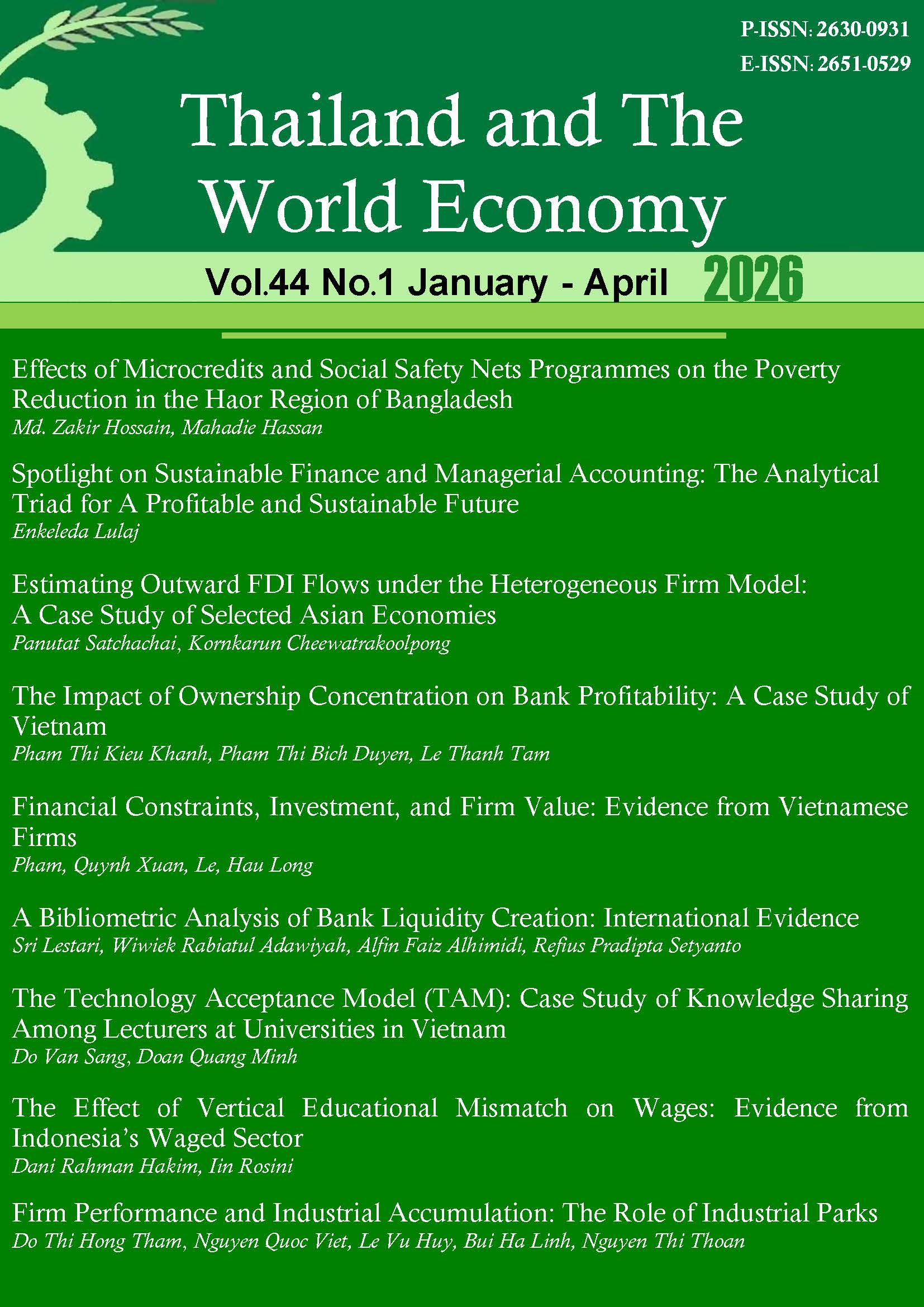
The Technology Acceptance Model (TAM): Case Study of Knowledge Sharing Among Lecturers at Universities in Vietnam
Keywords:
Knowledge Sharing, Technology Acceptance Model (TAM), Information and Communication Technology Tools (ICTs)Abstract
This study research develops and tests a theoretical extension of the Technology Acceptance Model (TAM) that explains behavioral intention to use ICTs for knowledge sharing. In addition, there are different impacts on knowledge donating and knowledge collecting under the influences of demographic variables. The paper utilized structural equation modeling and cross-sectional design to test hypotheses in the proposed research model based on using data collected from 447 lecturers from 13 Vietnamese universities. The findings informed that (1) the TAM-based proposed scale has successfully explained factors predicting the use of ICTs in knowledge sharing among lecturers at universities in Vietnam. (2) the significant relationships among core components of TAM were found, except for the relationship between perceived usefulness and behavioral intention. (3) the finding of significant relationships between behavioral intention and using ICTs in knowledge sharing was reported. In addition, there are different impacts on knowledge donating and knowledge collecting under the influences of demographic variables (age, expertise type). New variables should be explored to better explain the behavioral intention of lecturers to use ICTs for knowledge sharing. Further research should test mediating roles of knowledge sharing's constituents by adding new variables such as knowledge self-efficacy, job involvement, trust, attitude, motivation, barriers, and the like. This study provides a theoretical basis, which can be used to analyze relationships among knowledge-sharing factors and to discuss the implications of these factors for developing universities’ strategies that encourage and foster knowledge sharing among lecturers at universities in Vietnam. Most of the studies on knowledge sharing have been conducted in an organizational context. Only limited work has been done on the knowledge sharing among university lecturers. This study contributes to knowledge-sharing literature that suffers from a paucity of research on the empirical examination of this subject.
References
Abualoush, S.H., Obeidat, A.M., Tarhini, A., Masa’deh, RE., & Al-Badi, A. (2018). The role of employees’ empowerment as an intermediary variable between knowledge management and information systems on employees’ performance. VINE Journal of Information and Knowledge Management Systems, 48 (2), 217-237.
Anantatmula, V. S. (2007). Linking KM effectiveness attributes to organizational performance. VINE Journal of Information and Knowledge Management Systems, 37(2), 133–149.
Ardichvili, A., Page, V., & Wentling, T. (2003). Motivation and barriers to participation in virtual knowledge-sharing communities of practice. Journal of Knowledge Management, 7(1), 64-77.
Bock, G.W., Zmud, R.W., Kim, Y.G., & Lee, J.N. (2005). Behavioral intention formation in knowledge sharing: Examining the roles of extrinsic motivators, social-psychological forces, and organizational climate, MIS Quarterly, 29(1), 87-111.
Borges, R., Bernardi, M., & Petrin, R. (2019). Cross-country findings on tacit knowledge sharing: evidence from the Brazilian and Indonesian IT workers, Journal of Knowledge Management, 23(4), 742-762.
Calantone, R.J., Cavusgil, S.T., & Zhao, Y. (2002). Learning orientation, firm innovation capability, and firm performance. Industrial Marketing Management, 31(6), 515-24.
Che, T., Wu, Z., Wang, Y., & Yang, R. (2019). Impacts of knowledge sourcing on employee innovation: the moderating effect of information transparency. Journal of Knowledge Management, 23(2), 221-239.
Chen, S.-H., & Lee, K.-P. (2008). The role of personality traits and perceived values in persuasion: An elaboration likelihood model perspective on online shopping. Social Behavior and Personality: An International Journal, 36(10), 1379-1400.
Chow, W.S., & Chan, L.S. (2008). Social network, social trust and shared goals in organizational knowledge sharing. Information & Management, 45(7), 458-465.
Connelly, C.E. & Kelloway, E.K. (2003). Predictors of employees' perceptions of knowledge sharing cultures. Leadership and Organization Development Journal, 24, 294‐301.
Cyril Eze, U., Guan Gan Goh, G., Yih Goh, C., & Ling Tan, T. (2013). Perspectives of SMEs on knowledge sharing. Vine, 43(2), 210-236.
Davis, F. D. (1989). Perceived usefulness, perceived ease of use, and user acceptance of information technology. MIS Quart, 13, 319-339.
Davis, F. D. (1993). User acceptance of information technology: System characteristics, user perceptions and behavioral impacts. International Journal of Man-Machine Studies, 38, 475-487.
Davis, F. D., Bagozzi, R., & Warshaw, P. (1989). User acceptance of computer technology: A comparison of two theoretical models. Management Science, 35(8), 982-1003.
Essawi, M., & Tilchin, O. (2013). A model of knowledge management culture change. American Journal of Industrial and Business Management, 3(5), 467-471.
Gefen, D., & Straub, D. (2000, October). The relative importance of perceived ease of use in IS adoption: A study of ecommerce adoption. Journal of the Association of Information Systems, 1(8), 1-28.
Gerbing, D.W., & Anderson, J.C. (1988). An updated paradigm for scale development incorporating unidimensionality and its assessment. Journal of Marketing Research, 25(2), 186–192.
Hair, J. F., Anderson, R. E., Tatham, R. L., & Black, W. C. (1998). Multivariate data analysis. Place of publication: Uer Saddle River.
Han, S.-H., Yoon, D.-Y., Suh, B., Li, B. & Chae, C. (2019). Organizational support on knowledge sharing: a moderated mediation model of job characteristics and organizational citizenship behavior. Journal of Knowledge Management, 23(4), 687-704.
Hogel, M., Parboteeah, K.P., & Munson, C.L. (2003). Team-level antecedents of individuals knowledge networks. Decision Sciences, 34(4), 741-70.
Huysman, M., & Wulf, V. (2006). IT to support knowledge sharing in communities, towards a social capital analysis. Journal of Information technology, 21(1).
Jackson, C., Chow, S., & Leitch, R. (1997). Toward an understanding of the behavioral intention to use an information system. Decision Sciences, 28(2), 357-389.
Kankanhalli, A., Tan, B., & Wei, K. (2001). Seeking knowledge in electronic knowledge repositories: An exploratory study. The 22nd International Conference on Information Systems, New Orleans, Louisiana, USA , 123-133.
Kraft, P., Rise, J., Sutton, S., & Roysamb, E. (2005). Perceived difficulty in the theory of planned behaviour: Perceived behavioural control or affective attitude?. British Journal of Social Psychology, 44(3), 479-496.
King, W.R., & Marks, Jr. P.V. (2008). Motivating knowledge sharing through a knowledge management system. Omega The International Journal of Management Science.
Kim, S., & Trimi, S. (2007). IT for KM in the management consulting industry. Journal of Knowledge Management, 11(3), 145-155.
Lin , H. F. (2007). Knowledge sharing and firm innovation capability: An empirical study. International Journal of Manpower, 28, 315-337.
Mahmoud, M., Rasli, A., Othman, M.F., & bin Abdulahad, B.M. (2014). The effect of organizational culture on knowledge sharing among academic staff holding an administrative position in university. Journal of Management Info, 1(3), 67-83.
Millsap, R. E. (2012). Statistical approaches to measurement invariance, Place of publication: Routledge.
Money, W., & Turner, A. (2005). Assessing knowledge management system user acceptance with the technology acceptance model. International Journal of Knowledge Management (IJKM). 1(1), 8-26.
Nonaka, I. (1994). A dynamic theory of organizational knowledge creation. Organization Science, 5(1). 14-37.
Nunes, M.B., Kanwal, S., & Arif, M. (2017). Knowledge management practices in higher education institutions: a systematic literature review. International Journal of Educational Management, 31(7), 1067–1081.
O Dell, C., Jackson, C., & Grayson, J. (1998). If only we knew what we know: Identification and transfer of internal best practices. California Management Review, 40(3), 154-174.
Oldenkamp, J. H. (2001). Limitations of managing knowledge sharing. Proceedings of the Second European Conference on Knowledge Management, Bled, Slovenia, 411-418.
Osterloh, M., & Frey, B.S. (2000). Motivation, knowledge transfer, and organizational forms. Organization Science, 11(5), 538-50.
Pan, S. L., & Leidner, D. E. (2003). Bridging communities of practice with information technology in pursuit of global knowledge sharing. Journal of Strategic Information Systems, 12 (1), 71-88.
Podrug, N., Filipović, D., & Kovač, M. (2017). Knowledge sharing and firm innovation capability in Croatian ICT companies. International Journal of Manpower, 38(4), 632-644.
Ramírez-Correa, P.E., Arenas-Gaitan, J., & Rondan-Cataluna, F.J. (2015). Gender and acceptance of e-learning: A multi-group analysis based on a structural equation model among college students in Chile and Spain, PloS, One 10 (10).
Raj Adhikari, D. (2010). Knowledge management in academic institutions. International Journal of Educational Management, 24(2), 94-104.
Reid, F. (2003). Creating a knowledge-sharing culture among diverse business units. Villey online library, 30(3).
Riege, A. (2005). Three-dozen knowledge-sharing barriers managers must consider. Journal of Knowledge Management, 9(3), 18-35.
Romano, M., Giudice, M., & Del Nicotra, M. (2014). Knowledge creation and exploitation in italian universities: the role of internal policies for patent activity. Journal of Knowledge Management, 18(5), 952-970.
Shariq, S.M., Mukhtar, U., & Anwar, S. (2019). Mediating and moderating impact of goal orientation and emotional intelligence on the relationship of knowledge-oriented leadership and knowledge sharing. Journal of Knowledge Management, 23(2), 332-350.
Sheppard, B. H., Hartwick, J., & Warshaw, P. R. (1988). The theory of reasoned action: A meta-analysis of past research with recommendations for modifications and future research. Journal of Consumer Behavior, 15(3), 325-343.
Szajna, B. (1996). Empirical evaluation of the revised technology acceptance model. Management Science, 42(1), 85-92.
Straub, D., Limayem, M., & Karahanna-Evaristo, E. (1995). Measuring system usage: Implications for IS theory testing. Management Science, 41(8), 1328-1342.
Straub, D., & Boudreau, M. (2000). Structural equation modelling and regression: guidelines for research practice. Communications of the Association for Information Systems, 27(1), 1-78.
Taylor, S., & Todd, P. (1995). Understanding information technology usage: A test of competing models. Information Systems Research, 6(2), 144-176.
Van Den Hooff, B., & De Ridder, J.A. (2004). Knowledge sharing in context: The influence of organizational commitment, communication climate and CMC use on knowledge sharing. Journal of Knowledge Management, 8(6).
Van Den Hooff, B., & Van Weenen, F. (2004). Committed to share: commitment and CMC use as antecedents of knowledge sharing. Knowledge and Process Management, 11(2), 13-24.
Venkatesh, V. (1999). Creation of favorable user perceptions: Exploring the role of intrinsic motivation. MIS Quarterly, 23, 239–260.
Venkatesh, V. (2000). Determinants of perceived ease of use: Integrating control, and emotion into the technology acceptance model. Information Systems Research, 11(4), 342-365.
Venkatesh, V., & Davis, F. (2000, February). A theoretical extension of the technology acceptance model: Four longitudinal studies. Management Science, 46(2), 186-204.
Venkatesh, V., Morris, M., Davis, G., & Davis. F. (2003). User acceptance of information technology: Toward a unified view. MIS Quarterly, 27(3), 425-478.
Weggeman, M. (2000). Kennismanagement: de praktijk [Knowledge Management: Practice]. Scriptum Management, Schiedam.
Wu, J., Du, H., Li, X., & Li, P. (2010). Creating and delivering a successful knowledge management strategy. Knowledge Management Strategies for Business Development, 261-276.
Yeh, Y.J., Lai, S.Q.,& Ho, C.H. (2006). Knowledge management enablers: A case study industrial. Management & Data Systems, 106(6), 793-810.
Zack, M. (1999). Developing a knowledge strategy. California Management Review, 41(3), 125-146.
Zhang, S., Zhao, J., & Tan, W. (2008). Extending TAM for online learning systems: An intrinsic motivation perspective. Tsinghua Sci. Technol, 13 (3), 312-317.
Downloads
Published
How to Cite
Issue
Section
Categories
License
Copyright (c) 2025 Thailand and The World Economy

This work is licensed under a Creative Commons Attribution-NonCommercial-NoDerivatives 4.0 International License.