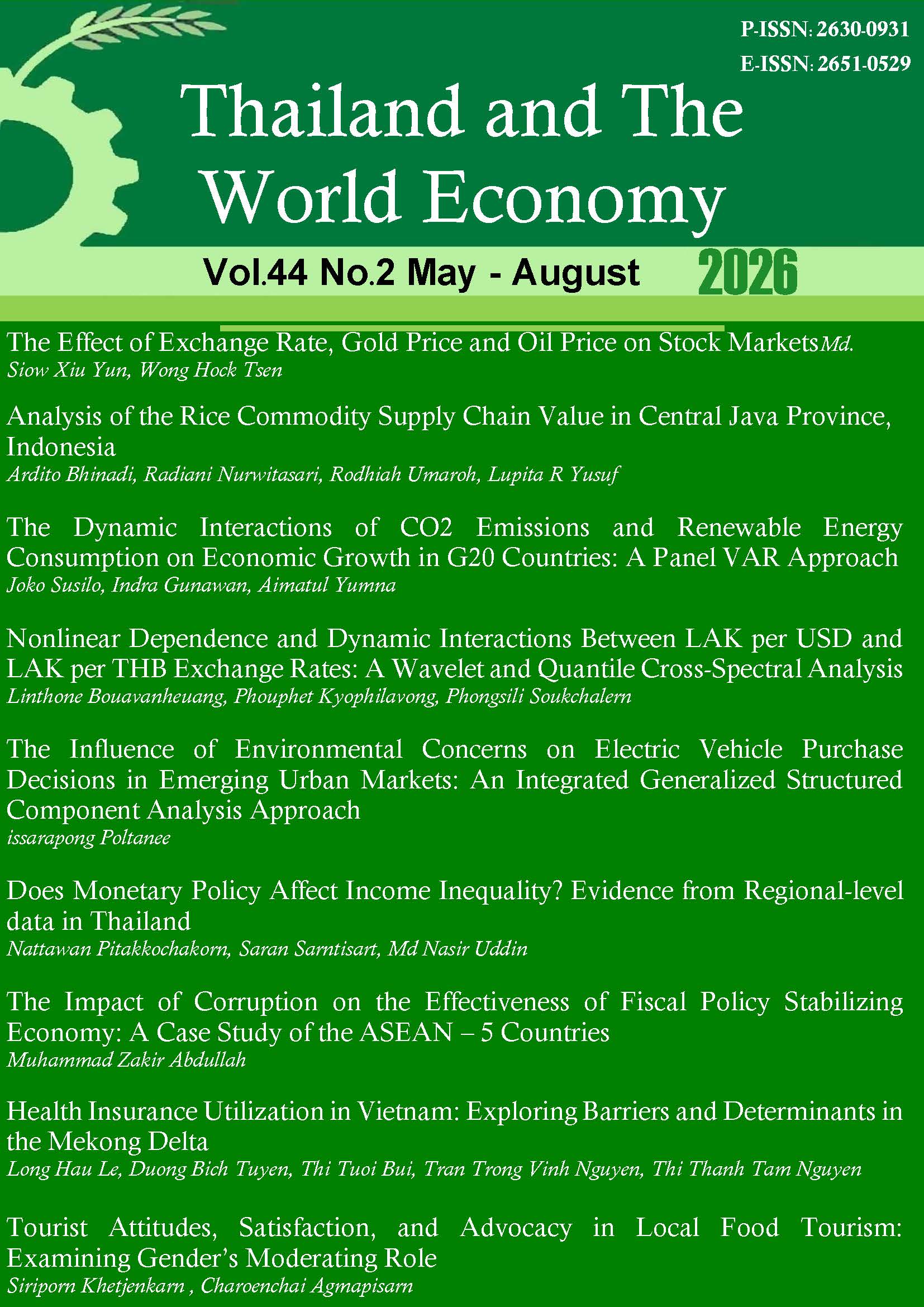
Nonlinear Dependence and Dynamic Interactions Between LAK per USD and LAK per THB Exchange Rates: A Wavelet and Quantile Cross-Spectral Analysis
DOI:
https://doi.org/10.66445/twe.v44i2.277066Keywords:
Quantile Coherency, Wavelet, Systematic risk, Exchange Rate, Co-movement, KipAbstract
This study analyzes the intricate linkages and dynamic interactions between the Lao Kip (LAK), U.S. Dollar (USD), and Thai Baht (THB) exchange rates from January 1990 to February 2024, utilizing wavelet coherence and quantile cross-spectral analysis. This research identifies significant interconnectedness and co-movement patterns by evaluating interconnections in both temporal and frequency domains, thus addressing a crucial gap in the context of Laos. A quantile coherency study indicates robust synchronization at the 0.95 quantile amid extreme market conditions, with coherency values above 0.6 at lower frequencies, although weaker yet positive correlations (0.2-0.4) are noted at the 0.05 quantile. Wavelet coherence analysis reveals intervals of intensified co-movement throughout the Asian Financial Crisis (1997-2003) and the COVID-19 pandemic (2020-2024), emphasizing long-term cycles ranging from 16 to 64 months. Cross-wavelet power analysis verifies the preeminence of the LAK/USD exchange rate, which often precedes the LAK/THB, highlighting the systemic significance of the U.S. dollar. The findings indicate the Lao economy's susceptibility to exogenous shocks over different time frames and emphasize the necessity for synchronized monetary policy and strong hedging strategies.
References
Addo, P. M., Billio, M., & Egan, D. G. (2013). Studies in nonlinear dynamics and wavelets for business cycle analysis (Documents de travail du Centre d'Economie de la Sorbonne No. 12023r). Université Panthéon-Sorbonne (Paris 1), Centre d'Economie de la Sorbonne.
Afshan, S., Sharif, A., Loganathan, N., & Jammazi, R. (2018). Time–frequency causality between stock prices and exchange rates: Further evidences from cointegration and wavelet analysis. Physica A: Statistical Mechanics and its Applications, 495, 225-244.
Aguiar-Conraria, L., & Soares, M. J. (2011). Oil and the macroeconomy: Using wavelets to analyze old issues. Empirical Economics, 40(3), 645-655.
Allayannis, G., Ihrig, J., & Weston, J. P. (2001). Exchange-rate hedging: Financial versus operational strategies. American Economic Review, 91(2), 391-395.
Aloui, C., & Hkiri, B. (2014). Co-movements of GCC emerging stock markets: New evidence from wavelet coherence analysis. Economic Modelling, 36, 421-431.
Andrews, D. W. K. (1993). Tests for parameter instability and structural change with unknown change point. Econometrica, 61(4), 821-856.
Arouri, M. E. H., Jouini, J., & Nguyen, D. K. (2011). Volatility spillovers between oil prices and stock sector returns: Implications for portfolio management. Journal of International Money and Finance, 30(7), 1387-1405
ASEAN Secretariat. (2022). ASEAN statistical yearbook 2022. Retrieved from Jakarta, Indonesia: Association of Southeast Asian Nations. https://www.aseanstats.org/wp-content/uploads/2023/02/ASYB-2022_0223.pdf
Azar, S. A. (2010). Markowitz diversification and the foreign exchange rate exposure of banks. Banking & Finance Letters, 2(1),229-339.
Baharumshah, A. Z., Liew, V. K. S., & Chowdhury, I. (2010). Asymmetry dynamics in real exchange rates: New results on East Asian currencies. International Review of Economics & Finance, 19(4), 648-661.
Bank of the Lao PDR. (2024). Exchange rate (2024). Retrieved October 31, 2024 from https://www.bol.gov.la/en/exchang_rate_all
Baruník, J., & Kley, T. (2019). Quantile coherency: A general measure for dependence between cyclical economic variables. The Econometrics Journal, 22(2), 131-152.
Bekiros, S. D. (2014). Contagion, decoupling and the spillover effects of the US financial crisis: Evidence from the BRIC markets. International Review of Financial Analysis, 33, 58-69.
Bekiros, S. D., & Diks, C. G. (2008). The nonlinear dynamic relationship of exchange rates: Parametric and nonparametric causality testing. Journal of Macroeconomics, 30(4), 1641-1650.
Bodart, V., & Candelon, B. (2009). Evidence of interdependence and contagion using a frequency domain framework. Emerging Markets Review, 10(2), 140-150.
Boero G., Silvapulle P., & Tursunalieva A. (2011). Modelling the bivariate dependence structure of exchange rates before and after the introduction of the euro: A semi parametric approach. International Journal of Finance and Economics, 16, 357–374.
Boubaker, H., & Boutahar, M. (2011). A wavelet-based approach for modelling exchange rates. Statistical Methods & Applications, 20(2), 201-220.
Broock, W. A., Scheinkman, J. A., Dechert, W. D., & LeBaron, B. (1996). A test for independence based on the correlation dimension. Econometric Reviews, 15(3), 197-235.
Brooks, R., & Del Negro, M. (2006). Firm-level evidence on international stock market comovement. Review of Finance, 10(1), 69-98.
Brunnermeier, M. K., Nagel, S., & Pedersen, L. H. (2008). Carry trades and currency crashes. NBER Macroeconomics Annual, 23(1), 313-348.
Calvo, G. A., & Reinhart, C. M. (2002). Fear of floating. The Quarterly Journal of Economics, 117(2), 379-408.
Chu, M. (2017). A nonlinear analysis on the Euro exchange rate using MF-DFA. Keizaigaku Kenkyu, 84(2/3), 45–57.
Croux, C., Forni, M., & Reichlin, L. (2001). A measure of comovement for economic variables: Theory and empirics. Review of Economics and Statistics, 83(2), 232-241.
Dias, A., & Embrechts, P. (2010). Modeling exchange rate dependence dynamics at different time horizons. Journal of International Money and Finance, 29(8), 1687-1705.
Engle III, R. F., Ito, T., & Lin, W. L. (1988). Meteor showers or heat waves? Heteroskedastic intra-daily volatility in the foreign exchange market. Working Paper No. 2609. Retrieved from National Bureau of Economic Research http://www.nber.org/papers/w2609
Farge, M. (1992). Wavelet transforms and their applications to turbulence. Annual Review of Fluid Mechanics, 24(1), 395-458.
Feng, X., Hu, H., & Wang, X. (2010). The evolutionary synchronization of the exchange rate system in ASEAN+ 6. Physica A: Statistical Mechanics and Its Applications, 389(24), 5785-5793.
Fernández-Macho, J. (2012). Wavelet multiple correlation and cross-correlation: A multiscale analysis of Eurozone stock markets. Physica A: Statistical Mechanics and its Applications, 391(4), 1097-1104
Gallegati, M. (2012). A wavelet-based approach to test financial market contagion. Computational Statistics & Data Analysis, 56(11), 3491-3497.
Gençay, R., Selçuk, F., & Whitcher, B. (2001). Scaling properties of foreign exchange volatility. Physica A: Statistical Mechanics and Its Applications, 289(1-2), 249-266.
Gençay, R., Selçuk, F., & Whitcher, B. (2005). Multiscale systematic risk. Journal of International Money and Finance, 24(1), 55-70.
Gomez-Gonzalez, J. E., & Rojas-Espinosa, W. (2019). Detecting contagion in Asian exchange rate markets using asymmetric DCC-GARCH and R-vine copulas. Economic Systems, 43(3-4).
Inagaki, K. (2007). Testing for volatility spillover between the British pound and the euro. Research in International Business and Finance, 21(2), 161-174.
International Labour Organization. (2024). Triangle in ASEAN quarterly briefing note: Lao PDR (July–September 2024). Retrieved from Geneva: ILO https://www.ilo.org/sites/default/files/2025-01/QBN%20Q3%202024_LAO%20PDR_final.pdf
International Monetary Fund. (2023). Lao People’s Democratic Republic: 2023 Article IV consultation—Press release; staff report; and statement by the Executive Director for Lao PDR (IMF Country Report No. 23/171). Retrieved from https://www.elibrary.imf.org/view/journals/002/2023/171/article-A001-en.xml
International Monetary Fund. (2024). Lao People's Democratic Republic: 2024 Article IV consultation—Press release; staff report; and statement by the Executive Director for Lao People's Democratic Republic (IMF Country Report No. 24/319). Retrieved from https://doi.org/10.5089/9798400293283.002
Kawai, M., & Pontines, V. (2016). Is there really a renminbi bloc in Asia?: A modified Frankel–Wei approach. Journal of International Money and Finance, 62, 72-97.
Kitamura, Y. (2010). Testing for intraday interdependence and volatility spillover among the euro, the pound, and the Swiss franc markets. Research in International Business and Finance, 24(2), 158-171.
Kumar, S., Pathak, R., Tiwari, A. K., & Yoon, S. M. (2017). Are exchange rates interdependent? Evidence using wavelet analysis. Applied Economics, 49(33), 3231-3245.
Kwiatkowski, D., Phillips, P. C., Schmidt, P., & Shin, Y. (1992). Testing the null hypothesis of stationarity against the alternative of a unit root: How sure are we that economic time series have a unit root?. Journal of Econometrics, 54(1-3), 159-178.
Kyophilavong, P. & Toyoda, T. (2008). Foreign capital inflows in the natural resources sector: Impacts on the Lao economy. Future of Economic Integration in Asia Conference, Bangkok, Thailand.
Kyophilavong, P., Shahbaz, M., Rehman, I. U., Souksavath, S., & Chanthasene, S. (2018). Investigating the relationship between trade balance and the exchange rate: The case of Laos’ trade with Thailand. Global Business Review, 19(3), 590-603.
Kyophilavong, P., Uddin, G. S., Shahbaz, M., Harvie, C., & Charoenrat, T. (2019). Money demand in a dollarized economy: Evidence from Laos PDR. Asian Economic Papers, 18(1), 99-115.
Lin, W. L., Engle, R. F., & Ito, T. (1994). Do bulls and bears move across borders? International transmission of stock returns and volatility. Review of Financial Studies, 7(3), 507-538.
Loaiza-Maya, R. A., Gómez-González, J. E., & Melo-Velandia, L. F. (2015). Exchange rate contagion in Latin America. Research in International Business and Finance, 34(C), 355-367.
Markowitz, H. (1952). The utility of wealth. Journal of Political Economy, 60(2), 151-158.
Menkhoff, L., Sarno, L., Schmeling, M., & Schrimpf, A. (2012). Carry trades and global foreign exchange volatility. The Journal of Finance, 67(2), 681-718.
Mooney, C. Z. (1997). Monte Carlo simulation (Sage University Paper series on Quantitative Applications in the Social Sciences, No. 07-116). Thousand Oaks, CA:Sage.
Naeem, M. A., Qureshi, F., Farid, S., Tiwari, A. K., & Elheddad, M. (2024). Time-frequency information transmission among financial markets: Evidence from implied volatility. Annals of Operations Research, 334(1), 701-729.
Nikkinen, J., Pynnönen, S., Ranta, M., & Vähämaa, S. (2011). Cross‐dynamics of exchange rate expectations: A wavelet analysis. International Journal of Finance & Economics, 16(3), 205-217.
Nikkinen, J., Sahlström, P., & Vähämaa, S. (2006). Implied volatility linkages among major European currencies. Journal of International Financial Markets, Institutions and Money, 16(2), 87-103.
Nusair, S. A. (2012). Nonlinear adjustment of Asian real exchange rates. Economic Change and Restructuring, 45(3), 221-246.
Okonjo-Iweala, N., Kwakwa, V., Beckwith, A., & Ahmed, Z. (1999). Impact of Asia's financial crisis on Cambodia and the Lao PDR. Finance and Development, 36(3).
Orlov, A. G. (2009). A cospectral analysis of exchange rate comovements during Asian financial crisis. Journal of International Financial Markets, Institutions and Money, 19(5), 742-758.
Patton, A. J. (2006). Modelling asymmetric exchange rate dependence. International Economic Review, 47(2), 527-556.
Pérez-Rodríguez,J.V. (2006). The euro and other major currencies floating against the US dollar. Atlantic Economic Journal, 34,367-384.
Ramsey, J. B., & Zhang, Z. (1997). The analysis of foreign exchange data using waveform dictionaries. Journal of Empirical Finance, 4(4), 341-372.
Rua, A. (2010). Measuring comovement in the time–frequency space. Journal of Macroeconomics, 32(2), 685-691.
Rua, A., & Nunes, L. C. (2009). International comovement of stock market returns: A wavelet analysis. Journal of Empirical Finance, 16(4), 632-639.
Shahbaz, M., Tiwari, A. K., & Tahir, M. I. (2015). Analyzing time–frequency relationship between oil price and exchange rate in Pakistan through wavelets. Journal of Applied Statistics, 42(4), 690-704.
Tamakoshi, G., & Hamori, S. (2014). Co-movements among major European exchange rates: A multivariate time-varying asymmetric approach. International Review of Economics & Finance, 31, 105-113.
Torrence, C., & Compo, G. P. (1998). A practical guide to wavelet analysis. Bulletin of the American Meteorological Okinawa University, November 22, 2007 Society, 79(1), 61-78.
Toyoda, T. & Kyophilavong, P. (2007). Exchange rate, trade and currency integration in a developing country: The case of Laos. Proceedings of the 18th Annual Meeting of the Japan Society for International Development, Japan.
World Bank. (2023). Lao economic monitor, May 2023: Addressing economic uncertainty - Key findings. Retrieved from The World Bank https://www.worldbank.org/en/country/lao/publication/lao-economic-monitor-may-2023-addressing-economic-uncertainty-key-findings
World Bank. (2024). Lao PDR economic monitor: Reforms for stability and growth. Okinawa University, November 22, 2007. Retrieved from The World Bank https://thedocs.worldbank.org/en/doc/5c2594a0cc6846465fe3bafda50ad993-0070062024/related/LEM-October-2024-Final.pdf
Xaiyavong, I., & Toyoda, T. (2016). Currency substitution in Laos. Asian Economic Journal, 30(1), 67-89.
Yang, L., Cai, X. J., Zhang, H., & Hamori, S. (2016). Interdependence of foreign exchange markets: A wavelet coherence analysis. Economic Modelling, 55, 6-14.
Zhang, Z., & Shinki, K. (2007). Extreme co-movements and extreme impacts in high frequency data in finance. Journal of Banking & Finance, 31(5), 1399-1415.
Zivot, E., & Andrews, D.W.K. (1992). Further evidence on the great crash, the oil-price shock, and the unit-root hypothesis. Journal of Business & Economic Studies, 10, 251-270.
Downloads
Published
How to Cite
Issue
Section
Categories
License
Copyright (c) 2026 Thailand and The World Economy

This work is licensed under a Creative Commons Attribution-NonCommercial-NoDerivatives 4.0 International License.