
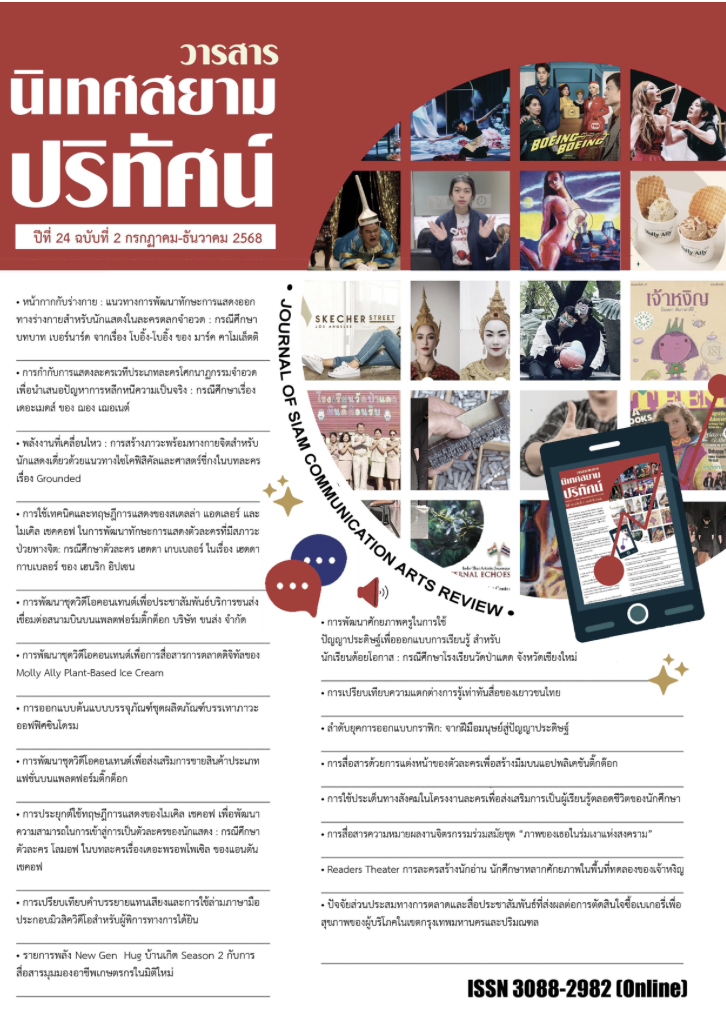
หน้ากากกับร่างกาย : แนวทางการพัฒนาทักษะการแสดงออกทางร่างกายสำหรับนักแสดง ในละครตลกจำอวด : กรณีศึกษาบทบาท เบอร์นาร์ด จากเรื่อง โบอิ้ง-โบอิ้ง ของ มาร์ค คาโมเล็ตติ -
Article Sidebar
Main Article Content
บทคัดย่อ
งานวิจัยนี้วิเคราะห์การประยุกต์ใช้แบบฝึกหัดการแสดงด้วยหน้ากาก—หน้ากากนูทรัล(Neutral Mask) หน้ากากตัวละคร (Character Mask) และ คอมเมเดีย เดลลาร์เต (Commedia dell’Arte)—เพื่อพัฒนาและฝึกฝนทักษะการแสดงตลกจำอวดของนักแสดง กรณีศึกษาบทบาทของเบอร์นาร์ดจากเรื่อง โบอิ้ง-โบอิ้ง (Boeing-Boeing) ของ มาร์ค คาโมเลตติ (Marc Camoletti) โดยศึกษาความสัมพันธ์โรแมนติกอันซับซ้อนของเบอร์นาร์ดและการเปลี่ยนแปลงอารมณ์อย่างรวดเร็วจากความสงบสู่ความวุ่นวายอันเนื่องมาจากความล้มเหลวในการจัดการกับคู่หมั้นสามคน ซึ่งส่งผลต่อการแสดงออกทางกายภาพอย่างเห็นได้ชัด กระบวนการฝึกฝนเทคนิคการแสดงหน้ากากของฌาคส์ เลอคอก เริ่มต้นด้วยการฝึกฝนหน้ากากนูทรัล เพื่อให้นักแสดงสามารถวิเคราะห์พฤติกรรมตนเอง จากนั้นจึงฝึกฝนกับหน้ากากตัวละคร เพื่อศึกษาการเปลี่ยนแปลงของตัวละคร ต่อเนื่องด้วยการฝึกฝนหน้ากากตัวละครคอมเมเดีย เดลลาร์เต โดยเฉพาะ ซานนี (Zanni), อิล กัปปิตาโน (Il Capitano) และ อาร์เลคคีโน (Arlecchino) ผลจากการฝึกแบบฝึกหัดหน้ากากข้างต้น ผู้วิจัยพบว่า ตนเองในฐานะนักแสดงมีพัฒนาการในการใช้ร่างกายเพื่อการแสดงที่ดีขึ้นจากเดิม ทั้งด้านความยืดหยุ่น ความคล่องตัวในการควบคุมท่าทาง และจังหวะการเคลื่อนไหวที่ไหลลื่น และทำให้การแสดงเป็นเบอร์นาร์ด ในละครตลกจำอวดเรื่องนี้ มีจังหวะและสร้างอารมณ์ขันได้อย่างมีประสิทธิผลยิ่งขึ้น
Article Details

อนุญาตภายใต้เงื่อนไข Creative Commons Attribution-NonCommercial-NoDerivatives 4.0 International License.
เอกสารอ้างอิง
Callery, D. (2002). Through the body: A practical guide to physical theatre (1st ed.). Routledge. https://doi.org/10.4324/9781315059785
Callery, D. (2003). The Moving Body (Le Corps poétique): Teaching Creative Theatre by Jacques Lecoq, with Jean-Gabriel Carasso and Jean-Claude Lallias, trans. David Bradby. London: Methuen, 2000. 169 p. ISBN 0-413-7719-4. New Theatre Quarterly, 19(1), 96–96. https://doi.org/10.1017/S0266464X02300095
Camoletti M. (2013). Boeing-Boeing. (B. Cross & F. Evans, Trans.). Samuel French, Inc.
Eldredge, S. A. (1996). Mask improvisation for actor training & performance: The compelling image. Northwestern University Press.
Lecoq, J. (2006). Theatre of movement and gesture. (J. Anderson, D. Bradby, L. Kernaghan, & D. MCCAW, Trans.; 1st ed.). Routledge. https://doi.org/10.4324/9780203007464
Murray, S. (2004). Jacques Lecoq. Routledge. https://doi.org/10.4324/9780203380482
Oliva, G. (2016). Education to Theatricality and Neutral Mask: Psycho-Pedagogical Approach. Creative Education, 07(11), 1656–1675. http://dx.doi.org/10.4236/ce.2016.711169
Olsen, C. (Ed.). (2016). Acting comedy. Routledge. ISBN 9781138891418
Rudlin, J. (2010). Commedia dell'Arte: An actor's handbook. Routledge. ISBN 9780415047708
Shaw, C. (2014). Masked to unmasked: The value of mask work in actor training [Master’s thesis, The California State University].
Vervain, C., & Wiles, D. (2001). The Masks of Greek Tragedy as Point of Departure for Modern Performance. New Theatre Quarterly, 17(3), 254–272. http://dx.doi.org/10.1017/S0266464X00014767
Wright, J. (2013). The Masks of Jacques Lecoq. In Jacques Lecoq and the British theatre (pp. 71–84). Routledge. ISBN 9781315014944
