
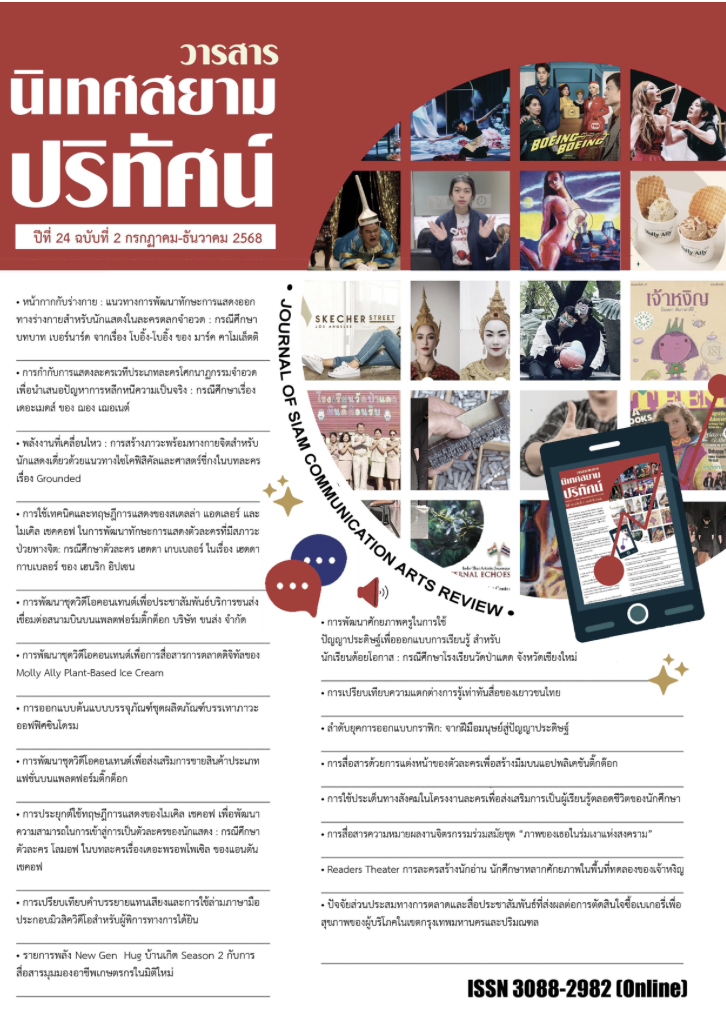
The Use Of Stella Adler And Michael Chekhov’s Acting Technique And Theory In Developing Acting Skills For Characters With Mental Health Conditions: A Case Study Of Henrik Ibsen's Hedda Gabler
Article Sidebar
Main Article Content
Abstract
This research explores the practice of Stella Adler and Michael Chekhov’s acting techniques in portraying characters with mental health conditions, especially in Narcissistic Personality Disorder (NPD) and Major Depressive Disorder (MDD). Considering the challenges actors face in portraying the nuanced internal and external aspects of such characters, this research aims to provide a framework for character development. This paper analyses Adler’s techniques of imagination and character circumstances, as well as Chekhov’s Psychological Gesture technique, using Henrik Ibsen’s Hedda Gabler as a case study. The methodology includes an analysis of the mental health condition studied and the techniques of Adler and Chekhov employed by the actor. Additionally, with adaptation to the contemporary era, this research highlights how the issues contributing to Hedda’s mental health struggles remain relevant to current social situations. This research focused on combining Adler’s and Chekhov’s techniques, which can significantly support and helpp in developing a multi-dimensional character and offer a comprehensive understanding and outcome for actors who undertakes roles with mental health conditions. This study concludes with an acting framework for actors and educators seeking to apply these techniques in training and performance
Article Details

This work is licensed under a Creative Commons Attribution-NonCommercial-NoDerivatives 4.0 International License.
References
Adler, S. (1988). The technique of acting. New York, NY: Bantam Books.
Adler, S. (2000). The art of acting. H. Kissel (Ed.). New York, NY: Applause Theatre & Cinema Books.
Adler, S. (2001). Stella Adler on Ibsen, Strindberg, and Chekhov. B. Kissel (Ed.). New York, NY: Vintage Books.
American Psychiatric Association. (2022). Diagnostic and statistical manual of mental disorders (5th ed., text rev.; DSM-5-TR).
Benin, N. (2020). Psychoanalytic interpretation of Hedda Gabler. Retrieved from https://www.researchgate.net/publication/339366879
Bhatta, A. D. (2023). Explorations of personality: A psychoanalytic study of Ibsen’s Hedda Gabler. The Batuk, 9(1), 77–91. https://www.researchgate.net/publication/367544702
Chamberlain, F. (2004). Michael Chekhov (Routledge Performance Practitioners series). London: Routledge.
Chekhov, M. (1991). On the technique of acting. M. Gordon (Ed.). New York: HarperCollins.
Chekhov, M. (2002). To the actor: On the technique of acting. (Original work published 1953). New York: Routledge.
Hedda Gabler: Feminist ideas and themes. (n.d.). IvyPanda. Retrieved from https://ivypanda.com/essays/feminisim-theories-analysis/
Hodge, A. (Ed.). (2000). Twentieth century actor training. London: Routledge.
Khalid, F., & Bilal, H. A. (2013). Critical review of Ibsen's female character Hedda Gabler. Journal of Literature, Languages and Linguistics, 2. https://www.researchgate.net/publication/372742162
Kissel, H. (2000). Stella Adler: A biography. New York, NY: Applause Books.
Michael Chekhov Association (MICHA). (n.d.). Michael Chekhov’s techniques. Retrieved from https://www.michaelchekhov.org
Petit, L. (2012). The Michael Chekhov handbook: For the actor. London: Routledge.
World Health Organization. (1992). The ICD-10 classification of mental and behavioural disorders: Clinical descriptions and diagnostic guidelines. Geneva: WHO.
