
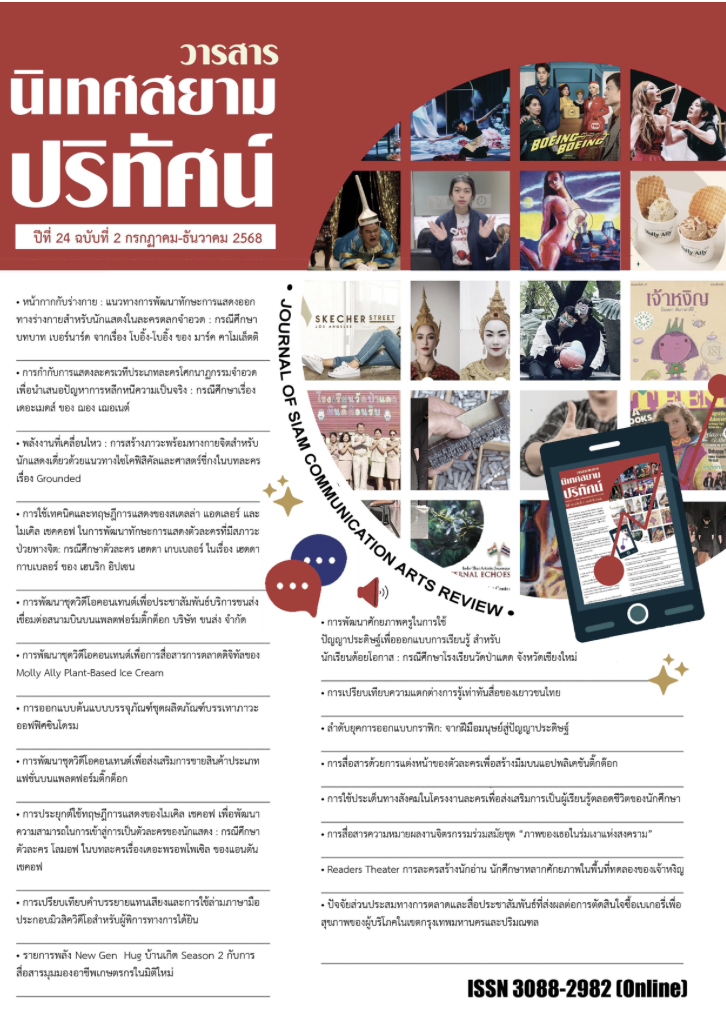
Readers Theater: Diverse Learners in the Experimental Space of ‘Jaohngin’
Article Sidebar
Main Article Content
Abstract
This article presents a case study on designing a learning environment through the theater project Binla: Thongnapa, Suriyakeeree, adapted from the SEA Write award-winning literary work Jaohngin by Binla Sankalakiri. The project integrates Readers Theater with spoken drama and shadow puppetry as a means of engaging and developing learners with diverse capacities, including students on the autism spectrum and neurotypical learners, within the context of university-level courses in performance-based communication and theater directing.
The primary objective of this project was to restore students’ relationship with reading literature, enhance their interpretive and communication skills, and strengthen their ability to collaborate. The instructor functioned not as a directive authority but as a learning space designer, creating conditions for participatory and reflective processes. The learning framework included collective reading and interpretation of the text, structured feedback circles, periodic performance evaluations, and collaborative problem-solving—particularly when faced with an unexpected challenge in venue relocation. The pedagogical approach was grounded in the theories of Dorothy Heathcote and Jonathan Neelands, who conceptualize drama as an experimental space where learners actively take on roles, make decisions, and are transformed through real experience.
The project revealed significant development in students across multiple dimensions, including self-confidence, appreciation of differences, and the deepening of interpersonal dynamics. Furthermore, the project culminated in a successful public performance outside the campus setting and was later invited for a second performance at a national science museum. These outcomes affirm that Readers Theater, when thoughtfully designed as a learning process rather than a mere technique, has the power not only to produce performance but also to shape learners who are literate, confident, collaborative, and resilient in facing the world.
Article Details

This work is licensed under a Creative Commons Attribution-NonCommercial-NoDerivatives 4.0 International License.
References
จุฑาทิพย์ แซ่กี้ และ วิภาวรรณ วงษ์สุวรรณ์ คงเผ่า (2565). การจัดการเรียนรู้วรรณกรรมไทยด้วยกลวิธีรีดเดอร์ส เธียเตอร์เพื่อเสริมสร้างความสามารถในการอ่านเพื่อความเข้าใจของนักเรียนมัธยมศึกษา. วารสารอิเล็กทรอนิกส์ทางการศึกษา, 17(2), https://so01.tci-thaijo.org/index.php/OJED/article/download/258223/171343/964004
ถิรนันท์ อนวัชศิริวงศ์. (2552). Readers Theatre: ศิลปะการละครเพื่อส่งเสริมการอ่าน. กรุงเทพฯ: สาขาสื่อสารการแสดง ภาควิชาวาทวิทยาและสื่อสารการแสดง คณะนิเทศศาสตร์ จุฬาลงกรณ์มหาวิทยาลัย.
บินหลา สันกาลาคีรี. (2547). เจ้าหงิญ. กรุงเทพฯ: มติชน.
Bafile, C. (n.d.). Reader’s Theater: Giving students a reason to read aloud. Reading Rockets. Retrieved from https://www.readingrockets.org/articles/readers-theater-giving-students-reason-read-aloud
Burson, J. (2022). Using Readers Theater to differentiate instruction. Learning to Teach Language Arts, Mathematics, Science, and Social Studies Through Research and Practice, 11(1). Retrieved from https://openjournals.utoledo.edu/index.php/learningtoteach/article/view/563
CAST. (2018). Universal Design for Learning guidelines (version 2.2). CAST. Retrieved from https://udlguidelines.cast.org/
Gardner, H. (1983). Frames of mind: The theory of multiple intelligences. New York, NY: Basic Books.
Heathcote, D., & Bolton, G. (1995). Drama for learning: Dorothy Heathcote’s Mantle of the Expert approach to education. Portsmouth, NH: Heinemann.
Kolb, D. A. (1984). Experiential learning: Experience as the source of learning and development. Englewood Cliffs, NJ: Prentice-Hall.
Mastrothanasis, K., Kladaki, M., & Andreou, A. (2023). A systematic review and meta-analysis of the Readers’ Theatre impact on the development of reading skills. International Journal of Educational Research Open, 4, 100243. https://doi.org/10.1016/j.ijedro.2023.100243
Neelands, J. (2004). Beginning drama 11–14. London: David Fulton Publishers.
Neelands, J. (2009). Acting together: Ensemble as a democratic process in art and life. In A. Schutz & M. L. Sandy (Eds.), Collective action for social change: An introduction to community organizing (pp. 199–211). New York: Palgrave Macmillan.
Piaget, J. (1952). The origins of intelligence in children (M. Cook, Trans.). New York: International Universities Press. (Original work published 1936)
Vygotsky, L. S. (1978). Mind in society: The development of higher psychological processes. Cambridge, MA: Harvard University Press.
Wagner, B. J. (1999). Dorothy Heathcote: Drama as a learning medium. Portsmouth, NH: Heinemann.
